A Comprehensive Guide to On-Chain Identity (DID): Overview of the Landscape and Projects
TechFlow Selected TechFlow Selected
A Comprehensive Guide to On-Chain Identity (DID): Overview of the Landscape and Projects
An on-chain identity is a person's digital representation, consisting of data stored on blockchain services.
 Navigating Web3 tides with focused insights
Author: Shreyjain.eth
Translated by: TechFlow Intern
In this article, we conduct a meta-review of innovations focused on placing work, professional identity, and reputation on-chain. For clarity, we exclude services that aim to catalog our non-professional affinities and identities. On-chain identity is a digital representation of a person, consisting of data stored on blockchain-based services.
Why On-Chain Identity Matters?
By proving unique identity on-chain, we move toward a one-person-one-vote model within DAOs, increasing protocol resistance against Sybil attacks.
Currently, professional identity on-chain lacks sufficient information. Because publicly shared professional details—such as those on resumes, personal websites, or LinkedIn—cannot be easily verified, hiring a technical employee takes recruiting teams an average of 49 days and $25,000. Much of the cost in recruitment serves as a filtering mechanism to ensure candidates truthfully represent their capabilities.
By placing identity on-chain, hiring teams can rely on verification instead of trust. For example, to a hiring manager, information like “Stripe engineer at team X” carries less weight—and is more prone to exaggeration—than verifiable on-chain accomplishments and peer evaluations, which are queryable and tamper-resistant.
As DAOs continue to grow in size, becoming a meaningful individual contributor becomes harder, increasing the importance of delegation. On-chain identity can assist in decisions about whom to delegate governance tokens to, without needing to know the delegatee personally.
Other underdeveloped use cases for on-chain identity include optimizing DTC marketing, lowering barriers through on-chain credentials, and enhancing compliance in customer due diligence.
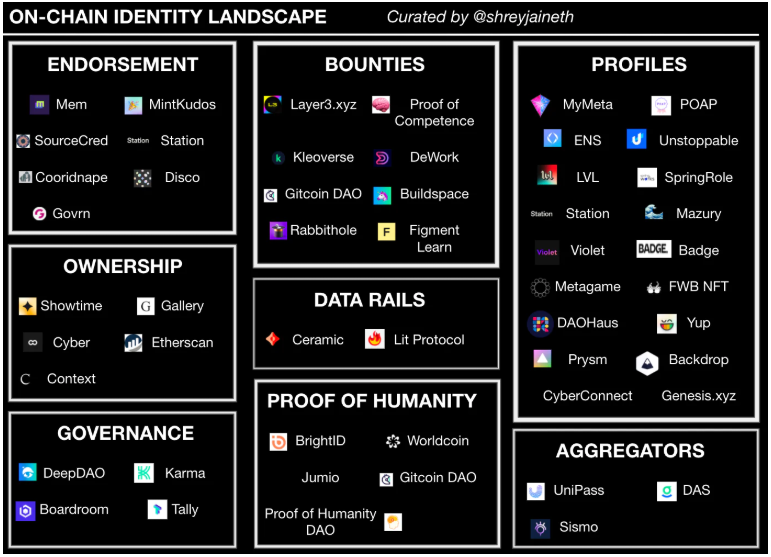
Overview of On-Chain Identity
Ownership
Objective data is the easiest to capture on-chain and can be linked to personal identity via wallet history (e.g., transactions, owned NFTs, and other crypto assets). Example projects: Showtime; Gallery; Cyber; Etherscan; Context.
Aggregators
Personal assets, transactions, and participation in Web3 communities occur across multiple wallets and chains. As networked products emerge beyond blue-chip infrastructure, using multiple wallets exacerbates identity fragmentation. Relying on a single wallet as a data source—or limiting identity to on-chain transactions—leads to misleading representations of a user’s Web3 professional identity. Projects that aggregate identity across multiple wallets exist to solve this problem. Example projects: UniPass; DAS Systems; Sismo.
Governance Participation
As we empower individual actors with governance rights, metrics of organizational participation are evolving. Tools like Snapshot allow us to quickly link governance activity in DAOs to individual wallet addresses. This data proves valuable when selecting token delegates or hiring personnel responsible for community growth and engagement. Example projects: DeepDAO; Karma; Boardroom; Tally.
Bounties
Current bounty systems require significant upfront planning, creating friction for technical teams. The most useful application of bounties lies in onboarding—allowing individuals to demonstrate their fit for a specific team while enabling core teams to assess early performance without formal hiring.
Bounties are currently used for non-technical tasks such as posting tweets or blogs. As DAOs increasingly unlock high-value bounties for top performers, the rewards available become closely tied to on-chain identity.
For individuals aiming to unlock these rewards, building strong on-chain reputation yields optimal outcomes. Example projects: Layer3.xyz; Proof of Competence; Kleoverse; DeWork; Gitcoin DAO; Buildpace; Rabbithole; Figment Learn.
Data Layer
The Web3 data layer transforms how we think about storing personal identity data by mapping on-chain keys to off-chain data storage via DIDs. The key shift is that individuals gain control over the discovery, sharing, and permissions of their data. Individuals can choose where their data is stored—whether in traditional databases or decentralized storage—and can link multiple accounts and data sources to a single unique identity. Example projects: Ceramic (and IDX); Lit Protocol.
Sybil Resistance
Protocols resistant to Sybil attacks unlock democratic voting, quadratic voting, credible reputation systems, and broader funding for public goods. The ability to prove unique identity while preserving privacy opens up numerous possibilities for DAOs. Example projects: BrightID; Worldcoin; Jumio; Proof of Humanity DAO; Gitcoin DAO.
Support
The more human-centric a DAO is, the more off-chain activities it involves. Current Web3 tooling lacks robust infrastructure to connect off-chain and on-chain data in a verified way to showcase professional identity. Example projects: Mem; SourceCred; Coordinape; MintKudos; Station; Disco; Govrn; Lens Protocol.
Profiles
The ability to display skills, values, or status is not new to Web3, but using blockchain technology to present them allows networks to view profiles from a perspective of verification rather than trust.
Being able to showcase your Web3 professional or social identity will be a critical factor in future work—whether applying for bounties or unlocking job opportunities. It includes displaying both objective and subjective data to form a holistic picture of who you are. You can think of this as a step toward a Web3 "LinkedIn."
Example projects: MyMeta Profiles; POAP; ENS; Unstoppable Web; LVL Protocol; SpringRoleInc; Station; Mazury; Violet; Badge; Metagame; FWB NFT; DAOHaus; Yup; Prysm; Backdrop; CyberConnect.
Concerns Around On-Chain Identity
Privacy and Transparency
In Web3, our identities can be private or public based on our own choices. Because these identities are decentralized and all data is visible on the blockchain, they can achieve far greater levels of transparency—or privacy—compared to Web2 identities. Individuals will be able to construct unique verified identities that may be entirely unrelated yet still reside on-chain.
The more we place identity on-chain, the closer we get to quantifying human value.
Lack of Consistency
In a world where every action comes with some form of reward or economic incentive, we no longer do work purely because it ought to exist.
In a system where bounties or rewards are attached from the outset, the concept of the “day one” contributor—someone who shows up early regardless of outcome—may disappear. We’re currently designing for misalignment while promoting the idea that crypto creates perfect alignment. Retroactive funding is a potential solution, allowing us to reward these “day one” contributors.
Cost of Action
The number of data points constituting a person’s on-chain identity is infinite, posing design challenges around agreed-upon methods for collecting, organizing, and presenting this data for others to understand. By isolating certain types of identity data, we can protect ourselves economically from negative consequences (e.g., separating health and insurance data). Verifying someone’s on-chain identity spans multiple dimensions of life—social, professional, financial—and the implications could be profound. Due to the permanence, immutability, and openness of on-chain identity, its impact may be more severe than currently anticipated.
Join TechFlow official community to stay tuned
Telegram:https://t.me/TechFlowDaily
X (Twitter):https://x.com/TechFlowPost
X (Twitter) EN:https://x.com/BlockFlow_News