A Deep Dive into LayerZero's Omnichain Ambition: Connecting All Chains, Unlocking Everything
TechFlow Selected TechFlow Selected
A Deep Dive into LayerZero's Omnichain Ambition: Connecting All Chains, Unlocking Everything
Multi-chain is just the beginning; we hope to work with LayerZero to realize the vision of omnichain interoperability.
 Navigating Web3 tides with focused insights
Original: "Portfolio Insights: LayerZero"
Authors: Henry Ang, Mustafa Yilham, Allen Zhao & Jermaine Wong, Bixin Ventures
The future of Web3 will be a multi-chain world, where numerous modular and monolithic blockchains coexist to form the entire ecosystem. However, current user experiences when operating across chains are far from seamless—for example, assets on Ethereum must go through cross-chain transfers before they can be used on Arbitrum; NFTs users hold can only circulate within the blockchain ecosystem in which they were minted. The cross-chain process is painful, requiring users to consider many factors such as wrapped assets, high gas fees, and long waiting times.
Imagine if your assets could freely move between multiple chains, or if you could use DApps across multiple blockchains without needing to bridge, or if there were a way for developers to easily deploy applications that leverage multi-chain assets... These possibilities all start from one fundamental premise: assets will no longer exist in isolation on their native chains. This is the critical omnichain future that LayerZero is building.
We believe that in the future, users will interact with DApps without needing to know which blockchain they're deployed on—just as today's users don't need to know whether Instagram, TikTok, or Google are hosted on Amazon Web Services or Microsoft Azure. LayerZero is developing an infrastructure layer that aims to realize true interoperability by connecting all Layer 1 blockchains, whether they belong to the EVM ecosystem, IBC ecosystem, or others. Users will no longer be constrained by whether mainstream protocols like Aave or Compound support certain chains.
TLDR: Multi-chain is just the beginning—we want to build the vision of omnichain interoperability together with LayerZero.
Introduction to LayerZero
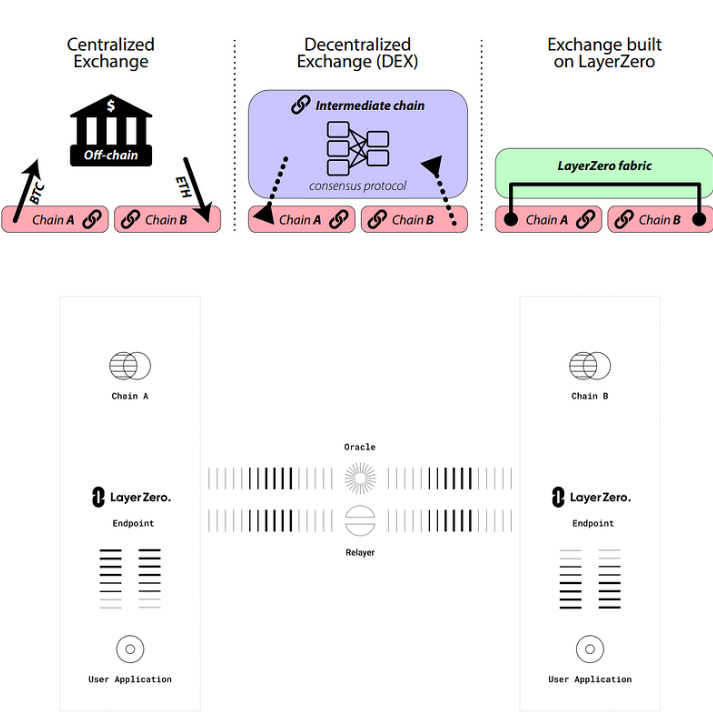
LayerZero is a universal base protocol for data communication that securely and simply transmits information across chains to enable cross-chain application interactions. By deploying "LayerZero Endpoints" (lightweight clients composed of smart contracts with communication, verification, and networking capabilities) on respective chains, users can achieve cross-chain communication within a single trustless and secure transaction.
LayerZero uses an Oracle (currently Chainlink) and a Relayer to deliver messages between LayerZero Endpoints on target chains. Notably, any party can serve as either the Oracle or the Relayer—a design rooted in principles of independence, openness, and permissionlessness. The Oracle publishes block headers from the source chain to the destination chain, while the Relayer delivers transaction data and proofs. The Oracle and Relayer operate independently from each other.
Limitless Possibilities
The beauty of LayerZero’s architecture lies in its ability to allow users and developers to execute virtually anything across chains via smart contracts—be it trading, asset bridging, NFT transfers, gaming, or social applications. Below are some use case examples of LayerZero across various scenarios.
Bridging & Trading
Common asset bridging models rely on the easy-to-implement Lock-Mint mechanism. The biggest drawback of this approach is that it cannot transfer native assets across different chains, instead relying heavily on intermediate wrapped assets. In practice, these bridging solutions face issues such as illiquidity, high slippage, high fees, and long wait times, resulting in poor user experience.
Stargate is a protocol built on top of LayerZero that enables seamless cross-chain transactions, and it is the first protocol to solve the cross-chain trilemma. With Stargate, users and applications can transfer native assets across chains using a unified liquidity pool while achieving instant transaction finality. Additionally, because Stargate eliminates the need for wrapped assets, users can effortlessly swap USDC on Ethereum for USDT on Arbitrum. Data shows that since launch, Stargate has processed over 1 million transfers and more than $4.5 billion in volume. Applications like Sushiswap have already deployed on Stargate, enabling native asset swaps. Moreover, Stargate allows users to pay gas fees for multi-chain transactions using their source chain’s native gas token—an important solution to a key pain point in cross-chain activity.
Cross-Chain Token Transfer – Omnichain Fungible Tokens (OFTs)
Similar to bridging, transferring tokens across different chains often involves wrapped, non-native tokens, which harms composability and fragments liquidity. For instance, UNI on Ethereum and UNI on Avalanche are considered two separate assets and cannot be used interchangeably in applications. Especially for long-tail tokens, insufficient liquidity often leads to price discrepancies.
LayerZero addresses this issue by introducing Omnichain Fungible Tokens (OFTs)—a new type of token that can be composed across all blockchains integrated with LayerZero. For example, Trader Joe integrated with LayerZero to launch JOE as an Omnichain Token. JOE is a truly native multi-chain token that can be bridged across Avalanche, Arbitrum, BNB, and others.
Another interesting example is how Pendle leverages LayerZero to deploy omnichain veTokenomics: Pendle users can now mirror their vePENDLE balances from Ethereum to all supported chains (such as Arbitrum). This way, veTokens are no longer siloed across chains, allowing users to seamlessly boost rewards across all Pendle pools.
Cross-Chain NFT Transfers – Omnichain Non-Fungible Tokens (ONFTs)
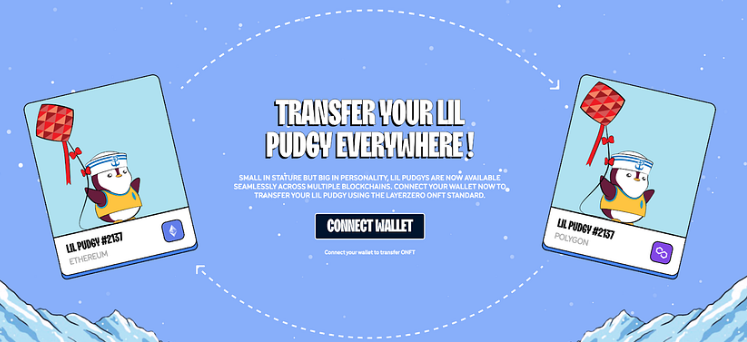
Likewise, NFTs will no longer be confined to their native ecosystems—users can now move their NFTs across ecosystems like Ethereum, Polygon, and Solana. One notable example occurred in January, when Pudgy Penguins announced the use of LayerZero’s omnichain technology to enable cross-chain functionality for its Lil Pudgys sub-collection, allowing movement between Polygon, BNB Smart Chain, and Arbitrum. This means that many NFT projects can now access liquidity and users from other ecosystems via cross-chain transfers, without having to split their communities by launching entirely new projects on another chain.
Derivatives Trading
One major challenge for DEXs is fragmented liquidity. Rage Trade aims to solve this problem by building on LayerZero to generate yield by bridging ETH/USD liquidity pools from protocols like GMX and Sushiswap, providing cyclical liquidity. In other words, Rage Trade can utilize LP tokens from other blockchains such as Polygon, Avalanche, and Solana as liquidity on Arbitrum. For example, with the 3CRV vault, even if the 3CRV LP token is used as collateral on Chain A, we can still provide virtual liquidity to Rage Trade on Chain B.
Money Markets
LayerZero also plays a role in lending. Users deposit collateral on one chain and borrow assets on another via LayerZero’s cross-chain message passing. By leveraging LayerZero messaging and Stargate’s stable routing interface, Radiant Capital allows users to deposit any asset on Arbitrum or BNB Chain and instantly borrow any asset on other blockchains supported by LayerZero. For example, a user can collateralize ETH on Arbitrum and borrow USDT on Avalanche. This process enables true omnichain asset interoperability and maximizes the unlocking of liquidity across blockchains.
Looking Ahead
As developers continue exploring new omnichain use cases, we look forward to more innovative applications built on LayerZero across areas such as NFTFi, yield aggregators, full-chain wallets without RPC switching, gaming, social platforms, and DID systems.
We are excited about LayerZero’s vision of achieving true interoperability in the Web3 ecosystem to enhance user experience. LayerZero has already delivered over 3 million messages and expanded to over 40 public chains—including non-EVM chains like Aptos and Solana. Its strong adoption among leading protocols and projects such as Stargate, Sushiswap, Trader Joe, and Pudgy Penguins not only demonstrates LayerZero’s excellent market fit but also highlights the execution excellence of its star team led by Bryan Pellegrino, Ryan Zarick, Caleb Banister, Ari Litan, and Irene Wu.
Join TechFlow official community to stay tuned
Telegram:https://t.me/TechFlowDaily
X (Twitter):https://x.com/TechFlowPost
X (Twitter) EN:https://x.com/BlockFlow_News
 Bixin Ventures