Goldman Sachs Research Report Analysis: June AI Infrastructure Deals Near $7 Billion, neocloud and Sovereign Cloud Both Scrambling for GPUs
TechFlow Selected TechFlow Selected
Goldman Sachs Research Report Analysis: June AI Infrastructure Deals Near $7 Billion, neocloud and Sovereign Cloud Both Scrambling for GPUs
Demand remains, but the winners are shifting from those who acquire the cards to those who can turn the cards into operational computing power.
 Navigating Web3 tides with focused insights
Written by: Rita
TechFlow Guide
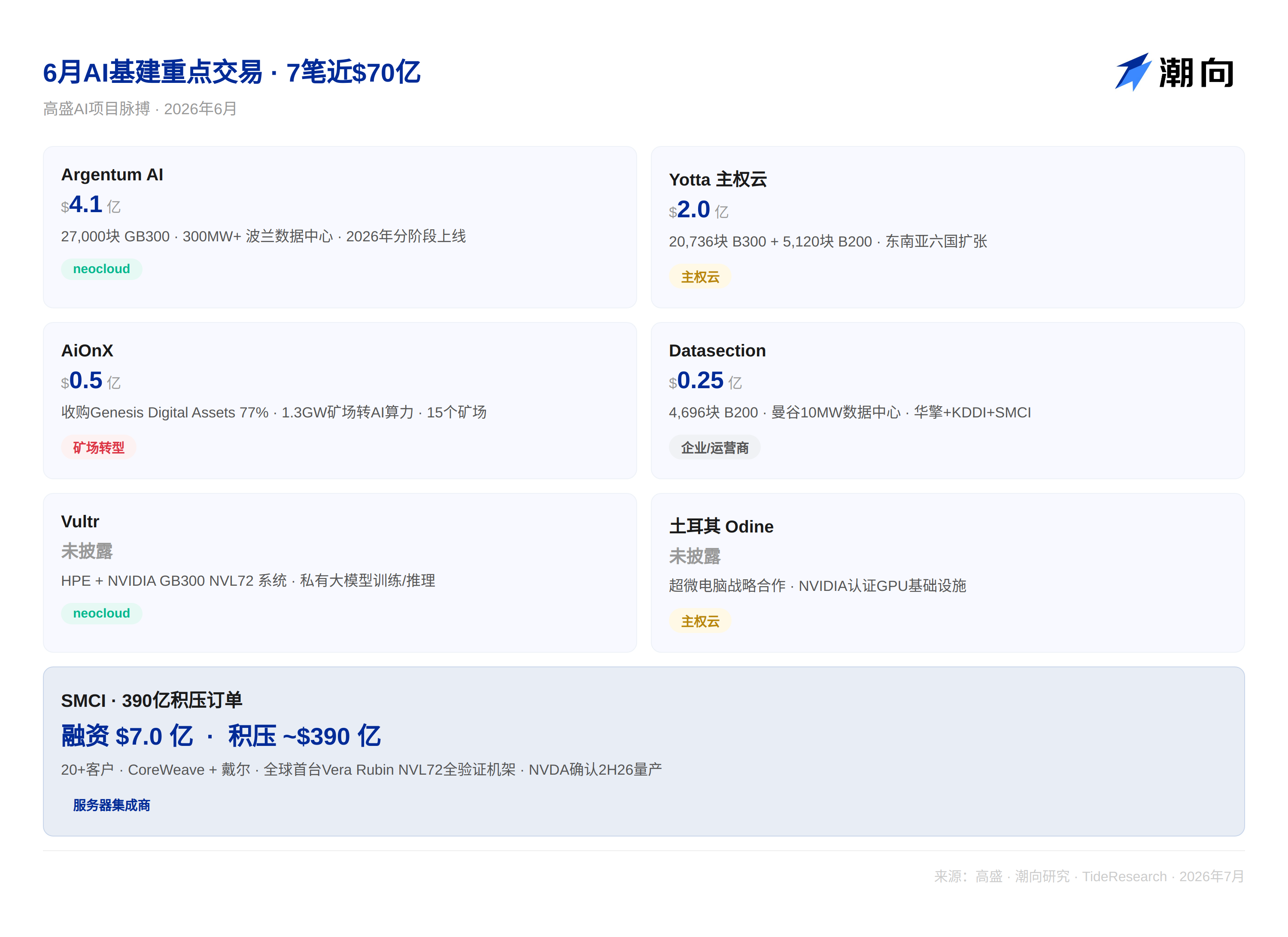
Goldman Sachs released its monthly AI Project Pulse Report on June 30, tracking AI infrastructure orders from neoclouds, sovereign clouds, and the enterprise side. In June, a total of 7 significant transactions were tracked, with a total amount nearing $7 billion. This covers Poland Sovereign AI Cloud $4.1 billion, India Yotta Sovereign Cloud $2 billion, Vultr choosing HPE plus NVIDIA to deploy GB300 clusters, Japan Datasection deploying B200 in Thailand, and crypto mining farm AiOnX transforming into an AI compute center. Goldman Sachs also raised its global server market size forecast to reflect AI server rack ramp-up and higher memory costs. SMCI financed $7 billion to digest $39 billion in backlog orders. NVDA Vera Rubin NVL72 first fully validated rack is now live on CoreWeave.
Demand is Dispersing, Money Hasn't Slowed Down
The biggest change in AI infrastructure is that the payers have become more diverse, while the amount size is secondary.
A year ago, almost only Microsoft, Google, and Amazon were signing such orders. Now the most active players are instead two new categories: neoclouds and sovereign clouds. Argentum AI secured a $4.1 billion contract to deploy 27,000 GB300 GPUs for a leading AI company, supporting a Poland data center with over 300MW, going live in phases in 2026. Note that this buyer is a neocloud, not belonging to any hyperscale cloud provider.
India Yotta Sovereign Cloud signed $2 billion, procuring 20,736 B300s and 5,120 B200s from Supermicro, subsequently expanding to six Southeast Asian countries. Turkey Odine also signed a strategic cooperation with Supermicro. The sovereign cloud line is accelerating implementation, no longer just a concept.
Crypto mining farms are also joining in. AiOnX acquired 77% equity of Genesis Digital Assets for $500 million, converting 1.3GW of power from 15 mining farms in Texas, North Carolina, South Carolina in the US, and Sweden for AI and HPC compute. The power and land held by mining farms are becoming the scarcest resources for AI compute.
Orders Secured, But Cash Hasn't Caught Up
All orders ultimately need to be converted into physical equipment. SMCI financed $7 billion in June to procure components, because it received about $39 billion in AI server orders in recent weeks, covering more than 20 clients; this is a sign of lacking cash flow to lock in upstream supply. Server integrators are becoming the tightest link in the entire chain.
In comparison, those AI server concept companies that only issued press releases, had no actual financing actions, and did not disclose client numbers have fallen behind at this stage. Every transaction mentioned in this Goldman Sachs report can be traced to specific buyers, specific chip quantities, and specific delivery times. For example, companies that only signed strategic cooperation intentions without procurement contract details cannot be found corresponding in this report at all.
NVDA's Vera Rubin NVL72 has also turned from PPT into physical reality. CoreWeave and Dell built the world's first fully functional Vera Rubin NVL72 rack, NVDA confirmed full mass production in the second half of 2026 at Taipei GTC. 72 Rubin GPUs plus 36 Vera CPUs, 260 TB/s NVLink Generation 6 interconnect, liquid cooling, 10x inference performance per watt improvement.
Japan Datasection signed a contract of about $250 million, procuring 4,696 B200 GPUs deployed in a 10MW data center in Bangkok to serve a US tech company. Although the amount of this transaction is not large, the signal significance is strong—AI compute is becoming a standardized commodity that can be delivered across borders.
TechFlow Perspective
The fact that SMCI financed $7 billion is worth looking into more than any single transaction. $39 billion in backlog orders sounds like a good thing, but if delivery requires locking in upstream components half a year or even a year in advance, capital occupation will be extremely exaggerated. The balance sheets of server integrators are bearing the cost of AI infrastructure expansion. Whoever can maintain delivery capability under this pressure is grabbing market share.
Another overlooked point is the transformation of mining farms. Converting 1.3GW of power to AI compute means the GPU installation base is larger than surface order data suggests. Mining farms do not need to wait for new wafer capacity, only need to retrofit lines. This will make the real GPU consumption exceed market expectations.
For US stock AI investors, the most valuable judgment in this report is: demand is still there, but the winners are shifting from those who get the cards to those who can turn cards into operable compute. The bargaining power of integrators like SMCI and Dell is rising, while the scarcity of pure GPU vendors is being diluted by dispersed procurement channels.
Disclaimer
This article is a compilation and interpretation of third-party broker research reports by TechFlow Research. The ratings, target prices, earnings forecasts, and related judgments cited in the text are the views of the broker's analysts, representing only the position of their affiliated institution, not representing the views of TechFlow Research, nor constituting any investment advice. The market has risks, decisions need to be independent. This article should not be used as a basis for buying or selling any securities.
Join TechFlow official community to stay tuned
Telegram:https://t.me/TechFlowDaily
X (Twitter):https://x.com/TechFlowPost
X (Twitter) EN:https://x.com/BlockFlow_News
 @chaoxiangooo