
Viewpoint: AI Bubble Bursts, Risk Assets Such as Bitcoin Are the First to Be Impacted
TechFlow Selected TechFlow Selected
Viewpoint: AI Bubble Bursts, Risk Assets Such as Bitcoin Are the First to Be Impacted
Trillion-dollar AI bubble bursts, Bitcoin traders may be the first to suffer.
 Navigating Web3 tides with focused insights
Author: CryptoSlate
Compiled by: TechFlow
TechFlow Editor's Note: The Bank for International Settlements warns that five major tech giants will spend $1 trillion on AI infrastructure in 2025-2026. If returns fall short of expectations, tightening financing could hit risk assets like Bitcoin first. Although loose policy may benefit Bitcoin in the long run, traders must first withstand this round of sell-offs.
Over the past year, AI trades have become one of the main pillars supporting global risk appetite.
But now, the Bank for International Settlements is issuing a warning: if expected returns fail to materialize, this spending boom could instead become a source of financial stress.
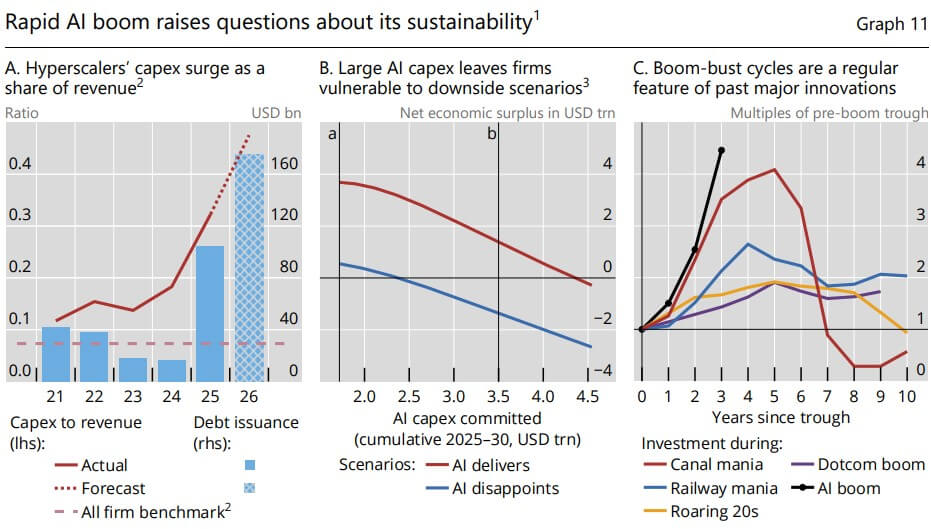
The Basel-based institution, which advises central banks worldwide, noted in its annual economic report that AI-related capital expenditure by the five major cloud computing giants will exceed $1 trillion in 2025 and 2026.
The Bank for International Settlements stated that such large-scale investment raises a question: whether companies have invested too much capital before business models are fully validated.
The Bank for International Settlements said:
"Returns falling short of expectations could trigger a sudden withdrawal of financing, turning the capital expenditure boom into a protracted investment depression, with chain reaction effects on financial conditions."
For Bitcoin traders, the impact of this warning goes far beyond the chip and data center race in Silicon Valley.
A sharp reversal in AI spending could tighten liquidity in stock and credit markets, forcing cryptocurrencies to face a tough test: during the sell-off, will Bitcoin first behave like another risk asset, or will its long-term monetary thesis regain strength after the shock.
AI Spending Boom Draws Central Bank Attention
The Bank for International Settlements, serving as a forum for central banks, warned in its annual economic report that the race for AI dominance may be pushing investment to levels unsustainable by future returns.
The Bank for International Settlements stated:
"If supply bottlenecks limit production, the current surge in capital expenditure may not be sustainable. Fierce competition for market leadership could further fuel overinvestment, as seen in previous waves of innovation; if AI returns disappoint, the risk of a sharp reversal increases."
The issue is not that AI lacks economic potential. The Bank for International Settlements stated that this technology could ultimately boost productivity in ways different from earlier waves of automation and software development.
If AI systems can self-improve and help generate new ideas, the long-term macroeconomic impact could be significant.
But recent financial risks are different. Companies like Google, OpenAI, and Anthropic are investing huge sums without clarity on how much revenue spending will generate, how long that revenue will last, or how quickly the infrastructure behind AI will become obsolete.
In fact, the largest tech companies are already pouring money into chips, cloud capacity, data centers, power supply, and networking equipment to compete for users and market share.
The scale of this race has helped consolidate investor confidence in tech stocks, while also boosting demand for suppliers and infrastructure companies related to AI construction.
But the Bank for International Settlements warns that fierce competition itself creates vulnerability. If every major player spends heavily to avoid falling behind, the entire industry could eventually face overcapacity, lower returns, and financing structures difficult to sustain once optimism fades.
This dynamic has occurred before. The Bank for International Settlements pointed to early investment booms related to canals, railways, electrification, and the internet.
Although each technology later transformed the economy, they also created periods where investors financed too much too quickly, ultimately leading to painful reversals.
In view of this, the Bank for International Settlements concluded:
"The scale and speed of the current AI investment boom, accompanied by expectations of significant productivity gains, are similar to these precedents, highlighting potential downside risks in the near term."
Compounding the issue are severe physical bottlenecks. Greedy demand for computing power is straining supplies of advanced semiconductors, grid equipment, and raw electricity.
According to the Bank for International Settlements, this surging demand is already pushing up electricity prices, potentially permeating into broader inflation metrics—at a time when geopolitical conflicts in the Middle East are independently stressing global supply chains.
Credit Risks Accumulate Beneath Stock Market Gains
Meanwhile, the Bank for International Settlements' concerns go far beyond simple stock market adjustments, but rather how an AI shock might affect the broader financial system.
Although the early stages of AI development were primarily funded by the vast cash reserves of Silicon Valley giants, current trillion-dollar scale investments require greater reliance on debt and increasingly opaque financing structures.
The Bank for International Settlements noted that AI infrastructure now spans corporate debt markets, private credit, lease financing, data center construction, energy contracts, and supplier agreements.
Chip manufacturers, cloud providers, AI labs, and data center operators are increasingly tightly linked through equity investments, procurement commitments, and long-term capacity trades.
In fact, Bitcoin-focused financial services company Onramp Bitcoin recently pointed out:
"A network of overlapping commitments now binds AI construction into a roughly $1 trillion loop: Nvidia invests in AI labs like OpenAI, labs rent cloud capacity from Oracle and CoreWeave, and these cloud providers in turn purchase Nvidia chips. The same dollar can simultaneously be recorded as investment, funding, revenue, and sales, so headline numbers no longer make as much sense as they appear."
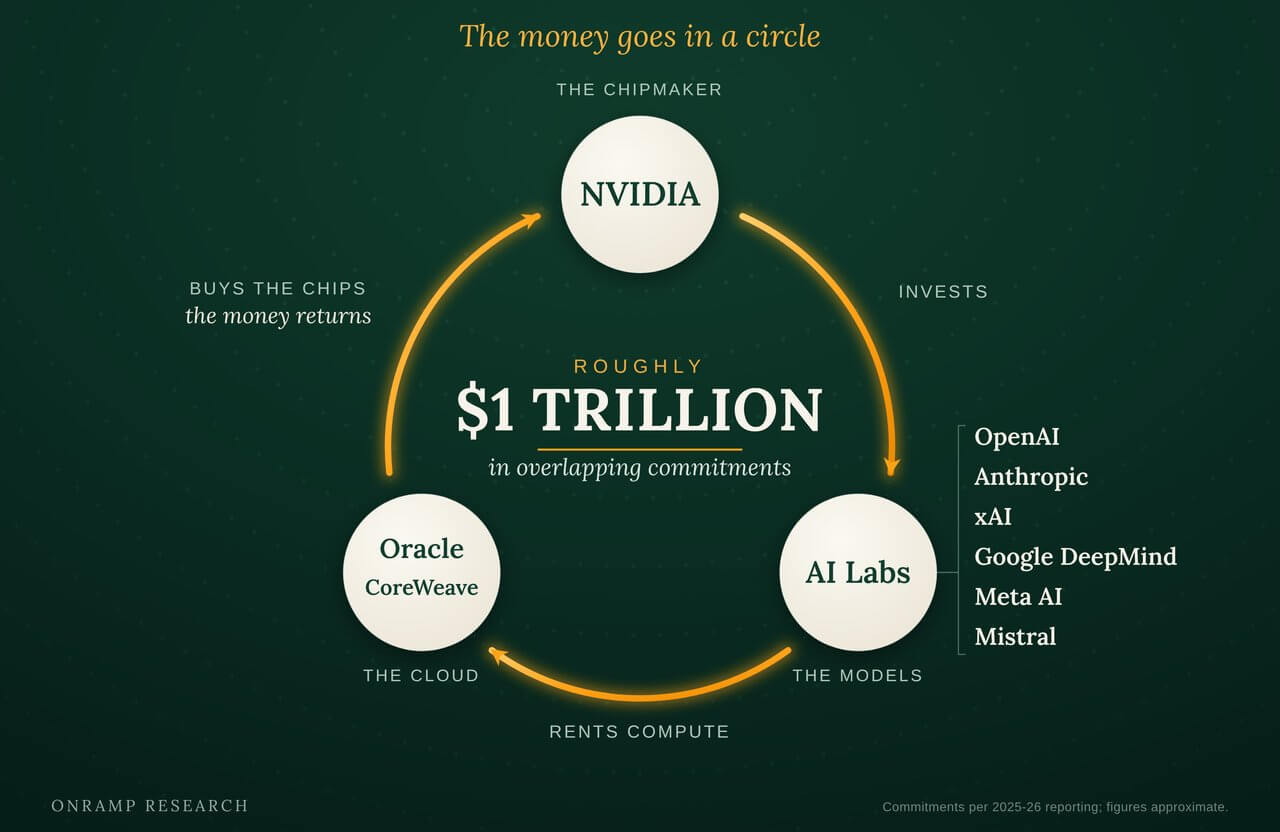
The Bank for International Settlements warns that these arrangements make risks harder to see, noting that this network of claims is built on expectations of future demand. If AI adoption continues to accelerate, this structure can self-reinforce.
But if demand disappoints, pressure could transmit back through the chain.
This could lead to a situation where suppliers may lose orders, and data center developers may struggle to fill capacity.
Meanwhile, private credit funds may face pressure on loans related to software, infrastructure, or tech borrowers. Banks may find their exposure to private credit and non-bank finance more complex than surface numbers suggest.
This is why the Bank for International Settlements' warning extends beyond tech stocks. A decline in AI-related stocks would directly hurt investors. A broader reassessment of AI financing could tighten credit conditions for companies relying on the same financing environment.
Credit spreads have remained relatively narrow, reflecting investor belief that borrowers can continue to repay debt.
A sharp repricing of equity risk could change this rapidly. Once lenders demand more risk compensation, weaker borrowers will face higher refinancing costs, reduced access to capital, and pressure to cut investment.
This is the path whereby AI disappointment could evolve into a macro event.
Bitcoin's First Reaction May Be Defensive
In such an economic shock, Bitcoin's role will be complex, as supporters of this asset often describe it as a hedge against currency depreciation, fiscal stress, and financial system vulnerability.
Its supply is fixed, there is no corporate issuer, and it does not rely on corporate earnings or debt repayment schedules.
If an AI credit crash ultimately forces policymakers to loosen financial conditions, these characteristics could become more attractive. But in the early stages of a broad sell-off, Bitcoin may face the same pressure as other risk assets.
When liquidity tightens, investors usually sell liquid positions first. Bitcoin trades continuously, can be sold quickly, and is held by many investors who also hold stocks, exchange-traded products, derivatives, and other high-beta assets. This makes it vulnerable during portfolio de-risking.
Recent market behavior supports this concern. CryptoSlate recently reported that Bitcoin fell below $63,000 after South Korea's benchmark KOSPI index plunged nearly 10% last week.
This decline indicates that liquidity conditions, leverage, and risk appetite can override scarcity narratives for extended periods.
A market shock triggered by AI could follow a similar sequence. Tech stocks related to construction may fall first. Credit spreads may widen as investors reassess debt related to data centers, suppliers, and private financing instruments. Funds facing losses or margin pressure may subsequently cut positions in cryptocurrencies and other liquid assets.
At that stage, Bitcoin does not need to have a direct link to AI infrastructure to be affected. It only needs to be part of the same risk budget.
Liquidity Issues Follow
But the second phase depends on the government's response to the ensuing market disaster.
If the reversal in AI investment remains confined to a small group of tech companies, damage may remain limited. Stocks will reprice, suppliers will adjust, investors will reassess valuations, without forcing a major shift in monetary policy.
But the risk flagged by the Bank for International Settlements is that the spending boom is already large enough to affect the broader financial system.
This suggests a significant pullback in AI capital expenditure could simultaneously hit corporate investment, employment, household wealth, and credit availability. If inflation remains high and central banks feel unable to cut rates quickly, these pressures could become more severe.
This creates a difficult situation for risk assets. Higher inflation may keep policy tight even amid weak investment. Tighter credit may expose leverage in private markets. Falling stock prices may reduce household wealth and slow consumption. Each channel could reinforce each other.
For Bitcoin, the policy path is crucial. This asset typically performs best when liquidity expands, real interest rates fall, and investors expect central bank support for markets. A credit shock that ultimately brings looser money could restart that trade.
BitMEX co-founder Arthur Hayes believes that if authorities respond by recreating liquidity, and investors shift out of debt-laden financial structures, an AI crash could help drive Bitcoin significantly higher.
This view remains speculative, but it captures why some crypto traders view AI capital expenditure and credit markets as potential drivers for the next Bitcoin cycle.
But timing is uncertain. Therefore, traders betting on the ultimate liquidity response may still have to endure prior drawdowns.
Bitcoin is up 2.28% in the past 24 hours, currently ranked first by market cap.
Broader Market Status
Currently, the total cryptocurrency market cap is $2.09 trillion, with a 24-hour trading volume of $81.45 billion. Bitcoin dominance is 57.97%.
For two years, buying more Bitcoin was enough to push up treasury stock prices. Strategy's BTC Yield is now sliding, Metaplanet's market cap is below its coin holding value, and new European entrants are asking investors to fund them at conditions that no one is pricing.
Join TechFlow official community to stay tuned
Telegram:https://t.me/TechFlowDaily
X (Twitter):https://x.com/TechFlowPost
X (Twitter) EN:https://x.com/BlockFlow_News
 @CryptoSlate