
Strategy Launches "Digital Credit Capital Framework": Authorizes $1.2 Billion Coin Sale, "Never Sell Coins" Narrative Ends
TechFlow Selected TechFlow Selected
Strategy Launches "Digital Credit Capital Framework": Authorizes $1.2 Billion Coin Sale, "Never Sell Coins" Narrative Ends
Selling Off $1.2 Billion in Own Stock, Urgently Launching "Sell Coins to Rescue" Framework?
 Navigating Web3 tides with focused insights
Curry, TechFlow
TechFlow Editor's Note:
Strategy, holding 847,000 Bitcoins, launched the "Digital Credit Capital Framework" on June 29, completely rewriting the script of only buying and never selling over the past four years. The new framework authorizes selling Bitcoin to raise up to $1.25 billion, sets a $2.55 billion cash reserve, increases the STRC dividend rate to 12%, and authorizes $1 billion each for repurchasing its own securities. The background is a 36% plunge in MSTR over eight days, preferred stock STRC falling about 24% below par value, and annual dividend obligations quadrupling in a year to $1.2 billion. For holders, this is a "plan to stem the bleeding," but whether it stops the bleeding depends on the Bitcoin price.

Strategy (formerly MicroStrategy) has officially admitted that the flywheel of endlessly buying coins by issuing preferred stock can no longer turn.
On June 29, the world's largest corporate Bitcoin holder announced the launch of the "Digital Credit Capital Framework" (Digital Credit Capital Framework), using a full set of cash reserve, repurchase, and coin-selling mechanisms to underpin its nearly out-of-control capital structure. The framework includes five components: USD reserve policy, revised STRC dividend policy, digital credit securities repurchase plan, Class A Common Stock repurchase plan, and a Bitcoin monetization plan.
The most impactful clause is: the company's board of directors authorized selling Bitcoin to raise up to $1.25 billion, used to supplement cash reserves, pay preferred stock dividends and interest, or repurchase its own securities. For a company that wrote "never sell coins" into its faith, this is equivalent to officially paving the institutional runway for selling coins.
Founder Michael Saylor's wording in the statement is already different from the past. He said Bitcoin remains the company's "primary treasury reserve asset," but immediately admitted: "Digital credit requires liquidity, discipline, and active capital management."
Translated, this means that hoarding coins alone cannot support the $1.2 billion annual dividend bill.
STRC Dividend Rate Surges to 12%, Preferred Stock Falling Below Par Value is the Trigger
To understand this framework, one must first see how passive Strategy is now.
The company simultaneously announced increasing the annual dividend rate of the Variable Rate A Series Perpetual Preferred Stock STRC from approximately 11.5% by 50 basis points to 12.00%, effective for record dates on July 1 and thereafter. On the surface, it looks like adding returns for investors, but in essence, it is forced by the market—STRC price has fallen to about $75 to $76, a discount of about 24% compared to the $100 par value, hitting a historical low.
STRC falling below par value hit the critical point of Strategy's financing model. This preferred stock was originally the company's "money printing machine": continuously issuing additional shares at prices close to or above par value, using the raised money to buy Bitcoin. Once the price is deeply discounted, new preferred stocks cannot be issued at a good price at all, and the entire financing flywheel gets stuck. Julio Moreno, Research Head at on-chain analysis firm CryptoQuant, calculated in a report on June 23: Strategy's annual dividend obligations have surged from about $300 million at the beginning of the year to about $1.2 billion, quadrupling in a year, while dividend coverage time plummeted from over seven years to about 14 months. He directly suggested the company pause buying coins and rebuild cash reserves to about $2.8 billion first.
For preferred stock holders, a 12% coupon sounds attractive, but the premise is that the company can pay it. The new framework requires USD reserves must cover at least 12 months of preferred stock dividend and interest obligations, equivalent to writing "whether money can be paid on time" into a hard constraint.
$2.55 Billion Cash Reserve, Shifting from "Hoarding Coins" to "Hoarding Cash"
Strategy's cash reserves are expanding at a visible speed, in a direction completely opposite to the past.
According to the company's 8-K filing, as of June 28, the USD reserve balance was $2.55 billion, which includes expected cash income from Class A Common Stock ATM additional issuance but not yet settled. This number represents a significant jump compared to $1.4 billion on June 21, and $1.44 billion when established in early December 2025. Where did the money come from? The answer is selling its own stock, not buying coins.
Operations over the past three weeks have shown signs of shifting. During the week of June 22, the company bought only 520 Bitcoins, spending about $34.9 million, one-third of the previous week; during the same period, it sold 2.71 million shares of MSTR common stock to raise $335.5 million, but invested less than 11% into Bitcoin, with the rest all added to cash reserves.
Cointelegraph posted on June 29 stating that Strategy dumped $1.2 billion worth of MSTR stock last week and did not buy any Bitcoin. If this figure is true, it means the intensity of selling stock to supplement cash is still increasing (Note: The $1.2 billion single-week dumping scale is significantly higher than previously disclosed weekly data, needs to be verified against the company's latest filings before publication). The company currently still holds 847,363 Bitcoins, with a weighted average cost of about $75,651 per coin.

The cost of shifting to "hoarding cash" is dilution. Issuing new shares when the MSTR stock price is lower than its Bitcoin net asset value per share will dilute the Bitcoin quantity corresponding to each share. And MSTR has fallen to about $82 this week, approaching the two-year low of $81.81; the "premium" on which the flywheel relies to operate no longer exists.
$1 Billion Each for Repurchase, Wanting to Buy Back the Discount
There are also two repurchase "knives" hidden in the framework: the Digital Credit Securities Repurchase Plan and the Class A Common Stock Repurchase Plan, with authorized amounts up to $1 billion each.
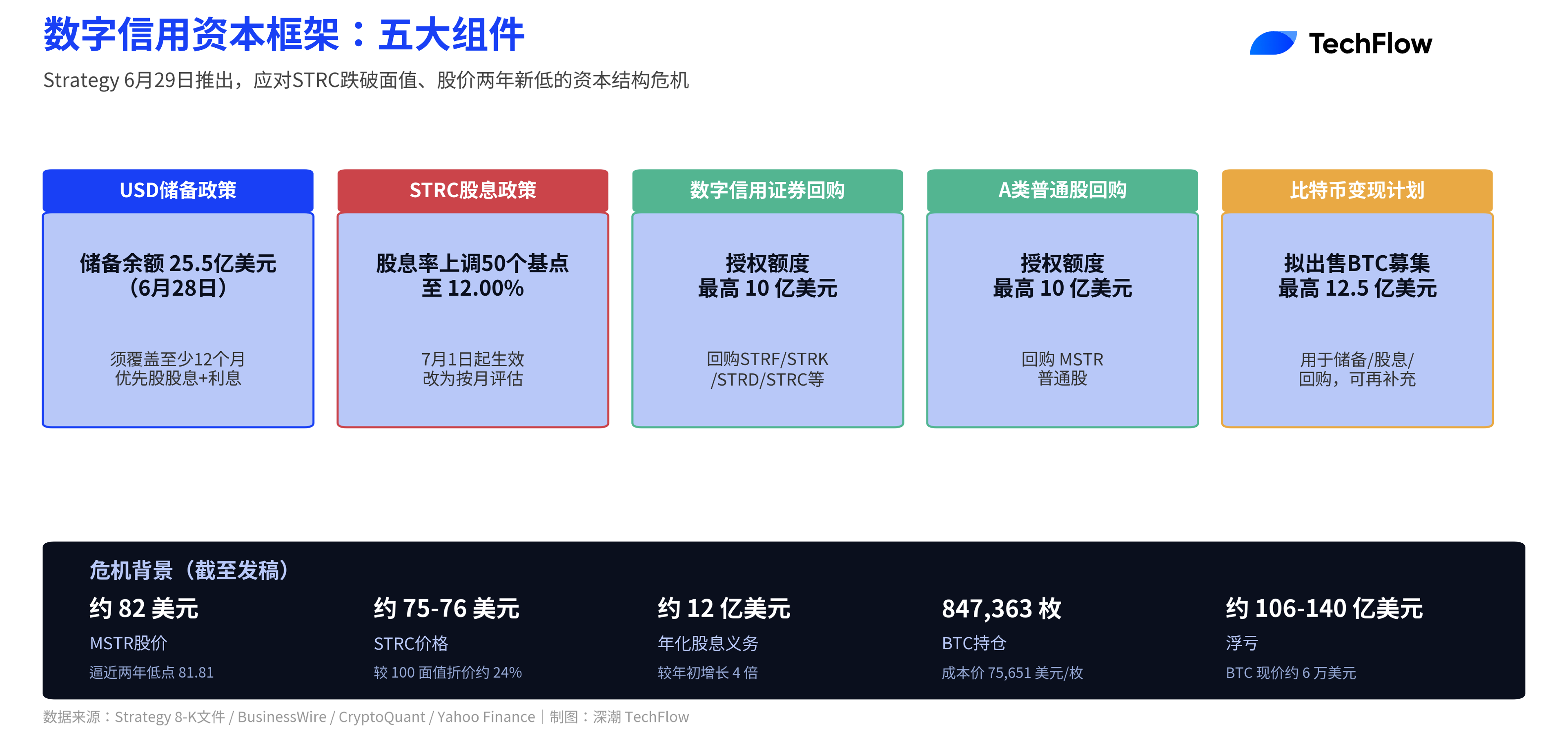
The logic is not complex. Preferred stocks such as STRC and MSTR common stock are all trading at deep discounts; the company uses cash (or proceeds from selling coins) to repurchase at low positions, theoretically narrowing the discount and protecting the price. Bitcoin critic Peter Schiff has repeatedly shouted on X these days, saying Saylor's best choice is to sell coins to repurchase stock to narrow the discount.
Now Strategy has written this suggestion into the formal framework, only Schiff simultaneously warned that forcibly selling coins might crash Bitcoin instead, plunging the entire structure into a death spiral.
Whether the repurchase can be effective depends on how much cash the company has. For investors holding MSTR or preferred stocks, the $1 billion authorization is just an upper limit, not equal to definitely executing all of it; the real buying pace depends on subsequent disclosures.
Not Just Stopping Bleeding: Legal Investigation and Debt Looming
This framework was launched hastily under multiple pressures; looking at financial figures alone is not enough.
On June 25, Rosen Law Firm disclosed it is investigating Strategy and Saylor, pointing out they may have released "materially misleading information" to investors regarding Bitcoin holdings; the investigation covers all five securities: MSTR, STRF, STRC, STRK, STRD. The investigation is still in early stages, no formal lawsuit yet, but the timing happens to coincide with the continuous decline in stock price.
The debt side is equally tight.
According to multiple media reports, cumulative debt on Strategy's balance sheet is as high as about $8.2 billion, cash reserves have shrunk by about 38% since 2026, and the company also did debt repurchases in May. Bitcoin current price is about $60,000, has completely fallen below the cost basis of all buying batches of Strategy from 2024 to 2026, with unrealized losses in the range of $10.6 billion to $14 billion (different sources vary).
For investors who are watching on the sidelines, the indicator that should be watched most right now is the discount magnitude of MSTR stock price relative to Bitcoin net asset value per share. Once the discount continues too deep, the ATM additional issuance engine will stall. That is the outcome this framework truly wants to avoid, but may not be able to avoid.
Join TechFlow official community to stay tuned
Telegram:https://t.me/TechFlowDaily
X (Twitter):https://x.com/TechFlowPost
X (Twitter) EN:https://x.com/BlockFlow_News
 深潮TechFlow