
IBIT Sees $1.3 Billion Outflow in Single Week, Bitcoin's Largest ETF Is Becoming a Sell Pressure Wall Bulls Must Break Through
TechFlow Selected TechFlow Selected
IBIT Sees $1.3 Billion Outflow in Single Week, Bitcoin's Largest ETF Is Becoming a Sell Pressure Wall Bulls Must Break Through
The capital flows over the next few trading days will determine whether this is a liquidation or the beginning of sustained bleeding.
 Navigating Web3 tides with focused insights
Author: Liam 'Akiba' Wright
Compiled by: TechFlow
TechFlow Editor's Note: BlackRock's IBIT accounted for nearly 73% of the net outflows from U.S. spot Bitcoin ETFs last week, with redemptions totaling $1.3 billion in a single week. As this largest gateway, which once brought Wall Street buying pressure to Bitcoin, begins to operate in reverse, bulls facing the $60,000 threshold are no longer confronting retail selling pressure, but rather structural selling pressure from ETFs. Capital flows over the next few trading days will determine whether this is a clearance event or the beginning of continued bleeding.
BlackRock's iShares Bitcoin Trust (IBIT) is becoming the test Bitcoin bulls least want to face. This ETF, which helped Bitcoin open compliant inbound capital channels and turned "institutional demand" into a simple narrative, has now become the place where price-sensitive holders are concentrated.
Bitcoin ETF capital flow data from Farside Investors shows that during the trading week from June 22 to 26, U.S. spot Bitcoin ETFs had combined net outflows of approximately $1.79 billion. IBIT alone accounted for about $1.3 billion of this, close to 73% of the total weekly outflows.
Data from the most recent trading day makes the signal even clearer: Farside's data table for June 26 shows that the ETF complex had net outflows of $444.5 million that day, with all negative values coming from IBIT.
This concentration changes the conditions for Bitcoin's rebound test. The ETF complex can still be a demand channel, but the largest spot Bitcoin ETF must now also be viewed as a redemption channel.
If this shell, which once helped Bitcoin win recognition from brokerage account investors, becomes the primary exit lane, then spot buyers outside the ETFs must take on these exposures when ETF holders reduce their positions.
IBIT Dominates ETF Capital Flight
The reason Farside data constitutes a market structure signal is that the pressure is concentrated on the most prominent Bitcoin ETF in the market.
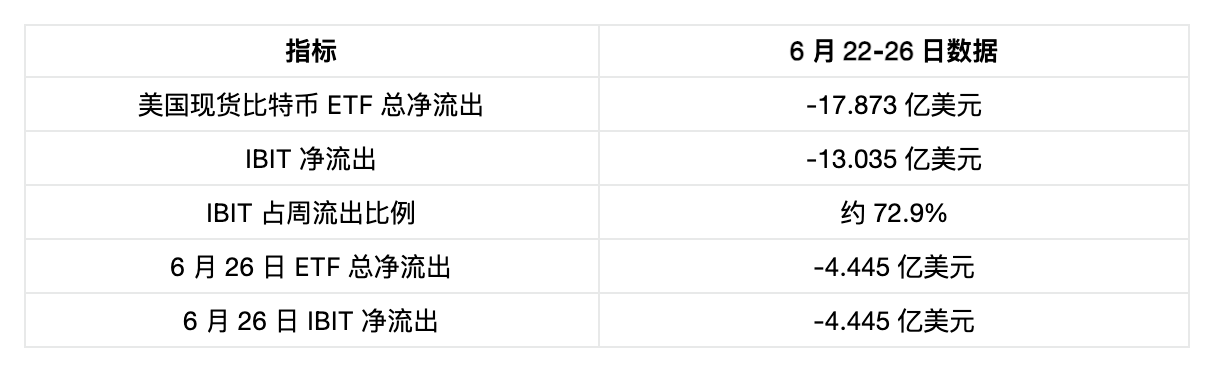
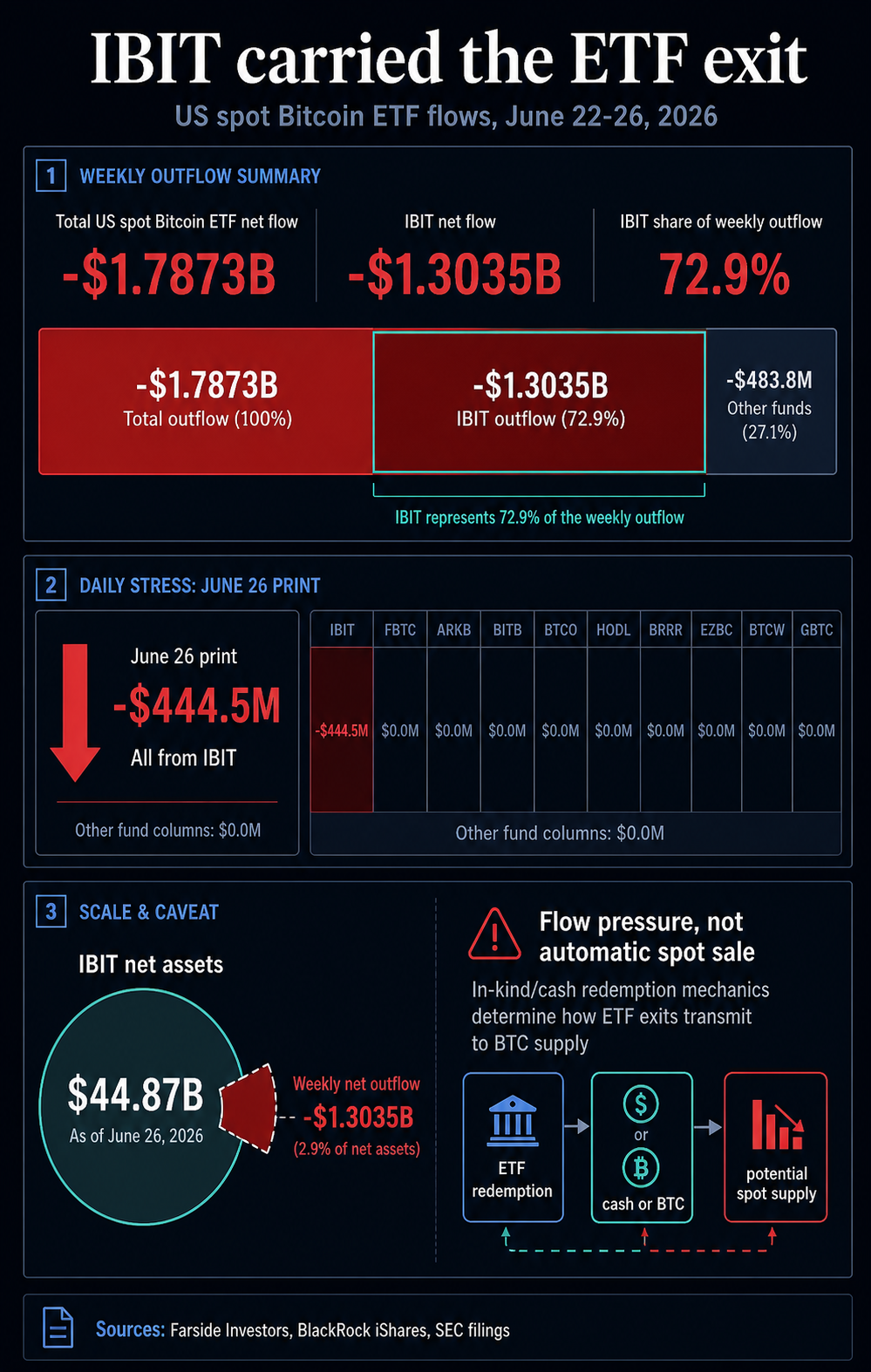
Caption: IBIT accounts for 72.9% of the total weekly outflows from U.S. spot Bitcoin ETFs ($1.3035 billion / $1.7873 billion), data source Farside Investors
IBIT is not just a ticker in the ETF complex. It is one of the clearest channels for Bitcoin to achieve compliant access through existing brokerage accounts, and its scale gives its capital flows more market weight than redemptions from smaller funds.
When this product contributes the majority of capital outflows within a week, the signal is no longer just "the ETF market is cooling down." This is a stress test of the strongest access channel Bitcoin has gained since the launch of spot ETFs.
When the capital outflows occurred, Bitcoin itself was already under pressure. CryptoSlate market data shows BTC traded near $60,000 on June 28, with negative percentage changes on both the 7-day and 30-day scales.
Previous CryptoSlate reports have already tracked the broader background of collective ETF surrender and Bitcoin's struggle in the $58,000 to $60,000 range. The new pressure added now is: IBIT itself has become the marginal capital flow that needs to be watched.
Narrative Flip: The Same Channel, Operating in Both Directions
The early spot ETF story was simple: compliant channels widened the buyer base, ETF demand reduced available supply, and Bitcoin gained a holding path more familiar to institutional and brokerage account investors.
The latest data preserves this history while revealing that the same gateway can operate in reverse when ETF holders decide to exit.
The scale of IBIT is both the reason why this week's outflows are significant and provides a proportional reference. BlackRock's iShares official product page shows that as of June 26, IBIT's net assets were $44.87 billion, with a benchmark price near $59,813.
Weekly outflows of $1.3 billion are enough to dominate the ETF complex, but relative to the fund's total assets, it is still a small proportion. IBIT remains an important compliant Bitcoin wrapper product. The market's question lies in what this scale means marginally.
When IBIT absorbs capital, its scale reinforces the "institutional demand" narrative. When IBIT bleeds, its scale makes this outflow hard for other parts of the market to ignore.
Small funds can bleed continuously without changing the overall ETF narrative, but IBIT cannot. Its redemptions indicate that ETF holdings may be becoming more price-sensitive near Bitcoin's support levels.
This distinction is crucial at the $60,000 threshold. An optimistic interpretation is: the largest redemptions have been digested by the system, outflows will slow down next, and Bitcoin reclaiming the $59,000-$62,000 range means the market has absorbed the selling pressure.
A cautious interpretation is: the next round of rebound must not only recover from liquidation shocks but also withstand new ETF selling pressure.
This is the "selling pressure wall" version of the IBIT story. It does not require BlackRock to be bearish on Bitcoin, nor does it require IBIT holders to exit all at once. It is a market structure assertion: the largest access product can become the place where price-sensitive holdings manifest first.
Precise Definition of ETF Mechanisms
ETF capital flow data is a pressure signal, not equivalent to a record of direct on-chain sales.
In July 2025, the SEC approved the in-kind creation and redemption mechanism for crypto ETPs. IBIT's filing documents also show that the redemption mechanism can involve cash proceeds from selling Bitcoin or Bitcoin in-kind, depending on the path used.
Therefore, ETF outflows should be viewed as transmission risk, not direct evidence that every dollar redeemed automatically means one dollar is thrown into the spot market.
The risk still truly exists. A large, liquid ETF can turn investors' de-risking operations into a recurring source of pressure on the Bitcoin supply side (or supply expectation side), especially when redemptions are cash-settled or the redeemed Bitcoin is subsequently sold.
The market does not need perfect mechanism certainty for the signal to have weight. If IBIT continues to post large net outflow days, buyers must ask: when ETF holders exit, who is taking on these exposures?
If Bitcoin fails to reclaim $60,000 during this period, the old "institutional demand" narrative will weaken. If capital flows stabilize quickly, the same set of data looked back upon may just be a clearance of crowded trades.
The real test is: whether ETF holdings have matured into a two-way price pressure source. Spot ETFs provide investors with a more convenient holding path, and more convenient holding also means more convenient exit.
Last week's outflows from IBIT happened to place this exchange condition at a vulnerable position on Bitcoin's chart.
Two Scenarios
If IBIT outflows slow down, Bitcoin holds the upper $50,000 range, and reclaim the $59,000-$62,000 level, this week can be interpreted as a possible capitulation clearance or capital flow reset.
In this version, ETF holders who wanted to leave have already exited, the market has absorbed the transmission risk, and the largest compliant product remains a net positive for Bitcoin over a longer time horizon.
If IBIT continues to dominate redemptions and Bitcoin fails to rebuild its position above $60,000, the interpretation changes. The ETF complex will define the conditions for the next round of recovery tests: non-ETF spot buyers must hold the market alone without the help of this shell that once provided the simplest bullish narrative.
The IBIT-dominated capital withdrawal leaves Bitcoin with a live test, not a conclusion. One week of capital flow data cannot determine investor motives, nor does the redemption mechanism allow for simple "one dollar outflow = one dollar spot sell-off" inferences.
But the data does indicate: at the moment when Bitcoin most needs demand outside the ETF system, the most prominent Bitcoin ETF in the market can become the main source of outflow pressure.
For Bitcoin, the weight of the next few trading days is exceptionally heavy. If IBIT bleeding slows, this week will be viewed as an exhaustion of selling pressure. Another round of large redemptions, and the "selling pressure wall" narrative will be harder to ignore.
Join TechFlow official community to stay tuned
Telegram:https://t.me/TechFlowDaily
X (Twitter):https://x.com/TechFlowPost
X (Twitter) EN:https://x.com/BlockFlow_News
 @CryptoSlate