








IOSG | Rented Faith: How Much Real Money Is in Bitcoin ETF Flows?
TechFlow Selected TechFlow Selected
IOSG | Rented Faith: How Much Real Money Is in Bitcoin ETF Flows?
This article clarifies how to identify it, the true scale of this deal, and why it is quietly exiting.
 Navigating Web3 tides with focused insights
By Darko, IOSG
ETF fund flows are often viewed as a “thermometer” for institutional confidence in Bitcoin. Yet week after week, they measure something else entirely: a repeatedly opened-and-closed, hidden interest-rate trade. This article explains how to distinguish it, how large it is, and why it is quietly exiting.
TL;DR
- Week-over-week, ETF flows are driven primarily by a hidden arbitrage trade—not conviction. Cash-and-carry arbitrageurs buy the ETF while simultaneously shorting Bitcoin futures on CME, hedging away price risk. Yet in the data, they are indistinguishable from genuine longs. Approximately half of weekly flow volatility is explained solely by newly added hedge fund short positions in futures—correlation stands at 0.70.
- Weekly Bitcoin returns explain virtually nothing about ETF flows. Using price return to predict ETF flows yields results statistically indistinguishable from zero. Weekly flows aren’t chasing performance—they move in lockstep with a hedged interest-rate trade.
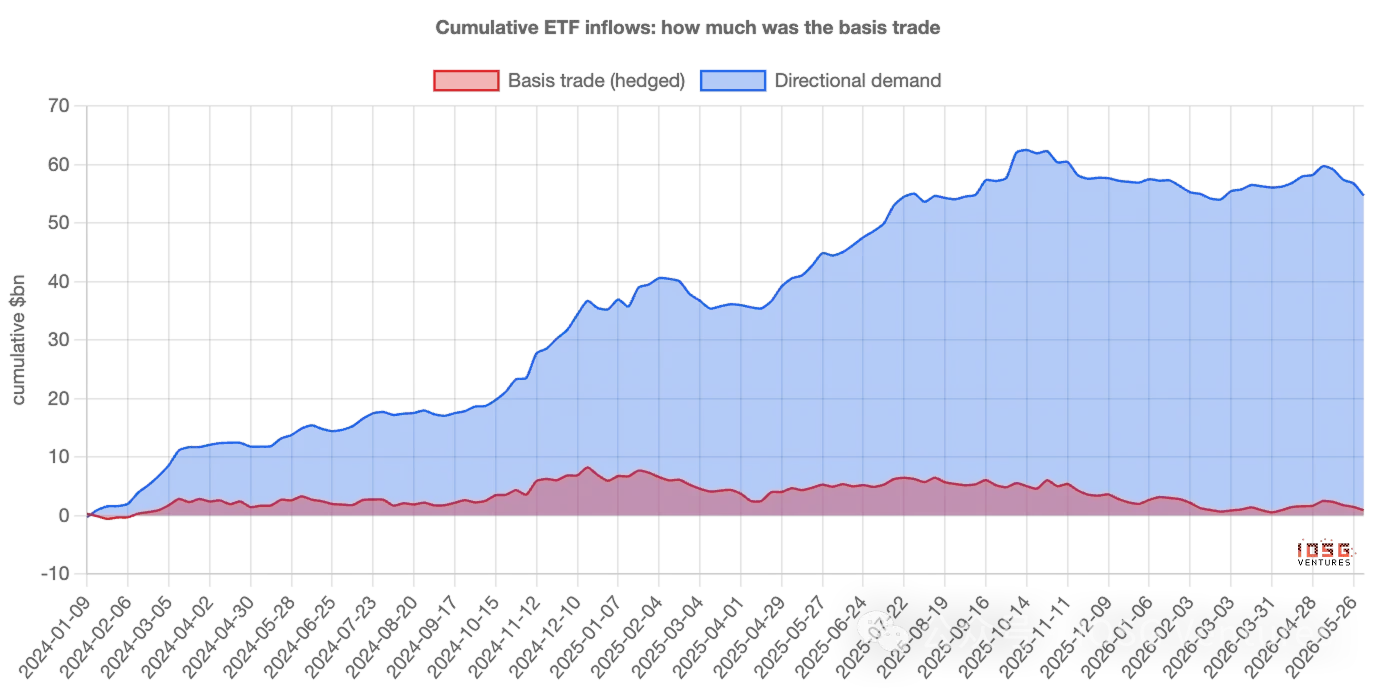
- Arbitrage dominates week-to-week “volatility,” but has never been the main driver of “stock.” Of the roughly $55 billion cumulatively流入 into ETFs, the net arbitrage position currently accounts for only ~$1 billion; the rest is stable, directional buying—around $400 million per week—which, compounded over two years, constitutes nearly the entire “mountain.”
- The correct framing is: ETF flows overstate the “volatility” of conviction—not its “level.” Weekly swings are mostly “rented”—arbitrage capital arrives and departs; the assets that truly remain are mostly “owned.”
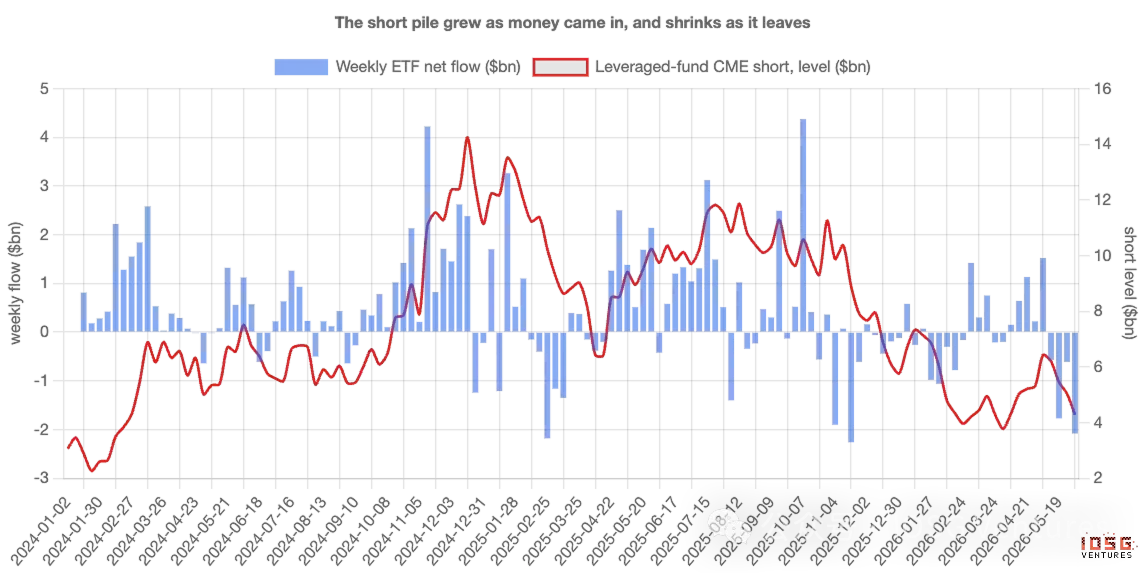
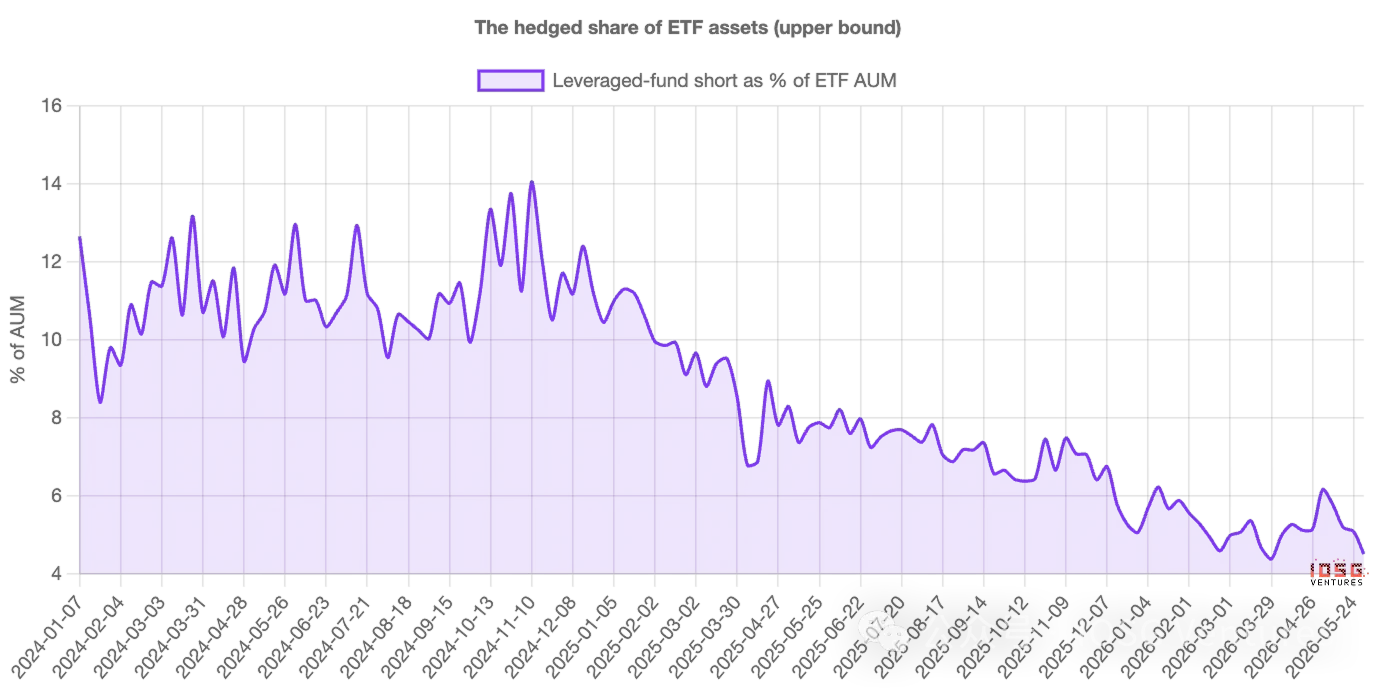
- This trade is exiting—and has been doing so for two years. Leveraged fund short positions rose from ~$3 billion at launch to ~$14 billion by end-2024, then steadily declined to ~$4.5 billion. Once basis compresses to unprofitability, inflows and shorts recede in tandem—don’t misread the resulting outflows as a market verdict on Bitcoin.
I. The Number Everyone Watches
Every week, Bitcoin ETFs report how much money flowed in or out—and this figure is often treated as a verdict. Large inflows signal institutional rush; outflows suggest eroding confidence. Fund flow data has quietly become the market’s top-line metric for measuring conviction.
The problem is that not everyone buying ETFs is betting on Bitcoin’s price. Some of the largest buyers don’t care where the price goes at all. Once you account for them, weekly flow numbers reflect their activity far more than anyone’s beliefs. To understand why, we must first meet a very different kind of buyer.
A buyer who doesn’t care about price
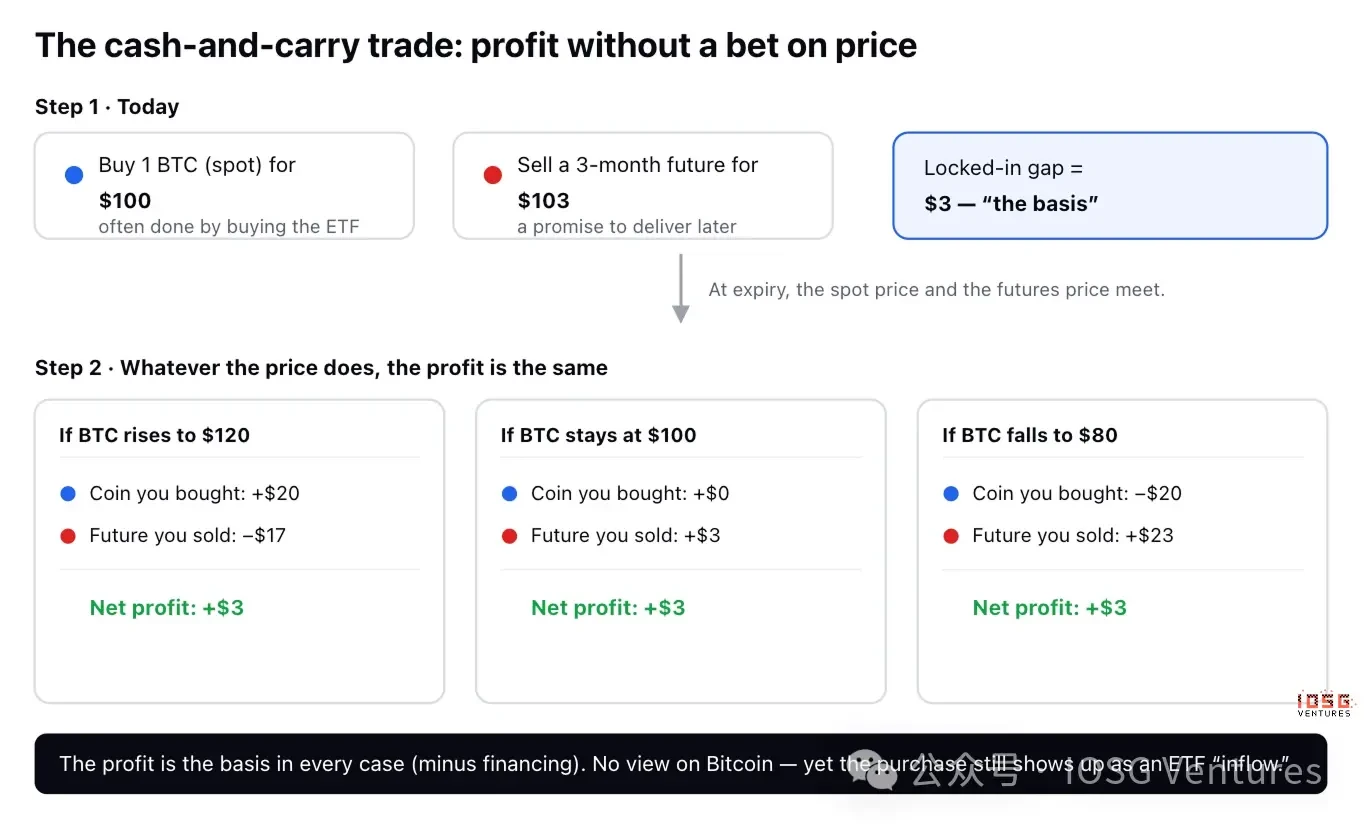
There exists a classic—and dull—trade called cash-and-carry arbitrage. Bitcoin “futures” are simply contracts to buy or sell Bitcoin at a fixed price on a future date. Most of the time, futures trade at a slight premium to spot—e.g., Bitcoin is trading at $100 now, but the three-month contract trades at $103.
Traders can pocket that $3 spread without forming any view on price:
- Buy 1 Bitcoin today for $100 (often done via ETF).
- Sell the $103 futures contract, committing to deliver in three months.
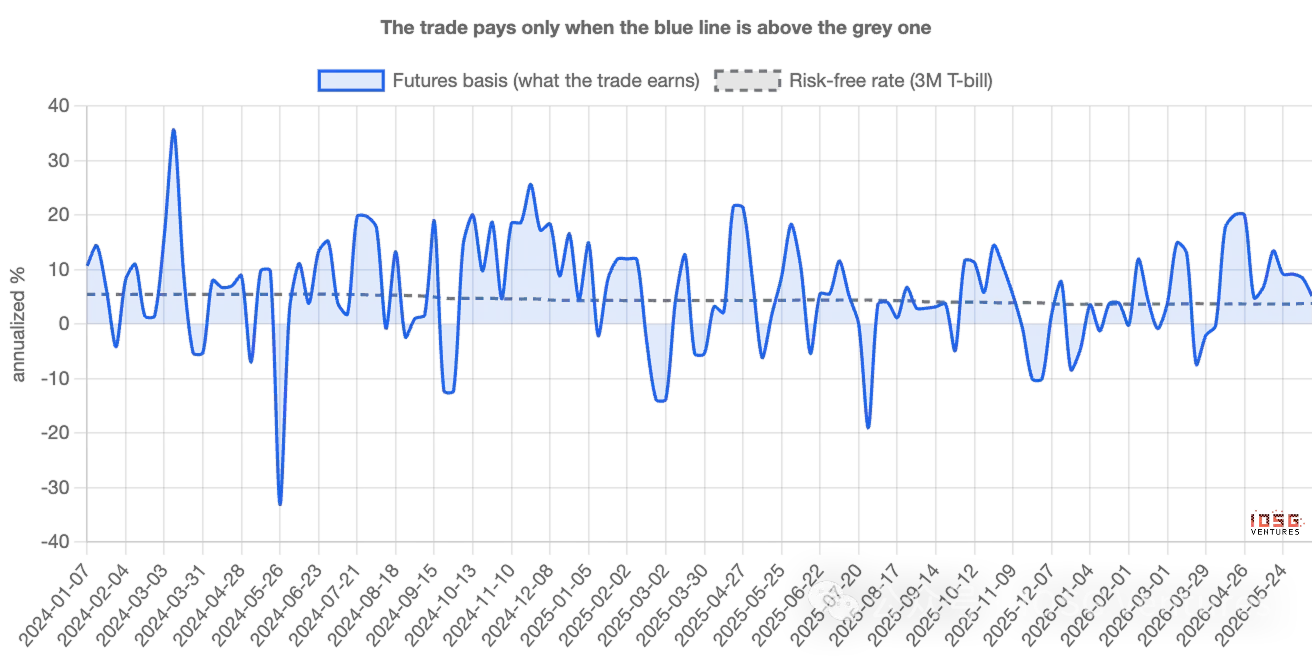
Consider what happens at expiry. If Bitcoin surges to $120, the trader gains $20 on the coin but loses $17 on the contract—net gain: $3. If it crashes to $80, the trader loses $20 on the coin but gains $23 on the contract—still a net $3. If it stays flat, still $3. In every case, profit is identical. Directionality is hedged away—a “delta-neutral” trade. That $3 spread, annualized, is the “basis”—essentially the interest rate earned by parking capital in this trade. As long as it exceeds the risk-free yield on U.S. Treasury bills (T-bills), the trade makes sense.
Why this contaminates the headline number
Here’s the crux: the first leg—buying 1 Bitcoin—is most commonly executed via ETF. So a delta-neutral trader with no Bitcoin view shows up in the data as an ETF inflow—indistinguishable from a true believer.
When many such cash-and-carry positions are established, inflows look strong, and the narrative “institutions are accumulating” naturally takes hold—even though those funds are hedged and will reverse instantly once the trade turns unprofitable. In other words, the flow number measures not just conviction—it measures the activity level of arbitrage desks. The question is how to separate the two—and quantify each.
How to tell them apart
Cash-and-carry traders leave a second footprint. For every $1 worth of Bitcoin they buy, they short $1 worth of futures on CME (the regulated U.S. exchange where institutions trade Bitcoin futures). True believers leave only the first footprint; arbitrageurs leave both.
And that second footprint is public. The U.S. derivatives regulator publishes weekly reports disclosing the long/short positions held by various trader categories on CME. One category—leveraged funds (i.e., hedge funds)—is precisely where cash-and-carry participants congregate. So you can line up, week by week, ETF inflows against newly established short positions by these funds. If “demand” were truly conviction-driven, the two shouldn’t correlate strongly; if much of it stems from that hidden trade, they should move together.
II. What the Data Says: Week-over-week, Flows Follow Futures—not Price
They move tightly in lockstep. Since ETF launch, weeks with larger new futures shorts have consistently seen larger ETF inflows—almost one-to-one. Roughly half of all week-to-week flow volatility is explained by a single variable: how many new shorts funds added that week. Correlation stands at 0.70—the strength you’d expect between two clearly related phenomena—not coincidence.
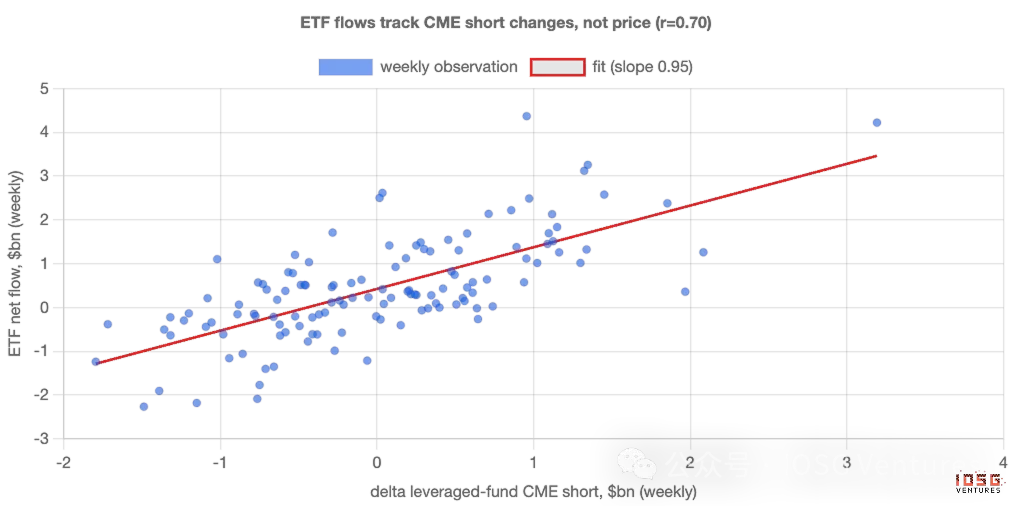
The most sobering point for believers: price itself explains almost nothing. Testing whether weekly Bitcoin returns predict ETF flows yields results statistically indistinguishable from zero. Weekly flows aren’t chasing performance—they march in step with a hedged interest-rate trade.
So, as a week-to-week signal, ETF “demand” is mostly arbitrage. The flow number is a poor thermometer for conviction because its ups and downs reflect the repeated opening and closing of basis trades—not shifts in anyone’s view on Bitcoin.
But How Much of the Flow Is This Trade?
This is where the blunt claim—“it’s all fake”—collapses, and the real story gets more interesting. Basis trades dominate week-to-week volatility—but have never been the bulk of the capital.
Break down weekly inflows into the portion explained by futures shorts (hedged) and the remainder (directional), then sum cumulatively since launch. Of the ~$55 billion cumulatively流入 into ETFs, the current net basis trade accounts for only ~$1 billion—the rest is stable, directional buying. This buying runs at ~$400 million per week, week after week, regardless of basis or price. Compounded over two years, it forms nearly the entire mountain.
Viewed as asset share rather than flow, the picture is similar: the hedged portion peaked near 14% of ETF assets in 2024, and now stands at ~4%–5%. At its peak, it was a nontrivial minority; today, it’s a small slice.
So the precise framing is: ETF flows overstate the *volatility* of conviction—not its *level*. Weekly swings are mostly “rented”—arbitrage capital arrives and departs; but assets that truly settle are mostly “owned.” This trade churns through the flow data—but has never been the dominant part of the balance sheet.
And this trade is exiting
The hedged portion isn’t just small—it’s shrunk for two years. Leveraged fund short positions climbed from ~$3 billion at launch to ~$14 billion by end-2024, then steadily declined to ~$4.5 billion. This arbitrage trade has been unwinding across the entire period—not just recently.
That matters for interpreting the present. Entering June, hedged positions halved again—fund shorts fell from ~$6.4 billion to $4.3 billion—while ETFs saw daily outflows of $300–500 million. On the surface, this looks like panic capitulation. But paired with futures data, it’s merely routine cleanup of an unprofitable interest-rate trade. Same outflow number—two completely different stories.
When basis compresses, demand recedes
The cleanest proof lies in what happens when the trade becomes unprofitable. When that $3 spread narrows close to the risk-free yield, the trade ceases to make sense. If a large chunk of weekly demand really is this trade, then demand should weaken precisely as basis compresses—and it does. Strip trends from both series and examine moments before and after compression: ETF inflows fall below their usual rhythm, and funds simultaneously cover shorts—both happening in sync. Demand breathes with the trade.
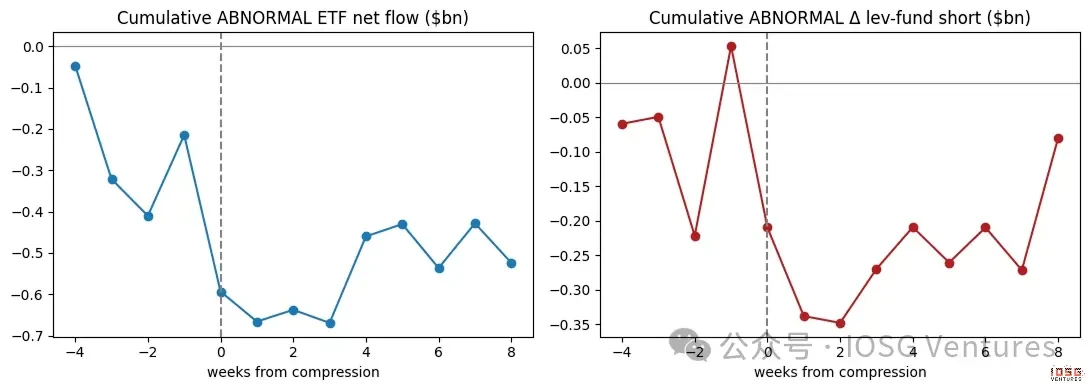
True believers don’t care about futures basis. Yet this weekly “demand” clearly does.
III. Who Leads, Who Follows—and Who’s Really Pulling the Levers
First, the correlation is contemporaneous—the tightest within the same week, with no clear lead or lag. And the scant directional evidence actually points the opposite way: ETF flows drive shorts, not vice versa. This fits paired-trade logic: buy ETF first, then hedge with futures—not shorting magically “creating” inflows. Second, arbitrageurs aren’t the sole drivers. Flows track leveraged fund shorts most closely—but also resonate with directional institutional positions—both buyer types are active. This article doesn’t claim every inflow is hedged; rather, that hedged trades are the tightest, most reliable driver of week-to-week volatility.
Ethereum: Same trade, but the math barely adds up
Applying the same test to Ethereum ETFs, the pattern persists—but weakens: correlation with futures shorts loosens, and the underlying stable directional buying is nearly absent. The reason is clear. Holding spot ETH instead of futures means forgoing staking yields (~3%–4% annually). Netting that out, ETH basis is often negative—arbitrage frequently fails to clear its hurdle yield. So ETH ETFs lack both robust conviction-driven buying and stable arbitrage support; they’re simply smaller and noisier than their Bitcoin counterparts.
IV. Going Forward: How to Interpret ETF Flows
The key isn’t price forecasting—it’s a method for interpreting flows. When basis is rich, expect “institutional demand” to appear strong—and heavily hedged—don’t mistake that strength for conviction. When basis compresses, expect inflows and shorts to recede together—don’t misread resulting outflows as a market verdict on Bitcoin. Two numbers to watch: the annualized basis yield relative to T-bill rates, and the net short position of leveraged funds reported weekly by CME. They’ll tell you how much of the next “demand” headline is real.
How We Calculated This
A few honest caveats. Basis is constructed using the front-month CME futures contract vs. spot, excluding the final days before expiry (ultra-short tenor amplifies rounding errors into false spikes); building the series contract-by-contract sharpens exact numbers but doesn’t alter conclusions. The link between flows and shorts is a strong co-movement—not proof of causation—the emphasis is that they represent two halves of the same trade. Futures short data serves as an upper bound on the ETF buy-side hedging ratio, since some shorts hedge coins held elsewhere.
None of this changes the core. Week-to-week, Bitcoin ETF “demand” is primarily a hidden interest-rate trade—not conviction. Flows measure participation in arbitrage far more accurately than they measure belief. And that genuine buying is real, patient—and now constitutes the overwhelming majority, because the “rented” portion has spent two years quietly going home.
Join TechFlow official community to stay tuned
Telegram:https://t.me/TechFlowDaily
X (Twitter):https://x.com/TechFlowPost
X (Twitter) EN:https://x.com/BlockFlow_News
 IOSG Ventures


