Saylor’s Latest Essay: Bitcoin Is Not Money—It’s Digital Capital, and Money Must Be Built on Top of It
TechFlow Selected TechFlow Selected
Saylor’s Latest Essay: Bitcoin Is Not Money—It’s Digital Capital, and Money Must Be Built on Top of It
Bitcoin itself does not require staking, does not rely on inflation, and does not need protocol upgrades—the returns are entirely generated by the upper-layer capital structure.
 Navigating Web3 tides with focused insights
Author: Michael Saylor
Compiled by: TechFlow
TechFlow Intro: Michael Saylor, founder of MicroStrategy, introduces the “Digital Asset Stack” framework—positioning Bitcoin as the foundational layer of digital capital, with five additional layers stacked above it: digital credit, digital currency, digital yield, and digital equity. His core thesis is that Bitcoin itself requires no staking, no inflation, and no protocol changes; instead, yield is generated entirely by the upper layers of the capital structure. This framework underpins MicroStrategy’s strategic approach—including its STRC and MSTR initiatives—and directly addresses ongoing debates such as “Should stablecoins pay yield?” and “Should Bitcoin emulate Ethereum?”
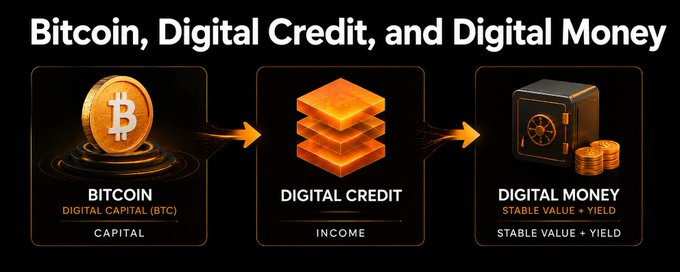
The Modern Digital Asset Stack
Bitcoin is digital capital.
It is the bedrock of the modern digital economy.
Bitcoin is scarce, globally accessible, highly liquid, programmable, divisible, and auditable. Anyone with internet access can hold it. It is not issued by governments, controlled by corporations, leased to tenants, burdened with maintenance costs, constrained by borders or physical addresses, governed by a board of directors, or subject to dilution by any central bank.
It is the foundational layer of digital value.
Yet capital alone is only the starting point.
The next phase for Bitcoin is not merely holding BTC—but building an entire digital capital stack atop it: digital capital, digital credit, digital currency, digital yield, and digital equity.
This is how Bitcoin evolves from a single asset into a global financial architecture.
Bitcoin remains Bitcoin. The world builds on top of it.
This Stack Has Five Layers
The modern digital asset stack comprises five layers.
Layer One: Digital Capital—the BTC itself, a pure, scarce, high-energy capital asset.
Layer Two: Digital Credit—tools like STRC, yield-generating instruments backed by Bitcoin, designed to dampen volatility and deliver yield.
Layer Three: Digital Currency—a stable-value, yield-bearing instrument. It is pegged to the U.S. dollar and may take the form of tokens, funds, senior securities, accounts, or other regulated wrappers, built upon a combination of digital credit and fiat cash equivalents.
Layer Four: Digital Yield—leveraged or structured yield products for investors willing to accept greater risk, leverage, volatility, or illiquidity.
Layer Five: Digital Equity—residual equity similar to MSTR’s common stock. It absorbs volatility as the junior tranche supporting the entire credit structure and captures residual upside after senior obligations are satisfied.
This is not a protocol upgrade, staking mechanism, monetary inflation, or yet another token masquerading as Bitcoin. It is a capital market built on Bitcoin.
Layer One: Digital Capital — BTC
BTC sits at the bottom of the stack.
BTC functions as the digital equivalent of gold, landmark real estate, and sovereign reserve assets—but with superior liquidity, divisibility, scarcity, and global settlement capability. It is the highest-energy asset in this system.
High energy implies volatility. Bitcoin exhibits sharp price swings precisely because it is pure digital capital—scarce, liquid, global, and traded around the clock. This volatility is not a flaw—it is the raw material for constructing digital capital markets.
Yet not every investor can—or should—hold BTC directly. Family offices seek capital appreciation; corporations require treasury reserves; banks need collateral; insurers want yield; retirees demand interest income; payment companies need stable settlement; crypto exchanges require a truly yield-bearing, dollar-pegged asset for users; and savers in emerging markets seek dollars, liquidity, and yield.
A 40% volatility asset suits some investors perfectly—and is wholly unsuitable for others.
The answer is not to change Bitcoin, but to build products atop it that match the needs of each class of capital.
Layer Two: Digital Credit — Yield Backed by Bitcoin
Digital credit transforms high-volatility digital capital into low-volatility yield.
STRC is an example: a senior, high-yield, short-duration yield instrument issued by a Bitcoin-backed company. BTC provides the long-term capital foundation; digital equity absorbs residual volatility; and digital credit sits above equity, distributing yield to investors who desire returns without direct exposure to BTC’s volatility.
The key point is not that digital credit maintains a fixed, unchanging volatility level. It does not.
Credit instruments exhibit low volatility in normal markets, but volatility rises during stress periods. Spreads widen, liquidity shifts, rates move, issuer reputations evolve, and market structures adapt.
A more precise description is: digital credit is intentionally designed to suppress the volatility inherent in digital capital.
It achieves this through capital structure, seniority, yield mechanics, par-value features, liquidity support, and a junior equity tranche acting as a buffer. Its objective is to convert Bitcoin’s raw, high-volatility capital energy into a steadier, more predictable yield stream suitable for credit investors.
Finance professionals have long understood this logic. A mortgage loan is not the house; municipal bonds are not the city; corporate bonds are not common stock; senior securities are not their underlying equity. Assets may be volatile, while the credit layer may remain comparatively stable.
The purpose of digital credit is not to eliminate risk—but to allocate it intelligently. Equity holders absorb residual volatility and capture upside; credit holders receive yield and senior claim priority; digital currency holders gain further stability and liquidity. Each investor selects the risk tier aligned with their mandate.
Bitcoin itself need not generate yield. No staking, no inflation, no protocol changes, no Ethereum-like transformation are required. Yield is created by the capital structure built atop Bitcoin—not by degrading Bitcoin.
This distinction is critical.
Layer Three: Digital Currency — Stable-Value Money Built on Digital Credit
Digital currency is the next layer.
It is a stable-value, daily-redeemable instrument that functions like money while delivering meaningful yield. Depending on jurisdiction, distribution channel, and investor type, it may be structured as a token, fund, senior security, account, or other regulated wrapper.
The concept is simple: combine digital credit with fiat cash equivalents. Digital credit serves as the yield engine; fiat cash equivalents provide liquidity and stability; the structure itself manages duration, redemptions, credit exposure, reserves, and market risk—delivering to holders a stable-value, yield-bearing asset.
For example, a product might hold Bitcoin-backed digital credit yielding ~10–12%, supplemented by Treasury bills, money market funds, repurchase agreements, or bank reserves. After deducting liquidity reserves, fees, and risk buffers, the target yield for this digital currency instrument could fall within the 6–8% range.
This is the breakthrough. Digital capital becomes digital credit; digital credit plus fiat liquidity becomes digital currency.
A Bitcoin-backed stable-value instrument thus delivers yield—not by magic, but via structured finance.
BTC is the capital asset; digital equity is the first-loss and upside layer; digital credit is the yield layer; digital currency is the stable-value, liquidity layer. The full stack transforms Bitcoin’s raw volatility into useful financial products—without touching Bitcoin itself.
Stable Value ≠ Risk-Free
This distinction matters profoundly.
Digital currency must not be marketed as risk-free or sold as an unconditional guarantee. It should instead be described as a vehicle *designed*—through reserves, liquidity, credit structure, transparency, and risk management—to maintain stable value.
A well-designed digital currency product should be evaluated using the same rigorous questions applied by finance professionals to money market funds, stablecoins, or short-duration credit products: What are the underlying assets? What is the credit exposure? How large are liquidity reserves? What is the duration? How do redemptions work? What is the seniority hierarchy? What collateral backs it? How transparent is it? Who bears first-loss risk? How does it perform under stress?
This scrutiny is healthy.
Digital currency does not eliminate risk—it packages, discloses, manages, and prices risk into forms useful to depositors, corporations, payment networks, exchanges, and institutions.
Why Digital Currency Should Be Fiat-Pegged
Many Bitcoin advocates ask: Why must digital currency be pegged to the U.S. dollar—or another fiat currency?
Because the world’s debt is still denominated in fiat.
Wages are paid in dollars, euros, yen, pesos, and local currencies; invoices are priced in fiat; taxes are assessed in fiat; mortgages are denominated in fiat; credit cards operate in fiat; corporate accounting is conducted in fiat. Banking systems, insurance contracts, payroll systems, and financial statements are all fiat-based.
Most people do not want their checking accounts to swing 5% daily. They need a stable unit of account.
This is precisely why stablecoins achieved product-market fit: the world wants digital dollars, because the U.S. dollar remains the dominant unit of account in global commerce.
Yet current stablecoin models are incomplete. Stablecoins offer digital liquidity—but holders rarely capture the full economic benefit of reserve yields. Bank deposits are convenient but often yield little. Money market funds deliver yield but lack native, 24/7 digital transferability. Staked assets generate yield—but require users to accept crypto-price volatility and protocol risk.
Digital currency combines the best attributes: stable value, digital transferability, daily liquidity, transparent reserves, meaningful yield, and a Bitcoin-backed capital structure.
Fiat pegs solve the unit-of-account problem; Bitcoin solves the capital preservation problem. The dollar is the ruler; Bitcoin is the energy source.
The Ideal Monetary Experience
Good money fulfills three functions: medium of exchange, store of value, and unit of account.
BTC is the strongest long-term store of value—but it is not yet a unit of account for most of the world. Digital currency bridges that gap.
A dollar-pegged, Bitcoin-backed, yield-bearing digital currency instrument functions as a medium of exchange due to its stability and transferability; serves as a store of value for fiat-based users because it pays yield rather than sitting idle; and acts as a unit of account because it is priced in the same currency people already use to price wages, bills, taxes, and debt.
This does not negate Bitcoin—it builds a bridge from the fiat world to the Bitcoin world.
This Is Bitcoin’s Killer Use Case
Bitcoin’s killer use case extends far beyond payments.
The true killer use case is rebuilding the world’s monetary, credit, and capital markets atop digital capital.
Bitcoin is a superior asset—but the world hosts diverse investors. Some want raw BTC; others want yield; others seek stable value; others need collateral; others pursue leverage; others prioritize payments; others chase growth equity; others require treasury reserves; and others demand a dollar balance that transfers instantly *and* pays yield.
The digital asset stack enables Bitcoin to serve them all. BTC serves capital allocators; digital credit serves yield investors; digital currency serves depositors and payment users; digital yield serves return-seeking investors; digital equity serves growth investors. One Bitcoin foundation supports every layer.
This is how Bitcoin expands from a trillion-dollar asset into a global financial system.
Bitcoin need not replace all fiat tomorrow. Instead, it can back the tools the world already uses today: dollars, credit, accounts, funds, securities, payment assets, and treasury products. That is the bridge.
Why This Framework Works for Finance Professionals
To finance professionals, this framework should feel familiar.
Innovation lies not in risk elimination—but in Bitcoin becoming the foundational collateral and capital asset for a modern, tiered financial system.
Traditional finance has long tiered risk: common equity, preferred equity, senior debt, secured lending, money market instruments, leveraged funds, structured products, bank deposits, and payment balances. The digital asset stack applies the same logic to Bitcoin.
All key variables are conventional: seniority, loan-to-value ratios, liquidity, duration, yield, credit spreads, redemption rights, market depth, disclosure, regulatory treatment, accounting treatment, tax treatment, and counterparty exposure.
Bitcoin introduces a superior foundational asset—and capital markets transform it into products tailored to distinct mandates.
This is not anti-finance. It is better finance.
Why This Framework Works for Bitcoin Investors
For Bitcoin investors, the most important principle is simple: Bitcoin remains Bitcoin.
No protocol changes. No base-layer yield. No staking. No inflation. No alteration of the 21-million supply cap. No forced surrender of self-custody.
Those who want pure BTC can hold pure BTC; those who wish to run nodes may run nodes; those who prefer self-custody may self-custody.
The digital asset stack does not weaken Bitcoin’s core principles—it extends its reach. This is disciplined expansion. The base layer must remain sacred; most innovation belongs *above* it: custody, applications, securities, credit instruments, payment systems, wallets, exchanges, funds, and capital markets.
This is how Bitcoin serves billions—without forcing everyone into one narrow adoption path. It can be an individual’s self-custodied currency, a corporation’s digital capital, a bank’s collateral, a nation’s reserve, a family’s wealth, market infrastructure, or hope for anyone trapped in economic hardship.
The world builds on Bitcoin—because Bitcoin is worthy of being built upon.
Why This Framework Works for MSTR Investors
For MSTR investors, the digital asset stack clarifies digital equity’s role.
Digital equity is the junior tranche. It absorbs volatility, supports the credit structure, benefits from BTC appreciation, and captures residual upside after senior debt obligations are met—providing the capital structure that enables digital credit and digital currency to exist.
MSTR-style equity is neither BTC nor STRC nor digital currency. Each role is distinct.
BTC is digital capital; STRC-style securities are digital credit; digital currency delivers stable-value yield; digital yield amplifies returns; MSTR-style common stock is digital equity.
Equity is more volatile because it holds residual claims; credit is less volatile due to its seniority; currency is designed to be even more stable by combining credit with liquidity reserves. This is the logic of the capital stack.
Digital equity makes the upper layers possible—because someone must bear residual risk and earn residual returns.
Why This Framework Works for Crypto Innovators
For crypto innovators, digital currency represents a massive opportunity.
Stablecoins proved the world wants digital fiat. DeFi proved users want yield. Exchanges proved global markets demand 24/7 liquidity. Wallets proved value can move at internet speed. Bitcoin proved digital scarcity can be secure, decentralized, and global.
The next step is combining these breakthroughs into superior products.
A Bitcoin-backed, yield-bearing, stable-value dollar instrument can become the native asset for wallets, exchanges, payment networks, fintech applications, DeFi protocols, treasury platforms, and global commerce.
It competes with stablecoins that pay little or no yield; with bank deposits that pocket the spread; with money market funds offering yield but lacking native digital transferability; and with staked assets requiring users to accept token volatility to earn returns.
This is constructive competition. Crypto does not need more speculation-for-speculation’s-sake. It needs useful, durable, transparent, yield-bearing financial products that solve real user problems. Digital currency is one such product.
Digital Yield: Not Money—But Useful
Above digital currency sits digital yield.
Digital yield is not money—it is an investment product.
It may be constructed using leveraged digital credit, leveraged digital currency, structured funds, private vehicles, or other instruments—targeting sophisticated investors seeking higher returns and willing to accept elevated risk, leverage, volatility, or illiquidity.
A leveraged digital currency strategy may target significantly higher returns than its unleveraged counterpart. But it is not a checking account, not a stablecoin, not a universal savings product. It is digital yield.
This distinction matters. Digital currency serves stability, liquidity, payments, savings, and working capital. Digital yield serves mature investors pursuing amplified returns. Digital equity serves investors targeting residual upside. The stack’s power lies in clearly defined product roles.
Three Transformative Layers
The key innovation lies in these three transformations.
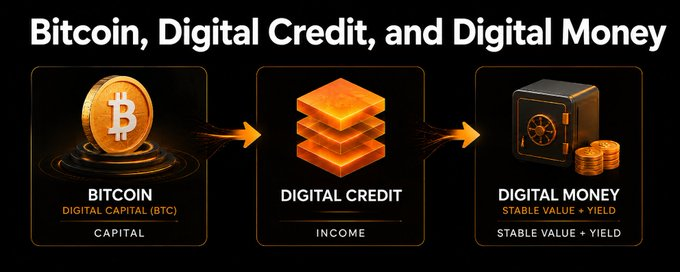
Digital Capital: High-volatility, high-energy BTC.
Digital Credit: Bitcoin-backed yield, engineered via seniority, structure, yield mechanisms, and equity support to suppress a substantial portion of BTC’s volatility.
Digital Currency: Combining digital credit with fiat cash equivalents and liquidity reserves to produce a stable-value, yield-bearing instrument.
This is the breakthrough. Bitcoin gives us the world’s strongest digital capital asset; capital markets convert that asset into credit; and credit plus liquidity reserves convert that yield into money.
The world does not need everyone pricing coffee in satoshis tomorrow. What the world needs today is better money: moving at internet speed, maintaining stability within users’ existing units of account, delivering meaningful yield, and ultimately powered by the strongest digital capital asset ever created.
That is digital currency.
Why This Is Good for BTC
Digital currency enhances BTC’s utility.
Every dollar of digital currency built on Bitcoin-backed credit creates incremental demand for the Bitcoin-backed capital structure—generating new reasons to hold BTC, finance BTC, custody BTC, audit BTC, insure BTC, and build services around BTC.
It also extends Bitcoin exposure to investors unable to tolerate raw Bitcoin volatility. Retirees may reject direct BTC exposure; corporations may resist it; banks may avoid it; payment companies may shy away. Yet they may embrace a stable-value dollar asset yielding 6–8%, backed by Bitcoin-backed digital credit.
This brings new capital into the Bitcoin ecosystem. More capital means greater adoption; greater adoption means deeper liquidity; deeper liquidity means stronger resilience; stronger resilience means stronger Bitcoin.
Why This Is Good for the Crypto Industry
The crypto industry needs a better monetary foundation.
Many crypto users want dollars; many crypto investors want yield; many crypto builders want programmable assets; many crypto platforms want liquid collateral; many crypto applications need a stable unit of account.
Digital currency built on Bitcoin-backed credit delivers a superior foundational product: a Bitcoin-powered, stable-value, yield-bearing digital dollar.
It can live on exchanges, in wallets, inside funds, across accounts, within payment networks—and ultimately wherever digital value flows. It does not force users to choose between zero-yield stablecoins and volatile staked tokens. Instead, it offers a third option: a stable-value, yield-bearing digital currency built on Bitcoin-backed capital. This is good for crypto.
Why This Is Good for Investors
Investors should not be forced into a single risk tier.
The digital asset stack offers each investor a choice: digital capital (BTC), digital credit (STRC-style instruments), digital currency (stable-value, yield-bearing instruments), digital yield (leveraged or structured products), or digital equity (MSTR-style common stock).
This is a complete menu. Depositors can choose digital currency; yield investors can select digital credit; growth investors can opt for digital equity; long-term believers can hold BTC; sophisticated investors can pursue digital yield. One Bitcoin foundation supports them all. Bitcoin thus becomes accessible to every mandate.
Why This Is Good for the World
The world needs better money.
Billions want dollars because they are liquid, familiar, and widely accepted. Yet they also want yield, transparency, liquidity, and protection against erosion by depreciation.
Today, many are forced to choose among unstable local currencies, low-yield bank deposits, zero-yield stablecoins, volatile crypto assets, or financial products they cannot access.
Digital currency improves this. It delivers stable value, digital liquidity, daily redemptions, and meaningful yield. It helps depositors, corporations, payment firms, emerging markets, exchanges, institutions—and anyone seeking better money without enduring raw BTC volatility.
The analog world built its economy on gold, real estate, banks, deposits, credit, equity, funds, and payment networks. The digital world will be built on BTC, digital credit, digital currency, digital yield, and digital equity.
Bitcoin is digital capital. Digital credit converts it into yield. Digital currency converts it into everyday utility. Digital yield amplifies it. Digital equity finances it.
The base layer remains sacred; the capital stack remains open.
This is the modern digital asset stack. This is how Bitcoin becomes the foundation of a better financial system.
Join TechFlow official community to stay tuned
Telegram:https://t.me/TechFlowDaily
X (Twitter):https://x.com/TechFlowPost
X (Twitter) EN:https://x.com/BlockFlow_News
 @saylor