
Bitcoin ETFs Record $4.4 Billion in Consecutive Outflows, Capital Flows Back In for the First Time in Three Weeks
TechFlow Selected TechFlow Selected
Bitcoin ETFs Record $4.4 Billion in Consecutive Outflows, Capital Flows Back In for the First Time in Three Weeks
Standard Chartered cited this signal as one of the indicators that Bitcoin has already hit its bottom.
 Navigating Web3 tides with focused insights
Author: Claude, TechFlow
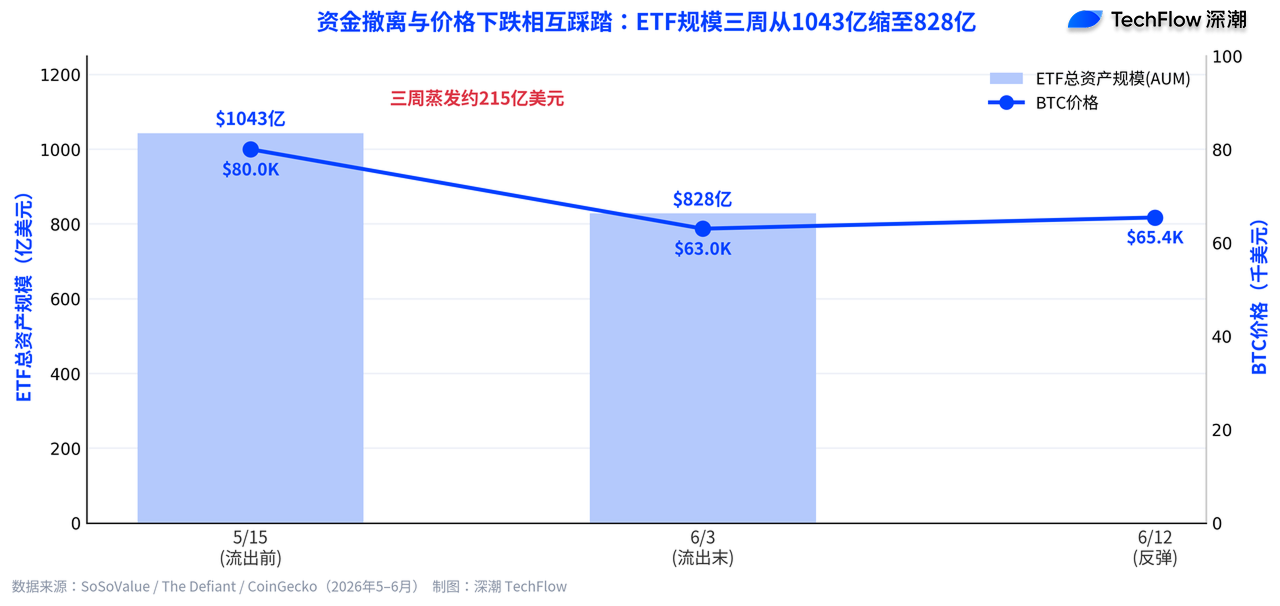
TechFlow Introduction: U.S. spot Bitcoin ETFs have just completed their most severe outflow period since launch: 13 consecutive trading days of net outflows from May 15 to June 3, totaling $4.4 billion—more than double the previous record set in February 2025. Compounded by falling Bitcoin prices, the total assets under management (AUM) of these ETFs shrank from $104.3 billion to $82.8 billion over three weeks.
On June 12, all 12 funds recorded zero outflows, with a single-day net inflow of $85.84 million. Standard Chartered cited this signal as one of three key indicators that Bitcoin has bottomed.
13 Days, $4.4 Billion: Bitcoin ETFs Experience Longest Outflow Since Launch
Fund flows are the most direct gauge of institutional sentiment toward Bitcoin.
These ETFs buy and sell spot Bitcoin in real time based on investor subscriptions and redemptions—money flowing in or out directly reflects changes in institutional positioning, without the ambiguity of verbal statements.
Over the past month, this metric registered its worst performance since launch. According to Galaxy Research, U.S. spot Bitcoin ETFs posted net outflows for 13 consecutive trading days from May 15 to June 3, totaling approximately $4.37 billion—or roughly 59,000 BTC. This marks the longest streak of consecutive outflows since these products launched in January 2024; the prior record was eight days and $3.2 billion in February 2025—more than doubled in this episode.
Galaxy Research also noted that outflows over multiple timeframes—including 7-day, 10-day, and 20-day windows—hit all-time highs during this period, indicating selling pressure was sustained rather than concentrated on a single day. This wave of redemptions pushed cumulative net inflows for 2026 into negative territory for the first time. Bloomberg ETF analyst Eric Balchunas confirmed that year-to-date fund flows turned negative for the first time this year.
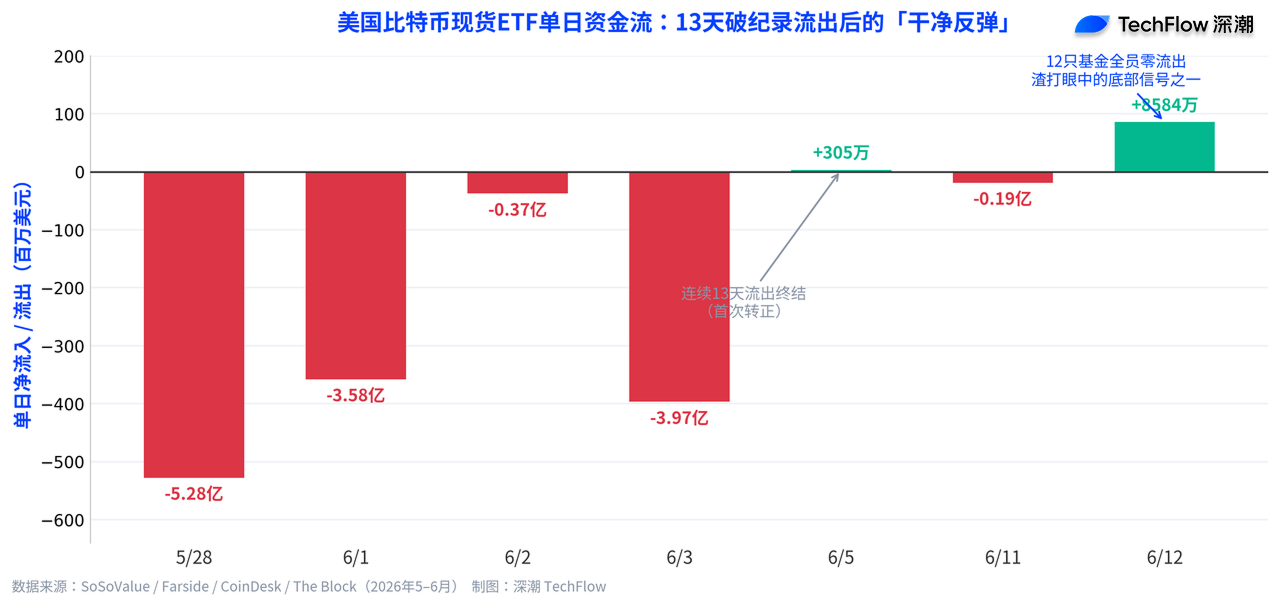
The largest outflows came from BlackRock’s IBIT. Per Farside Investors data, IBIT alone accounted for approximately $3.3 billion in outflows during this period—about three-quarters of the total. Fidelity’s FBTC followed with ~$456.6 million in outflows, while Grayscale’s GBTC saw ~$303.6 million withdrawn. IBIT, historically the strongest capital magnet since launch, became the epicenter of redemptions this time.
Capital Flight and Price Decline Reinforce Each Other—$21.5 Billion Vanishes in Three Weeks
The destructive impact of outflows was amplified by concurrent price declines.
Per SoSoValue data cited by The Defiant, the combined AUM of all U.S. spot Bitcoin ETFs fell from ~$104.29 billion on May 15 to ~$82.83 billion on June 3—a contraction of ~$21.5 billion over three weeks. This decline stems from two compounding forces: redemptions draining capital directly, and Bitcoin’s price dropping from above $80,000 to ~$63,000—a ~21% decline—eroding the market value of holdings. These dynamics reinforced each other.
In terms of BTC holdings, ETFs now hold ~1.277 million BTC—down ~7.2% from the peak reached in October 2025. Bitcoin held by these ETFs currently accounts for ~6.36% of Bitcoin’s circulating market cap, down from over 7% at mid-May highs.
A particularly stark redemption occurred on May 28: BlackRock’s IBIT posted a single-day net outflow of $527.8 million—the fund’s second-largest daily redemption on record. For the entire month of May, U.S. Bitcoin ETFs recorded a monthly net outflow of $2.43 billion—the largest single-month outflow on record—with $1.42 billion occurring in the final week alone.
A “Clean Rebound” After Outflows End—Standard Chartered Counts It Among Bottom Signals
The turning point emerged in early June.
On June 5, Bitcoin ETFs ended their 13-day streak of consecutive outflows with a modest net inflow of $3.05 million. Though negligible relative to the scale of the market, the directional shift mattered. On the same day, Ethereum ETFs also ended a 17-day streak of consecutive outflows, posting a $19.3 million net inflow—all driven solely by BlackRock’s ETHA fund.
What institutions viewed as a meaningful signal occurred on June 12 (Friday). Per SoSoValue data, U.S. spot Bitcoin ETFs recorded a $85.84 million net inflow that day: five funds saw inflows, while the remaining seven registered zero net flow—no fund posted an outflow. This “zero-outflow across all 12 funds” scenario is precisely the key indicator bulls monitor to assess whether selling pressure has eased.
Geoff Kendrick, Global Head of Digital Asset Research at Standard Chartered, included this event on his list of Bitcoin bottom indicators. In a brief client note released Friday, Kendrick stated that crypto asset prices have likely hit the low of this cycle—around $59,000 for Bitcoin, representing a 53% drop from the $126,000 peak—and identified three confirming signals: Strategy’s report showing renewed Bitcoin purchases last week, ETFs recording positive inflows on Friday, and continued declines in oil prices. He concluded the note with: “Winter is over—welcome back to crypto’s spring.”
Still, a single-day $85.84 million inflow cannot reverse a $4.4 billion outflow over three weeks. Yet a clean trading day serves as the starting point for assessing whether selling pressure has peaked.
ETF fund flows are increasingly driving Bitcoin’s price. Per Cryptopolitan’s citation of modeling estimates, ETF flows currently explain ~45% of Bitcoin’s weekly price volatility. Since their January 2024 launch, these Bitcoin ETFs still maintain cumulative net inflows exceeding $55 billion—within $10 billion of their all-time high. Balchunas therefore views the $4.4 billion outflow as a significant momentum reversal—not a structural collapse.
Join TechFlow official community to stay tuned
Telegram:https://t.me/TechFlowDaily
X (Twitter):https://x.com/TechFlowPost
X (Twitter) EN:https://x.com/BlockFlow_News
 深潮TechFlow