The Evolution of Physical Bitcoin
TechFlow Selected TechFlow Selected
The Evolution of Physical Bitcoin
Over a decade of physical exploration has witnessed the technological evolution of Bitcoin’s physical carriers.
 Navigating Web3 tides with focused insights
By Juan Galt
Translated by Saoirse, Foresight News
Bitcoin’s digital nature is its core strength. Its programmability enables self-custody, drastically increasing the difficulty of theft or seizure. Simultaneously, its digital form allows near-instantaneous transfer—global value movement and settlement can be completed within minutes.
Yet Bitcoin’s intangible nature has also drawn criticism. In its native form, Bitcoin cannot be touched or held; people can only grasp it through imagination and conceptual understanding—a major barrier to mainstream adoption. For over a decade, entrepreneurs and creators have persistently attempted to “physicalize” Bitcoin while preserving its cash-like core properties. Though no one has yet solved all the challenges, these efforts have yielded significant progress and produced numerous iconic physical products.
Casascius Coins
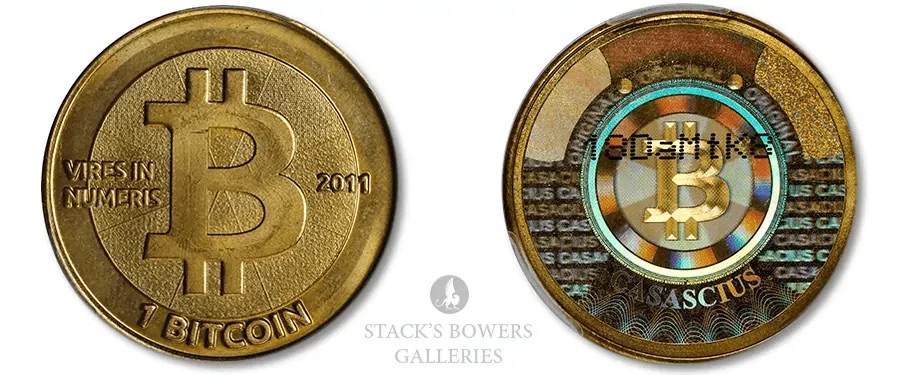
Image source: Stacks Bowers Galleries
First minted on September 6, 2011—when Bitcoin’s price stood at just $8—the Casascius Coin is undoubtedly the most iconic physical Bitcoin collectible in history, spawning countless imitations thereafter. The name derives from Mike Caldwell’s username on the Bitcointalk forum. Many of its design principles have since become foundational references for subsequent physical Bitcoin products.
A key challenge in realizing physical Bitcoin lies in private-key custody. As a natively digital asset, Bitcoin operates on cryptographic public-private key pairs; the private key—confidential by nature—is used to generate the corresponding public key via Bitcoin-specific cryptographic algorithms. Mike Caldwell generated private keys offline, printed them, and affixed them onto precious-metal coins—most likely destroying any backup copies stored on his computer. He also published exhaustive documentation of his entire security protocol on his personal website for prospective buyers’ review.
The printed private key was covered with tamper-evident stickers: once peeled off, they left behind a clear honeycomb pattern. Buyers could thus determine whether a coin purchased from a third party had previously been accessed by others.
Private-key management remains the greatest security risk in physical Bitcoin production. Casascius Coins addressed this by relying on users’ trust in the developer. By industry standards of the time, Mike Caldwell operated with exceptional transparency and rigor—and still enjoys an excellent reputation today. That trust has paid off: these collectibles now command substantial premiums beyond both Bitcoin’s market value and their intrinsic metal value, delivering handsome returns to holders.
In November 2013, Casascius Coins ceased production after the U.S. Treasury’s Financial Crimes Enforcement Network (FinCEN) informed Mike Caldwell that minting physical Bitcoin constituted a money transmission business—subject to stringent compliance requirements. Moreover, the centralized trust model inherent in private-key generation drew regulatory scrutiny.
RavenBit Coins

Launched one year after Casascius Coins were discontinued, RavenBit aimed to resolve the trust deficit surrounding physical Bitcoin minting by decentralizing the minting process. Visually similar to Casascius Coins, RavenBits shipped without pre-loaded private keys and with unsealed tamper-evident stickers. Users could generate their own keypairs, affix them to the coin, then apply the tamper-evident sticker themselves.
In theory, this design decentralized minting authority—an important breakthrough. In practice, however, it simply spawned numerous unbranded, low-reputation individual mints. Worse, many users generated private keys on office computers potentially infected with malware. When receiving a RavenBit from another person, there was no way to verify whether the sender retained a copy of the private key—or whether adequate security precautions had been taken.
The RavenBit project has long since shut down—but it delivered a crucial industry lesson: truly realizing physical Bitcoin requires more advanced technology.
Opendimes
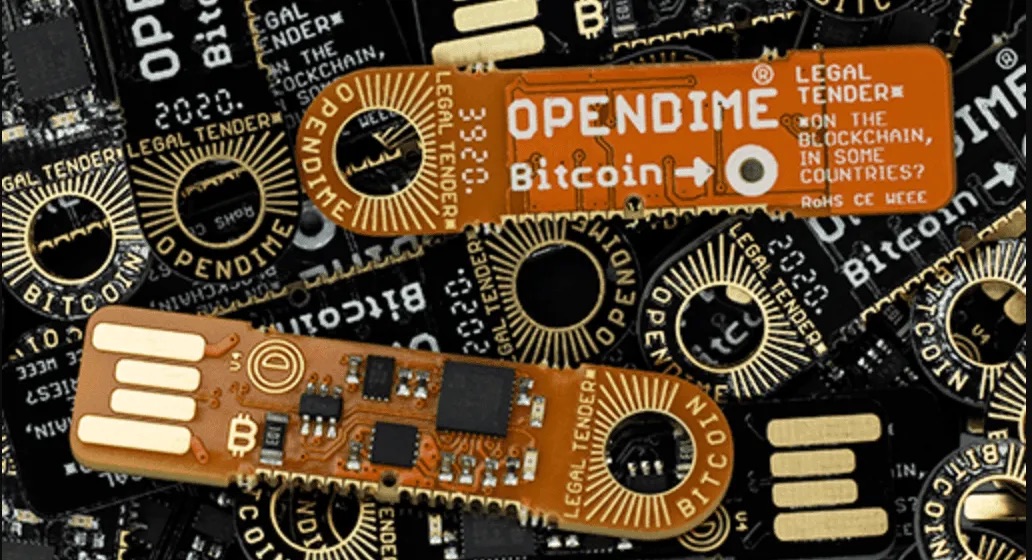
To fully resolve the trust dilemma surrounding physical Bitcoin minting—whether centralized or decentralized—hardware wallet maker Coinkite developed Opendimes: a miniature hardware device purpose-built to store Bitcoin bearer assets. NVK, Coinkite’s co-founder, explained the product’s genesis in an interview with Bitcoin Magazine: “Bitcoin is digital currency. Everything we do is simply creating a physical backup for it. Perhaps someday someone will manually break the secp256k1 algorithm—but for now, generating valid Bitcoin keys always requires a computer. The computer is today’s ‘minting tool.’”
Opendimes embodies this core logic. Its onboard chip autonomously generates public-private keypairs and securely stores the private key within a silicon-based tamper-proof structure.
During initialization, users must import entropy—either as a file or other random input—which the chip combines with internal randomness to generate a Bitcoin wallet. This open-source key-generation logic, paired with high-quality entropy input, further enhances key security.
When plugged into a computer like a standard USB drive, Opendimes displays its public key; its balance can be checked in real time via any blockchain explorer. Users may deposit Bitcoin into the device—but to withdraw funds, they must physically destroy it. This action unlocks the circuit to expose the private key, leaving unmistakable evidence of tampering.
Opendimes represents a landmark breakthrough in bearer-asset technology. Launched in 2016 at just $13, inflation has raised its current price to approximately $20. It has since become an industry icon—featured in high-end Bitcoin artworks by numerous artists and evolving into a cultural symbol within the Bitcoin community.
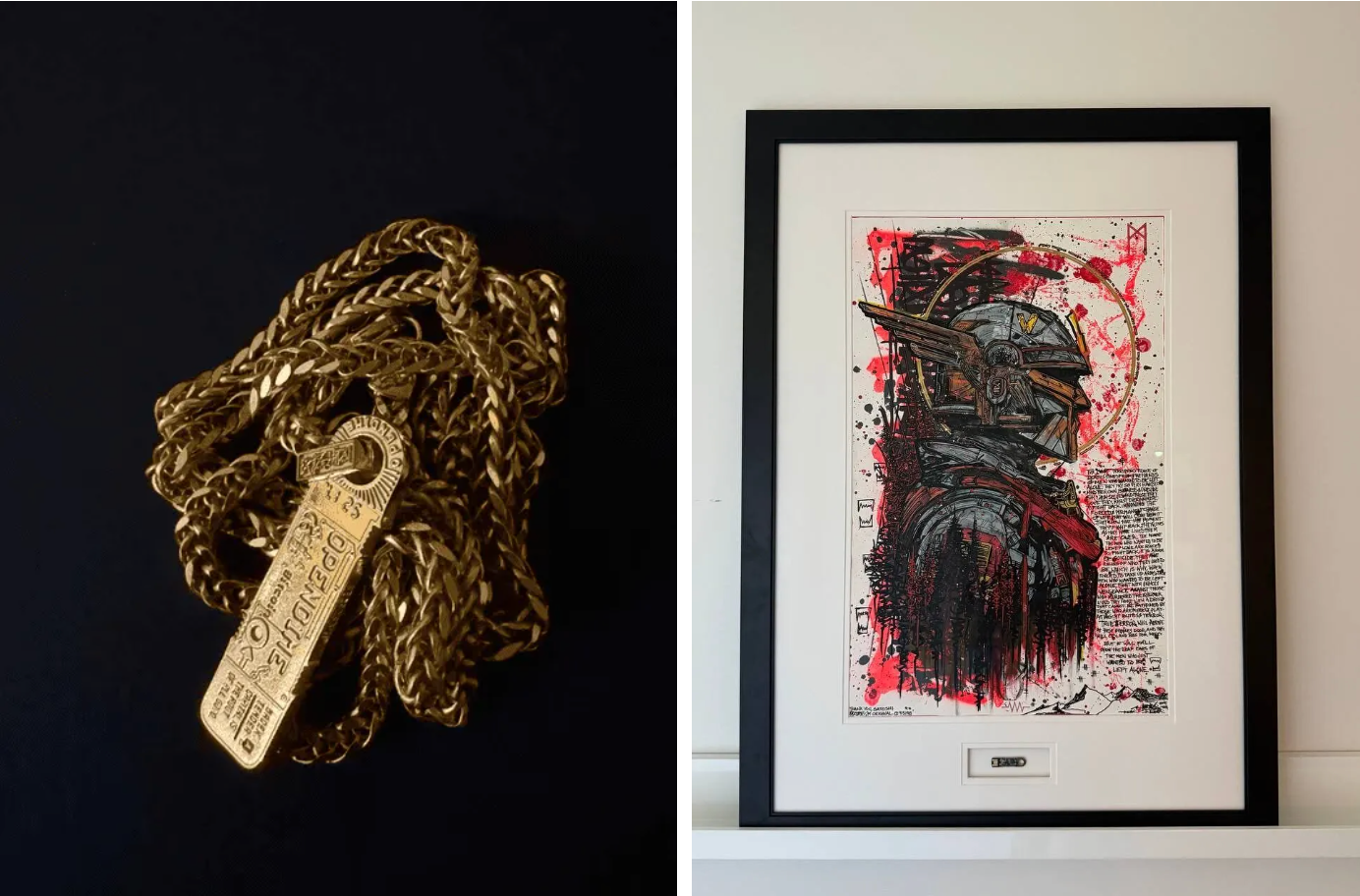
At $13–$20, Opendimes sits comfortably within the typical hardware-wallet price range—and its user-driven deposit model effectively resolves the minting-trust issue. Yet its pricing and form factor remain far removed from everyday cash usage. Even at $20, the hardware cost threshold is nontrivial. Applying Casascius’s ~20% premium benchmark, an Opendimes would need to hold at least $100 worth of Bitcoin to justify its hardware cost and achieve circulation utility—rendering it impractical for most daily microtransactions.
Moreover, while its USB-drive form factor is distinctive, it offers no intuitive display of on-device asset information. Each unit is unique and lacks the fungibility essential to cash. The industry thus recognized the need for lower-cost, more universally applicable alternatives.
Satodime
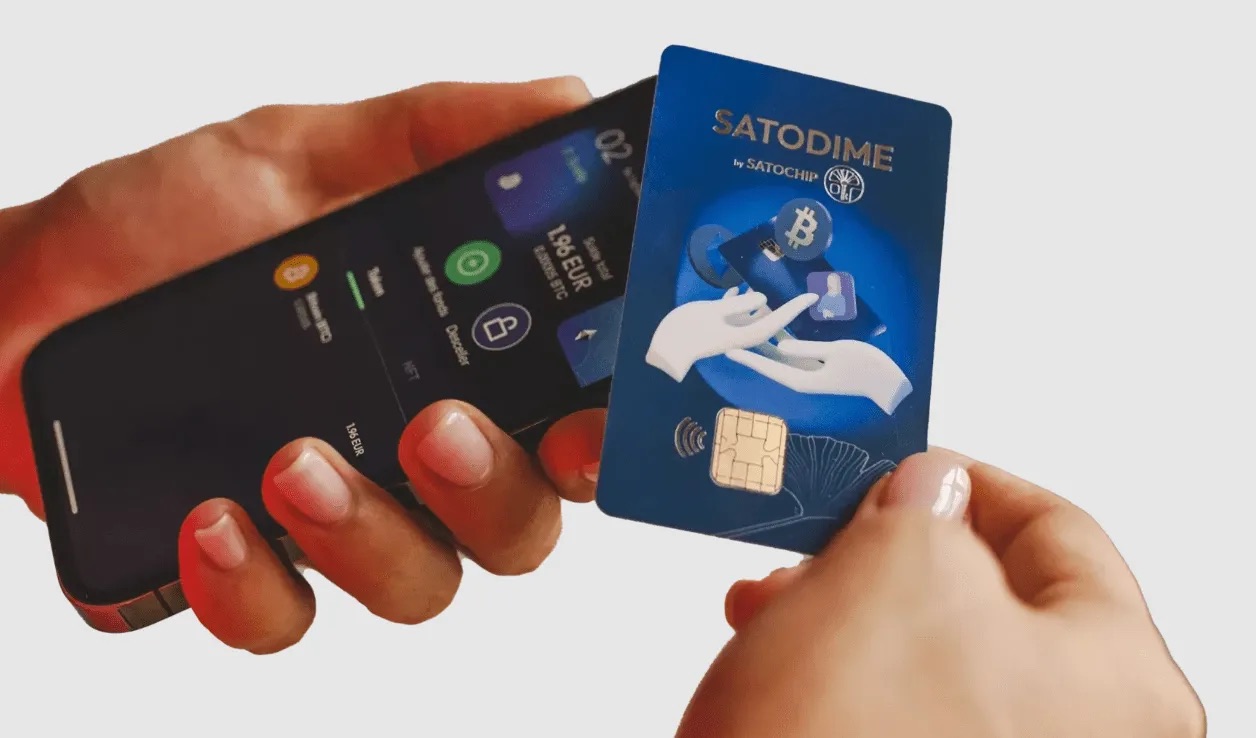
Belgian hardware wallet maker Satochip built upon Opendimes’ philosophy to launch Satodime: an open-source, more consumer-friendly product resembling a credit card. Functionally similar to Opendimes, it generates Bitcoin keypairs; certain versions even support transaction signing. Users interact with the device via smartphone apps using Near Field Communication (NFC). Multiple form factors—including rings and physical coins—are available, all powered by identical chips and offering identical functionality.
In bulk procurement, Satodime’s hardware cost drops as low as €13—more affordable than Opendimes and closer to everyday cash usability, though still significantly distant. Fundamentally, Satodime is a high-security hardware wallet—not a cash substitute designed for routine circulation. The inherently high cost of such high-performance microchips currently prevents prices from falling below the $10 threshold.
The Cost Conundrum: An Intractable Bottom Layer Constraint
What hardware cost target must physical Bitcoin hit to achieve commercial viability?
According to Federal Reserve data, U.S. dollar bill production costs range from $0.041 to $0.113 per note. Smaller denominations carry higher per-unit production costs—producing a $1 bill incurs a 4.1% manufacturing loss.
Applying this logic, a physical Bitcoin holding 20,000 satoshis (currently worth ~$16) must keep hardware costs under $1. Yet most chips capable of running Bitcoin’s cryptographic algorithms fall well short of this target. The NTAG X DNA chip from NXP, however, offers a glimmer of possibility.
This chip features a thin, sticker-style antenna only a few millimeters thick. It supports multiple cryptographic protocols—including ECDSA and ECC—enabling key generation, transaction signing, and data encryption. However, it lacks native support for Bitcoin’s secp256k1 elliptic curve, preventing direct execution of Bitcoin-specific programs.
Nonetheless, when supply is abundant, the 2025 version of the NTAG chip sells for around $3—demonstrating substantial room for further cost reduction in cryptographic chips.
Unfortunately, the foldable paper-bill form factor commonly used in daily life poses a serious threat to delicate microchips. Coinkite’s team confirmed this firsthand during their development of Bitcoin bearer-asset hardware.
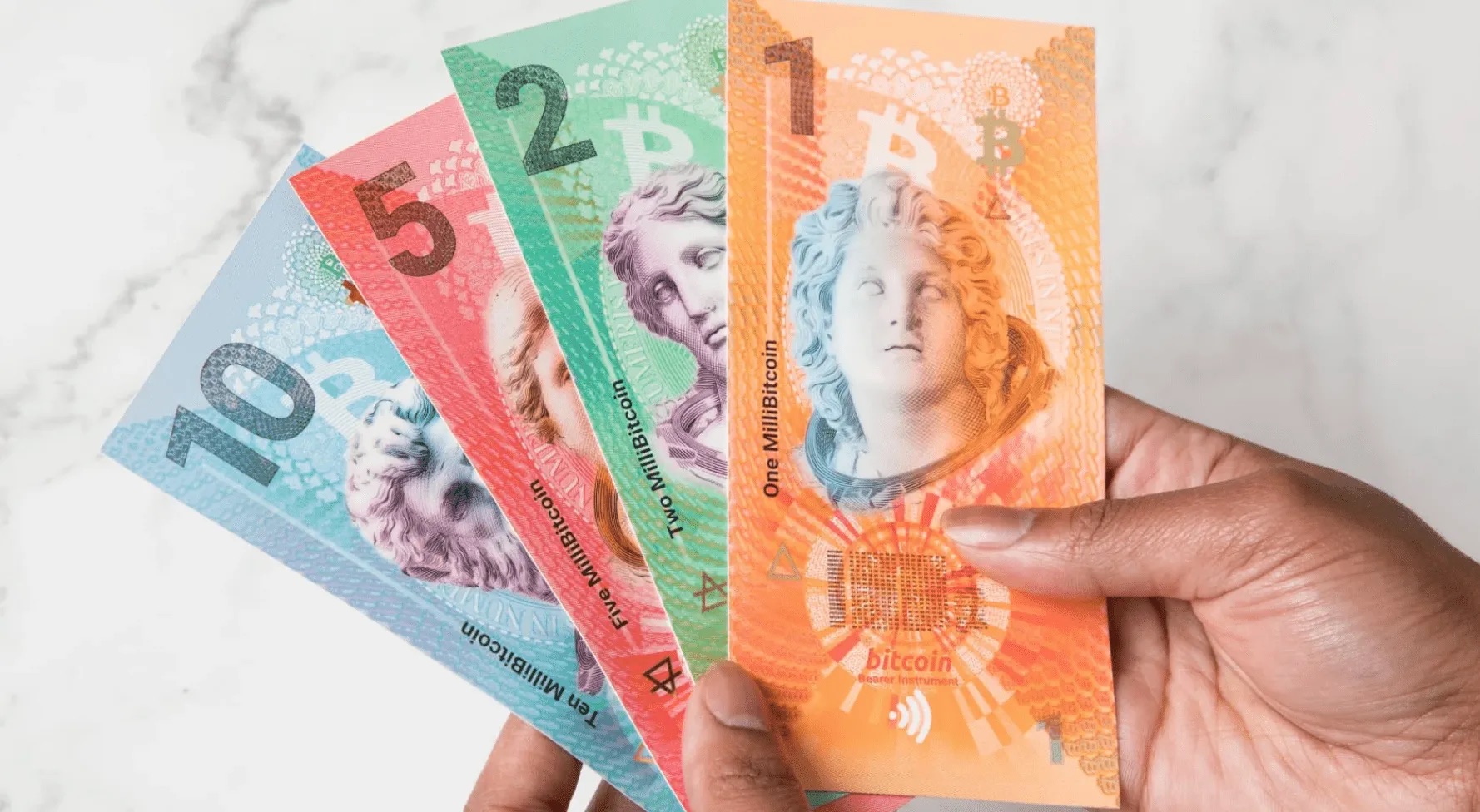
OfflineCash’s product currently represents the closest approximation to traditional paper currency in appearance. These Bitcoin-denominated bills embed NTAG-series NFC chips storing user-generated keys, while OfflineCash retains a second key on its servers—creating a 2-of-2 multisig wallet. The server-held key is time-locked; upon expiration, the multisig wallet converts to a single-signature wallet, enabling users to withdraw funds. While this approach attempts to sidestep conventional minting-trust risks, it inadvertently introduces new challenges around decentralized minting. Still, its paper-bill aesthetic is highly appealing—and lends itself well to collectibility.
Developing an NTAG chip with native secp256k1 support demands upfront investments often exceeding several million dollars. Non-cryptographic specialists attempting to adapt Bitcoin’s cryptographic software risk introducing critical vulnerabilities. Furthermore, such chips must be fully open-source to guarantee the absence of backdoors.
As a bearer asset, physical Bitcoin faces another fundamental hurdle: even if a low-cost, paper-bill-shaped hardware carrier is realized, Bitcoin remains a digital asset at its core—requiring online verification to confirm whether genuine assets reside on the device.
Trusting the issuing entity and accepting the face value of the bill solves the verification problem—but contradicts Bitcoin’s foundational design goals of self-custody and trustless cash. Of course, such models may find traction in jurisdictions with favorable regulatory environments.
In summary, products like OfflineCash—blending secure chips with paper-bill aesthetics—remain aspirational but far from scalable deployment. Moreover, they suffer from functional over-engineering: today’s market lacks a Bitcoin change system, so consumers still receive fiat as change. Only in a future fully Bitcoinized economy might such products fulfill their true potential.
Within the foreseeable horizon, Coinkite views card-form factors as superior to paper bills—motivating its launch of Tapsigner.
Tapsigner
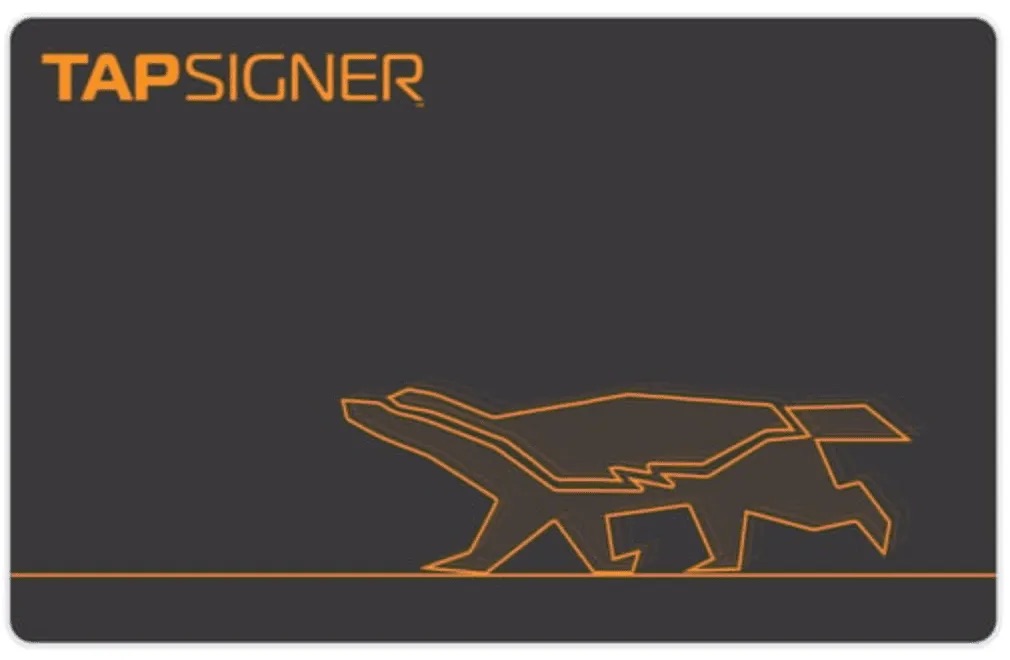
Tapsigner integrates Coinkite’s proprietary Bitcoin NFC chip—performance-matched to NXP’s NTAG X DNA but enhanced with stronger functionality and correspondingly higher cost. Designed in the familiar debit-card form factor, it embeds a secure chip supporting NFC tap-to-pay functionality—and offers multiple aesthetic options.
Its onboard chip hosts full Bitcoin wallet capabilities, including native secp256k1 cryptographic support for key generation and secure private-key storage. Transactions are signed entirely on-device before being broadcast via companion mobile applications. The mobile app also provides transaction details for user verification—adding an extra layer of security.
Tapsigner functions both as a bearer-asset carrier and, more practically, as a reusable hardware wallet. Like a conventional debit card, it enables targeted payments of fixed Bitcoin amounts—perfectly solving the change problem—while remaining compatible with mainstream tap-to-pay infrastructure.
Priced at approximately $20, Tapsigner refocuses Bitcoin payment development on real-world retail adoption and integration with mainstream enterprise finance and payment software ecosystems—a trajectory actively accelerated by platforms like Cash App and Square.
Join TechFlow official community to stay tuned
Telegram:https://t.me/TechFlowDaily
X (Twitter):https://x.com/TechFlowPost
X (Twitter) EN:https://x.com/BlockFlow_News
 @BitcoinMagazine