









Only 67 of the top 1000 crypto projects by market cap have Wikipedia pages; ChatGPT's "understanding" of the crypto industry is being distorted
TechFlow Selected TechFlow Selected
Only 67 of the top 1000 crypto projects by market cap have Wikipedia pages; ChatGPT's "understanding" of the crypto industry is being distorted
Even Hyperliquid doesn't have a Wikipedia page.
 Navigating Web3 tides with focused insights
Author: Claude, TechFlow
TechFlow Editor's Note: Crypto communications agency Chainstory audited the Wikipedia coverage of the top 10,000 tokens by market cap on CoinGecko, finding that only 67 of the top 1,000 have entries. Wikipedia is the single most cited source by ChatGPT (accounting for about 7.8% of total citations), which means AI tools have systematic blind spots regarding the vast majority of crypto projects. Hyperliquid, valued at $15 billion, and Sui, valued at $5 billion, both lack Wikipedia pages.
The crypto industry hardly exists on Wikipedia.
According to a CoinDesk report on July 14, a research report released by crypto communications agency Chainstory shows that among the top 1,000 crypto projects ranked by market cap on CoinGecko, only 67 have Wikipedia entries, with a coverage rate of less than 7%. At a time when AI tools are increasingly becoming the main channel for users to obtain information, this gap is systematically affecting how models like ChatGPT understand and present the crypto industry.
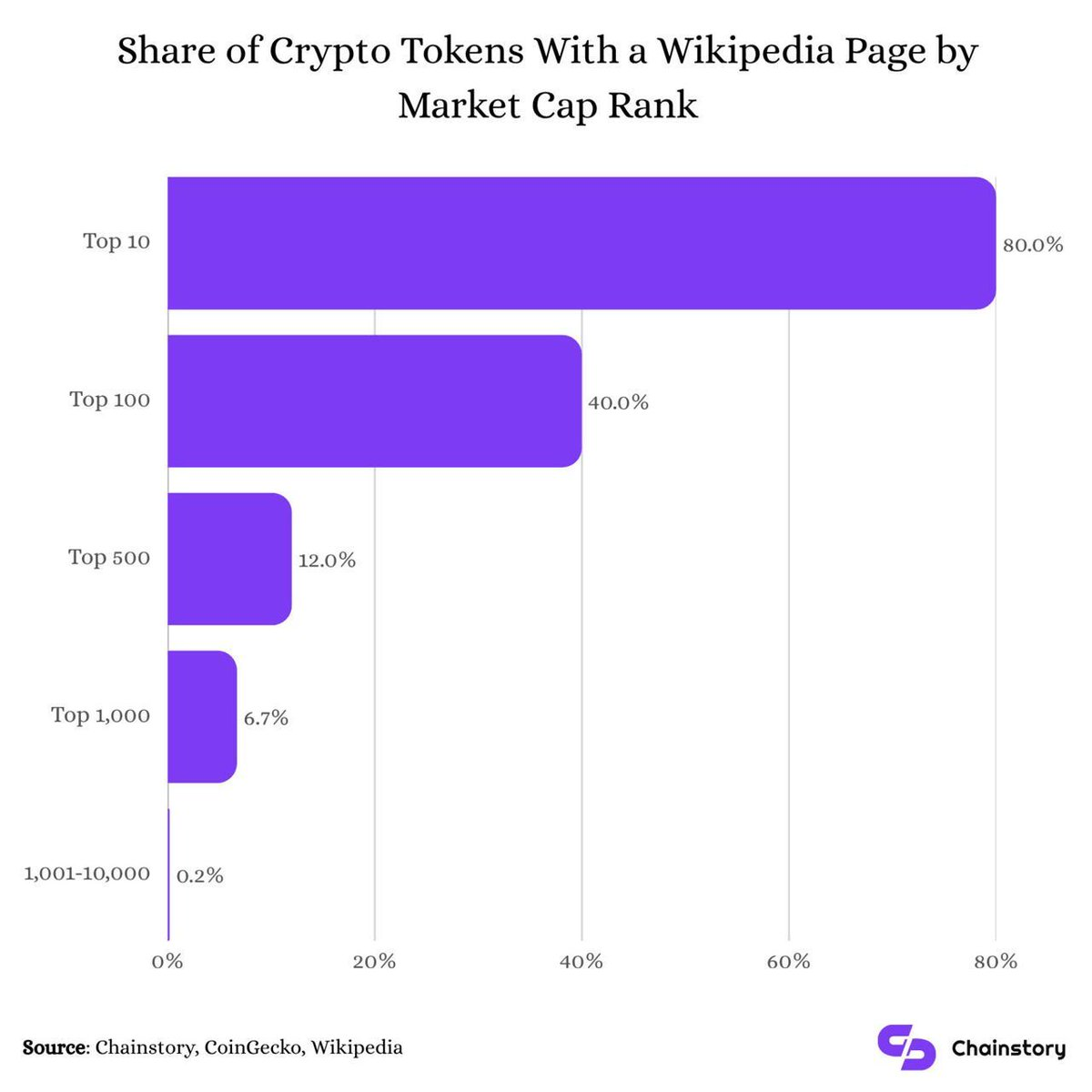
Coverage Plummets with Market Cap Ranking, $15 Billion Project Has No Entry
Chainstory audited the top 10,000 tokens by market cap on CoinGecko from June 1 to 4, 2026, verifying the existence of entries one by one via the Wikipedia API. The results showed an extreme long-tail distribution:
The coverage rate for the top 10 tokens by market cap was 80%, dropping to 40% for the top 100, only 12% for the top 500, falling to 6.7% for the top 1,000, and the coverage rate for tokens ranked 1,001 to 10,000 was only 0.2%. Among the entire top 10,000, only 84 tokens have Wikipedia entries.
The list of absentees includes many large-scale projects. The perpetual contract platform Hyperliquid, with a market cap of about $15 billion, has no Wikipedia page; the Layer-1 network Sui, with a market cap of about $5 billion and ranked 22nd, is also absent; Monad Labs led by Paradigm (valued at $3 billion), Berachain co-led by Brevan Howard Digital (valued at $1.5 billion), and EigenLayer, in which a16z invested $100 million, have all left no record on Wikipedia.
The smallest project with an entry is Firo, with a market cap of $15 million and ranked 959th.
For comparison, Wikipedia includes about 640 fintech companies and over 7,000 software companies, but only about 80 companies in the crypto and Bitcoin categories.
Wikipedia is the Single Most Cited Source by ChatGPT, Accounting for Nearly 8%
The reason this coverage gap matters is that Wikipedia's position in the AI information chain far exceeds general perception.
Chainstory cited audit data from AI tracking platform Profound in the report: among all citation links in ChatGPT, about 7.8% point to Wikipedia, far ahead of Reddit (1.8%) and Forbes (1.1%) in second and third place. Among the top 10 domains most cited by ChatGPT, Wikipedia accounts for about 47.9% of the share.
Analysis of 3.29 million citation links by another research institution, Trakkr, shows that as of May 2026, Wikipedia accounted for 36.1% of the share in ChatGPT's top 10 citation sources and 25.3% in the top 100 citation sources.
A May 2026 study by Muck Rack further confirmed that Wikipedia is not only ChatGPT's top citation source but also Claude's second-largest citation source (second only to PubMed Central), and Gemini's fourth-largest citation source.
The report points out that Wikipedia mainly provides conceptual information to AI models, but when user questions involve specific projects, Wikipedia entries are the core basis for model reasoning. Projects with entries have clear definitions and descriptions in AI answers; for projects without entries, AI can only piece together information from scattered secondary mentions, prone to basic factual errors such as founders, establishment time, and headquarters location.
Wikipedia Lists Crypto Media as "Generally Unreliable" Sources
The root cause of the low Wikipedia coverage of crypto projects lies in the special review thresholds Wikipedia has set for the crypto industry.
Wikipedia has specifically formulated notability guidelines related to cryptocurrencies, requiring that a project's notability must come from "mainstream" news sources, explicitly stating that media primarily reporting on the crypto industry are "insufficient to demonstrate notability." The guidelines even name CoinDesk and Bitcoin Magazine as "generally unreliable" crypto media. The same logic applies to crypto-native media such as Cointelegraph, Decrypt, and The Block.
Reliable sources recognized by Wikipedia include mainstream business media such as Reuters, Bloomberg, CNBC, and the Financial Times. However, these media pay almost no attention to crypto sub-sectors such as liquid staking and perpetual contract DEXs.
Chainstory pointed out this contradiction in the report: media that truly report on crypto industry dynamics do not have source value in the eyes of Wikipedia, while mainstream media recognized by Wikipedia do not cover most crypto projects.
The process of creating new entries itself constitutes an obstacle. New articles need to pass volunteer review, checking standards such as notability, verifiability, and reliable sources. Even if approved, administrators can still delete them unilaterally, or decide their fate through a 7-day community vote, where the subject of the entry has no right to participate or appeal.
Join TechFlow official community to stay tuned
Telegram:https://t.me/TechFlowDaily
X (Twitter):https://x.com/TechFlowPost
X (Twitter) EN:https://x.com/BlockFlow_News
 深潮TechFlow











