
Wall Street's Six Major Banks Q2 Earnings Collectively Positive: Goldman Sachs Profits Double, Up 8%, SpaceX IPO Becomes "Strongest Catalyst"
TechFlow Selected TechFlow Selected
Wall Street's Six Major Banks Q2 Earnings Collectively Positive: Goldman Sachs Profits Double, Up 8%, SpaceX IPO Becomes "Strongest Catalyst"
The spring of US brokerage stocks.
 Navigating Web3 tides with focused insights
Author: Claude, TechFlow
TechFlow Editor's Note: On July 14, five major banks including JPMorgan, Goldman Sachs, Bank of America, Citigroup, and Wells Fargo released their Q2 earnings reports on the same day, all exceeding expectations. Goldman Sachs EPS $20.98, nearly double last year's, stock price rose nearly 8% to hit a historic high; JPMorgan net profit of $21.2 billion set a quarterly record. Severe market volatility caused by geopolitical conflicts instead filled the trading desks' coffers, and SpaceX's largest IPO in history ($86 billion) injected huge fee income into investment banking businesses. However, "beating expectations" does not equal "rising," Citigroup's performance fully beat estimates yet fell 4.5%, JPMorgan fell 2% in pre-market before reversing. Morgan Stanley releases its report on July 15, market expects EPS to increase over 30% year-over-year.
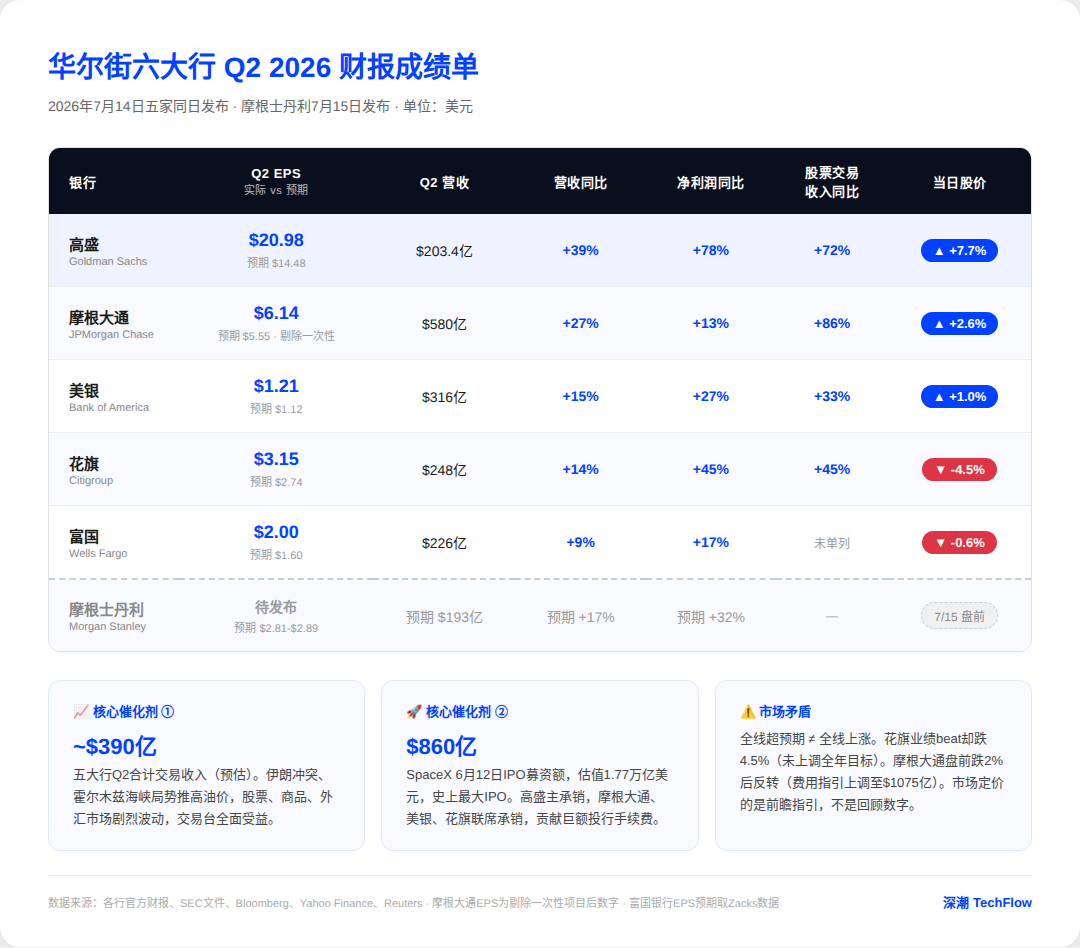
The five Wall Street giants submitted their results on the same day on July 14, with performance records increasingly staggering.
Goldman Sachs set its strongest single-quarter performance in company history. JPMorgan net profit refreshed the historical record. Bank of America, Citigroup, and Wells Fargo also all exceeded market expectations. However, stock price trends diverged severely, Goldman Sachs rose nearly 8% to touch a historic high, while Citigroup fell 4.5% instead. In June, SpaceX listed and raised $86 billion, valued at $1.77 trillion, becoming the largest IPO in history, and almost every major bank secured huge fees from it.
Goldman Sachs Profit Doubles to Record, Stock Price Rises Nearly 8%
Goldman Sachs Q2 earnings per share were $20.98, nearly double the $10.91 from the same period last year, far exceeding analyst expectations of $14.48. Net revenue was $20.34 billion, a 39% year-over-year increase. Net profit was $6.63 billion, compared to $3.72 billion in the same period last year.
According to Bloomberg, Goldman Sachs' stock trading division revenue was $7.42 billion, a 72% year-over-year increase, breaking records set by any bank for the third consecutive quarter. Derivatives, cash products, and prime brokerage businesses all strengthened comprehensively. Investment banking fees were $3.4 billion, a 55% year-over-year increase, equity underwriting surged 130%, and debt underwriting grew 75%. According to Barron's, Goldman Sachs served as the lead underwriter for the SpaceX IPO in June. According to Bloomberg, the bank participated in advisory roles for announced M&A transactions exceeding $1 trillion in the first half of the year.
Asset and Wealth Management division revenue was $4.6 billion, a 20% year-over-year increase. Assets under management reached $4.04 trillion, compared to $3.29 trillion a year ago. The Goldman Sachs Board increased the quarterly dividend by 11% to $5 per share, returning $5.36 billion to shareholders through buybacks and dividends during the quarter.
CEO David Solomon stated in a release that clients are handing the most strategic transactions to Goldman Sachs, these transactions often drive synergy across the entire business chain.
According to Schaeffer's Investment Research, Goldman Sachs' stock price rose about 8% that day, touching a historic high intraday, marking the largest single-day gain since April 2025. Year-to-date cumulative gain is about 27%.
JPMorgan Net Profit $21.2 Billion Sets Quarterly Record, But Expense Guidance Drags Pre-Market
JPMorgan Q2 net profit was $21.2 billion, $7.70 per share, setting the highest quarterly profit in company history. However, this included $4.6 billion in gains from Visa holdings and $1 billion in gains from other equity investments. Excluding one-time items, net profit was $16.9 billion, $6.14 per share, a 13% year-over-year increase. Return on Tangible Common Equity (ROTCE) was 23%.
Revenue was $58 billion, a 27% year-over-year increase, with all business lines setting records. Equity trading revenue was $6 billion, surging 86% year-over-year. Fixed income trading revenue was $6.1 billion, a 6% year-over-year increase. Combined, the two totaled $12.1 billion, exceeding the trading revenue record previously set by the bank in Q1 2026. Investment banking fees were $3.3 billion, a 30% year-over-year increase, hitting a new high since 2021.
Management raised the full-year net interest income guidance to approximately $105.5 billion (previously $103 billion), but simultaneously raised the full-year adjusted expense expectation to approximately $107.5 billion. The latter became the main reason for the approximately 2% pre-market stock price decline. According to FX Leaders, JPMorgan closed ultimately up about 2% to $341, achieving an intraday reversal.
CEO Jamie Dimon's wording was cautious. He stated that the US economy shows "significant resilience," AI capital expenditure and fiscal stimulus are tailwinds, but warned that geopolitical instability, sticky inflation, swelling sovereign debt, and high asset valuations are "moving underground like tectonic plates."
Bank of America EPS Increases 34% Year-Over-Year, Citigroup's Strongest Revenue in Decade Yet Sold Off
Bank of America Q2 earnings per share were $1.21, a 34% year-over-year increase, exceeding market expectations of $1.12. Revenue was $31.6 billion, a 15% year-over-year increase. Net profit was $9.1 billion, a 27% year-over-year increase. Sales and trading revenue increased 33% year-over-year, investment banking fees increased 50% year-over-year, and asset management fees increased 20% year-over-year. The efficiency ratio (cost as a percentage of income) improved to 59%. CEO Brian Moynihan stated that consumers and businesses showed resilience.
Citigroup Q2 earnings per share were $3.15, exceeding expectations of all 20 analysts (consensus expectation $2.74). According to Bloomberg, revenue of $24.8 billion set a ten-year high, net profit was $5.8 billion, a 45% year-over-year increase. Equity trading revenue was $2.3 billion, a 45% year-over-year increase, investment banking fees were $1.55 billion, a 44% year-over-year increase.
But Citigroup's stock price fell about 4.5% instead that day. According to Investing.com, market dissatisfaction focused on management not raising the full-year return target (maintaining ROTCE 10%-11%), while year-to-date it has already reached 13.1%. CEO Jane Fraser stated the company chose to reinvest excess earnings into the business, rather than sacrificing long-term construction for good-looking short-term numbers. CFO Gonzalo Luchetti admitted Citigroup's layout in equity business was not fast enough, catching up with competitors will be a gradual process.
Wells Fargo Q2 revenue was $22.62 billion, a 8.6% year-over-year increase. Earnings per share were $2.00, a 25% year-over-year increase. Net interest income was $12.3 billion, a 5% year-over-year increase. Closed slightly down 0.56%.
Two Major Catalysts: Geopolitical Volatility Feeds Trading Desks, SpaceX IPO Feeds Investment Banking
The driving force behind this round of earnings exceeding expectations is highly concentrated on two things.
First is market volatility. The US-Iran conflict remains stalled, the Strait of Hormuz situation pushed up oil prices, and stock, commodity, and forex markets fluctuated violently. This environment is extremely favorable for bank trading departments. Goldman Sachs equity trading revenue increased 72% year-over-year, JPMorgan equity trading revenue increased 86% year-over-year, Citigroup equity trading revenue increased 45% year-over-year, Bank of America sales and trading revenue increased 33% year-over-year. According to Bloomberg, the five major banks combined Q2 trading revenue approached $39 billion.
Second is the SpaceX IPO. On June 12, SpaceX listed, raising $86 billion, valued at $1.77 trillion, becoming the largest IPO in history. Goldman Sachs served as lead underwriter, JPMorgan, Bank of America, and Citigroup as major co-underwriters. According to indmoney, besides underwriting fees, each bank also benefited from subsequent debt financing arrangements and new wealth management clients. According to A.O. Shearman M&A law firm data, global M&A transaction volume in the first half of 2026 reached $2.8 trillion, the highest since 2021. Goldman Sachs is also a co-advisor for Anthropic's planned IPO in the second half of the year.
Morgan Stanley Releases Report Card Today, Expectations Raised by Peers
Morgan Stanley releases Q2 earnings report before market on July 15 (today).
According to Zacks data, consensus EPS expectation is about $2.89 (up 4% in the past week), a year-over-year increase of about 35.7%. Revenue expectation is about $19.34 billion, a year-over-year increase of about 16.9%. Yesterday (July 14), Morgan Stanley rose about 4% driven by peers all exceeding expectations, but its own earnings report has not yet been released.
Last quarter Morgan Stanley EPS was $3.43, greatly exceeding expectations, revenue was $20.6 billion, a 16% year-over-year increase, equity trading revenue was $5.2 billion a 25% year-over-year increase. Wealth Management division added $118 billion in assets. Taking peers' performance as a reference, the market expects Morgan Stanley has a high probability of exceeding expectations, but the expectation itself has already been raised. Oppenheimer analyst Chris Kotowski downgraded the rating to "Underperform" on June 30, currently one of the few bearish voices.
Join TechFlow official community to stay tuned
Telegram:https://t.me/TechFlowDaily
X (Twitter):https://x.com/TechFlowPost
X (Twitter) EN:https://x.com/BlockFlow_News
 深潮TechFlow