Robinhood Chain Comprehensive Review: Besides cashcat and other memes, which projects are worth watching?
TechFlow Selected TechFlow Selected
Robinhood Chain Comprehensive Review: Besides cashcat and other memes, which projects are worth watching?
2 weeks post-launch, TVL reaches $160 million; Meme tokens lead the hype, ecosystem projects are the follow-up opportunities.
 Navigating Web3 tides with focused insights
Author: Curry, TechFlow
TechFlow Editor's Note: Two weeks after the Robinhood Chain mainnet launch, TVL broke through $160 million, stablecoin market cap exceeded $327 million, cumulative DEX trading volume reached $4 billion. Meme coin CASHCAT corrected from a peak market cap of $170 million to about $138 million; on-chain speculation sentiment is shifting from memes to utility projects. Among ecosystem partners, Arcus (dYdX team) and Rialto (multi-asset DEX) have not issued tokens, constituting an early interaction window; on-chain native projects like Arrow Finance and INDEX have risen against the trend amidst the meme retreat.
On July 1, Robinhood launched the Robinhood Chain public mainnet at the "The World is Flat" event in London. Two weeks later, this Ethereum L2 built on the Arbitrum tech stack has undergone a standard cycle of "meme ignition, data peak, heat retreat" and is entering a key window for ecosystem filling.
According to DeFiLlama data, as of July 15, Robinhood Chain TVL was about $161 million, stablecoin market cap was about $327 million (USDG accounting for 68.2%), cumulative DEX trading volume was about $3.9 billion, and RWA active market cap was about $12.4 million. For an L2 launched two weeks ago, these numbers are not bad, but the structure needs to be broken down.
CASHCAT Ignites the First Week, Story of $85 Turning into $2 Million Pushes DAU to 193,000
The first week's activity on Robinhood Chain was almost sustained by the single token CASHCAT.
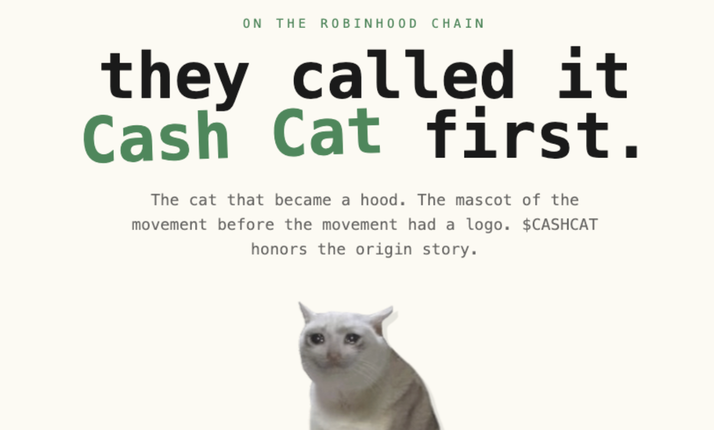
The name CASHCAT comes from an alternative name Robinhood founders Vlad Tenev and Baiju Bhatt chose for the company in their early days. This token was deployed before the mainnet launch. On July 8, it contributed about $98 million in DEX trading volume in a single day, with market cap once surging to $150 million to $170 million. On that day, Robinhood Chain's total 24-hour DEX trading volume reached $560 million to $570 million, briefly surpassing Hyperliquid.
Several typical early get-rich-quick cases appeared on-chain: one wallet bought CASHCAT for about $85 (0.05 ETH), with holding market cap peaking over $2 million; another wallet entered at $838, with returns exceeding 1180 times. After these on-chain data were tracked by Lookonchain and Bubblemaps, they spread rapidly, becoming the main narrative driving new wallets to flood in. On July 8, 141,000 new active wallets were added, with total DAU near 193,000.
Tenev himself joined to boost. He posted on X platform saying Robinhood Chain is "built for RWA, but memes also work."
But as of July 15, according to GMGN market data, CASHCAT market cap has fallen back to about $138 million, with 24-hour drop of 12%. HOODRAT, JUGGERNAUT and other meme coins dropped more than 25%. The meme retreat has begun.
Utility Projects Rise Against the Trend: ARROW and INDEX Become New Focus
While memes retreat, some on-chain native projects with actual product logic began to absorb capital.
Arrow Finance (ARROW) is a native CDP (Collateralized Debt Position) protocol on Robinhood Chain. Users can mint aUSD stablecoin after depositing collateral. Its core difference from general CDPs lies in the collateral scope: besides mainstream crypto assets and stablecoins, Arrow Finance is the first CDP protocol to accept tokenized public stocks and ETFs as collateral. Users holding tokenized stocks can borrow liquidity without selling stocks, triggering taxable events, or leaving Robinhood Chain.
According to CoinGecko data, ARROW currently has a market cap of about $16 million, price about $1.79, up more than 10 times from the starting price of about $0.15 on July 7. CoinMarketCap shows a higher price, about $2.26. ARROW has launched staking function (LP Staking), trading mainly concentrated on Uniswap V2/V3/V4 (Robinhood Chain).
INDEX is another utility token receiving attention. Public data shows INDEX rapidly surged 160% on the evening of July 14 due to attention from Robinhood team members, with market cap about $7.36 million as of press time. The project's core mechanism is using trading fees to buy on-chain stock tokens and distribute them to INDEX holding addresses. This "trading fees → buy stock tokens → distribute" flywheel structure is essentially building a yield distribution layer on top of Robinhood Chain's stock token ecosystem.
It needs to be emphasized that both INDEX and ARROW belong to extremely early on-chain native projects, with thin liquidity, violent price volatility, and project information mainly from on-chain data and community propagation, lacking institutional-level due diligence verification.
Ecosystem Projects That Have Issued Tokens: Fundamentals and On-Chain Performance
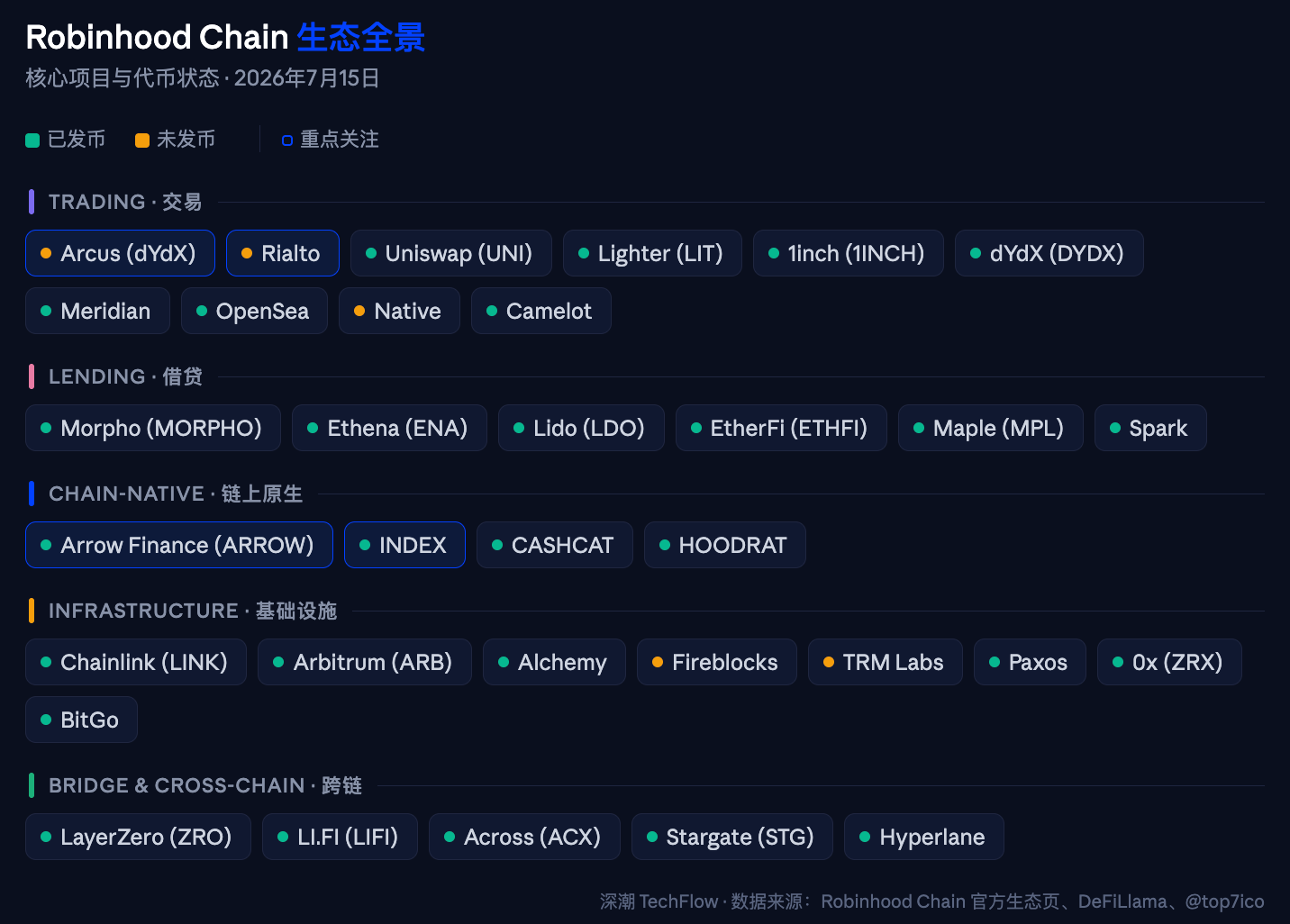
The first batch of Robinhood Chain partner list covers 16 projects. Most already have tokens; for these projects, investors are concerned with fundamentals and the actual function of tokens on Robinhood Chain.
Lighter (LIT): ZK-driven perpetual contract and spot DEX, already directly integrated into Robinhood wallet. Eligible users can trade perpetual contracts within the wallet. Lighter promised the Robinhood community to invest $11 million LIT tokens, trading earns points (trading via Robinhood wallet gets double points), points can be converted to LIT in the future. This is currently the most direct points mining channel on Robinhood Chain.
Morpho (MORPHO): Lending protocol, carrying the main part of on-chain TVL. In the first week of launch, about $90 million TVL was concentrated in Morpho, it is the underlying infrastructure for Robinhood Earn product (estimated 7% APY USDG lending). Lloyd's of London and RELM provide insurance coverage for it. TVL highly concentrated in a single protocol is a risk, but also shows lending demand does not purely come from speculation.
Chainlink (LINK): As Robinhood Chain's official oracle and cross-chain infrastructure, providing price data for all Stock Tokens, CCIP, Data Streams and Data Feeds deployed on mainnet from day one.
Arbitrum (ARB): Robinhood Chain's underlying tech stack. Offchain Labs simultaneously launched a revenue sharing model: 10% of Robinhood Chain net protocol fees flow back to Arbitrum ecosystem (8% into DAO treasury, 2% into Developer Guild). ARB rose about 7.6% after mainnet launch.
Other partners with existing tokens include Uniswap (UNI), LayerZero (ZRO), 1inch (1INCH), etc. These projects have actual deployment on Robinhood Chain, but token price drivers do not mainly come from Robinhood Chain.
Projects Without Tokens: Interaction Paths and Airdrop Expectations
There are 4 projects in the partner list that have not yet undergone TGE. Among them TRM Labs (compliance risk control) and Fireblocks (MPC infrastructure) are enterprise-focused, retail investors have almost no participation entry. The ones truly constituting interaction opportunities are Arcus and Rialto.
Arcus: Incubated by dYdX Labs, jointly built with Robinhood Crypto, Robinhood Crypto has invested in it (amount undisclosed). CEO is Eddie Zhang, previously founded social trading app Pocket Protector (acquired by dYdX Labs in July 2025). dYdX founder Antonio Juliano joined Arcus board.
Arcus currently offers zero-fee spot trading for 95 Stock Tokens, running 24/7, covering over 120 countries (USA, Canada, UK not available). 35 RWA perpetual contracts are still in waitlist stage, also plan to open Pre-IPO market.
Regarding tokens, dYdX clearly stated in the announcement: future Arcus tokens will be prioritized for users who trade, stake or validate on dYdX. In other words, there are two interaction paths for Arcus airdrop. One is to accumulate trading, staking and validation history on dYdX Chain; the second is to trade Stock Tokens directly on Arcus (currently zero fee, interaction cost extremely low). Issuance time undecided.
Market reaction to Arcus launch diverged: DYDX token fell about 23% within 24 hours (traders worried about resource diversion), Robinhood stock (HOOD) rose over 10% in the same period.
Rialto: Full-asset class on-chain spot exchange launched from stealth mode, supporting 24/7 trading of cryptocurrencies, Stock Tokens, ETFs, commodities and Pre-IPO assets. Team comes from hedge fund, high-frequency trading and market maker backgrounds.
Rialto's core differentiation is PropAMM (Proactive Automated Market Maker) engine "Rivo Altus". Unlike passive AMM, PropAMM provides on-chain market making with team's own inventory and proprietary pricing logic, using Arbitrum's Stylus infrastructure to deploy market making logic directly on-chain, aiming to make on-chain trading execution quality close to centralized exchanges.
Rialto has no token plan, but has launched a referral program: referral code unlocked after cumulative trading volume reaches $10,000, referrer gets 10% of referee's fees. Exchanges on new chains filtering early users through referral programs and trading volume accumulation before issuing tokens is a common airdrop pre-signal. Initial launch covers over 90 Robinhood Stock Tokens and mainstream crypto assets.
Structural Problems of Robinhood Chain
Two weeks of data have an unavoidable fact: on-chain TVL is highly concentrated in Morpho, DEX trading volume seriously relies on meme speculation, RWA active market cap is only about $12.4 million. Robinhood Chain's narrative is "financial infrastructure", but so far, the most active trading target on-chain is a cat meme coin.
Actual on-chain activity of Stock Tokens is also far below expectations. According to SQD on-chain data analysis, as of early mainnet, only 24 Stock Token and ETF token produced on-chain transfers, total 313 transactions, accounting for 0.27% of full chain ERC-20 transfers. Real trading demand for tokenized stocks on-chain is far from verified.
90-day Gas fee exemption period is another variable. Robinhood Chain's current trading activity has factors of Gas subsidies, retention rate after subsidy ends is the key window to judge ecosystem real stickiness.
Join TechFlow official community to stay tuned
Telegram:https://t.me/TechFlowDaily
X (Twitter):https://x.com/TechFlowPost
X (Twitter) EN:https://x.com/BlockFlow_News
 深潮TechFlow