Robinhood Launches Its Own L2 Chain, Stock Tokens Trade 24 Hours, 140 Giants Jointly Issue Token to Challenge USDT
TechFlow Selected TechFlow Selected
Robinhood Launches Its Own L2 Chain, Stock Tokens Trade 24 Hours, 140 Giants Jointly Issue Token to Challenge USDT
This is a critical week for traditional finance to reconstruct itself using blockchain.
 Navigating Web3 tides with focused insights
Author: Artemis Analytics
Compiled by: TechFlow
TechFlow Editor's Note: Robinhood Chain integrated DeFi protocols like Uniswap on its first day of launch, with Apple and Nvidia stock tokens tradable globally; 140 institutions including Google, Visa, and BlackRock jointly launched the Open USD stablecoin, directly targeting USDT's $260 billion market. This is a critical week for traditional finance reconstructing itself using blockchain.
Market Overview
Global risk assets closed higher in the first week of July, but capital flows shifted dramatically beneath the calm surface of the indices. The Dow Jones Industrial Average broke through 53,000 points for the first time and set a new record, marking an 8.9% gain for the Dow, 9.6% for the S&P 500, 12.8% for the Nasdaq, and 22% for the Russell 2000 in the first half of the year (the best first half since 1991). The macro environment warmed up: weak June employment data plus Federal Reserve Chair Kevin Warsh's statement that inflation risks are declining reignited hopes for rate cuts, reversing the "higher for longer" expectation of recent months. The hedging factor was geopolitics: an attack on the Strait of Hormuz and the U.S. revoking Iran sanctions exemptions pushed up oil prices and 30-year Treasury yields (back above 5%), raising the discount threshold for long-duration growth stocks just as the Q2 earnings season began. Later in the week, this tension triggered a real chip stock crash: Samsung's record quarterly guidance on July 7 failed to stop the semiconductor sell-off, leaving the Nasdaq teetering while the broader market barely held on.
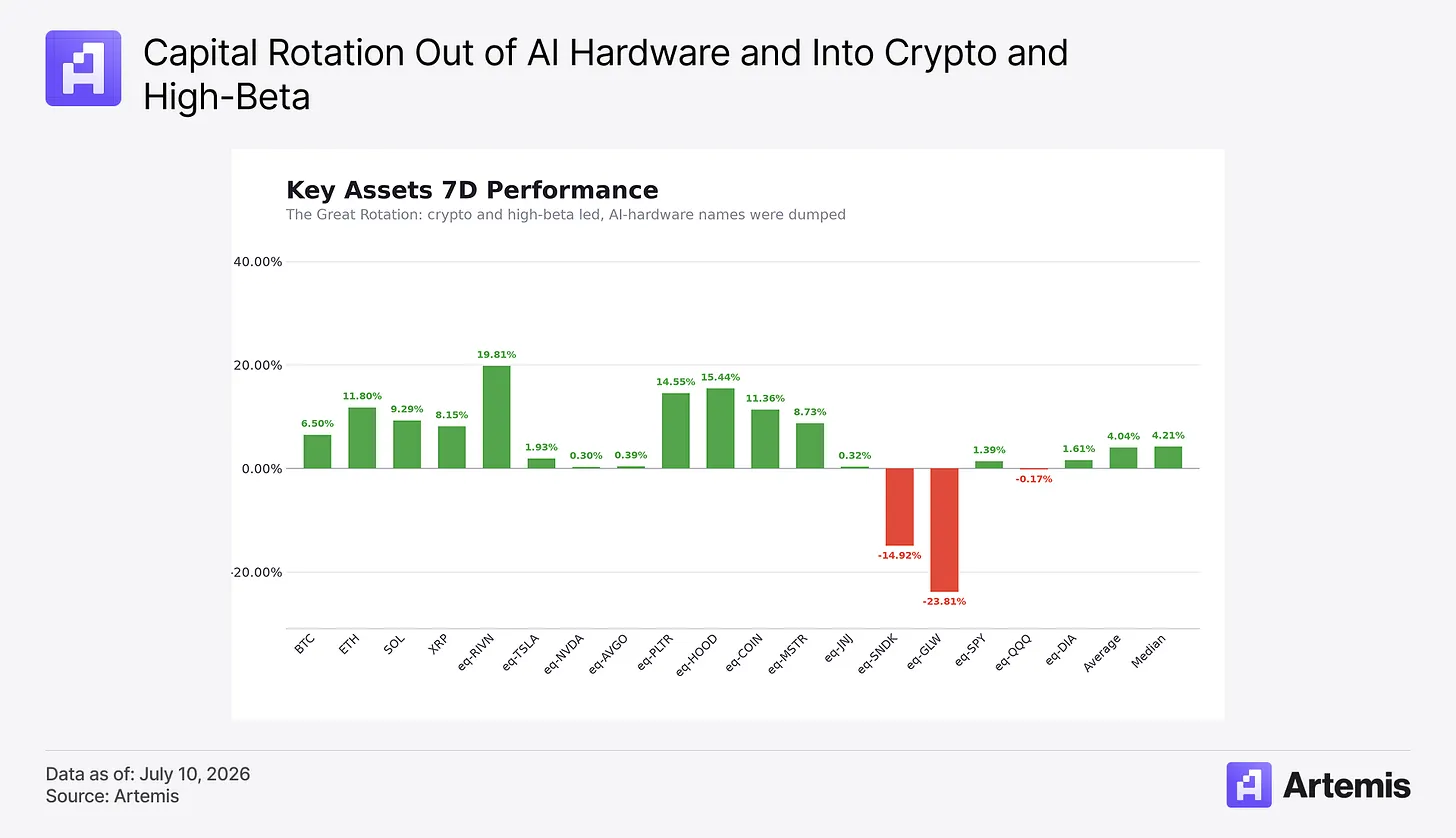
This week's leaderboard tells the rotation story in one chart. The biggest single-stock winners were not AI hardware leaders, but recovering high-beta and crypto-related concepts: Rivian up 19.8%, Robinhood up 15.4% (benefiting from Robinhood Chain launch), Palantir up 14.6%, Coinbase up 11.4%, Strategy up 8.7%, accompanied by a strong crypto rebound (ETH up 11.8%, BTC up 6.5%). Benchmark indices only rose slightly (Dow +1.6%, S&P 500 +1.4%, Nasdaq 100 -0.2%). The hardest hit areas concentrated on the AI capital expenditure supply chain: Corning down 23.8%, SanDisk down 14.9%, even mega-cap AI stocks (Nvidia +0.3%, Broadcom +0.4%) traded sideways—a textbook "sell crowded leaders, rotate into everything else" market.
Key Highlights This Week
The Great Rotation: AI Crash, "Boring Stocks" Rise
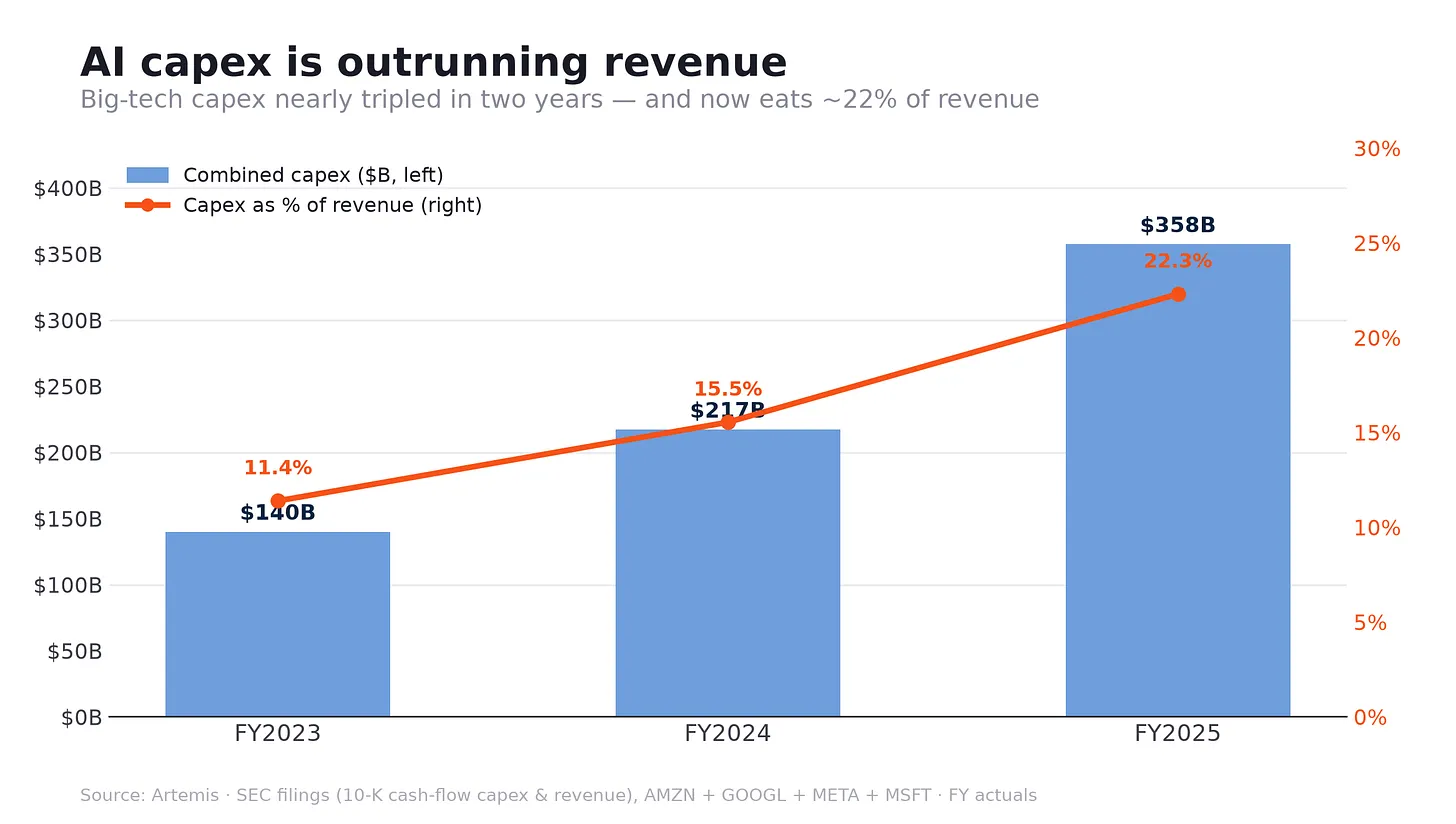
The most important market story this week is capital rotating from AI hardware into value and defensive sectors that missed the 2025 rally. The direct reason is investors increasingly demanding evidence of actual returns on record AI capital expenditures. Big tech AI capex is expected to rise another 50% in 2026 to well over $600 billion; the gap between investment and revenue now exceeds the 2001 telecom bubble, as capex growth is about 46% faster than revenue growth. With U.S. tech/AI valuations approaching 25x EV/EBITDA, the market is starting to punish spending—even if operating results beat expectations—due to concerns that monetization lags will lead to margin compression.
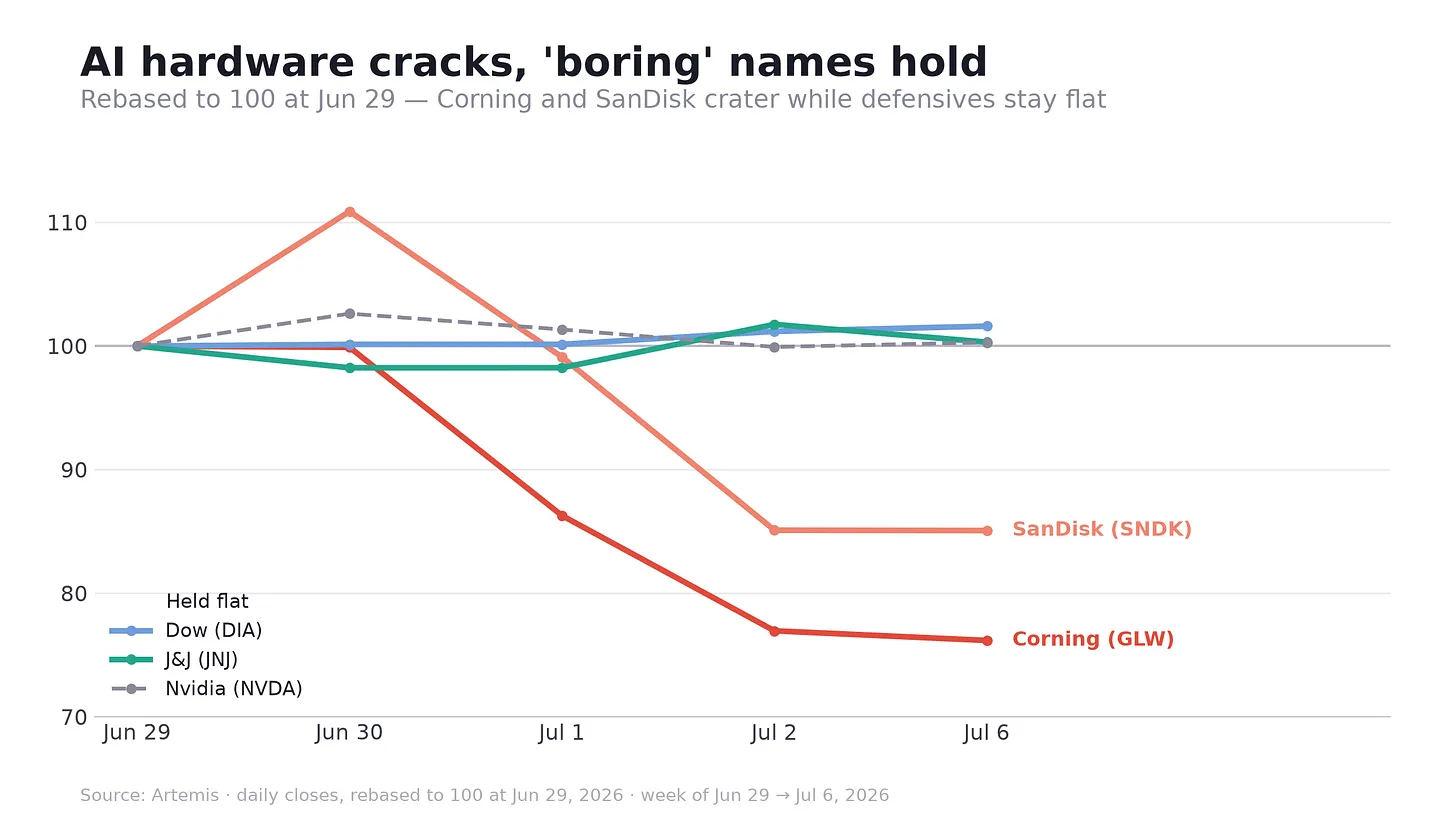
Corning fell 23.8% for the week, SanDisk fell 14.9%, while Nvidia and Broadcom traded flat, and Samsung was sold off even after a record quarterly report. This is a typical characteristic of position unwinding rather than demand collapse: market breadth remained positive, equal-weight indices outperformed market-cap weighted indices, and leading sectors shifted to finance, insurance, healthcare, consumer staples, and mid-stream energy. The Dow hit a new high while the Nasdaq 100 declined.
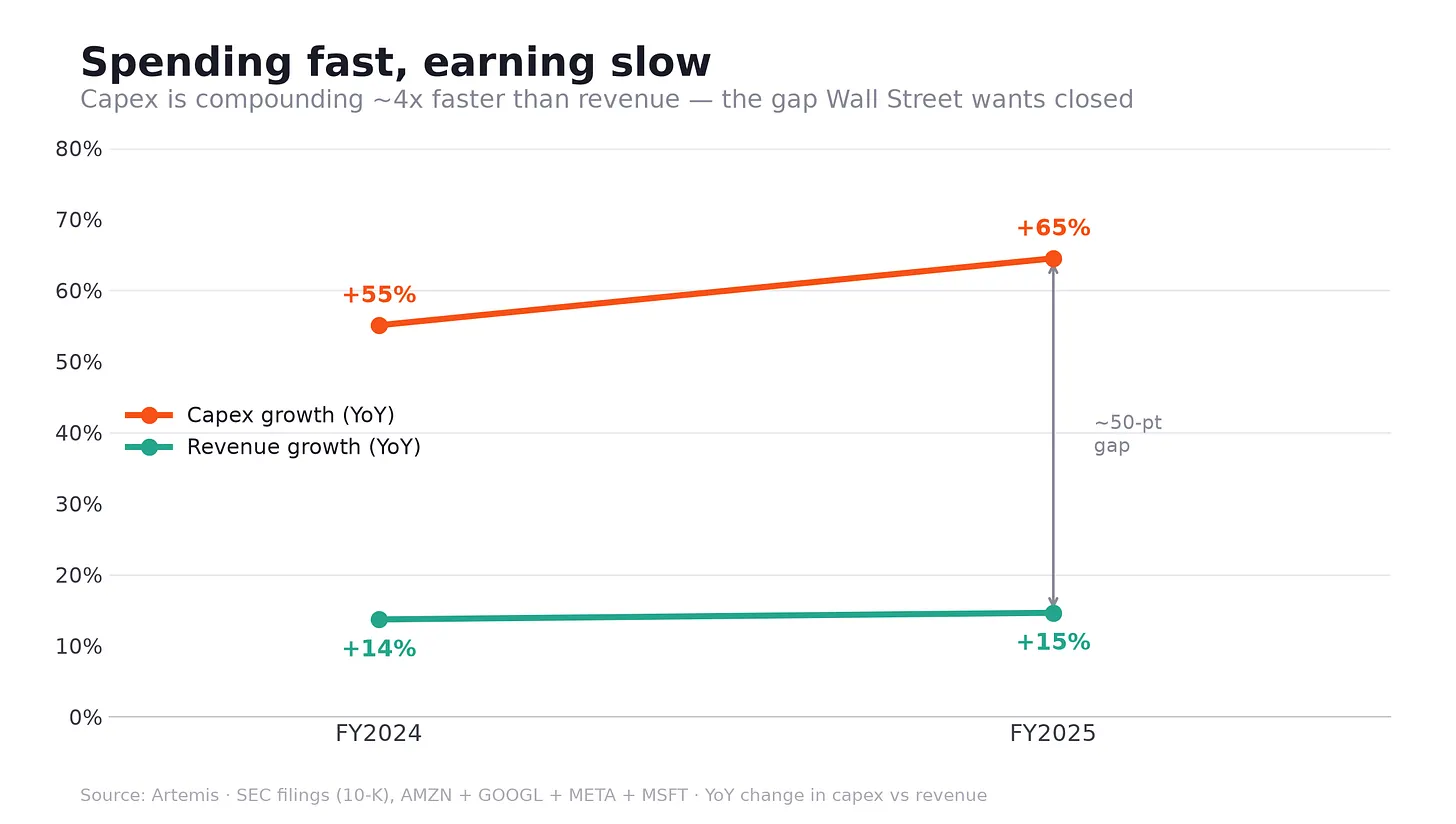
The Federal Reserve and the restart of U.S.-Iran war tensions were the catalysts. After a hawkish June (PCE around 4.1%, Goldman Sachs pushed the next rate cut to 2027), the shift to dovish in early July caused interest-rate sensitive value stocks to reprice higher; additionally, Hormuz pushed up oil prices and long-term bonds, mechanically raising the threshold for long-duration AI winners, with timing that was absolutely terrible.
Robinhood Chain: From App to Infrastructure
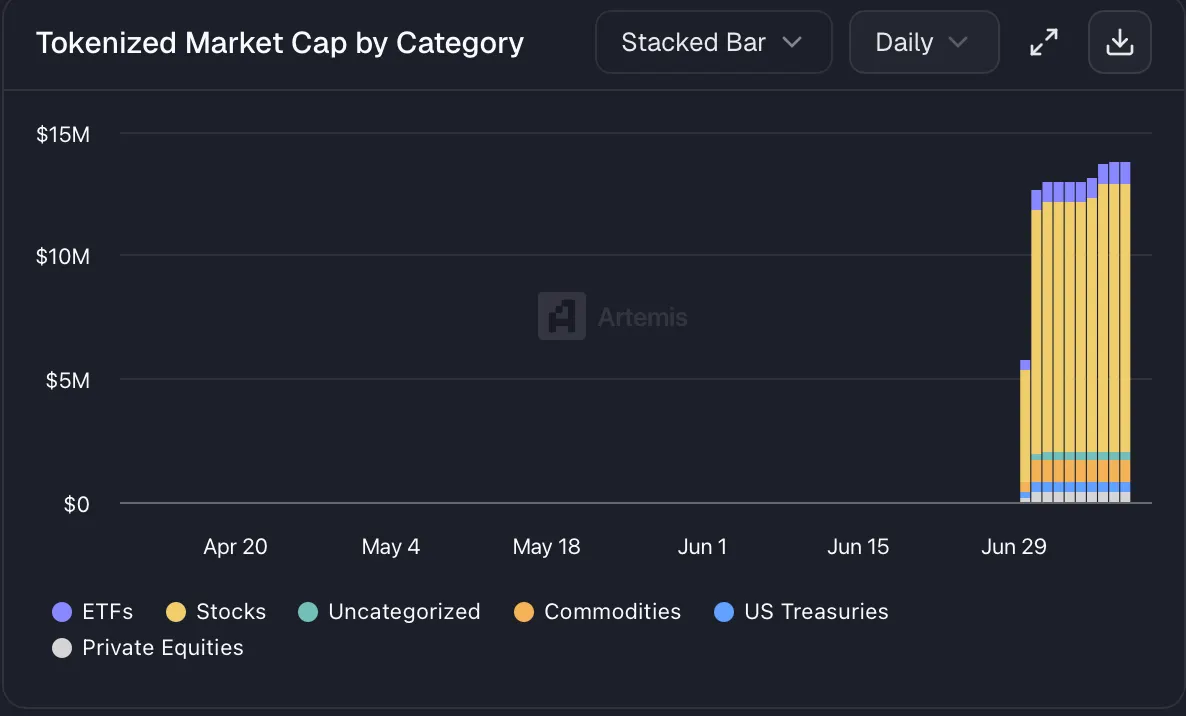
On July 1, Robinhood launched the Robinhood Chain public mainnet, an Ethereum Layer-2 built on the Arbitrum tech stack, designed specifically for tokenized real-world assets traded 24/7 with direct DeFi access. The core product is stock tokens: on-chain exposure to stocks like Nvidia, Apple, and Google, structured as tokenized debt securities (economic exposure rather than legal ownership), available via the Robinhood wallet in over 120 countries, excluding the U.S. What distinguishes it from common enterprise chain announcements is the complete DeFi stack on day one: Uniswap (dedicated AMM as primary liquidity), Lighter, 1inch, Rialto, and Arcus (from the dYdX team), with Chainlink as the official oracle. Robinhood also launched Earn, a lending product based on Morpho, with USDG targeting an annual yield of around 7%.
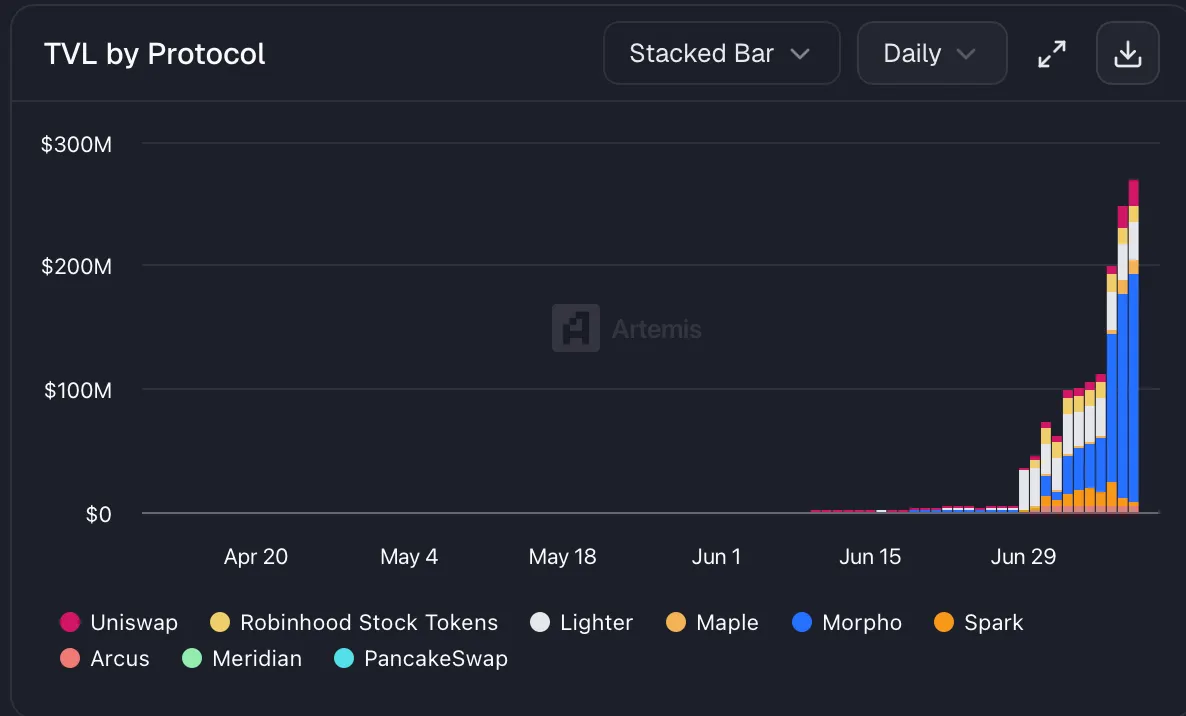
The strategic interpretation is that this is the culmination of Robinhood's 2025 acquisition spree (Bitstamp, WonderFi, European tokenized stock pilots), combining into a vertically integrated on-chain broker—assets tokenized on their own network, traded via their own wallet, financed using integrated lending, and custodied on their own tech stack. The market likes it: HOOD was one of the biggest winners this week, up 15.4%. The pending question is regulation; the line between compliant synthetic instruments and unregistered securities varies hugely across jurisdictions, with multiple regulators (including the SEC, which just added crypto rulemaking to its July agenda) drawing boundaries.
Open USD: Consortium Stablecoin
The biggest fintech headline this week is the launch of Open USD, a new stablecoin introduced by Open Standard, supported by about 140 partners, a list comparable to a tech-finance hall of fame: Google, Samsung, IBM, Coinbase, Solana, BlackRock, Standard Chartered, Bank of America, American Express, BBVA, Visa, Mastercard, BNY Mellon, led by former Coinbase product head Zach Abrams. Positioned as "a new stablecoin for global money flows... built for the internet economy," it is planned to launch later this year.
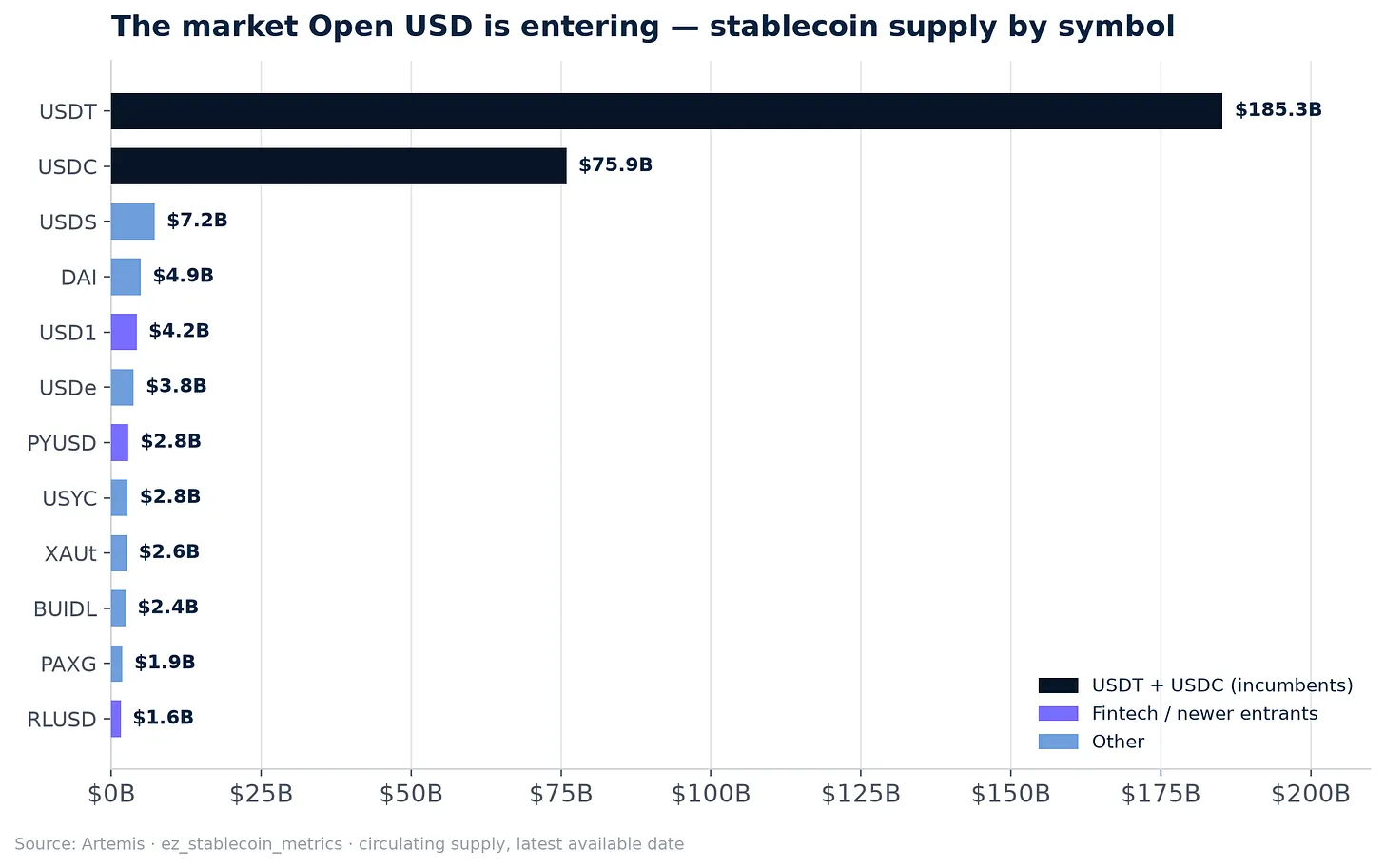
The ambition is huge; the incumbent advantage to overcome is equally huge. Stablecoin supply remains highly concentrated: according to Artemis data, USDT (around $185 billion) and USDC (around $76 billion) together account for the vast majority of the over $295 billion tracked volume, even though well-funded fintech entrants remain small—PYUSD near $2.8 billion, Ripple's RLUSD near $1.6 billion, USD1 near $4.2 billion. Open USD will start from the lower end of this distribution. The difference lies in distribution: a consortium spanning card networks, banks, and big tech can direct real-world payment flows to the stablecoin from day one, which is exactly the "monetization model" fintech companies have been calculating. This is also the clearest signal that stablecoins have become essential—during the same week, Standard Chartered enabled institutions to mint/redeem USDC directly via Circle, and PayPal converted PYUSD to native issuance on Polygon.
Charts of the Week
Other News Worth Watching
DTCC began limited production trading of tokenized Russell 1000 stocks, ETFs, and U.S. Treasuries in July, supported by over 50 companies (BlackRock, Goldman Sachs, JPMorgan, Circle, Ondo), with full launch scheduled for October; unlike Robinhood's synthetic model, DTCC tokenizes already custodied assets, so the tokens carry actual legal ownership
The MiCA transition period closed on July 1, with Binance locked out of the EU after withdrawing its Greece application on June 24; capital is flowing to licensed operators, as proven by SBI's approximately $289 million acquisition of Japanese exchange Bitbank—a nine-figure purchase of a "license"
Join TechFlow official community to stay tuned
Telegram:https://t.me/TechFlowDaily
X (Twitter):https://x.com/TechFlowPost
X (Twitter) EN:https://x.com/BlockFlow_News
 @artemis__xyz