








Bear Market Earnings Comparison: Pure Crypto Exchanges vs. Multi-Asset Platforms—Robinhood Is More Resilient Than Coinbase
TechFlow Selected TechFlow Selected
Bear Market Earnings Comparison: Pure Crypto Exchanges vs. Multi-Asset Platforms—Robinhood Is More Resilient Than Coinbase
The $12 Billion Gap in Coinbase’s and Robinhood’s Earnings Reports: Can Exchanges Survive the Bear Market?
 Navigating Web3 tides with focused insights
Author: Lex
Translation & Editing: TechFlow
TechFlow Insight: Last week, both Coinbase and Robinhood reported earnings that missed expectations, wiping out $12 billion in market value. This highlights a fundamental flaw in the exchange business model: when revenue is heavily reliant on trading fees, how do platforms survive a bear market? In contrast, Revolut—a platform built around payments—derives only 15% of its revenue from trading and remains virtually unaffected. This comparison reveals the underlying logic of competition among fintech platforms.
Cryptocurrency is deep in a bear market.
Bitcoin is hovering near $80,000—down approximately 36% from its peak of $126,000 on October 2025. Spot trading volume on centralized exchanges has fallen to its lowest level since September 2019; according to Coinbase data, it declined 44% year-on-year in Q1.
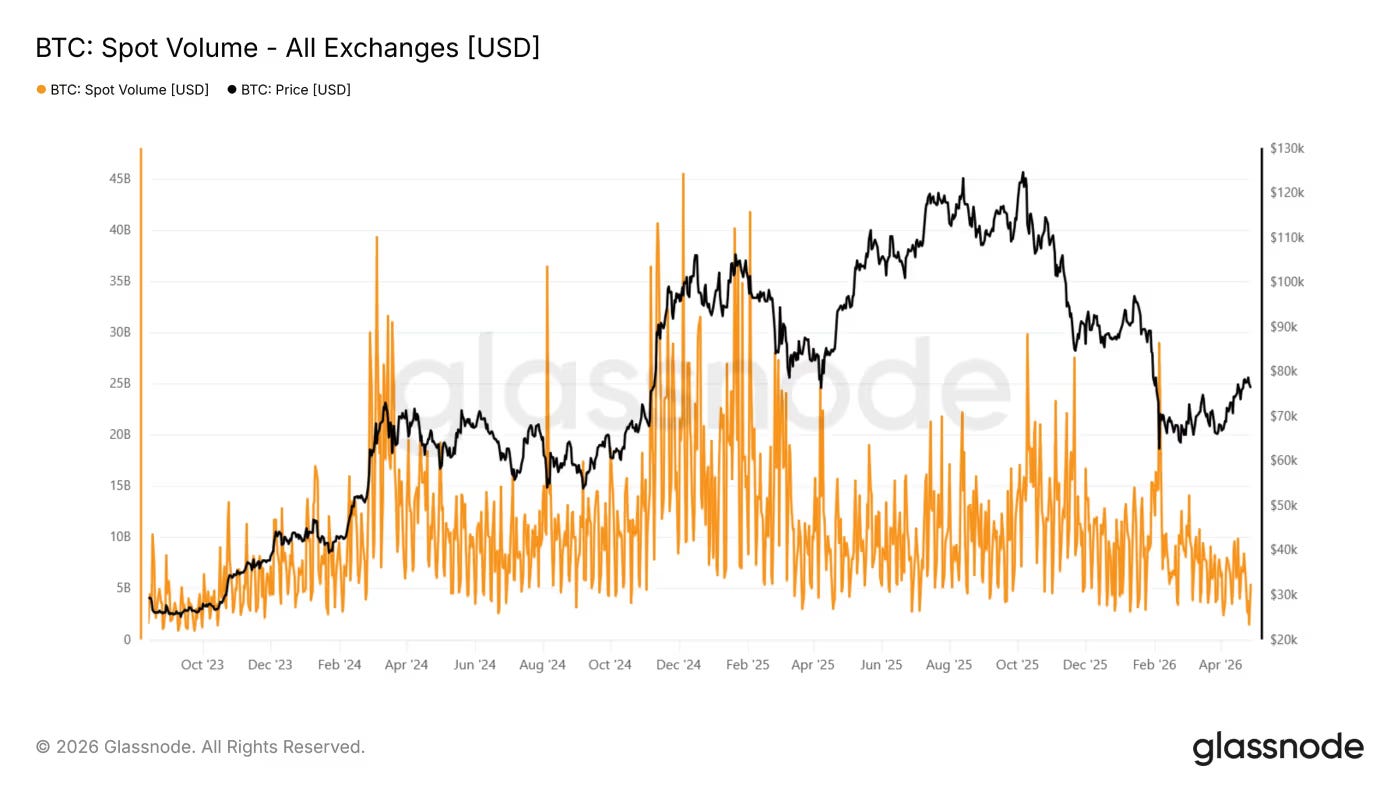
Some on-chain analysts believe the recent rebound from $60,000 may lack sustained momentum. This is already the longest bear-market rally in the past two cycles—but appears driven more by technical factors than fundamentals. While open interest in derivatives (perpetual contracts) has risen, spot activity remains low, suggesting the rally is fueled largely by short liquidations and speculative position closures—not durable buying pressure.
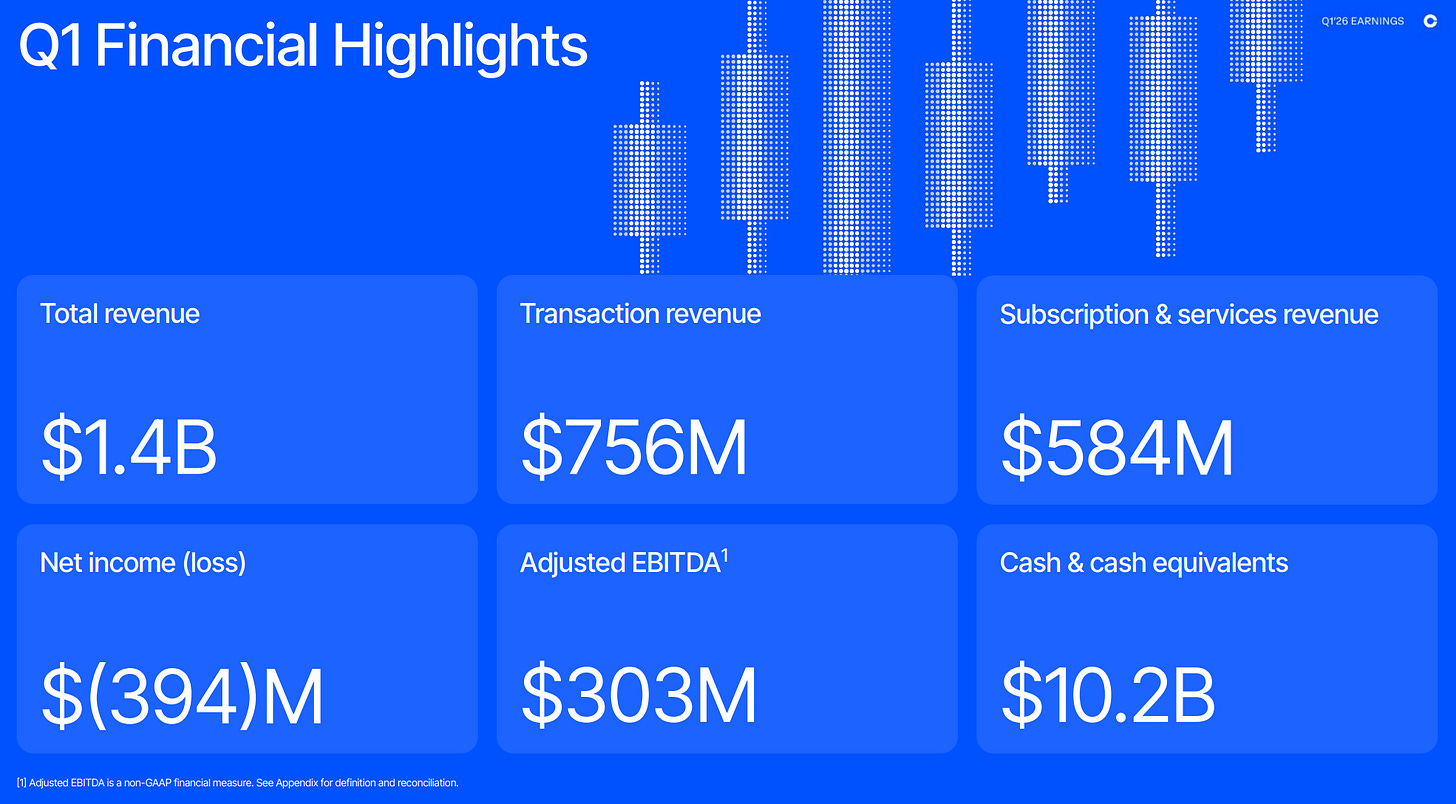
Declining trading activity is eroding platform revenues. Coinbase’s revenue fell 31% year-on-year to $1.41 billion, with a net loss of $394 million—compared to a $66 million profit in the same period last year. Management also announced layoffs of 700 employees (roughly 14% of its workforce) that same week, citing both cryptocurrency’s cyclical nature and “AI-era” cost restructuring.
The trading business sits at the center of this decline.
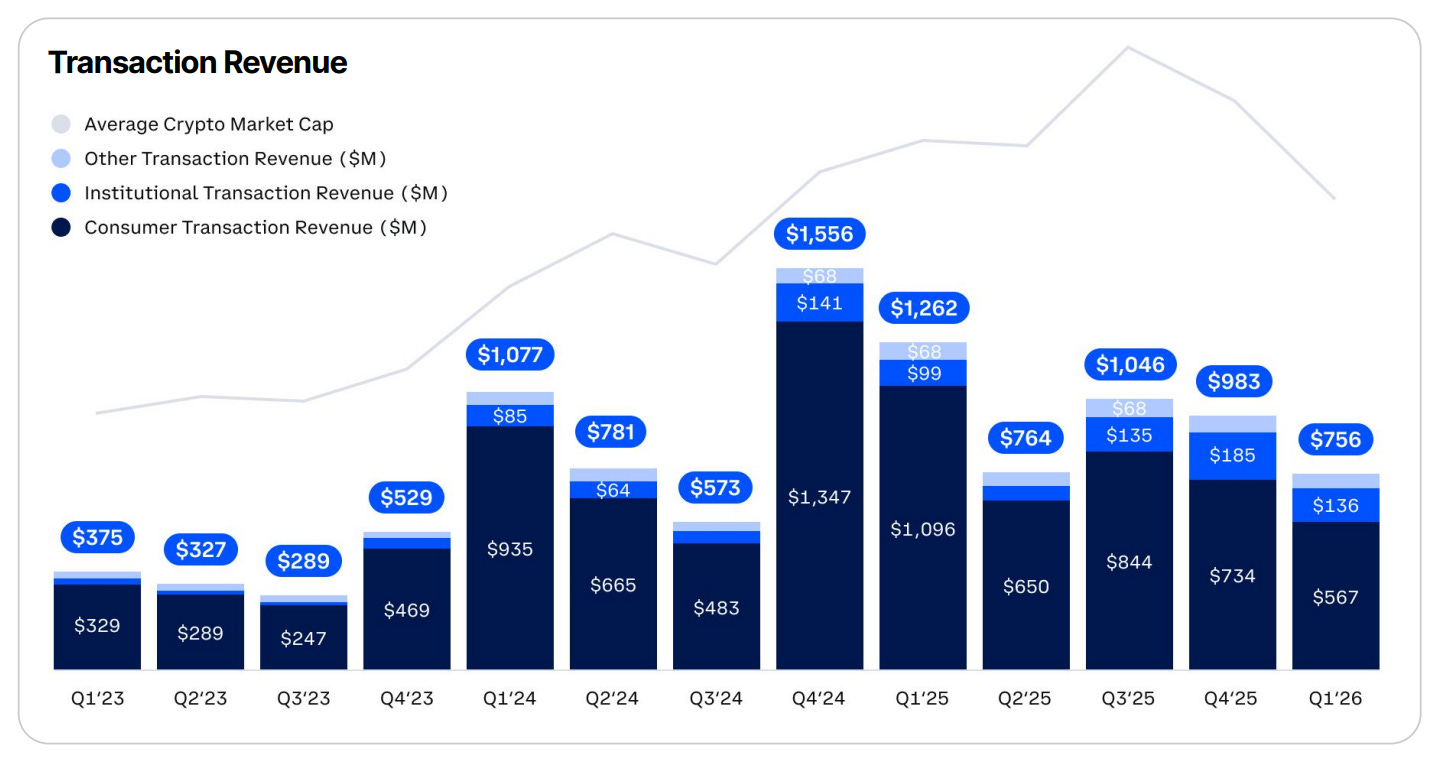
In Q1, trading revenue accounted for 56% of total revenue—down 40% year-on-year. Consumer trading revenue dropped 48% to $567 million. Institutional trading revenue actually grew during the period—but this growth was almost entirely attributable to the $4.3 billion acquisition of Deribit, completed in August 2025; organic institutional trading volume declined 48%.
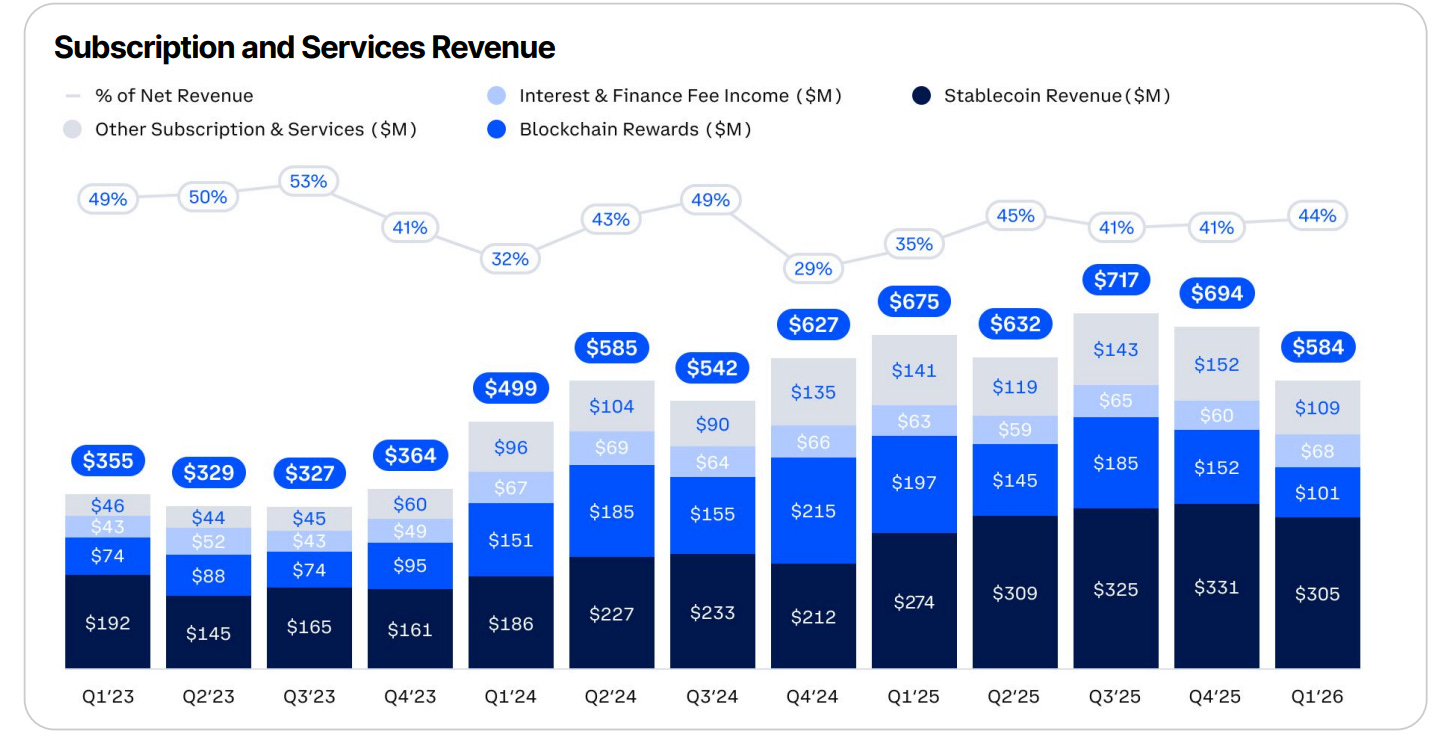
The remainder of revenue comes from subscriptions and services—including stablecoin income (interest earned on customer USDC balances via Coinbase’s partnership with Circle), blockchain rewards, interest and financing fees, and other subscription products such as Coinbase One.
This segment now accounts for 44% of total revenue, and management positions it as a “durable buffer” against trading volatility. But this is somewhat misleading. Stablecoin income—the largest single contributor—represents 22% of net revenue and grew 11% year-on-year. Yet it remains highly correlated with trading volume: customers move into USDC when seeking to hedge volatility or rotate between assets—but reallocate back into volatile assets once market sentiment improves. This dynamic partly explains why the share of subscriptions and services in total revenue has appeared relatively stable over the past three years.
Meanwhile, Robinhood reported stronger results.
Revenue rose 15% year-on-year to $1.07 billion, with net income of $350 million—yet still fell short of analyst revenue expectations. As with Coinbase, the miss was crypto-driven: related trading revenue declined 47% year-on-year to $134 million. Notably, this was the *only* major revenue line item to decline year-on-year.
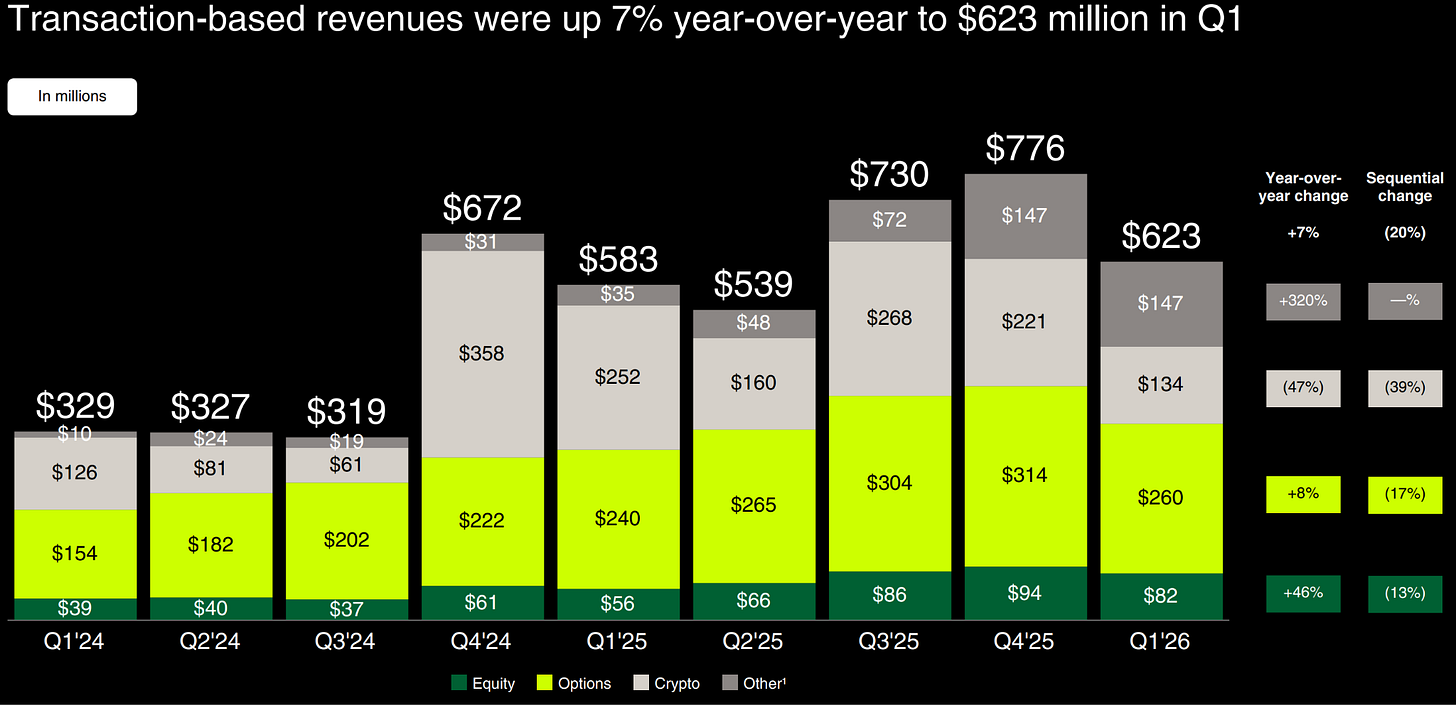
Trading still accounts for 58% of Robinhood’s revenue—essentially unchanged from a year ago. But thanks to greater diversification across tradable asset classes, the company has fared better throughout the bear market. Total trading revenue rose 7% year-on-year to $623 million—driven by a 320% surge in prediction market revenue (via Robinhood’s partnership with Kalshi), a 46% rise in stock revenue, and an 8% increase in options revenue.
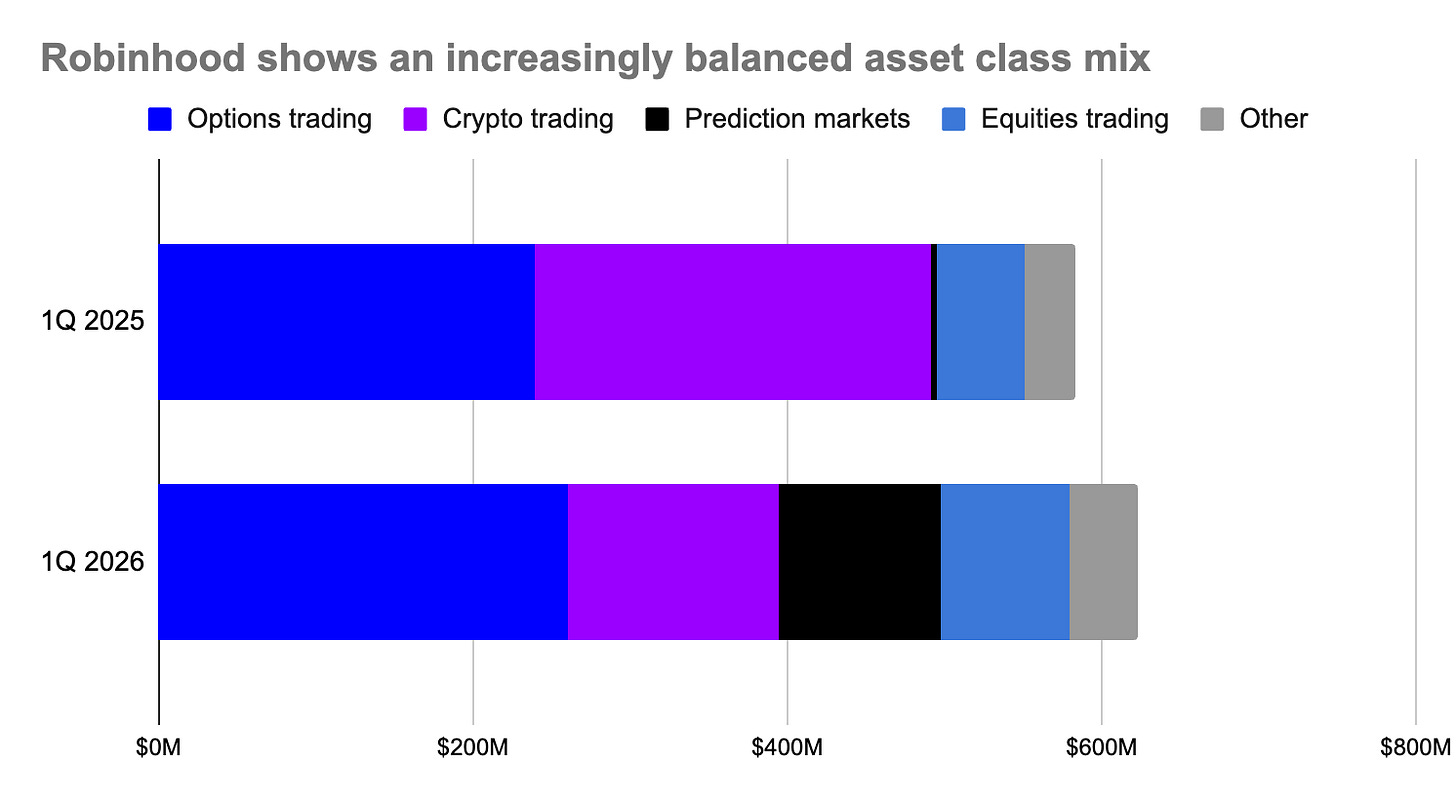
Derivatives such as prediction markets and perpetual contracts have proven more resilient during downturns. Kalshi raised $1 billion last week at a $22 billion valuation—doubling its valuation in just six months—and annualized trading volume surged threefold to $178 billion.
Event-driven trading—such as prediction markets—typically focuses on sports, elections, and economic data, making it less sensitive to broad market movements. Growth is also being driven by institutions increasingly adopting these instruments as hedging tools amid market volatility. An organic tailwind is masking cyclical pressures.
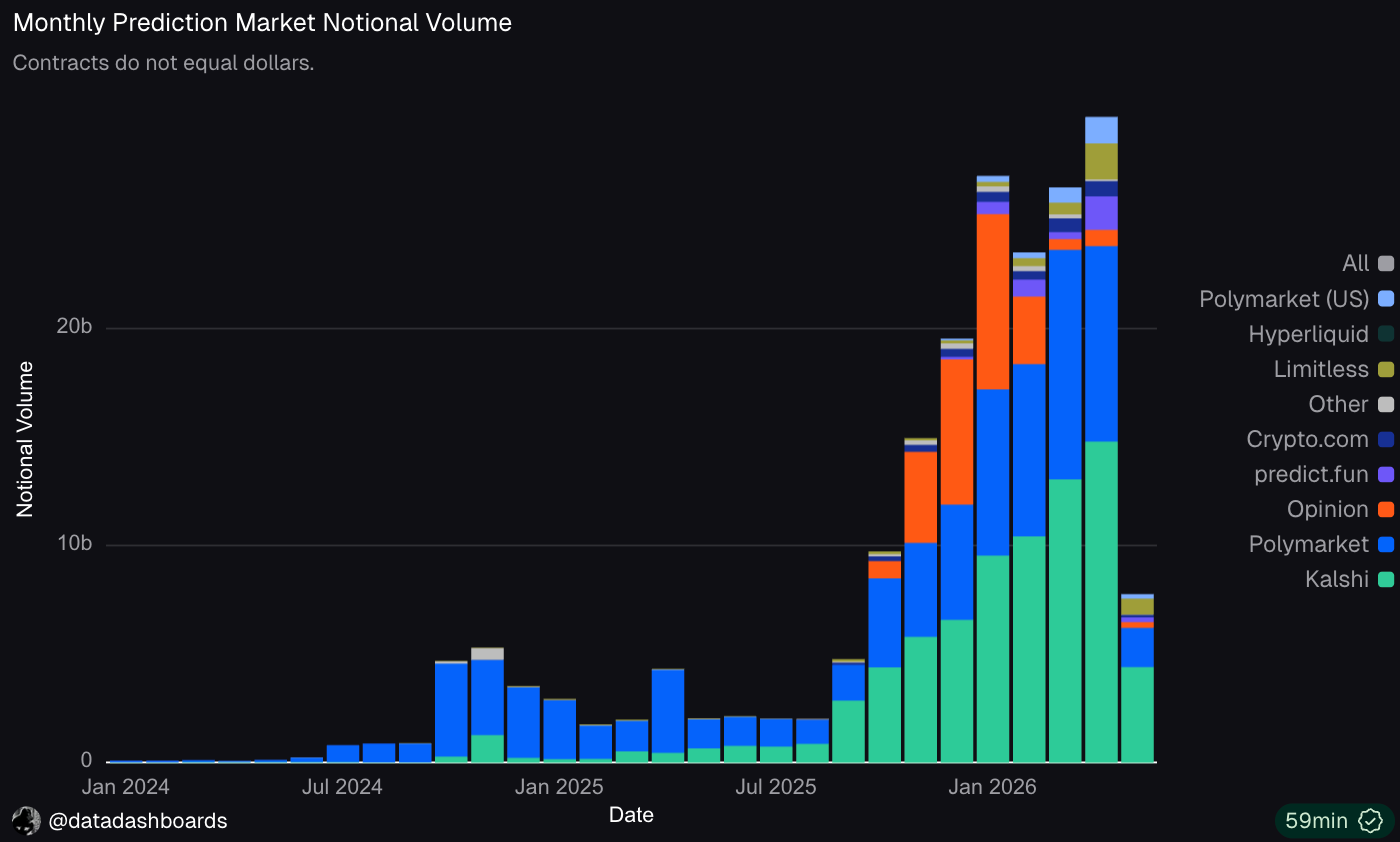
Perpetual contracts follow a similar pattern. As of end-April, the total value of leveraged trader positions on Hyperliquid—measured by “open interest”—stood at $4.3 billion. Despite the broader collapse in spot markets, this figure rose 9% over the past two months. It remains below the October peak—but significantly outperformed.
This matters greatly for platforms offering these features.
Prediction markets now account for 17% of Robinhood’s total trading revenue!
While Robinhood does not offer perpetual contracts directly, it provides similar margin trading on stocks and cryptocurrencies—and earns interest on those positions. In Q1 2026, margin interest revenue jumped 75% year-on-year to $193 million, representing 18% of total revenue.
Coinbase entered this shift later. Though it launched prediction markets and perpetual contracts for retail customers in January 2026, they have yet to meaningfully impact its P&L. As a result, the exchange remains far more exposed to spot trading.

Financial platforms like Revolut—centered on payments and banking but with meaningful trading activity—are far less affected. Its 2025 revenue surged 45% to $6.1 billion, with revenue streams evenly distributed across major categories—each accounting for 13–22% of total revenue.
Card interchange fees and interest income are the two largest contributors, each roughly $1.3 billion. Cryptocurrency trading—grouped with stocks and CFDs under the “Wealth” segment—accounts for 15% of total revenue: a fraction of Robinhood’s exposure and a tiny sliver of Coinbase’s.
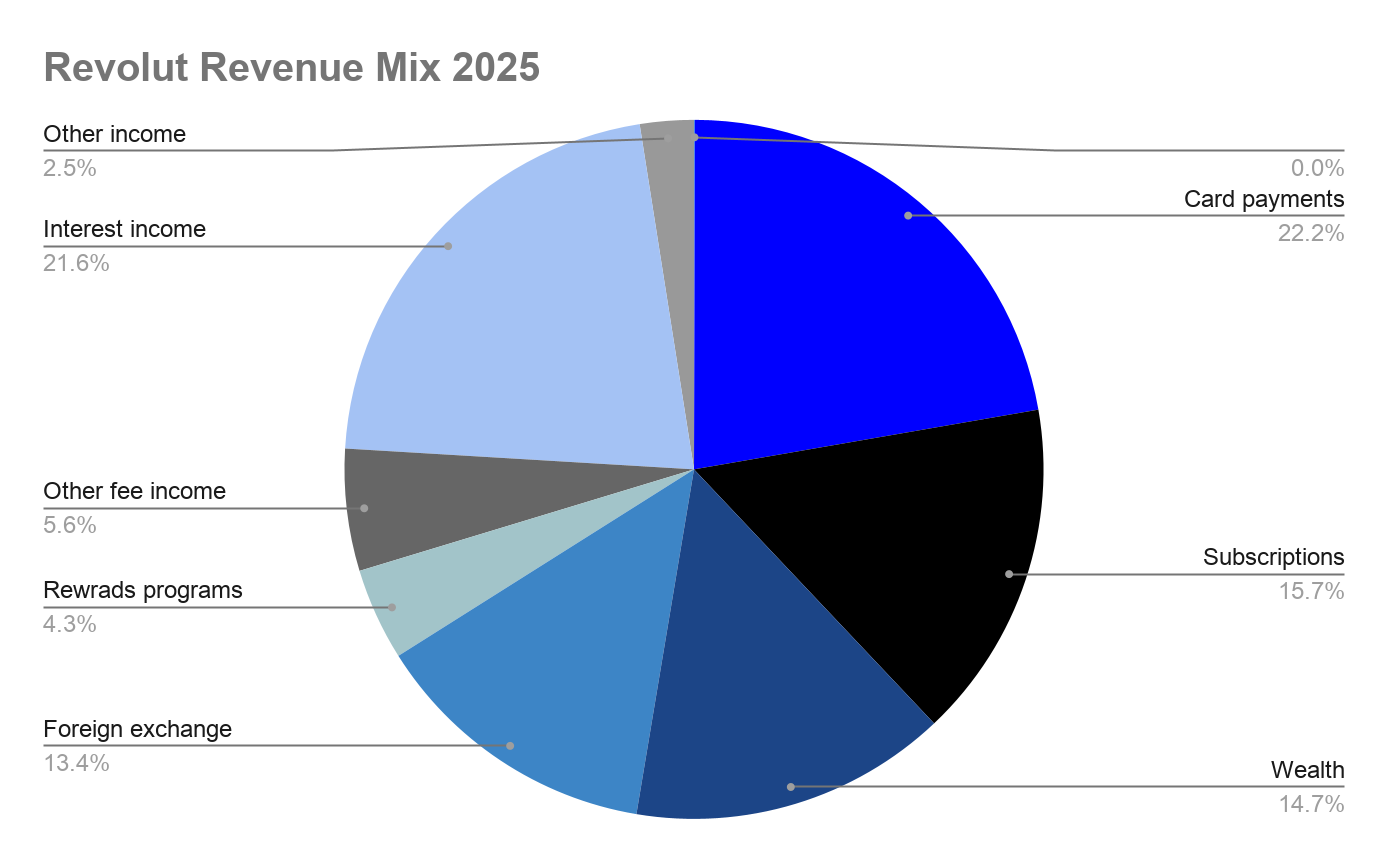
Notably, Revolut’s interest income functions similarly to Coinbase’s stablecoin income—both monetize idle customer balances. By year-end, Revolut held 90% of its $68 billion in customer balances in cash and Treasury investments. Yet the drivers behind these balances differ fundamentally. Revolut’s deposits grew alongside expanding relationships with primary banks and direct deposit adoption (up 45% year-on-year), whereas Coinbase’s USDC balances rose as trading willingness declined. If the crypto market turns more bullish, Coinbase is more likely to see those balances shrink.
The challenge facing trading-first platforms like Coinbase and Robinhood is whether they can meaningfully expand into adjacent financial products while remaining tightly coupled to market cycles. Robinhood has already demonstrated that diversifying tradable asset classes—especially prediction markets and derivatives—can act as a hedge.
Coinbase is moving in a similar direction. The risk is that prolonged bear markets hinder their growth capacity—while fintech competitors like Revolut, Nubank, and Cash App gain greater shares of customer deposits.
Join TechFlow official community to stay tuned
Telegram:https://t.me/TechFlowDaily
X (Twitter):https://x.com/TechFlowPost
X (Twitter) EN:https://x.com/BlockFlow_News


