Export to Domestic Sales: A Chinese-Style Overseas Expansion of an AI-Generated Short Film
TechFlow Selected TechFlow Selected
Export to Domestic Sales: A Chinese-Style Overseas Expansion of an AI-Generated Short Film
Self-proclaimed vocational school student from Yunnan; offering 3,000 free tokens—triggering a web-wide search by Hollywood’s AI community.
 Navigating Web3 tides with focused insights
Author: David, TechFlow
Hollywood is searching the entire internet for a Chinese creator—but the person they’re looking for didn’t even leave behind a usable contact method.
On the evening of May 10, PJ Ace, founder of Los Angeles–based AI film studio Genre.ai, shared on X a short AI-generated film titled Zombie Janitor. Within the AI video community, PJ Ace is arguably one of the most influential voices—his own content has amassed over 300 million views across platforms.
He praised the film highly: “One of the best short films I’ve seen in recent years.”
The film’s premise goes something like this: A robot cowboy rides an ostrich across a post-apocalyptic wasteland, battles zombies, and falls in love with a plastic mannequin. Beyond its cyberpunk-meets-magical-realist theme, the visuals and soundtrack also possess cinematic quality.
(Viewers who haven’t watched it yet can click here to experience it.)
Within hours of PJ’s post, it had already racked up 5 million views.
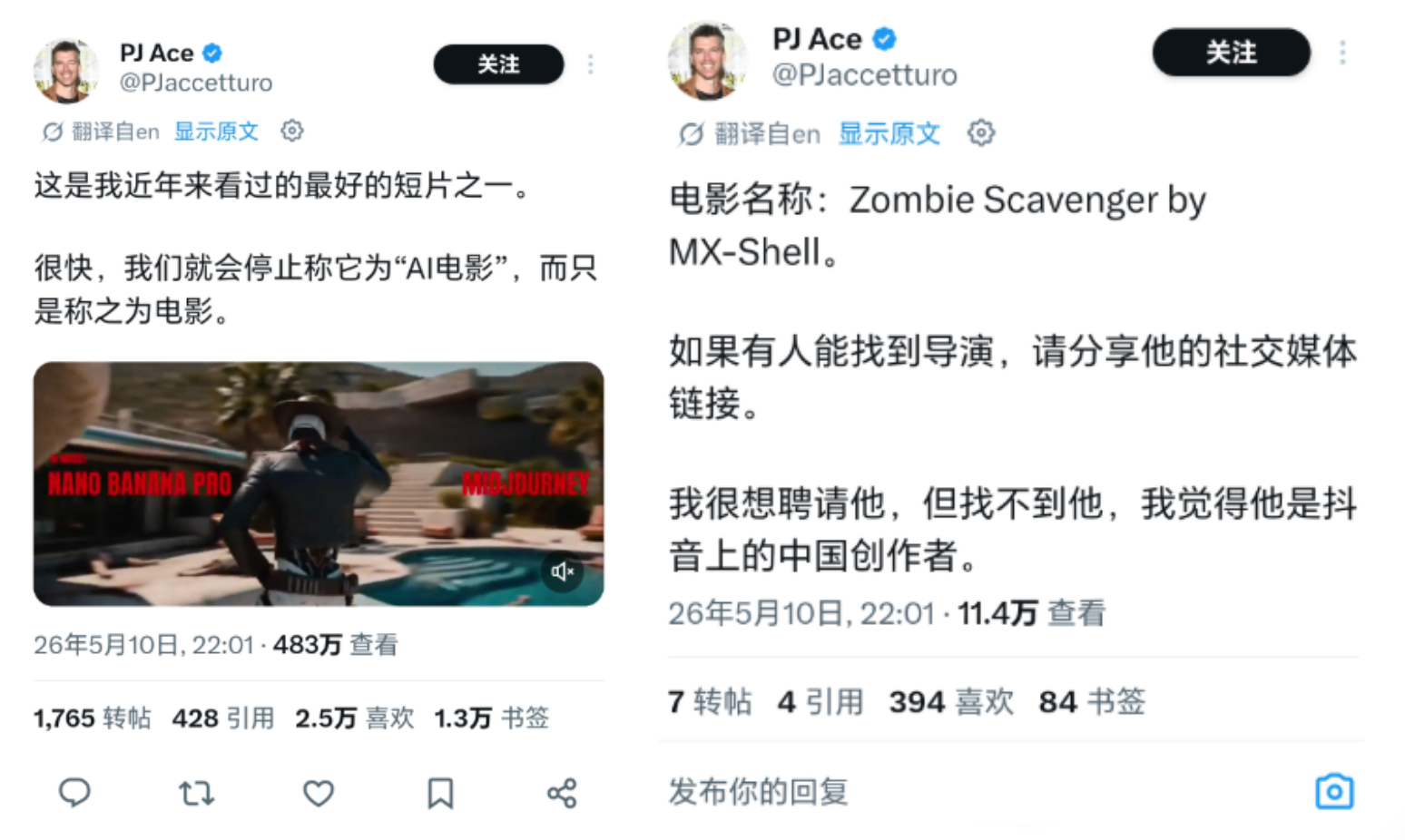
Shortly after, he posted a “missing person” notice: “I’d love to hire the director of this film—but I can’t find him. I believe he’s a Chinese creator on Douyin.”
A Hollywood insider holding top-tier production resources is literally posting a lost-and-found notice on X to locate a Chinese creator? To this author, that image alone feels more surreal than the short film itself…
His reasoning: Before AI, producing something of this caliber would have cost at least $500,000 and taken six months—but this creator achieved it solo, using only his own tools and talent. The post quickly turned into a massive online search effort: some scoured MX-Shell—the creator’s ID—while others traced clues to Bilibili.
And just like that, a large-scale, cross-platform hunt—from Hollywood to Bilibili’s comment section—began.
Yet, on the very same day PJ Ace frantically posted his X search notice, the short film remained relatively unnoticed on Bilibili and Douyin, quietly drifting through users’ feeds.
A short film made by a Chinese creator using domestic AI tools first had to circle all the way across the Pacific Ocean to go viral overseas before finally being discovered back home. The process of this cross-platform search making its way back to China, in itself, became a classic case of “export then re-import.”Making Amateur Passion Visible
The person PJ Ace was trying to locate identifies himself on Bilibili with just five characters: “Amateur Enthusiast.”
The creator, Mx-Shell, describes himself in the comments as a vocational school graduate from Yunnan Province—no university education, no experience working at any film or television company. His Bilibili profile reads “non-professional, amateur enthusiast”—a description delivered with unmistakable sincerity.

According to reports, Mx-Shell created Zombie Janitor entirely using Seedance 2.0, ByteDance’s AI video tool. He worked alone—no team, no investors—handling everything from concept development to final cut. Even the background music was composed by him.
The production took roughly 10 days, with token costs amounting to approximately ¥3,000 (roughly $420 USD).
Then comes what this author considers the most fascinating part of the whole story.
PJ Ace’s X search post reached millions—but Mx-Shell himself couldn’t see it. He had no idea a Hollywood filmmaker was actively seeking him across the Pacific.
When news finally trickled back to China, the comments under the video exploded—but Mx-Shell neither understands English nor has channels to engage directly with overseas media. In fact, he even posted his QQ email address in the comments, asking netizens to help forward messages to PJ Ace.
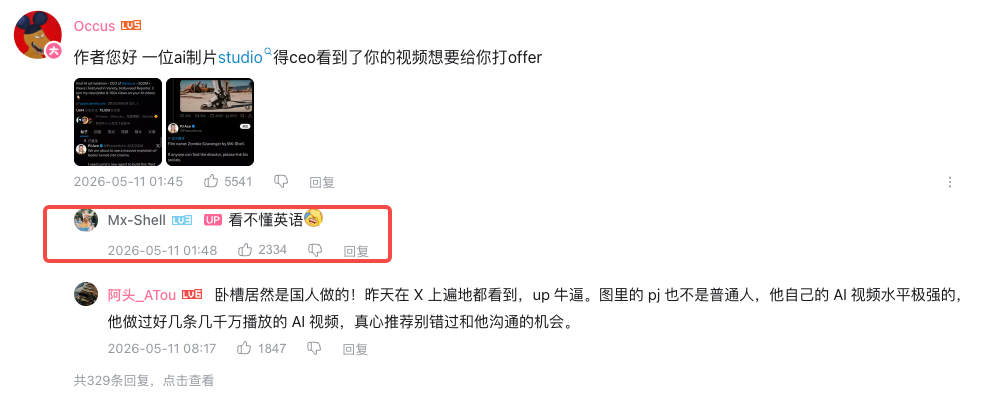

Hollywood searches for him in English on X; he searches for Hollywood via QQ email on Bilibili. With netizens acting as matchmakers, this cross-platform dialogue ultimately reached a happy ending.
As of now, PJ has emailed Mx-Shell directly. In his message, PJ introduced himself as the founder of a film studio in Los Angeles and noted that the short film surpassed 4 million views on its first day of sharing—then asked simply: “Would you be interested in becoming a Hollywood director?”
An amateur enthusiast receiving an olive branch from Hollywood—that may well be one of AI era’s most serendipitous and poetic discoveries of raw talent.Talent Going Global: Export Then Re-Import
Let’s return to why the film initially sat quietly on Bilibili but exploded once uploaded to X.
On Bilibili, a short film explicitly labeled “AI-generated content” must compete for attention in the same feed as professional animations, gameplay videos, and popular fan-made content—much of it produced by creators with millions of followers. At the time, Mx-Shell had only a few thousand followers, zero algorithmic promotion, and vanished like a grain of sand in the desert.
X, by contrast, operates in a completely different world. Over the past two years, the overseas AI creator community has matured into a self-sustaining ecosystem—with leading influencers, shared evaluation standards, and robust dissemination networks.
PJ Ace sits at the core of that ecosystem. When he watched Zombie Janitor, he saw the work itself—not just the AI tools behind it. His audience amplified the post instantly, triggering virality within hours.
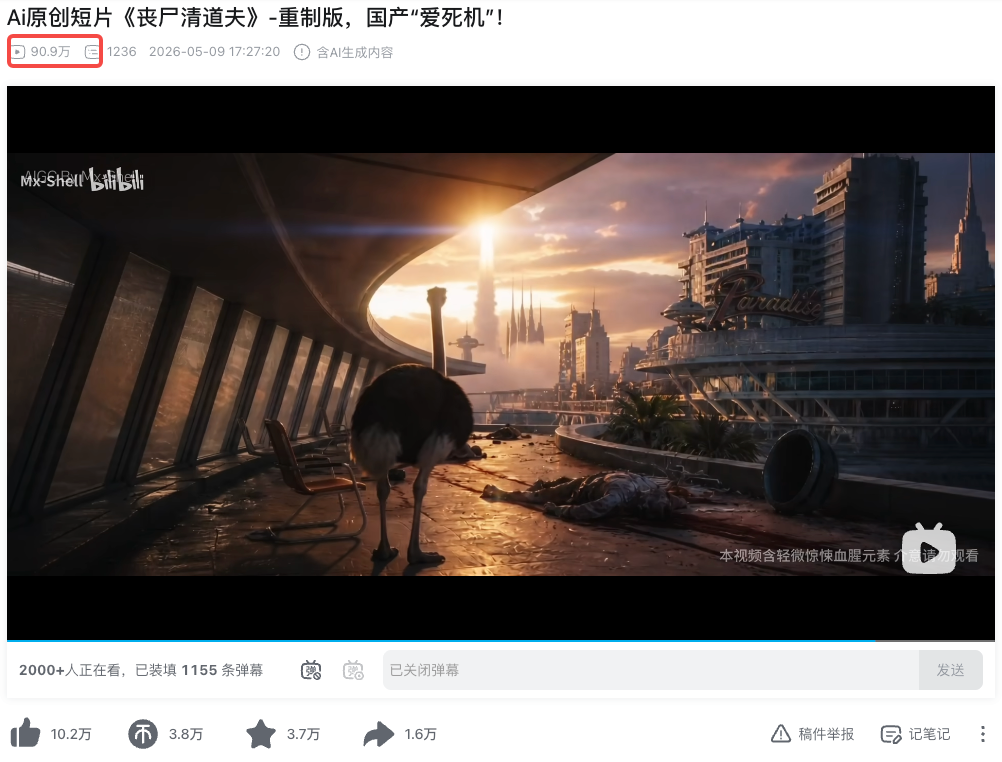
Subsequent data flowing back into China confirms this point: Domestic viewers responded just as enthusiastically—over 900,000 views and 100,000 likes on Bilibili. In the AI era, content quality has never been the primary bottleneck—it’s whether the right people ever get to see it.
This reminds the author of a similar phenomenon: “Token going global.”
Chinese large language models sell computing power globally via APIs—electricity never leaves China’s grid, yet value crosses borders via tokens. Mx-Shell’s story is the creative counterpart to the same logic: Talent and aesthetic sensibility never left his laptop—but the work itself crossed oceans in the form of a short film. Seedance is a ByteDance product; the compute power comes from Chinese data centers; the creator hails from Yunnan—and the first wave of mass viewership came from across the Pacific.
If “token going global” is electricity going global, then Zombie Janitor is talent going global.
Why did this path first succeed out of China? Likely because China possesses two key ingredients simultaneously: the world’s most fiercely competitive AI video tool market—where ByteDance, Alibaba, and Kuaishou are locked in cutthroat competition, driving generation costs down to rock-bottom levels. Mx-Shell used Seedance 2.0, whose relative affordability lowered his barrier to entry.
And second: a vast pool of highly creative individuals previously lacking an outlet—people with strong aesthetics and ideas, missing only a capable tool.
The former gave the latter a key; turning the doorknob opened access to global markets.AI Is a Great Shovel—But You Still Have to Dig Yourself
The story isn’t over yet.
After connecting with PJ Ace, Mx-Shell published a detailed response addressing public interest—13 points, each grounded in reality. This author believes the text itself deserves close reading.
He named the film’s visual style “Atom Punk,” a retro-futurist subgenre. Its inspiration came from Pixar’s WALL·E, and he held himself to the production standards of Netflix’s wildly popular Love, Death & Robots series.
One of his core motivations: to show international audiences what level Chinese AI-generated content has reached.

Shot composition was driven entirely by written prompts—crafted manually, line by line. Post-production was handled solo. Even the background score was original. Taken together, these details reveal that Mx-Shell is far more than someone who “just happened to stumble upon an AI tool.”
He possesses visual aesthetics—trained as a photographer. He possesses auditory aesthetics—as an independent musician. He possesses narrative intuition—setting his own bar against industry benchmarks like Love, Death & Robots.
AI tools boosted his output capacity—but aesthetic judgment and discernment remain uniquely his own.
That’s why this author believes the phrase “AI lets anyone make movies” is only half true. Yes, AI has flattened production barriers—but while computing power can be purchased, aesthetic sense cannot.
Anyone can use Seedance 2.0—so why did Mx-Shell produce exactly the kind of work that prompted Hollywood to issue a public search notice? Tools are equal for all—but the people wielding them vary immensely.
This leads to another intriguing angle.
How much ByteDance has invested in Seedance 2.0 remains unknown externally—but so far, the tool’s most powerful advertisement may well be this short film by a vocational school graduate from Yunnan.
ByteDance’s marketing department could never have engineered such a story—its persuasive power lies precisely in its spontaneity, organic emergence, and complete unpredictability.
The strongest validation for any platform product is always when users create things that exceed the platform’s own expectations. Taobao’s early benchmark story featured rural women earning millions annually selling local specialties; YouTube’s was teenagers producing higher-quality programming from their bedrooms than broadcast TV networks. For Seedance 2.0, the benchmark story will be more creators like Mx-Shell.
According to DataEye, the overseas AI short-drama and AI comic-drama market is projected to reach $650 million in 2026—a sixfold year-on-year increase. Currently, two distinct paths are emerging in this space:
One follows an industrialized model: Domestic teams mass-produce AI short dramas—zombie apocalypses, werewolves, rags-to-riches narratives—packaged into genre formats familiar to Western audiences and distributed via TikTok ads for monetization. Reports indicate several titles have already achieved tens of millions of views. This path hinges on capital, team size, and production scale—reminiscent of the early “short-video factories.”
The other path is the one Mx-Shell took: one person, one computer, no ad spend, no scaling—content itself becomes the engine of virality. With token costs under a few thousand RMB and production completed in under two weeks, the payoff wasn’t platform revenue shares—it was Hollywood knocking on his door.
Both paths are viable—but this author believes the second merits closer attention.
Because the first path’s barrier is money—anyone with capital can enter, regardless of individual creative capability. The second path’s barrier is human: taste, vision, and content judgment—qualities AI cannot provide and money cannot buy.
He won’t be the last to walk this path.
China hosts a vast reservoir of creators possessing strong aesthetics, bold ideas, and expressive drive. What once stood between them and the world were equipment, funding, teams, and academic credentials—barriers now being dismantled, one by one, by AI tools. Only one question remains: How do you get seen?
Mx-Shell’s answer was a QQ email address and a group of enthusiastic netizens. The next creator may find another way.
But until China’s domestic AI-creation ecosystem matures fully, this circuitous route—export then re-import—will likely persist for some time.
Join TechFlow official community to stay tuned
Telegram:https://t.me/TechFlowDaily
X (Twitter):https://x.com/TechFlowPost
X (Twitter) EN:https://x.com/BlockFlow_News
 深潮TechFlow