








Gradients: Decentralized AI Training Infrastructure for the Bittensor Ecosystem
TechFlow Selected TechFlow Selected
Gradients: Decentralized AI Training Infrastructure for the Bittensor Ecosystem
Gradients completes the training infrastructure within the TAO ecosystem and explores a new paradigm of “market-driven AI optimization,” with long-term potential to evolve into a key entry layer for decentralized AI training.
 Navigating Web3 tides with focused insights
Source: CoinW Research Institute
Executive Summary
Gradients is a decentralized AI training subnet (SN56) built on Bittensor. Its core innovation lies in transforming model training—a traditionally complex technical process—into a market-driven, networked collaboration via mechanisms such as “task posting, miner competition, and validator screening.” Architecturally, it integrates AutoML with distributed compute resources to form a training marketplace centered on incentive mechanisms. This not only lowers the barrier to AI adoption but also improves computational resource utilization efficiency. From an ecosystem and data perspective, Gradients has completed foundational network deployment; however, its current incentive weightings and capital inflows remain relatively limited. Gradients fills a critical gap in the TAO ecosystem by providing training infrastructure and pioneers a new paradigm of “market-driven AI optimization.” In the long term, it holds potential to evolve into a key entry layer for decentralized AI training.
1. Starting from Web2 AutoML: The Current State and Limitations of AI Training
1.1 What Is AutoML?
Traditionally, training an AI model is a high-barrier activity requiring engineers to handle data preprocessing, select models, tune hyperparameters repeatedly, and evaluate performance—an intricate and time-consuming process. AutoML (Automated Machine Learning), by contrast, essentially “packages and automates” these tedious steps. Think of it as an “automatic model-building tool”: users simply supply data and specify their objective—such as classification, prediction, or recognition—and the system automatically handles model selection, hyperparameter tuning, and training optimization. This shift transforms AI from a tool reserved for elite engineers into a capability accessible to ordinary developers and even enterprises—a pivotal step toward AI democratization.
1.2 Core Limitations of Traditional AutoML
Today’s mainstream AutoML implementations are concentrated on cloud vendor platforms—for example, Google Vertex AI and AWS SageMaker—which offer “AI training-as-a-service.” Although Web2 AutoML significantly lowers the barrier to AI usage, its underlying architecture still suffers from clear limitations. First, it is centralized: compute resources, pricing, and governance rules are all controlled by the platform, leading to strong user dependency on a single provider and minimal bargaining power. Second, costs are high and opaque: GPU resources essential for AI training are predominantly held by cloud vendors, and pricing lacks market-driven competition. More critically, optimization efficiency faces inherent ceilings. Fundamentally, traditional AutoML remains “a single system searching for the optimal solution”—no matter how sophisticated the system, it operates along one fixed technical path. Its exploration space is inherently constrained, making it difficult to simultaneously test radically divergent approaches. Thus, today’s Web2 AI training constitutes a “closed system,” where model training, optimization, and resource scheduling all occur within a single-platform-controlled environment. While efficient, this model’s boundaries are increasingly apparent as demand grows.
2. Gradients: Reconstructing AI Training Using a “Network”
2.1 What Is Gradients? A Decentralized AutoML Platform
In the previous section, we noted that the central problem with traditional Web2 AutoML is its “closed-system” nature: model training depends on platforms, optimization paths are narrow, and resource flow is restricted. Gradients represents a deliberate reconstruction of this model. Originating from the decentralized engineering community WanderingWeights, Gradients is built atop the Bittensor network and operates as Subnet 56—an AI training subnet. Unlike conventional platforms, it does not deliver centralized services. Instead, it decomposes the training process and delegates execution across an open network. Users need only define their task objectives—e.g., model type and data inputs—while the rest—including training execution, parameter optimization, and result filtering—is handled automatically by the network. Under this paradigm, AI training shifts from a complex engineering workflow to a simple “submit requirement → receive result” process, becoming more akin to a general-purpose capability than a highly specialized technical task.
2.2 From Closed System to Open Collaboration: What Problems Does Gradients Solve?
Gradients’ core innovation lies in transforming what was once an internally closed training process into an open, collaborative network process. Training tasks are no longer executed by a single system but are instead distributed to multiple participants who attempt them in parallel, with results filtered through a unified evaluation mechanism. This structure first reduces reliance on centralized service providers, grounding training in distributed compute resources. Simultaneously, disparate GPU resources are integrated into a shared network, forming a more market-like resource allocation dynamic driven by competition. Most importantly, model optimization is no longer confined to a single path but advances continuously through parallel exploration of diverse methods—raising the overall ceiling for optimization.
2.3 Fundamental Shift: From Tool to “Training Marketplace”
In traditional AutoML, the platform functions more like a tool, using internal algorithms to help users find the optimal solution. In Gradients, the process resembles a continuously operating “market”: users post demands, various participants compete on the same task, and outcomes are selected via an evaluation mechanism. Consequently, model performance no longer hinges on the capabilities of any single system but emerges from sustained competition and iteration among multiple contributors. AutoML thus evolves from a relatively closed technical optimization problem into a dynamic, incentive-driven process—one whose optimization capacity can scale as participation increases. This transformation imbues AI training with market-like self-evolutionary characteristics.
2.4 Role Within the TAO Ecosystem: The AI Training Infrastructure Layer
Within Bittensor’s subnet architecture, different subnets fulfill distinct roles—such as inference, data processing, and training—with Gradients occupying the training layer. It converts fragmented compute resources into tangible model outputs and, via task distribution and evaluation mechanisms, enables continuous scheduling and optimization of those resources. Simultaneously, it bridges compute supply and model demand, transforming training from a mere resource consumption process into an organized, optimized, networked collaboration. In this system, Gradients functions as a central hub—converting distributed resources into usable AI capabilities and supporting the development of upper-layer applications.
3. Core Architecture: How AI Training Is Executed Across the Network
In the previous section, we highlighted how Gradients shifts AI training from “executed inside a platform” to “collaboratively executed across a network.” So how exactly does this network operate? This section dissects that process in an intuitive, step-by-step manner.
3.1 Distributed Training: How a Single Task Is “Completed by Multiple Participants”
Imagine Gradients as a continuously running “training collaboration network.” When a user submits a training task, it is not assigned to a single system for execution. Instead, it is broadcast simultaneously to multiple participants across the network. These participants independently experiment with different training methodologies—using identical data and objectives—and submit their results within a defined timeframe. The system then uniformly evaluates all submissions and selects the best-performing solution. Ultimately, superior results earn rewards, while others are discarded. From the user’s perspective, initiating a single task effectively “calls upon” multiple optimization strategies in parallel and automatically selects the optimal outcome. The crux of this approach lies not in the strength of any individual node but in the combined effect of multi-participant parallel experimentation plus automated filtering—continuously driving results toward optimality.
Three primary participant types operate within this network: users, miners, and validators. Users articulate training requirements; miners contribute compute power and explore diverse training methods; validators assess results and select the optimal model. This division of labor enables the training process to run continuously and iteratively refine toward better solutions. Overall, it forms a collaborative network driven by “demand, supply, and evaluation.”
3.2 Market-Driven AutoML
As illustrated in the prior mechanistic breakdown, Gradients does not merely port AutoML onto-chain. Rather, by introducing multi-party participation and incentive mechanisms, it fundamentally reshapes the underlying logic of model optimization. Traditional AutoML relies on a single system searching for the optimal solution within finite pathways. In Gradients, this process expands across the entire network: different participants continually experiment with varied approaches around the same task, with uniform evaluation enabling iterative refinement. As a result, model optimization ceases to be a one-off computation—it becomes a repeatable, evolving, dynamic process. Under this mechanism, higher-performing outcomes yield greater returns, continuously attracting participants to improve their strategies and pushing overall performance upward.
4. Incentive and Competition Mechanisms: How AI Training Forms a “Positive Feedback Loop”
4.1 Incentive Mechanism (TAO-Driven): From Training Behavior to Economic Return
The sustainability of Gradients hinges on its underlying incentive mechanism—powered by Bittensor’s native incentive framework. TAO is Bittensor’s native token and serves as the network’s “value carrier”: it rewards participants contributing compute resources and model improvements, and it facilitates subnet weighting allocation (e.g., via staking), thereby influencing how resources flow across subnets.
The Bittensor mainnet continuously generates new emission rewards (i.e., newly minted TAO)—currently ~3,600 TAO per day—distributed across subnets according to predefined rules. Each subnet’s share depends on its “performance” across the broader network—measured by factors including activity levels, contribution quality, and financial backing. For Subnet 56 (Gradients), allocated TAO is redistributed internally among participants. The core allocation principle is straightforward: those delivering higher-quality models receive larger rewards.
Specifically, miners submit training results; validators test and score those results. The system calculates each participant’s “contribution weight” based on scores, then distributes rewards proportionally. Models demonstrating superior generalization ability or stability earn higher rewards. Validators who provide more accurate, quality-reflective assessments likewise receive increased incentives. This design directly links “performing better” with “earning more,” thereby motivating participants to continuously optimize their models.
4.2 Inter-Subnet Competition: Not Just Internal Rivalry, But Cross-Subnet Ranking
Beyond internal competition, Gradients also contends in “horizontal competition” across the entire Bittensor network. Since TAO allocation is dynamic, subnets compete for higher weighting allocations. Only subnets consistently producing high-quality outputs and attracting more participants secure larger reward shares. Thus, Gradients’ incentives depend not only on internal model performance but also on its relative competitiveness within the broader ecosystem. The system therefore forms a multi-tiered feedback loop: internal model-level competition coexists with cross-subnet performance competition. Ultimately, compute investment, model efficacy, and economic return become tightly coupled—creating a self-sustaining positive feedback mechanism.
4.3 Gradients 5.0: From Competition to “Tournament Mechanism”
Building upon earlier continuous competition, Gradients has evolved a more structured approach: the “tournament-style training.” Conceptually, this is a periodic contest: each training round defines a time window during which multiple participants compete on the same task, undergoing successive rounds of filtering and elimination until the optimal solution emerges. This format emphasizes phased comparison and centralized evaluation. A key evolution is that miners no longer submit raw training results directly; instead, they submit “training methods” (code), which validators then execute uniformly. This enhances fairness—eliminating interference from heterogeneous computing environments—and better safeguards data and training privacy. Moreover, winning methodologies are often archived as reusable “best practices,” building an ever-evolving repository of training techniques. Long-term, this mechanism doesn’t just select optimal models—it cultivates a progressively advancing library of training methodologies.
5. Ecosystem Status
5.1 Participant Structure: A Collaborative Network Composed of Demand, Supply, and Evaluation
The Gradients ecosystem comprises three core roles: users (demand side), miners (supply side), and validators (evaluation side). Users include AI developers, SMEs, and Web3 builders—technically proficient but lacking either compute resources or full model-training capabilities—making Gradients an attractive low-cost option for model development. Miners supply GPU compute power and compete for training tasks, primarily motivated by TAO rewards. Validators assess and rank training outputs, playing a crucial role in ensuring model quality and mechanism integrity.
Zooming into finer-grained user segmentation, Gradients’ actual user base exhibits a distinct “semi-developer” profile: neither top-tier AI research labs nor completely non-technical end-users, but rather developers and Web3 technologists possessing solid engineering skills. This is mirrored in its community structure—predominantly English-speaking, with core users concentrated among North American and European developer communities, supplemented by Southeast Asian miners and global GPU resource providers. Overall, it closely resembles a technology-driven developer community.
5.2 Current Ecosystem Operations
As of May 12, Gradients’ alpha token trades at ~0.0255 TAO, with ~4,890 unique token-holding addresses, 243 miners, 12 validators, and an emission weighting of 1.61%. Its liquidity pool comprises 2.19% TAO and 97.81% Alpha. Price and holder count indicate a nascent but established user base and growing visibility—yet the project remains in early diffusion phase. By comparison, Chutes—the leading project in the TAO ecosystem—trades its alpha token at 0.0877 TAO with 13,409 holders on the same day.
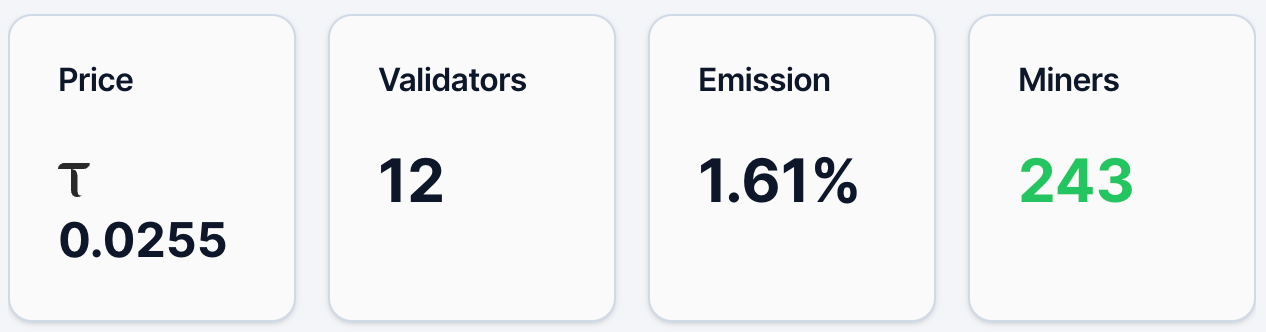
Figure 1. Gradients data.
Source: https://bittensormarketcap.com/subnets/56
Next is the emission incentive mechanism. In Bittensor’s framework, “emission” denotes a subnet’s real-time allocation weight of the network’s newly minted rewards. The Bittensor network continuously mints new TAO, distributing them across subnets according to weightings. Gradients’ current 1.61% weighting means it receives only a small fraction of the network’s total new emissions. This metric essentially reflects the market’s “voting outcome” via capital flows (e.g., staking) across subnets. Hence, 1.61% typically signals relatively limited market recognition and capital inflow—yet also implies meaningful headroom for future weighting growth. Regarding funding structure (liquidity pool), TAO accounts for just 2.19%, while Alpha dominates at 97.81%, indicating scarce external capital inflow and current dominance by internal subnet supply. Prices remain highly sensitive to new capital: additional TAO inflows could trigger pronounced amplification effects.
6. Competitive Landscape and Strengths & Weaknesses
6.1 Industry Positioning: Decentralized AutoML Training Infrastructure
Gradients occupies the niche of “AI training infrastructure + decentralized AutoML.” It aims to liberate model training from centralized platforms and achieve more efficient resource utilization and model optimization via networked mechanisms. In the Web2 sphere, this segment is already mature, led by industry standards like Google Vertex AI and AWS SageMaker—cloud-based, one-stop model training and deployment services. Yet their underlying architecture remains centralized. Gradients’ differentiation lies not in “more features,” but in fundamentally distinct logic: it repositions training from “platform service” to “network collaboration,” employing competitive mechanisms to filter optimal results—making it functionally closer to a market-operated training system.
6.2 Horizontal Comparison: Differences Between Web2 and Web3 AutoML
At a macro level, the distinction between Web2 and Web3 AutoML reflects two contrasting paradigms. Web2 prioritizes efficiency and stability—leveraging consolidated resources and engineering excellence to deliver predictable, mature service experiences. Web3, conversely, emphasizes openness and incentive design—introducing multi-party participation to enable model optimization to evolve organically through competition. Concretely, Web2 AutoML resembles “a powerful tool”: users delegate tasks to the platform, which internally searches for the optimal solution. Web3 AutoML—exemplified by Gradients—functions more like “an open market”: users post requirements, diverse participants propose solutions, and an evaluation mechanism filters outcomes. This divergence yields direct implications: Web2 offers greater stability and control but narrower optimization horizons; Web3 affords broader exploration space and higher theoretical ceilings, yet still requires maturation in reliability and robustness.
6.3 Gradients’ Differentiation Within Web3
Across today’s Web3 AI landscape, most projects focus on inference layers or AI agents, while dedicated “training infrastructure” initiatives remain scarce. Some projects attempt to combine compute or data networks to support training—but generally remain at the resource orchestration or compute-market level. Gradients distinguishes itself by moving beyond compute matching to embed “model optimization mechanisms” directly—introducing evaluation and competition frameworks that grant the training process intrinsic evolutionary capacity. This means Gradients tackles not just “where compute comes from,” but also “how to use it more efficiently.” Strategically, Gradients aligns more closely with a “results-oriented training network” rather than a pure compute market or toolkit platform—its defining distinction from most Web3 AI projects.
6.4 Core Strengths: Efficiency Gains Driven by Mechanism Design
Overall, Gradients’ strengths stem from its mechanism design. First, task abstraction lowers usage barriers: users obtain model outputs without deep involvement in complex training workflows, broadening its potential user base. Second, distributed compute eliminates dependence on any single cloud vendor, theoretically enabling a more elastic cost structure through competition. Most crucially, its optimization methodology differs fundamentally. By enabling parallel exploration across multiple participants and coupling it with rigorous filtering, Gradients delivers an alternative to traditional single-path optimization—allowing models to achieve superior performance faster. This “competition-driven optimization” constitutes its most fundamental advantage.
6.5 Potential Challenges
Model quality may suffer from instability. Decentralized training relies on multi-party participation: although this raises performance ceilings, it may also introduce result volatility. Compared to centralized systems, controllability carries inherent uncertainty. Second, enterprise-grade trust remains a hurdle. For corporate users, data security and verifiability of the training process are paramount—yet ensuring data isn’t misused and outcomes remain auditable in decentralized environments remains a critical challenge. Finally, Gradients’ operation heavily depends on its token economics. If TAO’s reward appeal declines, miner participation and overall network vitality may wane. Thus, its long-term sustainability hinges partly on whether its economic model can sustain a stable positive feedback loop.
7. Future Outlook: Can Decentralized AutoML Succeed?
At its current stage, Gradients remains early-stage. Its ultimate viability depends on several pivotal factors: foremost, whether it can sustainably attract authentic training demand—not merely participation driven by incentives; second, whether its decentralized approach can reliably produce usable—and potentially superior—model outputs; and third, whether its economic mechanism can establish a durable positive feedback loop, balancing compute supply and economic returns over the long term.
Viewed against the broader industry backdrop, AI training is bifurcating into two trajectories. One is the Web2 path, led by tech giants leveraging concentrated resources and engineering prowess to incrementally strengthen model performance—its advantages lie in stability and maturity. The other is the Web3 path exemplified by Gradients: using open networks and incentive structures to engage broader participation in model optimization, raising performance ceilings through competition. The former builds “stronger systems”; the latter constructs “self-evolving networks.”
From this vantage point, Gradients embodies a novel possibility: AI training transcends being purely a technical challenge—it becomes the convergence of “compute + data + market mechanisms.” Should this model prove viable, Gradients holds promise as the foundational training gateway for decentralized AI and a critical infrastructure pillar within the Bittensor ecosystem. Of course, this direction requires further validation over time—but it has already charted an evolution path for AutoML distinctly different from traditional approaches.
References
1. Bittensor Documentation: https://docs.learnbittensor.org
2. Gradients website: https://www.gradients.io/
3. Gradients: https://bittensormarketcap.com/subnets/56
4. Gradients X: https://x.com/gradients_ai
5. Taostats: https://taostats.io/subnets/56/chart
Join TechFlow official community to stay tuned
Telegram:https://t.me/TechFlowDaily
X (Twitter):https://x.com/TechFlowPost
X (Twitter) EN:https://x.com/BlockFlow_News


