Workers Who Bought AI Subscriptions and Fell Back into Poverty
TechFlow Selected TechFlow Selected
Workers Who Bought AI Subscriptions and Fell Back into Poverty
AI subscriptions have become the most covert assassins in the workplace.
 Navigating Web3 tides with focused insights
Author: Tian Mi
Proficiency in AI has become a hard requirement in the workplace.
The rule “Token consumption counts toward KPIs” has spread downward from Alibaba and ByteDance—even small startups with just dozens of employees have issued internal notices mandating universal AI adoption.
No one can quantify how much efficiency has actually improved. But workers’ wallets are shrinking first.
Not every company treats Token quotas as an office welfare benefit—like Alibaba does, distributing them freely. Most employers only assess outcomes, not costs. To avoid falling behind—or being laid off—workers must pay out of pocket, topping up one account after another.
AI subscriptions have become the workplace’s most stealthy assassin.
Wallets Can’t Keep Up
It’s not even mid-April, and Long Shen’s AI tool library already has another account running dry.
Long Shen is a front-end programmer at a major e-commerce firm. Hired through the 2024 campus recruitment cycle, he belongs to the company’s first cohort of “AI-native employees.” Since day one, he’s experimented with AI-assisted coding. Last year, he began paying for AI tools.
His first payment went to Cursor—the hottest AI coding tool among developers. Its standard monthly subscription on the official website costs $20; annual billing brings it down to $16/month.
That $16 doesn’t buy unlimited usage—it buys a monthly-resetting quota pool. Cursor charges based on actual token consumption. For complex tasks requiring multiple long-context conversations, the equivalent of $16 in tokens can be exhausted in just a few days.
The money is spent for work—but there’s nowhere to claim reimbursement. At his large corporate employer, slogans like “AI-driven productivity gains” echo loudly across internal emails full of grand declarations about “intelligent transformation.” Yet when it comes to execution—how Token quotas are allocated, or how much can be reimbursed monthly—no one mentions it. Workers foot the bill themselves.
Long Shen opens Xianyu (a Chinese secondhand marketplace) and types “Cursor” into the search bar. A list of items appears: “white accounts,” “ready-to-use accounts,” “dedicated accounts.” Like an underground rendezvous, he clicks one link—and the seller replies instantly: “Brand-new dedicated account; prorated refunds if banned within 30 days.”
Behind these links lie mostly gray-market shared accounts or suspiciously sourced top-ups. Long Shen sometimes wonders: Could these accounts be topped up using overseas stolen credit cards?
He hasn’t ruled out direct official purchases—but when work piles up, token consumption flows like water. To ensure output, his “arsenal” extends far beyond Cursor. ChatGPT Plus, Midjourney, various API services—he routinely spends over ¥1,000 per month, hitting ¥2,000 in his highest-spending month.
Paying to work means cutting corners wherever possible. After brief hesitation, Long Shen clicks “Buy”—despite the risk of account suspension.
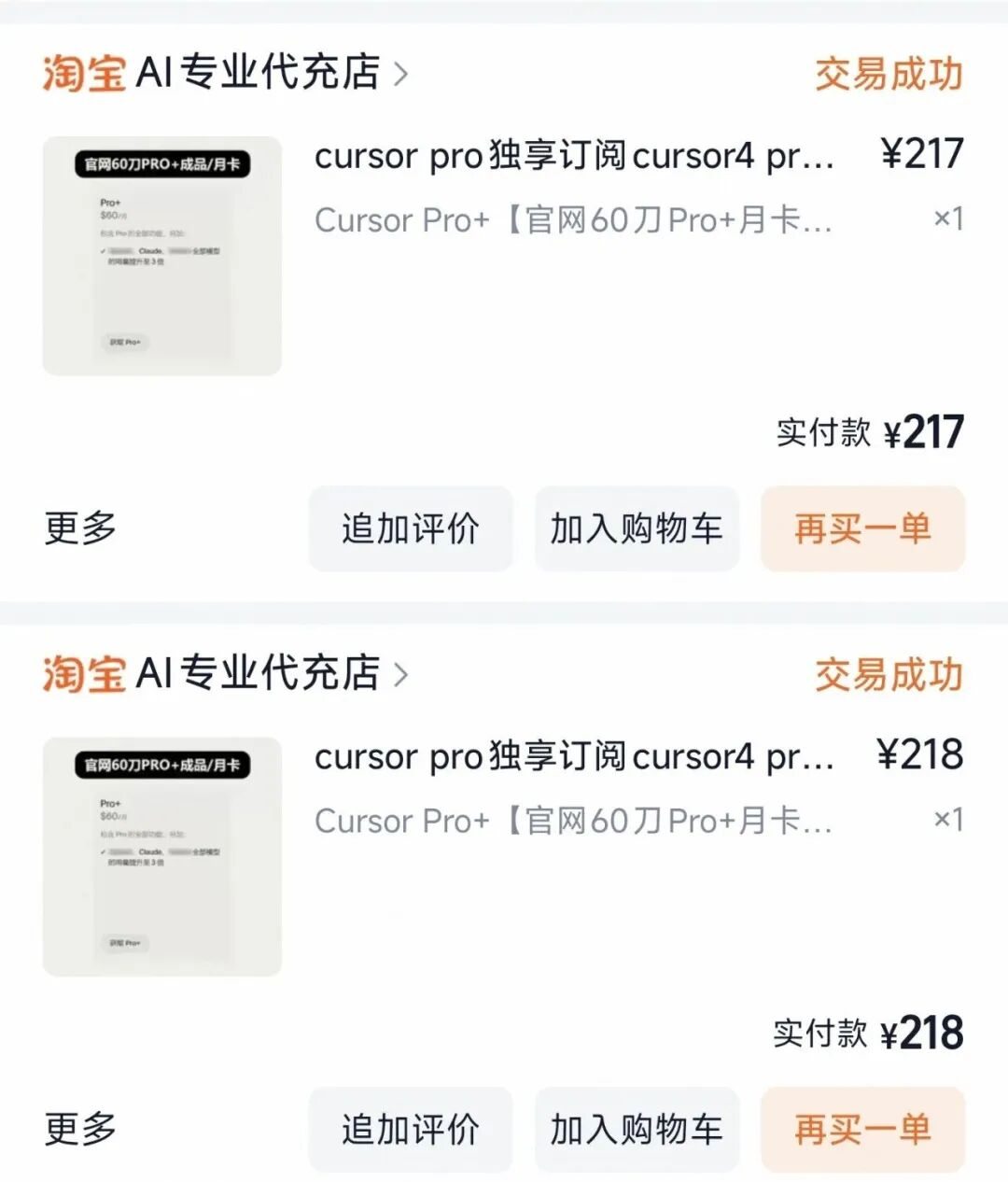
Figure | Part of Long Shen’s payment records
The expense stings—but he’s done the math: spending an extra ¥1,000 per month amounts to only ~3% of his salary, yet helps him complete 80–90% of his coding tasks. That ROI leaves little room for hesitation.
After subscribing, Long Shen’s workflow transformed entirely. He once took on a graphics-related project—an area with steep entry barriers for most front-end engineers, rarely encountered in daily work. Starting virtually from zero, he didn’t explain his lack of background to management. Instead, he dove straight in using AI—and delivered results over three months.
“Managers don’t read code—they only check whether pages run and features work.” The project launched successfully, earning him managerial recognition. Only after stabilization did he circle back to fill knowledge gaps.
The company does provide free internal coding tools, which Long Shen tried briefly—but found them clunky. They only integrate domestic models, lacking core capabilities of leading international ones, leaving him constantly constrained. After struggling for a while, he abandoned them entirely—resuming personal payments for external tools.
He also tried promoting Cursor within his team. But colleagues, having exhausted their free quotas, refused to pay further.
One nearly 40-year-old colleague waited until the company mandated AI adoption across the board before urgently approaching him: “How do you use this thing? Teach me.”
Not everyone spends as willingly as Long Shen.
“Sometimes I really think life would be fine without AI,” Peng Peng murmurs while calculating her top-up amount—juggling corporate AI bans and managerial demands like a guerrilla fighter.
She works as a designer in R&D at an automotive company with extremely strict confidentiality rules—all external AI websites are blocked outright. Attempting access via work computers triggers immediate connection failures.
Last August, everything changed after her manager discovered ChatGPT. Having seen AI-generated images firsthand, he dismissed all Pinterest and Instagram-sourced visuals as “second-hand”—already widely circulated online, raising risks of design duplication.
To him, AI images exude forward-looking appeal—perfect for designs that must feel avant-garde and eye-catching. In meetings, he now directly requests AI-generated visuals, speaking with casual authority—as if it were merely a finger-tap away.
Trapped in the middle, Peng Peng resorts to generating images on personal devices, saving them to her personal email, then transferring them to her work computer for editing and use. This roundabout process is tedious and time-consuming—with no viable alternative.
She subscribed to Midjourney, JIMENG, and Keling, gradually learning each tool’s quirks. Her most-used tools are Doubao and Midjourney: Doubao is free and beginner-friendly—ideal for basic recoloring and adjustments—but its aesthetic sensibility feels flat. Midjourney delivers superior visual quality, perfect for high-fidelity renderings—but it’s notoriously difficult to control; tweaking one detail often ruins the entire image.
One month, she spent ¥500–600 across several accounts. She requested reimbursement from her manager—receiving only one reply: “No budget for that.”
She pays out of pocket—yet her workload keeps growing. Once her manager tasted AI’s productivity gains, his appetite expanded rapidly. Previously, revisions allowed two-day turnaround windows; now, he expects doubled speed—submitting edits today and demanding new versions by tomorrow morning. Deliver ten images? He’ll ask for twenty.
“Humans aren’t AI—and certainly not machines.” Peng Peng complains aloud, but knows deep down: managers care only about outcomes—not processes, nor hidden costs.
She sometimes reflects: Edison invented the light bulb—but people didn’t gain more leisure at night; instead, they simply worked longer hours.
Once, her manager demanded a specific material texture rendering. Peng Peng fed the prompt repeatedly into AI—generating over thirty variants—none fully meeting specifications.
Finally, she shut down AI, opened Photoshop, and manually stitched together sections from multiple outputs—adjusting colors and details painstakingly over two hours—before daring to submit the final version.
Subscription Assassins Disrupt the Workplace
Li Huahua has grown increasingly paranoid lately.
Initially, AI’s emergence brought her no pressure. As a programmer at a state-owned enterprise, she operates under strict confidentiality protocols restricting external tools. She viewed AI as someone else’s concern—irrelevant to her own role.
Until recently, late one night, a friend called venting. Working at a private firm, he’d secretly subscribed to AI services this month to boost efficiency. After delivering tangible results, he eagerly reported to his boss—only to find his boss responded not with praise, but by raising departmental KPIs. Now each person must handle twice the previous workload.
After listening silently, Li Huahua blurted out: “Aren’t you exactly what netizens call a ‘code traitor’? You chase personal glory while dragging down your whole team.”
Her friend bristled: “Then why don’t you start using it too?”
After hanging up, Li Huahua lay awake all night. The next day, she spent the entire day researching how to subscribe to Codex.
But once subscribed, her anxiety deepened. Her friend’s experience served as a mirror: AI-driven efficiency gains aren’t always beneficial—she might soon become the poster child for productivity, triggering KPI hikes or even headcount reductions. And she’d already received low performance ratings for two consecutive months due to strained relations with her manager.
“When not using AI, I fear falling behind. When using it, I worry others are too. It feels like danger lurks everywhere—but I can’t pinpoint where it’s coming from.”

Figure | After adopting AI, Li Huahua feels constantly besieged
Since then, she’s begun discreetly observing colleagues. Whenever someone’s pace suddenly accelerates, she instinctively wonders: Did they secretly subscribe to AI? She’s never asked anyone—and of course, no one would answer honestly.
While Li Huahua fears layoffs, Long Shen’s company has launched aggressive hiring for AI talent this year.
Long Shen briefly assisted with recruitment—reviewing so many resumes daily that his head ached. The company explicitly requires candidates to demonstrate AI project experience and real-world implementation cases. Yet those sitting in the interviewer’s seat are veteran engineers with 10–20 years’ experience—whose entire AI knowledge may consist of letting their kids chat with Doubao about Ultraman.
AI boosted Long Shen’s productivity, yet he realized the company was essentially letting novices lead experts.
To management, however, this poses no issue. They hold rallies and presentations, cascading KPIs downward—tasking engineers with exploration, delivery, and reporting—while themselves neither learning nor purchasing subscriptions.
“They treat us like Agents,” Long Shen sighs. “Just issue commands and consume us—doing nothing themselves.”
AI genuinely saved him time—but that time morphed into another form of invisible labor: performing diligence.
Now he finishes his full day’s work by mid-morning. To avoid appearing idle—and receiving new assignments—he sits motionless at his desk, feigning busyness. Company computers are monitored—he dares not even connect side gigs. Often idle, yet unable to leave.
This hollow sensation unsettles him deeply—sparking involuntary thoughts: Should he invest in stocks? Buy gold? Is he destined to keep working until forced out at age 35?
He knows clearly: AI’s golden window is closing fast. In 2024, he leveraged AI to stand out and earn recognition; by 2026, when AI use becomes ubiquitous across the company, no individual will retain competitive advantage through it.
Like school days—when everyone attends tutoring, overall efficiency rises, homework loads increase accordingly—but no one gets to leave class earlier.
At another major tech firm, programmer Zhang Mu faces “AI over-praise”—a managerial trap.
One day, the department’s senior leader posted March’s Token consumption leaderboard in the work group chat—announcing that probation confirmations, KPI evaluations, and promotions would all hinge on Token usage, with low users potentially replaced.
Zhang Mu inexplicably topped the list. His boss publicly praised him and asked him to share AI best practices post-holiday. His scalp prickled instantly—over half his Token usage had gone toward organizing personal data and note-taking, unrelated to work.
He felt exposed on a hot plate. Forced to prepare a presentation, he dared not reveal his truly effective methods—hard-won insights refined over weeks. “I feel increasingly replaceable. Sharing them would erase my last competitive edge.”
This pressure is spreading industry-wide. Previously, free tools like Doubao and Kimi sufficed—chatting, editing documents, handling routine tasks.
But that fallback is vanishing rapidly. Kimi introduced paid plans last September—starting at ¥39/month; Doubao launched its App Store pricing page this May—Standard Edition ¥68, Enhanced Edition ¥200, Professional Edition ¥500.
The era of “free AI assistants” is ending before our eyes. Want to use them? Pay up.
No Stopping Now
Before launching his startup, Jin Tu never imagined spending so much on AI.
With years of experience in brand marketing content, he used Doubao and Kimi like most people—chatting, editing copy, researching—covering daily needs adequately.
Then one day, he saw a friend conversing with AI inside a code editor—and realized AI could generate local documents directly, saving each revision separately, eliminating endless scrolling, copying, and pasting within chat windows.
Trying it himself unlocked a new world.
From then on, he began applying AI to creative and systematic tasks. He wanted to compile all his past WeChat Official Account articles into a knowledge base for AI—but WeChat’s anti-scraping measures prevented direct extraction. He described the need to Codex, who built a custom browser extension in just 2 minutes and 25 seconds. Clicking it on any article instantly exports the content as a local Markdown file.
Later, he built a personal knowledge base workflow. Articles, quotes, long-form insights—anything he encounters online—he drops in casually. AI automatically organizes them into structured notes—including his own analysis and commentary.
Most astonishingly, his personal website was built entirely by AI from scratch—he wrote zero lines of code himself. Now updated 577 times, it draws thousands of visitors. Each update requires only one command: “Go ahead.” AI handles verification, modification, submission—and generates detailed operational logs.

Figure | Website designed by Jin Tu using AI
Thanks to this site, Jin Tu placed well in an AI startup competition—and secured government entrepreneurship support resources.
Maintaining this full toolchain requires substantial monthly AI subscription fees—but he considers it worthwhile. Quoting an AI entrepreneur: “Our $200/month Claude Pro subscription equals hiring a software engineer earning a million-yuan annual salary.”
“You must pay to access true AI.” In his view, most non-paying users only experience diluted, compromised AI. Using “real AI” is like buying a premium handbag—you sense its superiority over ordinary ones, yet struggle to articulate precisely why.
He’s already mapped out his next move: soon, he’ll launch his startup in Hangzhou.
Peng Peng still tops up her AI subscriptions occasionally.
Her manager specifically praised her growing AI proficiency—urging her to continue. Yet she feels uneasy: half the AI-generated output isn’t truly hers. While inspiration originates with her, credit for the final image easily shifts to AI. For designers, winning approval for selected concepts is paramount.
Does her manager truly value her ideas—or AI’s? She remains uncertain.
Li Huahua’s “suspended anxiety” has finally settled.
Even her nearly 50-year-old department head now passionately discusses AI-driven efficiency in meetings. Though “one person doing two people’s work” hasn’t been mentioned yet, Li Huahua knows it’s inevitable. Every day, she quietly activates her subscription—and quietly uses it—waiting for that moment.
Long Shen continues buying accounts on Xianyu. With AI’s assistance, he earned three promotions within 18 months—and last year received the company’s top-tier A-level performance rating, plus a nine-month bonus.
That’s AI’s real power: it doles out rewards incrementally—gradually reshaping your workflow—making you willingly hand over money, then cultivating dependency.
After writing tens of thousands of lines of code with AI, Long Shen finds he can’t function without it.
“I can’t possibly reread and take over the tens of thousands of lines AI wrote before me. Once this cycle begins, exiting is nearly impossible.”
For him, the question is no longer whether to pay—but rather, technical dependence has taken root. Maintenance work must remain with AI; stopping would cost far more than continuing subscriptions.
Join TechFlow official community to stay tuned
Telegram:https://t.me/TechFlowDaily
X (Twitter):https://x.com/TechFlowPost
X (Twitter) EN:https://x.com/BlockFlow_News