








This AI relay station business is so lucrative that even the U.S. President’s family has joined in.
TechFlow Selected TechFlow Selected
This AI relay station business is so lucrative that even the U.S. President’s family has joined in.
Spend $10,000 on an AI token and get a Mar-a-Lago入场券 🤡
 Navigating Web3 tides with focused insights
Author: Kuli, TechFlow
Spend $10,000 on an API key—and get a dinner invitation to Mar-a-Lago in Florida, where your tablemate might be Donald Trump Jr.
This isn’t a joke.
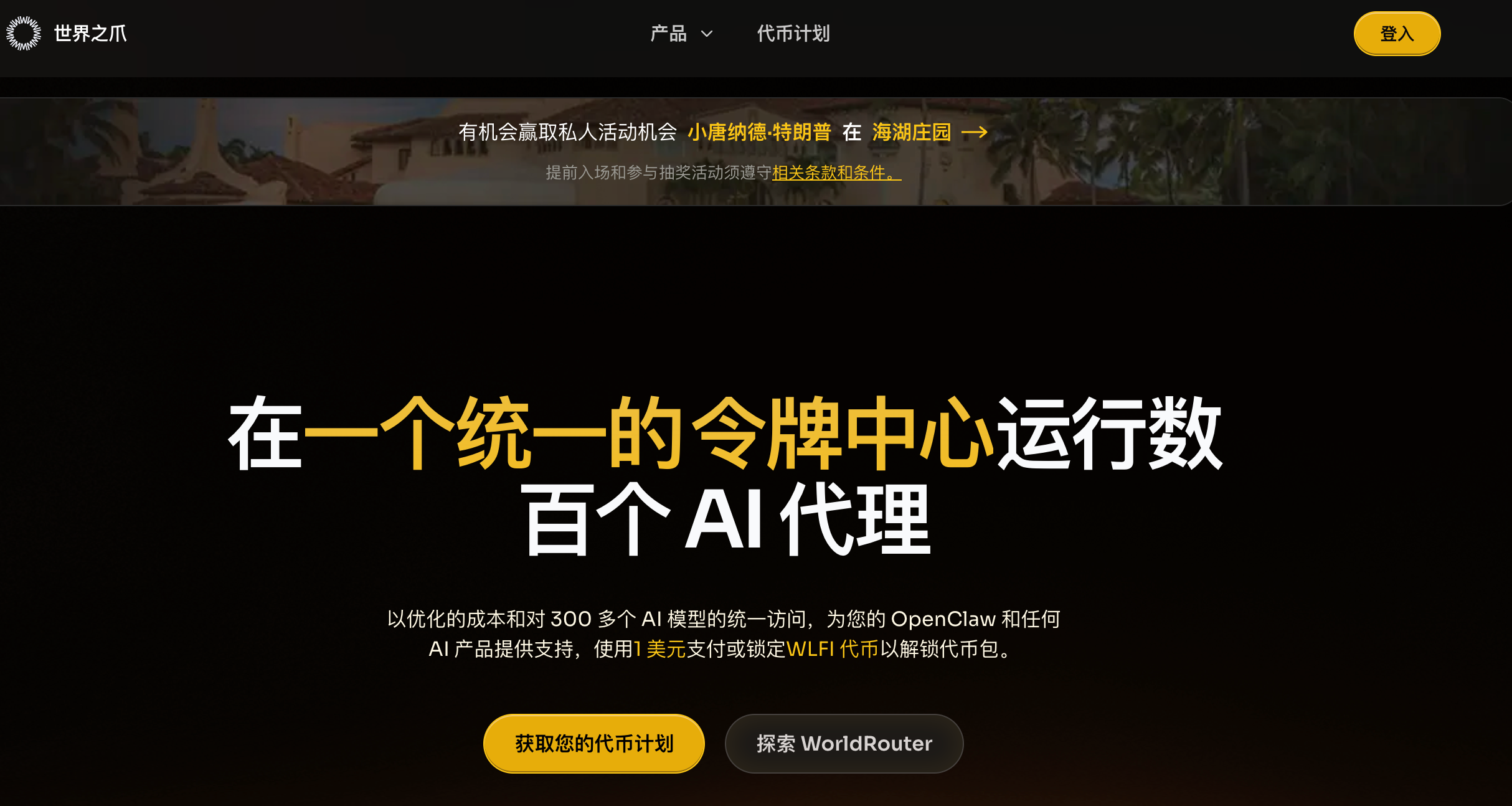
On May 5, World Liberty Financial (WLFI), a crypto project co-founded by the Trump family (hereinafter “WLFI”), officially reposted a new product called WorldClaw; Donald Trump Jr. then shared it on his social media accounts.
WorldClaw bills itself as the first AI project within the WLFI ecosystem and positions itself as an “AI Agent Operating System.”
Experience shows that to gauge whether a business is gaining traction, you need only check whether industry leaders are participating. At its core, this project is essentially an AI proxy service.
WorldClaw’s flagship feature currently live is WorldRouter, which aggregates APIs from major AI models—including Claude, GPT, Gemini, and Qwen—into a single unified interface. Register an account, obtain an API key, and instantly switch between all supported models.
According to its official website, WorldRouter has already integrated over 60 models, with plans to expand coverage to more than 300.
Per WorldClaw’s official site, WorldRouter’s pricing is roughly 30% lower than both the public rates offered by individual model providers and those listed on OpenRouter.
Take Claude Sonnet 4.6 as an example: Anthropic charges $3 per million input tokens, while WorldRouter charges just $2.10. How it achieves this discount remains unexplained on the website…
No KYC is required. No overseas phone number or credit card needed. To use its proxy service, payment is accepted in only one form: USD1—the dollar-pegged stablecoin issued by WLFI itself.
The product is sold in four tiers:
The cheapest tier costs $9.90 for 1,000 AI credits; the Standard tier is $99 for 10,000 credits; the top-tier Max package costs $9,999 (or requires staking 2.5 million WLFI tokens) for 1 million AI credits plus an unnamed hardware device whose brand and specifications remain undisclosed. A small note beneath the product image on the website reads: “Illustrative image only; actual product may differ.” Delivery is scheduled for Q3 2026.
We aren’t even sure what this hardware does.
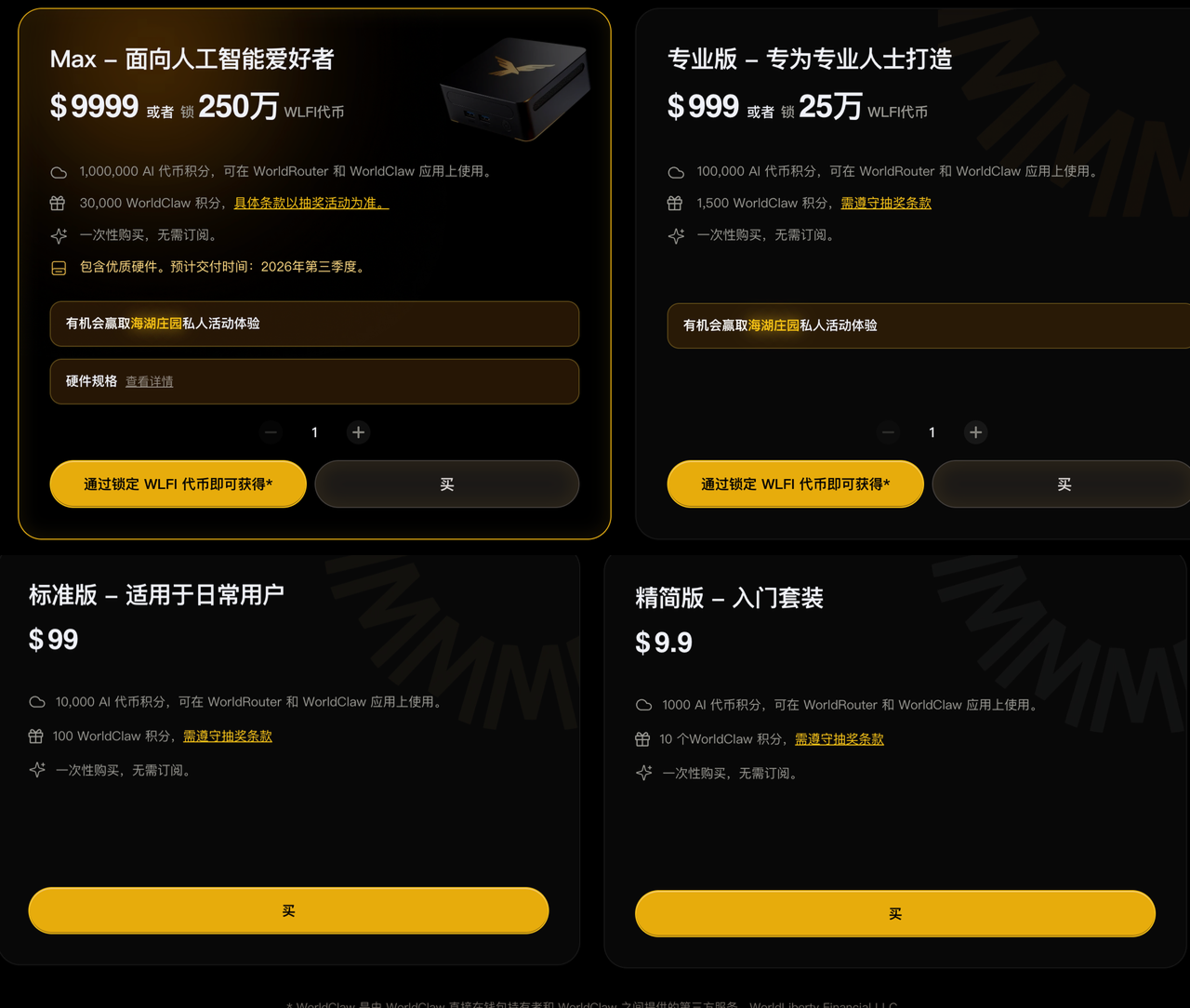
However, the most compelling perk of the Max package is entry into a raffle for a private dinner at Mar-a-Lago—potentially granting you a seat at the same table as the Trump family.
The AI proxy business is nothing new: according to TokenNav’s directory, at least 84 similar domestic and international services exist. But WorldClaw is the first to bundle AI usage quotas with access to a presidential-family dinner.
In such an overcrowded market, how much competitive moat can a dinner invitation really build?
It’s Brutally Competitive
How profitable is the AI proxy business?
The current industry benchmark is OpenRouter, founded by Alex Atallah, former CTO of OpenSea. Public reports indicate that a16z led a $40 million Series A last year, valuing the company at $500 million. With fewer than ten employees, OpenRouter reportedly generates over $100 million in annual revenue, taking a 5% cut on every API call.
OpenRouter proves this business model can scale. Yet competition beneath it is far fiercer—and bloodier—than most imagine.
In a March report by TechFlow covering the token-driven gold rush sparked by OpenClaw, we noted that some proxy operators earned over $1 million in monthly profits. A Tencent News investigation identified three primary revenue streams for AI proxy services: access fees, quota management fees, and information asymmetry premiums.
Domestic proxy services operate far more aggressively than OpenRouter.
According to evaluations posted on Zhihu, certain platforms offer Claude Sonnet 4.6 at just 0.3x the official price—roughly RMB 0.45 per million tokens.
How do they achieve this?
By bulk-purchasing subscription accounts and using browser automation and reverse engineering to wrap web-based chat interfaces into API endpoints. Users believe they’re calling official APIs—but behind the scenes, requests may be routed through rotating cookie pools.
Such practices raise clear compliance concerns. Public reports indicate that China’s National Computer Virus Emergency Response Center has repeatedly warned that AI proxy services carry multiple legal risks. Yet demand remains overwhelming—and prices so low—that users keep flooding in.
Earlier, Sun Ge’s B.AI entered the proxy space; now even Fu Sheng has joined. Cheetah Mobile’s EasyRouter launched this year, touting across-the-board discounts of 15%, with select models discounted up to 75%...
Now reconsider WorldClaw.
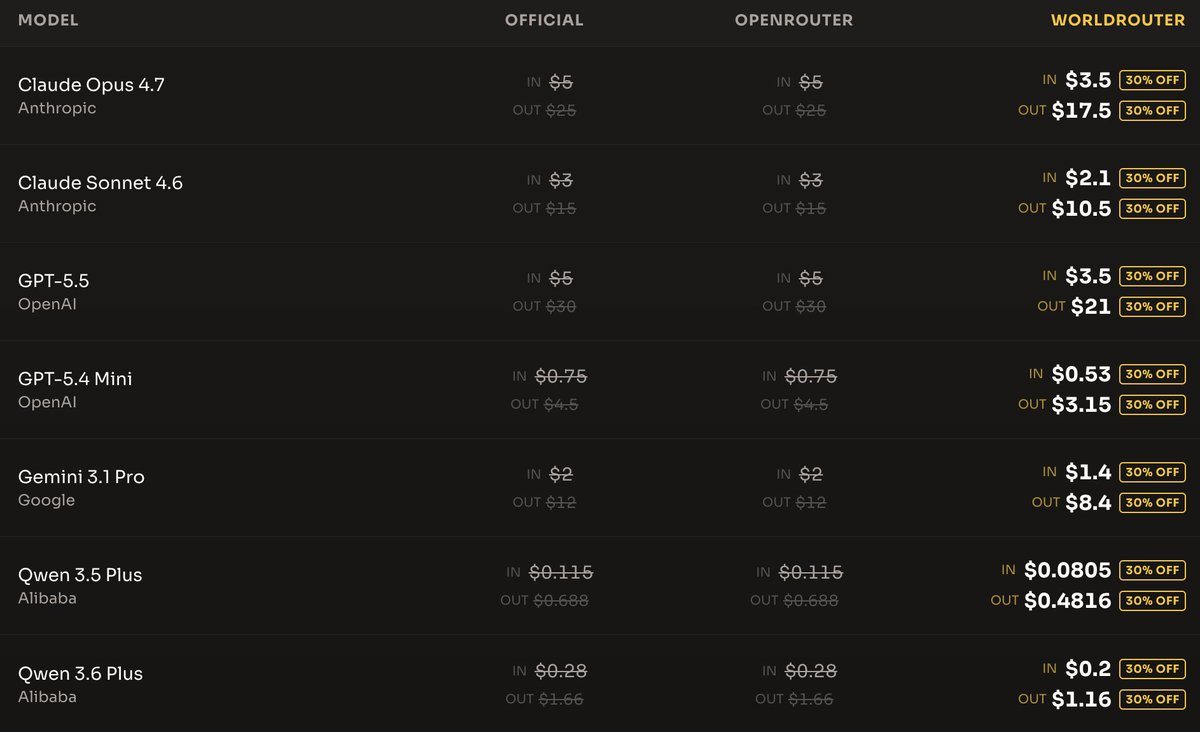
Its claim of being 30% cheaper than official pricing appears reasonable among legitimate channels—but in the broader proxy market, this price point offers zero competitiveness. A domestic user seeking affordability and reliability has dozens of more mature, cheaper alternatives.
Clearly, WorldClaw isn’t targeting the same user base as these other proxies. In fact, it may not even intend to compete in the proxy space at all.
The Real Target Isn’t the Proxy—it’s the Stablecoin
OpenRouter accepts credit cards; domestic proxies accept Alipay and WeChat Pay; some even accept USDT. WorldClaw accepts only one payment method: USD1.
This choice alone reveals the answer.
USD1 is WLFI’s dollar-pegged stablecoin, launched in March 2025. According to official documentation, it is custodied by BitGo Trust and backed 1:1 by U.S. Treasury securities, dollar-denominated bank deposits, and cash equivalents. It currently runs on Ethereum, BNB Chain, and Solana.
In short, WLFI aims to become its own USDT.
WorldClaw’s entire payment architecture revolves around USD1: Buy AI credits with USD1. Prefer not to spend? You can instead stake WLFI tokens to unlock quotas—250,000 tokens for the Pro tier, 2.5 million for the Max tier. Both paths converge on the same goal: locking users into WLFI’s token ecosystem.
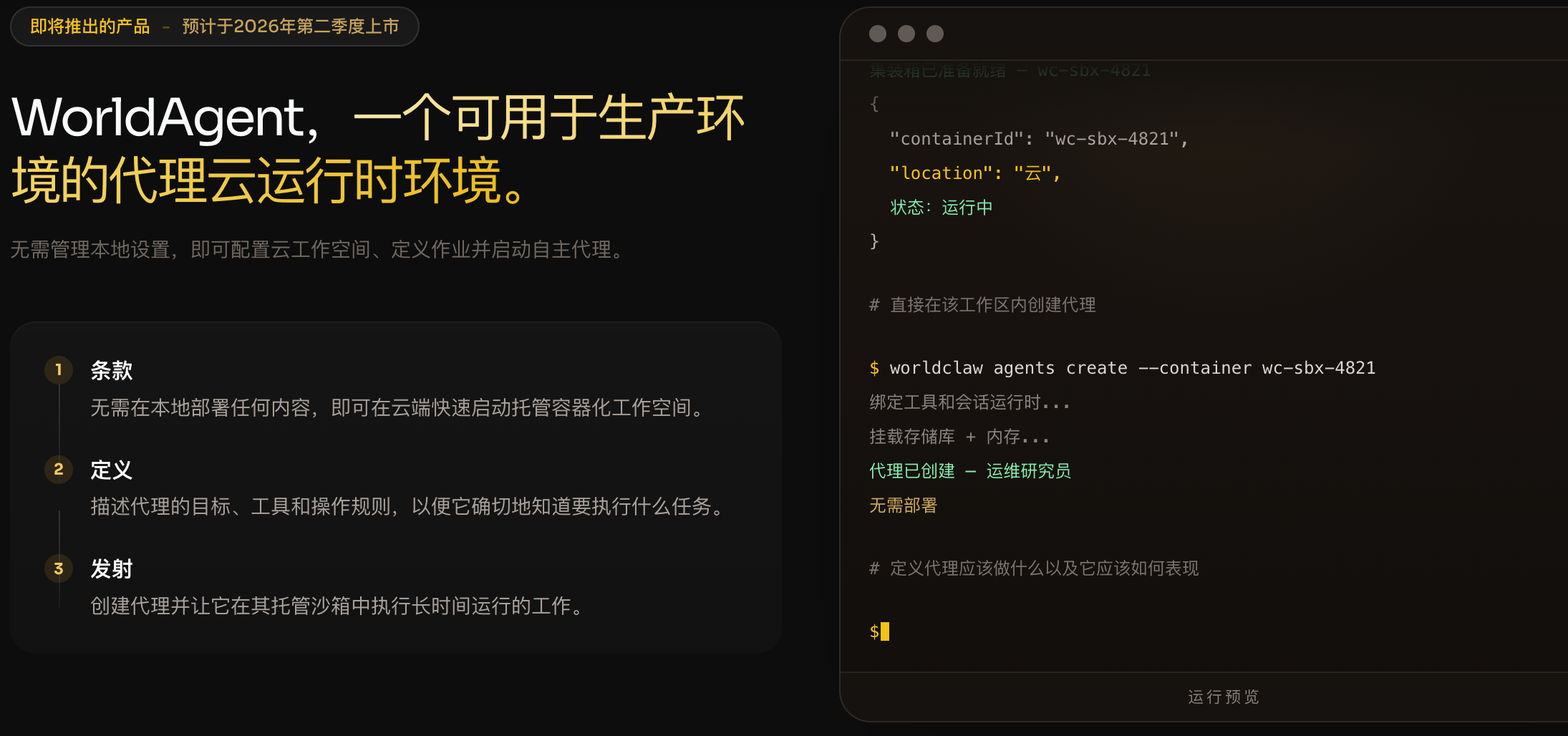
Even more noteworthy is something called the AgentPay SDK. Integrated directly into WorldClaw’s product, it enables AI Agents to autonomously execute payments using USD1 while performing tasks. If successfully deployed, every AI-initiated model call or automated workflow execution would generate an on-chain USD1 transaction.
Machines don’t care about payment tools—whichever gets embedded first becomes the default.
Public reports indicate WLFI has filed an application with the U.S. Office of the Comptroller of the Currency (OCC) for a national bank trust charter. Upon approval, WLFI would be authorized to issue, custody, and redeem USD1 under its own regulated entity—eliminating reliance on third-party custodians. This charter is intended to transform USD1 from a project token into a compliant financial infrastructure.
Connect these dots, and WorldClaw’s business logic becomes clear.
Existing proxy services compete on the same dimensions: model coverage, price, and latency.
WorldClaw competes on something else entirely: the payment layer. Every user purchasing AI credits must first acquire USD1. The more they use it, the greater USD1’s on-chain circulation volume grows.
AI demand serves merely as the entry point; stablecoin adoption is WLFI’s true north star metric.
So view WorldClaw not as an AI company adding crypto payment functionality—but as a crypto project leveraging AI as its distribution channel.
A Turbulent Time
On April 22, Justin Sun formally sued WLFI in the U.S. District Court for the Northern District of California, alleging extortion and claiming WLFI is “on the verge of collapse,” while publicly questioning whether USD1 holds sufficient reserves.
On May 4, WLFI countersued, accusing Sun of orchestrating a “coordinated smear campaign” by hiring influencers and bots to spread false information aimed at depressing the token’s price.
On May 5, WorldClaw launched.
Beyond litigation, WLFI’s governance structure remains a focal point of community controversy. According to Taiwan-based blockchain media ChainNews, WLFI’s largest single wallet controls nearly 13% of voting power, while the top four wallets collectively hold approximately 40%.
Previously, WLFI’s treasury pledged 5 billion of its native tokens as collateral to borrow $75 million in stablecoins from Dolomite—a lending platform co-founded by WLFI’s own co-founders—a move criticized by the community as indirect token monetization.
This is the ecosystem underlying WorldClaw.
AI proxy services operate on a prepaid model: users deposit funds upfront before consuming services. Trust is therefore foundational—you must trust the platform won’t exit-scam, that model calls are genuine, and that deposited funds will reliably convert into usable service.
For a small domestic proxy operator, this trust rests on the operator’s reputation and community oversight. For WorldClaw, it rests on WLFI’s ecosystem credibility. And WLFI’s credibility is currently being pulled in opposite directions—in federal court in San Francisco and in Delaware state courts—by plaintiff and defendant alike.
Put plainly, the technical capability to wrap and resell APIs is not scarce. What’s scarce is convincing users to hand over their money first.
WorldClaw’s answer is the Trump family name—and a Mar-a-Lago dinner invitation. Whether that answer suffices is for each person to decide.
Join TechFlow official community to stay tuned
Telegram:https://t.me/TechFlowDaily
X (Twitter):https://x.com/TechFlowPost
X (Twitter) EN:https://x.com/BlockFlow_News
 深潮TechFlow


