








Earnings Beat Expectations; $222 Million Raised for Blockchain Launch—Can Circle Escape the “Interest-Stock” Valuation Logic?
TechFlow Selected TechFlow Selected
Earnings Beat Expectations; $222 Million Raised for Blockchain Launch—Can Circle Escape the “Interest-Stock” Valuation Logic?
Circle is attempting to move away from its valuation narrative centered solely on “USDC interest income” and transform into an infrastructure platform company.
 Navigating Web3 tides with focused insights
Author: Claude, TechFlow
TechFlow Digest: Circle released its Q1 2026 financial results: adjusted EPS of $0.21 beat expectations, but revenue of $694 million missed estimates. USDC’s circulating supply reached $77 billion, and on-chain transaction volume surged 263% year-on-year to $21.5 trillion. On the same day, Circle announced a $222 million token pre-sale for its Arc blockchain at a $3 billion fully diluted valuation, led by a16z with a $75 million investment; BlackRock, Apollo Global Management, and others also participated. The company also launched Agent Stack—a developer toolkit enabling AI agents to autonomously hold USDC, initiate payments, and invoke services. CRCL stock surged 16% to $131.76 that day, up 66% year-to-date.
Circle is undergoing its most intense strategic rollout since its IPO.
On May 11, the world’s second-largest stablecoin issuer—USDC—unveiled three major announcements in a single day: its Q1 2026 financial results, the successful completion of the Arc blockchain token pre-sale, and the launch of Agent Stack, a new infrastructure toolkit designed for AI agents. According to Cointelegraph, CRCL closed nearly 16% higher at $131.76—the highest since March 18—and its year-to-date gain widened to 66%, valuing the company at approximately $35 billion.
In an interview with CNBC, Circle CEO Jeremy Allaire stated, “We’re becoming a broader internet platform company—we’re entering the operating system business.” He positioned Arc as a multi-stakeholder distributed network, drawing analogies to mobile operating systems and cloud platforms.
Viewed together, these three developments point to a single conclusion: Circle is actively seeking to move beyond its current “USDC interest income–only” valuation narrative and pivot toward becoming an infrastructure platform company.
Financial Results: Revenue Misses Expectations, Profits Beat Estimates, USDC Transaction Volume Up 263%
According to CoinDesk, Circle’s Q1 2026 revenue totaled $694 million, up 20% year-on-year but below Wall Street’s consensus estimate of ~$715 million. Adjusted EPS came in at $0.21—exceeding analysts’ forecast of $0.17. Adjusted EBITDA stood at $151 million, up 24% year-on-year. Net income was $55 million, down 15% year-on-year, primarily weighed down by post-IPO equity-based compensation expenses and a 76% increase in operating expenditures.
However, key operational metrics were strong.
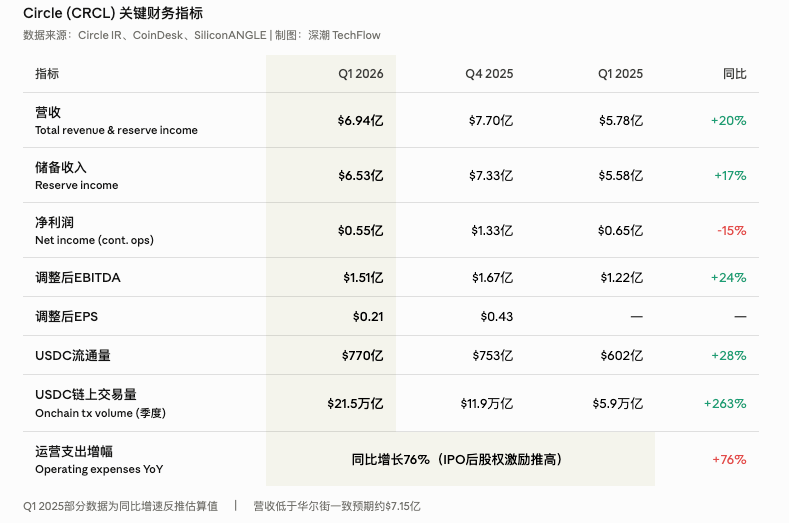
As of the end of Q1, USDC’s circulating supply reached $77 billion, up 28% year-on-year. More notably, on-chain USDC transaction volume hit $21.5 trillion for the quarter—up a staggering 263% year-on-year. According to a Mizuho analyst report, USDC’s adjusted transaction volume for 2026 to date stands at approximately $2.2 trillion—surpassing Tether’s USDT (~$1.3 trillion) and capturing ~64% market share of adjusted stablecoin transaction volume, marking the first time since 2019 that USDC has led on this metric.
The core reason behind the revenue miss is clear: interest rates. Over 95% of Circle’s revenue comes from interest earned on USDC reserve assets. Reserve income for Q1 totaled $653 million, up 17% year-on-year. However, the reserve yield declined by 68 basis points year-on-year to 3.8% in Q4 2025. The downward pressure of the rate-cutting cycle on Circle’s revenue is now gradually materializing. Even as USDC’s circulating supply continues expanding, falling interest rates remain a looming threat. This is precisely the fundamental driver pushing Circle to urgently articulate a “second growth vector” story.
Arc Token Pre-Sale: Building Its Own Public Blockchain, $3 Billion Valuation
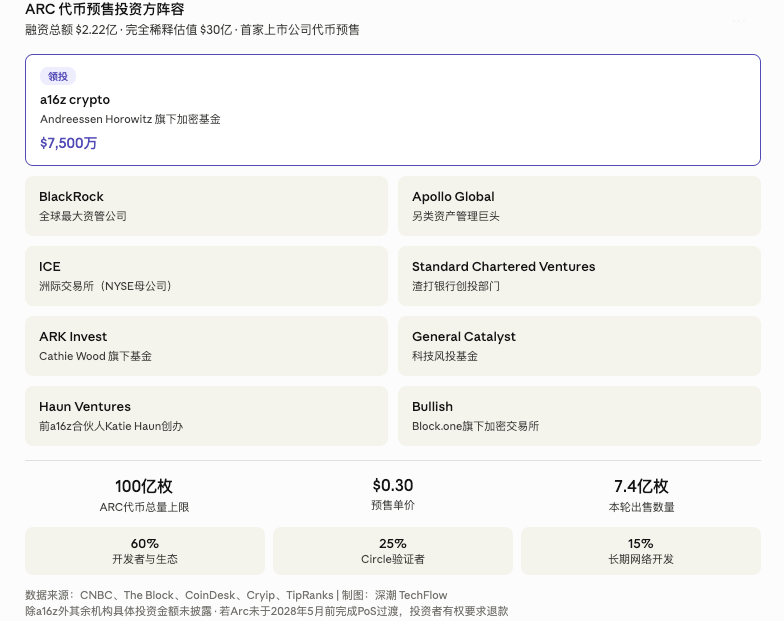
Simultaneously disclosed with the earnings report was the landmark announcement of the Arc blockchain token pre-sale. According to an exclusive CNBC report, Circle sold 740 million ARC tokens at $0.30 each, achieving a $3 billion fully diluted valuation and raising $222 million. Circle is the first publicly listed company to conduct a token pre-sale.
a16z crypto led the round with $75 million. Other participants included an elite lineup: BlackRock, Apollo Global Management, Intercontinental Exchange (ICE), Standard Chartered Ventures, ARK Invest, General Catalyst, Haun Ventures, and Bullish.
Currently, USDC relies heavily on third-party networks—including Ethereum and Solana—for settlement, and depends on distribution partners such as Coinbase to reach users. Building its own public blockchain signals Circle’s ambition to exert greater control over the foundational infrastructure underpinning USDC. From a defensive standpoint, with the GENIUS Act already signed into law and the CLARITY Act scheduled for its initial vote this week before the Senate Banking Committee, regulatory clarity for stablecoins is lowering industry entry barriers—potentially enabling banks and fintech firms to launch their own dollar-pegged tokens. By building its own network, Circle aims to secure a first-mover advantage at the infrastructure layer before this competitive landscape fully crystallizes.
In its earnings report, Circle explicitly noted that its current financial guidance does not yet incorporate “future Arc-related revenue streams,” implying Arc could become an independent revenue source beyond USDC.
Agent Stack: When AI Agents Become “Customers”
The third major announcement unveiled the same day was Circle Agent Stack—a financial infrastructure toolkit purpose-built for AI agents.
According to Decrypt, Agent Stack comprises four core components: Agent Wallets enable AI agents to autonomously hold assets; Circle CLI empowers developers and AI agents to build applications on the Circle platform; Agent Marketplace allows AI agents to browse, evaluate, and pay for services offered by other agents; and Nanopayments—built atop Circle Gateway—enables gas-free USDC transfers as low as $0.000001.
Allaire stated in the press release: “Financial infrastructure has historically been built for humans—with manual onboarding, approval, and payment processes—never designed for autonomous software. Agent Stack is our first full service suite built specifically for AI agents themselves—not just for developers and enterprises.”
Circle is betting on a machine-to-machine (M2M) payments future: AI agents transacting autonomously, hiring one another for services, and settling instantly on demand—all powered by USDC.
Yet Circle isn’t alone in this space. Recently, Amazon partnered with Coinbase and Stripe; Google Cloud teamed up with the Solana Foundation; and MoonPay also launched similar AI agent–focused stablecoin payment solutions.
Can a $35 Billion Valuation Hold?
CRCL currently trades at a market cap of ~$35 billion, with a forward P/E ratio of ~135x—far above the sector median of ~33x. Citigroup analyst Peter Christiansen set a $243 target price; Bernstein’s Gautam Chhugani assigned $190; and all 12 analysts tracked by TipRanks issued “Buy” ratings, with a consensus target price of $138.50.
But some are applying the brakes. Compass Point downgraded CRCL to “Sell” in April, warning that gross margins are narrowing in the first half of 2026 due to a shift in USDC supply toward lower-margin use cases. Even per management guidance, non-reserve revenue ($150–$170 million annually) remains negligible relative to the reserve-income engine. Whether Arc can evolve from whitepaper to a real revenue-generating business line will be the critical validation point in H2 2026.
William Blair analyst Andrew Jeffrey told clients that Circle stock may “remain volatile in the near term,” but highlighted multiple positive catalysts stemming from its “significant stablecoin commercial advantages.”
CRCL had already surged nearly 20% on May 4 when the bipartisan compromise version of the CLARITY Act was finalized. This week’s preliminary Senate Banking Committee vote represents the next key catalyst. Some analysts view the bill as effectively providing Circle with a “regulatory shield”: compliance requirements allow Circle to retain reserve income instead of distributing it to users—preserving profitability under regulatory cover.
With all three cards played, Circle’s valuation narrative has shifted—from a “stablecoin interest income stock” to an “infrastructure platform + AI agent economy gateway.” Whether this narrative holds depends on actual adoption following Arc’s mainnet launch and Agent Stack’s competitive performance in the M2M payments arena.
Join TechFlow official community to stay tuned
Telegram:https://t.me/TechFlowDaily
X (Twitter):https://x.com/TechFlowPost
X (Twitter) EN:https://x.com/BlockFlow_News
 深潮TechFlow


