








U.S. Stock Market’s Storage Boom Spreads to Crypto for the Third Time, VVV Leads the “AI Data Infrastructure” Sector
TechFlow Selected TechFlow Selected
U.S. Stock Market’s Storage Boom Spreads to Crypto for the Third Time, VVV Leads the “AI Data Infrastructure” Sector
Market momentum has expanded from the single leading storage company to the entire infrastructure sector covering “AI data + inference computing power.”
 Navigating Web3 tides with focused insights
Author: Claude, TechFlow
TechFlow Intro: The capital spillover effect from the U.S. equities “super-cycle” in memory chips is recurring in the crypto market at a frequency of three times per week. On May 11, Venice Token (VVV), a project under the “AI Data Infrastructure” sector, surged 17.63% in a single day, with trading volume reaching $65.05 million—the highest among its peers. Chainbase, SQD, and Vana followed closely, posting gains of 5% to 8%. Meanwhile, the U.S. equity catalyst remains strong: on May 8, SanDisk jumped 16.60%, while Micron Technology rose 15.49%, pushing its market cap above $842.2 billion—a weekly gain of nearly 38%. Starting with FIL breaking out of its range on May 6, IO’s explosive 69% surge on May 7, and VVV taking the baton this Monday, the rally has expanded beyond individual storage leaders into the entire “AI Data + Inference Compute” infrastructure sector.
The crypto AI sector rose again today—but the narrative is quietly shifting.
If last week’s story was still “FIL, AR, and STORJ—the three leading storage tokens—rising alongside U.S. equities like SanDisk and Micron,” this week’s main theme has broadened from pure storage to the wider “AI Infrastructure” category: AI inference compute (VVV), on-chain data networks (Chainbase), data indexing (SQD), and user-data DAOs (Vana) are now taking turns leading the charge. Yet the original driver remains unchanged: the ongoing memory chip frenzy in U.S. equities.
First Wave of Transmission: May 6 — FIL/AR/STORJ Triple Rally
The crypto market’s first follow-on rally occurred on May 6.
According to BanklessTimes’ May 6 report, Filecoin opened at $0.975, peaked at $1.161 intraday, and closed at $1.122—a daily gain of 15.08%, breaking out of its sideways trading range that had persisted for over three months since early February. FIL’s spot trading volume hit $372 million—up 260.22% from the previous day—while futures volume reached $816 million, up 213.63% week-on-week. Within the same sector, Storj surged 40% and Arweave rose 20%.
Chinese crypto news platform Followin reposted analyst Ao Ying’s view that day, directly attributing this rally to capital spillover from U.S. memory equities, stating, “Equity-market memory investments are repricing FIL.” The logic chain is that AI infrastructure’s voracious demand for storage capacity has already fully booked available supply through 2026; this supply-demand dynamic was first priced into U.S. equities and then transmitted to crypto tokens representing “on-chain storage.”
Second Wave Continuation: May 7 — IO’s 69% Daily Surge, DePIN Sector Broadens Out
The rally did not stop after one day. According to CoinMarketCap CMC AI citing TradingView data, on May 7, FIL rose another 15.5%, breaking past the critical resistance level of $1.08—a level it had failed to breach since February.
Expansion within the sector was even more dramatic: IO surged 69% in a single day, while STORJ rose another 30%. This second wave confirms this is no longer a “leader-only, long-tail idle” localized rally, but rather a systemic repricing of the entire DePIN (Decentralized Physical Infrastructure Networks) sector by the market.
However, CoinMarketCap CMC AI also cited a pessimistic analysis on the same day labeling FIL a “dead asset,” citing its cumulative 99% decline from its all-time high. This contradiction precisely reflects the current split in the crypto storage sector: short-term beta rallies driven by foreign capital inflows coexist with long-term skepticism about business models.
Third Wave Expansion: May 11 — VVV Leads the “AI Data + Inference Compute” Rally
This Monday’s rally marked a shift from “pure storage” to the broader “AI Infrastructure” narrative.
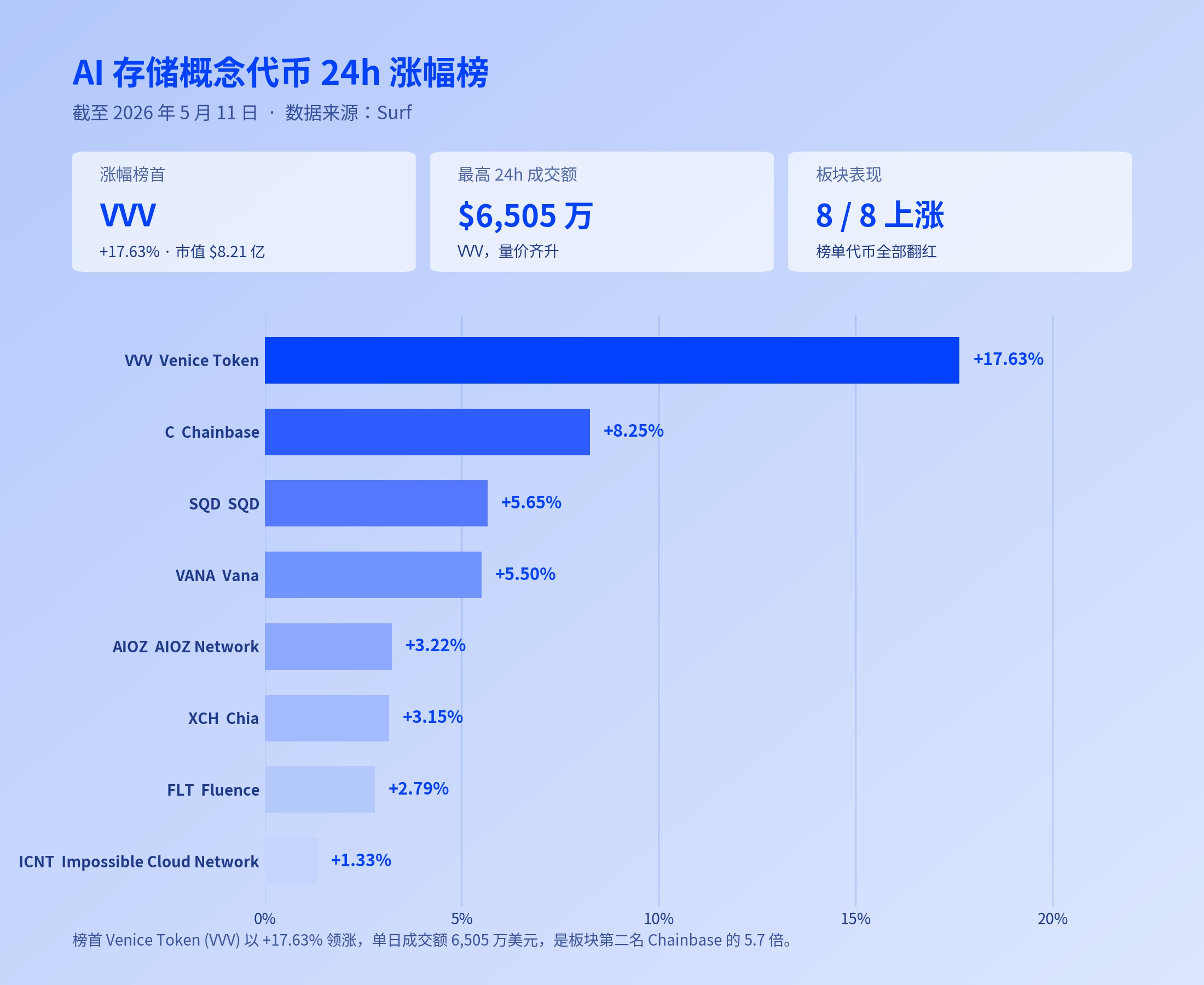
Data shows VVV currently trades at $17.83, with a market cap of $821 million and a daily trading volume of $65.05 million—5.7 times higher than Chainbase, the sector’s second-largest player. Chainbase (C, +8.25%), SQD (+5.65%), and Vana (VANA, +5.50%) rank second through fourth, each with market caps between $14 million and $54 million.
Yet VVV isnot technically a storage token. As reported by The Block in January 2025 and confirmed in Venice’s official documentation, VVV is the native token of Venice—a decentralized AI inference platform founded by Erik Voorhees—positioned as “providing private, censorship-resistant inference services for AI agents.” Staking VVV entitles holders to proportional revenue shares from Venice API usage, eliminating per-request billing.
VVV’s leadership stems from its own fundamental catalysts. According to Phemex’s April 7 analysis, Venice permanently reduced its annual token inflation by 25% (from 80 million to 60 million) on February 10, 2026; following OpenClaw’s March 2 announcement selecting Venice as its primary inference model provider, VVV rose 20% in a single day. Per Messari data, Venice launched its “programmatic VVV buyback and burn” mechanism on April 15, automatically triggering a $1 on-chain token repurchase and burn for every Venice Pro subscription. CMC AI data indicates that, as of March, approximately 33 million VVV tokens—42% of the initial supply—had already been burned.
Thus, the crypto AI sector’s current narrative can be broken down into two layers: the external driver is the spillover from the U.S. memory equity rally, while the internal driver is self-reinforcing fundamentals—like VVV’s deflationary mechanisms and concrete partnership deployments. Tokens delivering outsized gains in this cycle almost universally possess both layers of logic.
Four Genuine Storage Tokens Gained Less Than 4% Today
Notably, today’s Surf leaderboard shows thatauthentic storage projects are not among the top gainers. AIOZ Network (+3.22%), Chia (+3.15%), Fluence (+2.79%), and Impossible Cloud Network (+1.33%)—four traditional decentralized storage projects—all posted gains under 4%. Even last week’s leaders—FIL, AR, and STORJ—are absent from this list.
This structural divergence signals a key insight: the pure “storage beta transmission” rally may have entered its second phase. Phase One (May 6–7) involved catch-up rallies among storage leaders; Phase Two (this week) sees tokens with their own narrative catalysts taking the lead—VVV with its buy-and-burn mechanism, Chainbase branded as “AI Data,” and both SQD and Vana falling under the “data network” umbrella. Capital is now selectively picking “story-rich assets” within the sector—not indiscriminately deploying funds.
Historically, such a three-stage pattern—“leader catch-up → concept diffusion → selective capital allocation”—typically signals the sector’s rally has entered its second half. Future sustainability will hinge on whether the U.S. memory chip rally can continue. Given current fundamentals—including DRAM contract prices rising 58%–63% and HBM production capacity sold out through 2026—the narrative remains intact—at least for now.
Join TechFlow official community to stay tuned
Telegram:https://t.me/TechFlowDaily
X (Twitter):https://x.com/TechFlowPost
X (Twitter) EN:https://x.com/BlockFlow_News
 深潮TechFlow


