








Visa Paves the Way, Circle Provides Lifeline: Eastern and Western Institutional Forces Converge in Canton
TechFlow Selected TechFlow Selected
Visa Paves the Way, Circle Provides Lifeline: Eastern and Western Institutional Forces Converge in Canton
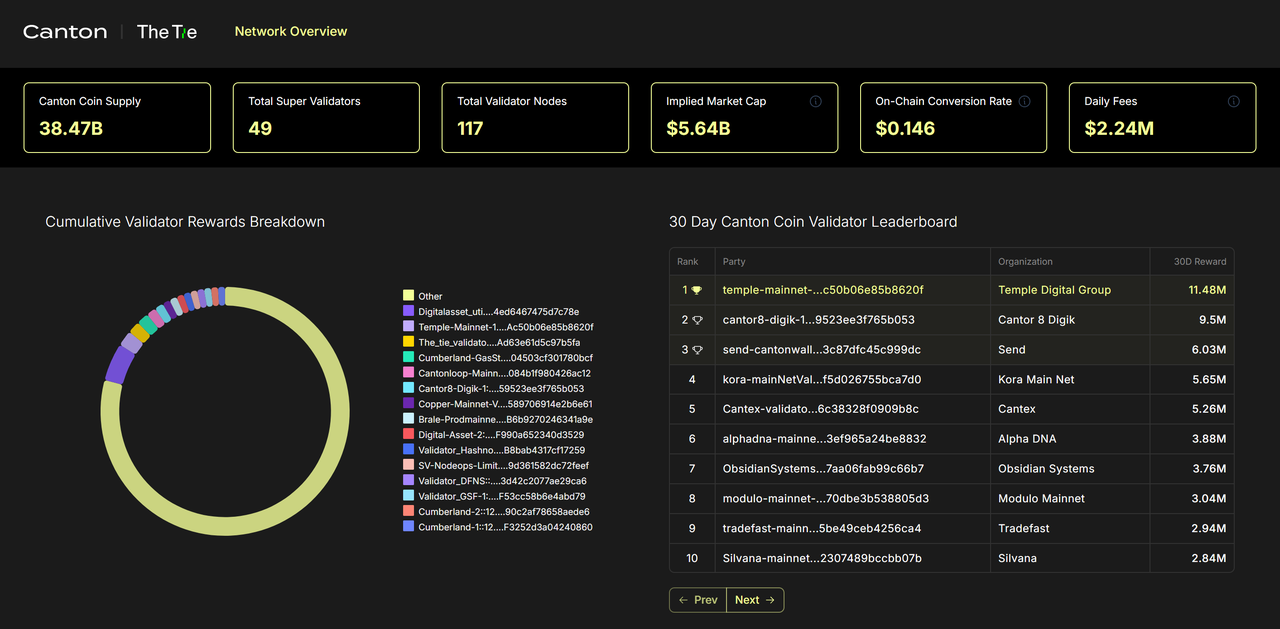
Daily fee revenue exceeds $2.24 million, and Canton steadily handles real institutional business.
 Navigating Web3 tides with focused insights
Author: TechFlow
Introduction
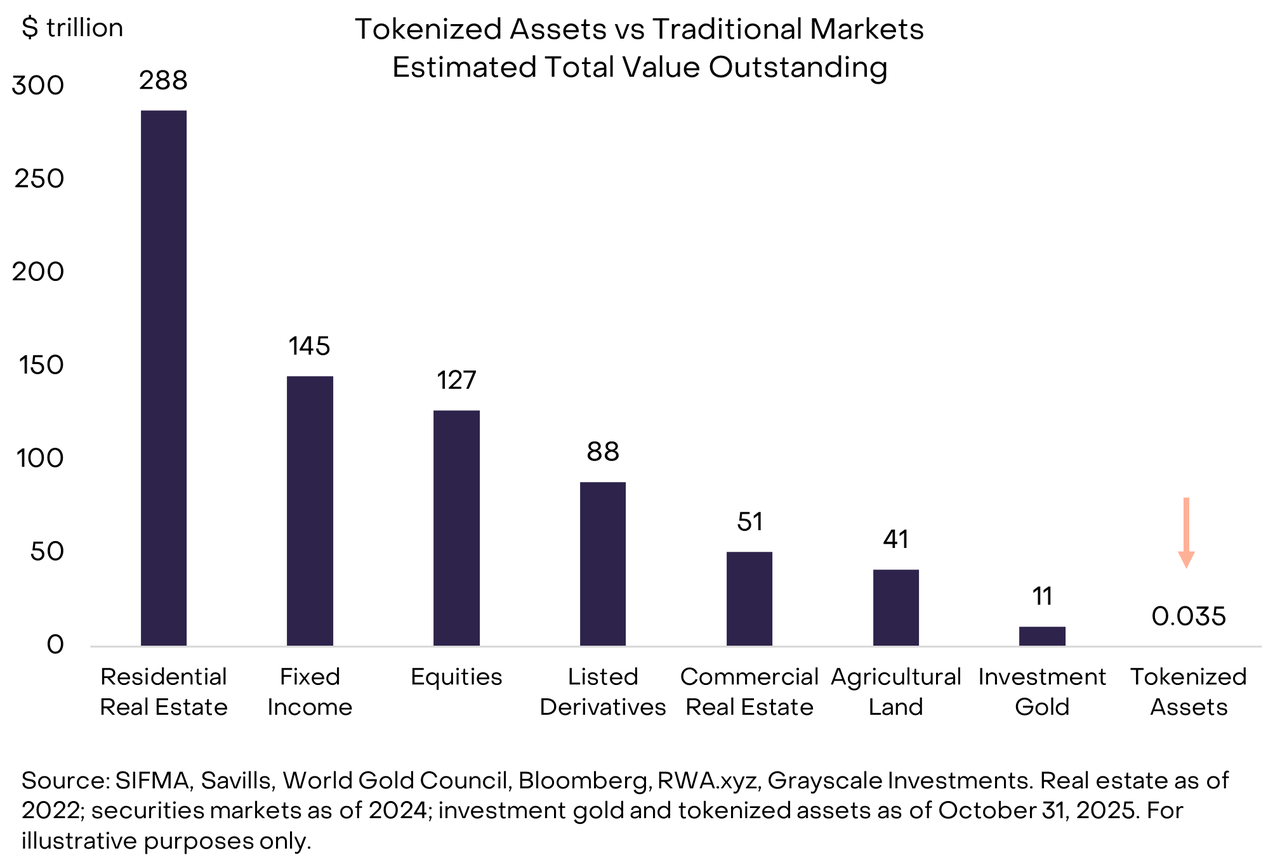
Grayscale’s 2026 Digital Asset Outlook dubs 2026 the “Dawn of the Institutional Era” and forecasts that tokenized asset volumes could grow approximately 1,000-fold by the 2030s.
A 1,000-fold increase may sound radical at first—but it’s not unimaginable.
On one hand, the growth trend is already evident: According to data from rwa.xyz, on-chain RWA asset value has surged from $21.45 billion to $31.12 billion since January 1, 2026—nearly a $10 billion increase in just a few months.
On the other hand, tokenized assets currently represent only 0.01% of the global stock and bond markets’ combined market capitalization. As on-chain infrastructure matures and regulatory frameworks become increasingly clear, institutional capital will be further drawn in—becoming the primary driver of growth in on-chain finance.
This leads to a more critical question:
When trillion-dollar assets truly begin migrating on-chain, which platform will serve as the main hub for this transition?
Institutions have already answered—with action.
Prior to 2026, traditional financial giants—including Goldman Sachs, Nasdaq, JPMorgan Chase, Broadridge, Franklin Templeton, Moody’s, and BNY Mellon—had announced moving their real-world operations onto the Canton Network.
In 2026, this list of institutional partners continues to expand with major new entrants:
On March 25, 2026, Visa announced its appointment as a Canton Network Super Validator. Six days later, Circle joined as well—within one week, a Web2 payments giant and a Web3 stablecoin leader both chose to become key participants on the same public chain.
On April 20, 2026, Asia achieved another breakthrough: Mizuho Financial Group, Nomura Holdings, and Japan Securities Clearing Corporation jointly announced plans to explore digital collateral management for Japanese Government Bonds (JGBs) built on the Canton Network.
At the starting point of this projected 1,000-fold growth, as institutions become the central growth vector, Eastern and Western financial institutions are rapidly converging on Canton.
As a chain renowned for customizable privacy, regulatory-compliant trust, and institutional-first design, Canton’s rapidly emerging “on-chain finance” landscape—built through deep institutional collaboration—deserves careful examination.
Behind $2.24 Million in Daily Fees: 288 Institutions Running Real Business On-Chain
Let’s begin with a number.
According to The Tie, Canton generates over $2.24 million in daily transaction fees.
In today’s market environment, this figure even surpasses those of established mainstream public chains—including Ethereum, Solana, and BNB Chain—during certain periods.
High fee revenue stems directly from robust transaction volume and activity:
Per official disclosures, Canton processes approximately 1.1 million transactions per day, with daily repo trading volume reaching ~$384 billion. Its annual cumulative repo volume approaches $9 trillion—and it has already processed over $6 trillion in real-world assets.
The combination of high-frequency trading, high-value-per-transaction, and strong operational stability is uniquely characteristic of institutional activity—and a concrete manifestation of why an increasing number of large financial institutions are moving actual business operations onto Canton.
According to the official ecosystem page, Canton now has over 288 partners spanning clearing, asset management, payments, and other critical functions.
Clearing was the first large-scale institutional use case successfully deployed on Canton:
Broadridge—the firm that migrated repo settlement onto Canton—is not only a Canton Super Validator and member of the Canton Foundation, but also the most mature and largest production-grade application within the Canton ecosystem, having processed trillions of dollars in tokenized real-world assets. Beyond Broadridge, clearinghouses such as DTCC and Euroclear continue exploring tokenization of U.S. and U.K. government bonds, thereby bringing the scale, security, and regulatory certainty of TradFi’s multi-trillion-dollar infrastructure into Canton.
Meanwhile, banks providing liquidity, custody, validator services, and tokenization pilots constitute another core pillar of the network:
Canton’s banking partners include BNP Paribas, Bank of America, HSBC, Citibank, and BNY Mellon. These names do far more than lend brand credibility: they participate in network governance as validators, contribute real-world assets directly, co-develop on-chain applications, and integrate their liquidity and client networks into the Canton ecosystem.
Additionally, issuers serve as the supply-side engine of the Canton ecosystem, focused on tokenizing real-world assets:
Goldman Sachs has deployed its GS DAP platform on Canton in production, running Canton Daml smart contracts and completing multiple institutional-grade bond and fund issuances. JPMorgan announced native deployment of its institutional dollar deposit token, JPM Coin, onto the Canton Network—enabling institutional-grade stablecoin settlement and treasury management. T-RIZE Group, an institutional tokenization platform, announced building a private credit digital bond program for Horizon Group on Canton with up to $500 million in size—delivering 24/7 trading, instant/atomic settlement, and privacy-preserving multi-party collaboration, significantly improving capital efficiency and reducing costs.
Of course, while accelerating the onboarding of traditional finance, Canton has not settled for being an “elite yet isolated” silo. Instead, it actively collaborates with broader on-chain infrastructure to connect seamlessly with the wider blockchain ecosystem.
In March 2026, LayerZero became the first officially launched interoperability protocol on Canton—enabling institutions on Canton to route tokenized real-world assets across more than 165 blockchains, all while preserving privacy and regulatory compliance.
Earlier, Chainlink announced deployment of its data standards on Canton, and its Cross-Chain Interoperability Protocol (CCIP) is set to support Canton soon—providing real-time pricing, valuation, collateral verification, and secure cross-chain transfers for tokenized real-world assets.
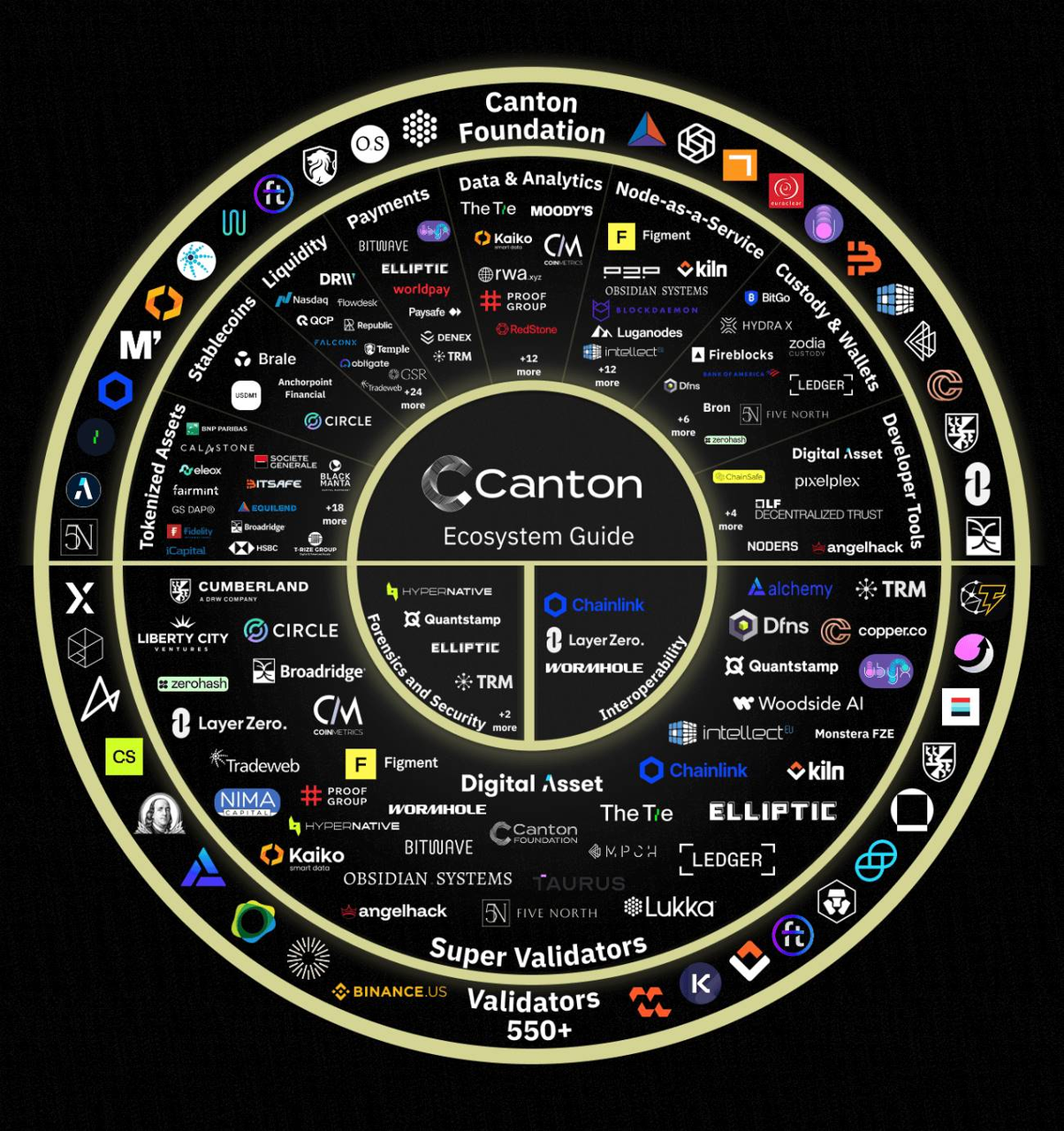
Behind this long roster of globally recognized names lies the active participation of institutions across the core pillars of global finance:
Canton’s capability to onboard institutional clients is fully realized;
and as trillion-dollar real-world business goes live on-chain, Canton gradually gains confidence to move beyond the narrative of being merely a “single-purpose RWA network,” instead developing the full skeletal architecture of an institutional-grade on-chain financial system.
With Visa and Circle joining sequentially, this on-chain financial ecosystem begins to grow its circulatory system—its veins and arteries.
Visa and Circle Enter: Unlocking the “Entry Point” and “Medium”
Note that Visa and Circle didn’t join as ordinary validators—they secured seats as Super Validators with maximum weight (Weight 10).
Within Canton’s design, only highly trusted institutions qualify as Super Validators. They serve dual roles—as both “guardians” of network security and “rule-makers” of the network. First, they coordinate cross-domain transaction synchronization, ensuring atomic settlement among participants without exposing the underlying transaction details. Second, Super Validators hold substantive governance voting rights—participating in major decisions including network upgrades, parameter adjustments, and economic policy formulation.
We previously published an article explaining Canton’s operational logic—interested readers can revisit it here:
From Wall Street to Hong Kong: Why Top Institutions Choose Canton Network for Going On-Chain
Put simply, this mechanism’s core principle is: assign the most critical authority to the participants most trusted by the institutional world—thereby enhancing the network’s compliance, stability, and trustworthiness.
That’s precisely why Visa and Circle’s entry matters—not just as institutional endorsements, but for what they bring to the network.
Visa’s strategy focuses on integrating mature Web2 payment infrastructure with on-chain use cases.
Operationally, Visa will pilot on-chain payments, settlements, and treasury management—and further expand its stablecoin initiatives. Notably, as of early 2026, Visa’s annualized stablecoin settlement volume had reached $4.6 billion, covering over 130 stablecoin-linked card programs across more than 50 countries. Regardless of how far Visa’s exploration progresses, it will channel real-world payment settlement traffic onto Canton.
As a core governance participant, Visa will also introduce decades of accumulated trust frameworks, governance experience, and risk-control systems from the payments industry into Canton—bringing a sense of order familiar to traditional finance. Without altering existing compliance structures, this approach makes it easier for banks and financial institutions to migrate stablecoin-based payments, settlements, and treasury management onto the chain.
Circle’s value lies in its pre-existing, mature USD liquidity network.
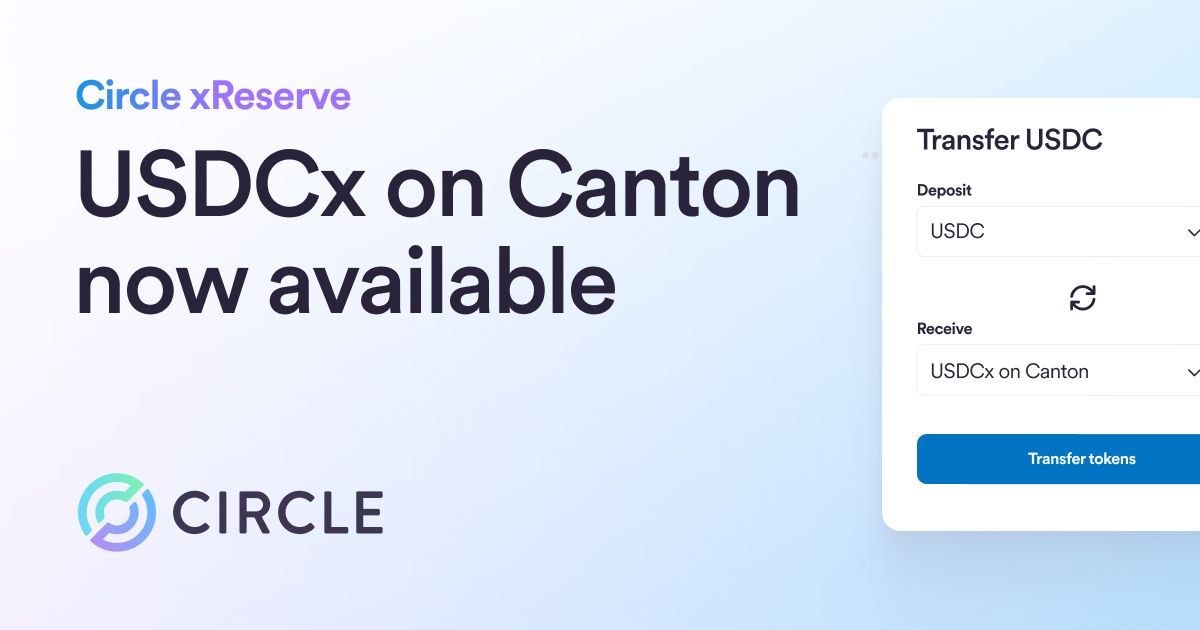
USDCx is now live on Canton. Backed by USDC and equipped with full Canton privacy features, USDCx provides Canton ecosystem participants with a native settlement instrument that is compliant, private, and directly pegged to the off-chain USD system—significantly boosting Canton’s practicality across payments, lending, collateral management, and RWA use cases.
According to Circle’s financial report, the total number of addresses holding USDC has reached 43.1 million, with 6 million active wallets holding at least $10 in USDC. This massive user base and liquidity pool could fuel Canton’s ecosystem via USDCx.
Together, these two pieces form a compliant, private, and atomically secure on-chain closed loop:
With trust-enabled entry (Visa) and settlement medium (USDCx) both in place, a complete institutional-grade on-chain payment and settlement pipeline has taken shape within Canton’s on-chain financial ecosystem.
Yet when this vast network—comprising top-tier global clearinghouses, Wall Street investment banks, payments giants, and massive USD liquidity—truly begins operating, the story doesn’t end there.
Because a chain hosting real-world business does not automatically guarantee that its native token captures value.
So where does the immense value generated daily by this trillion-dollar financial engine ultimately flow?
Or more directly: Does Canton possess a mechanism capable of converting genuine usage into tangible value for token holders?
$CC is Canton’s answer.
$CC: Token Value Anchored in Real Network Usage
As the native utility token, $CC is tightly coupled to actual network usage.
Its core value proposition is simple: fees on Canton are denominated in USD but must be paid in $CC—and every $CC used for fee payment is permanently burned. This means each real transaction on Canton simultaneously reduces $CC’s circulating supply. As network usage grows, so does the burn rate—counterbalancing issuance and driving total supply toward stability.
In other words:
The higher the real network usage, the greater the $CC burn—and thus, the higher the $CC value;
Conversely, lower real network usage leads to reduced $CC value.
This “Proof of Utility” model further distances $CC from short-term speculation. Meanwhile, Canton is progressively implementing measures to reinforce genuine usage and long-term holding:
On January 12, 2026, Canton implemented a dual halving: its annual token issuance was cut from 20 billion to 10 billion, while the Super Validators’ share of that issuance dropped from 48% to 20%. Reward distribution is now tilted further toward application developers and asset providers—strengthening usage-driven value creation.
Additionally, Canton advanced governance proposals such as CIP-0105 to incentivize Super Validators to lock up rewards long-term—reducing sell pressure and enhancing price stability.
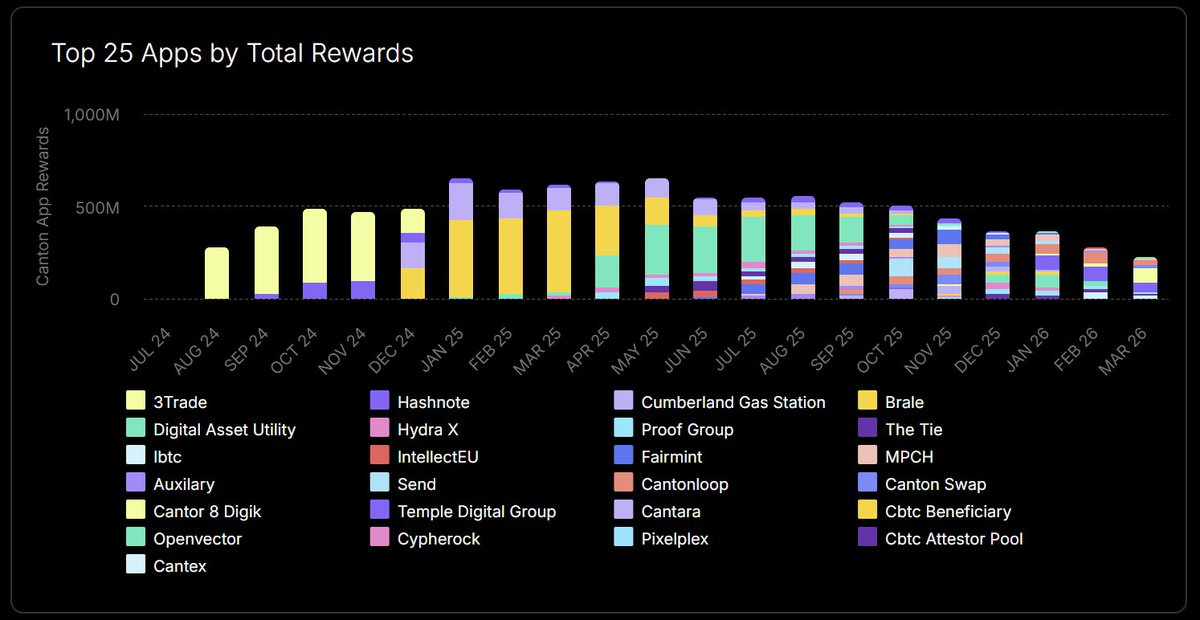
As noted earlier, Canton’s daily transaction fee revenue has already reached the $1.8 million level—meaning $CC already operates a powerful, real-world financial business–driven burn engine. With future adoption expanding across richer institutional use cases, $CC’s fee revenue and burn volume will rise accordingly—further broadening the token’s value potential.
Architectural Debates Remain Unresolved, But Institutions Are Already Paying
Naturally, Canton’s rapid growth has also sparked debate.
Shortly after Visa and Circle announced their appointments as Canton Super Validators—triggering widespread market attention and a short-term price surge in $CC—Helius CEO posted: “Canton is just an interesting way of saying ‘a Web2 database with a token.’”
Additionally, when Canton’s founding team stated that “ZK is unsuitable for institutional-grade financial systems,” ZKsync’s founder countered that Canton’s heavy reliance on Super Validators introduces centralization risks.
Yet many community members view such disagreements as “different perspectives on the same problem”:
Solana emphasizes high performance, open composability, low fees, and developer-friendliness—ideal for DeFi, meme tokens, and consumer applications;
ZK represents cryptographic maximalism—prioritizing minimal trust and mathematically verifiable security;
Whereas Canton prioritizes privacy, compliance, and atomic settlement—accepting certain trust assumptions under institutional endorsement. This path may not be “crypto-purist,” yet it continues gaining traction among institutions.
Hence, rather than debating architectural preferences, perhaps the more meaningful question is:
When trillion-dollar traditional finance begins seeking on-chain footholds, should the chain adapt to capital—or should capital adapt to the chain?
Returning to Grayscale’s opening prediction that 2026 marks the “Dawn of the Institutional Era,” whether Canton will emerge as the ultimate winner of this institutional migration remains too early to tell.
But with institutions now widely accepted as the dominant market force, industry giants have already begun choosing their preferred chain—with real actions and real capital.
At the starting point of this 1,000-fold growth trajectory, real-money commitments backed by real business may matter more than debates over “which chain is correct.”
Join TechFlow official community to stay tuned
Telegram:https://t.me/TechFlowDaily
X (Twitter):https://x.com/TechFlowPost
X (Twitter) EN:https://x.com/BlockFlow_News
 深潮TechFlow


