








Crypto “Spring Water” Warms Up First at L1: SUI Up 24% Weekly, TON Doubles in Three Days—Is the Small-Cap Season Here?
TechFlow Selected TechFlow Selected
Crypto “Spring Water” Warms Up First at L1: SUI Up 24% Weekly, TON Doubles in Three Days—Is the Small-Cap Season Here?
U.S. stocks are buzzing with activity; localized opportunities in crypto🔍
 Navigating Web3 tides with focused insights
Author: Kuli, TechFlow
Are we back to “eating crypto” again?
Over the past two weeks, the crypto market has shown signs of recovery. Aside from localized on-chain narratives—such as Uniswap Hooks V4—a wave of veteran tokens have experienced a revival.
Among them, Layer-1 (L1) blockchains delivered particularly strong performance, with ZEC, TON, and SUI posting standout gains. We covered ZEC last week; meanwhile, both SUI and TON staged independent rallies even as the broader market remained flat: TON surged from $1.35 to $2.89 in just three days, while SUI rose over 24% in one week to break above $1.24.
(See also: “30-Day Doubling, 15x YTD Gains: Why Is the English-Speaking World FOMOing $ZEC Again?”)
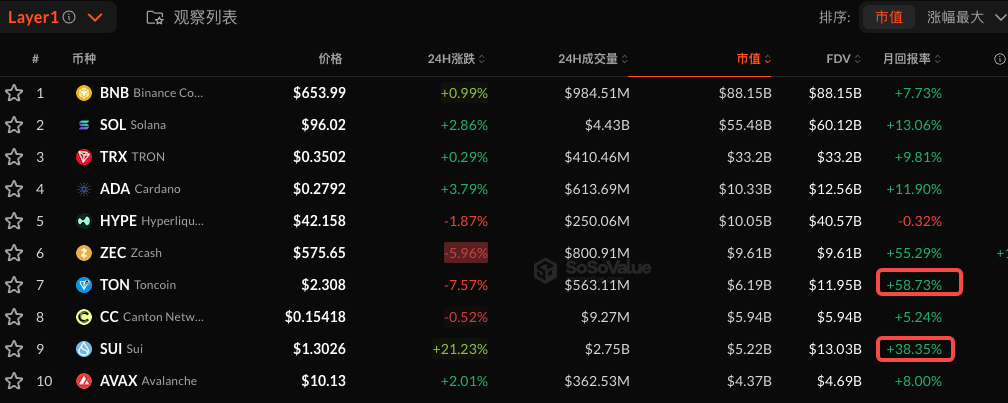
Each chain has its own concrete, verifiable catalysts—backed by real-world developments and fundamentals. With L1s leading the charge, does this signal the imminent onset of a broader altcoin rotation?
BTC Dominance Hits Yearly High—but L1s Lead the Rotation
First, consider the macro backdrop.
According to Bitget data, as of May 9, BTC dominance rose to 60.3%, the highest level of 2026. Meanwhile, Blockchaincenter’s Altseason Index stood at roughly 35—far below the 75 threshold required to confirm an altseason. The market remains firmly in “Bitcoin season.”
Yet structural signals are already emerging. BTC dominance has been consolidating in the 58%–60% range for nearly eight months (from August 2025 through April 2026), and the RSI shows signs of stagnation.
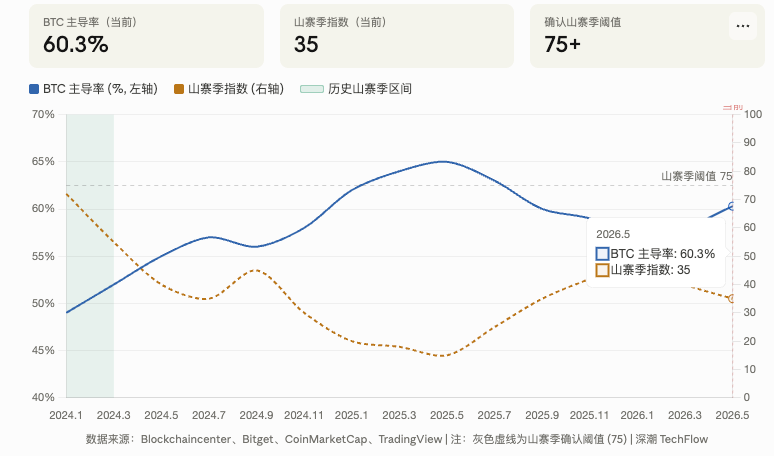
Analyst el_crypto_prof on X noted that the weekly chart structure of total altcoin market cap (excluding BTC) closely resembles patterns observed just before the start of the 2016–2017 and 2020–2021 altseasons. In both historical cases, the combination of high BTC dominance and low Altseason Index readings appeared 2–6 months before the most profitable altcoin rallies began.
It is precisely within this window—where the macro environment remains unconfirmed but individual assets begin moving—that SUI and TON each staged their independent rallies.
TON: Telegram Shifts from “Partner” to “De Facto Controller”
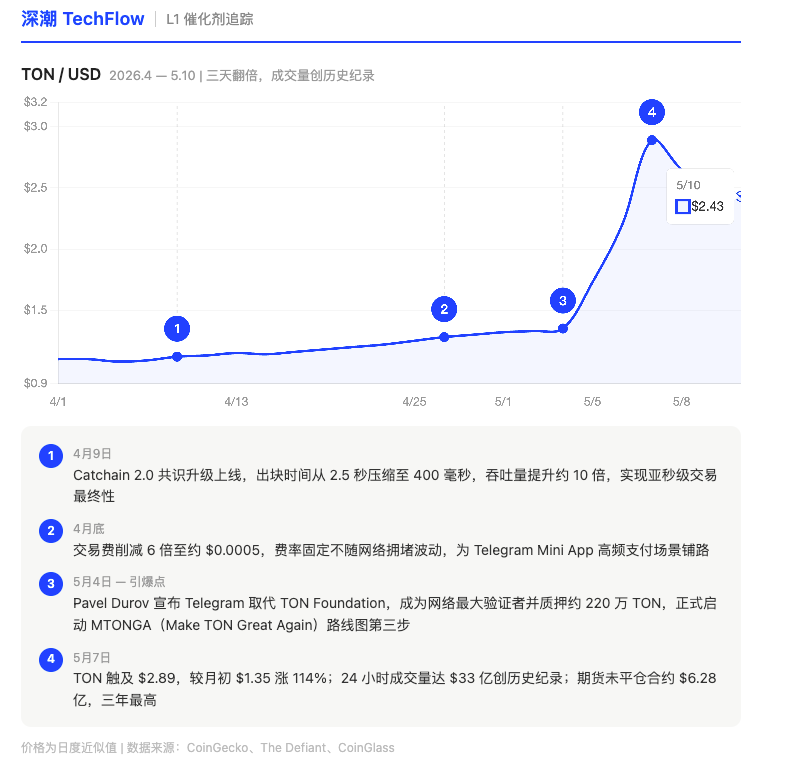
This TON rally had a precise trigger: On May 4, Telegram founder Pavel Durov announced on X that Telegram would replace the TON Foundation as the network’s largest validator and primary driving force.
The significance of this move must be understood in historical context.
In 2020, Telegram was forced to abandon the TON project following SEC enforcement action—returning $1.22 billion to investors and paying an $18.5 million fine. Durov officially declared the project terminated in a blog post. Thereafter, the TON Foundation operated independently as a community-driven entity for five years.
Six years later, Durov personally returned—staking approximately 2.2 million TON, and switching the ton.org domain to an MTONGA (“Make TON Great Again”) themed landing page.
According to The Defiant, TON surged 33% on that day, peaking intraday at $1.90. By May 7, its price had skyrocketed from $1.35 at the start of the month to around $2.89—a ~114% gain in three days. Its 24-hour trading volume reached $3.31 billion, the highest in TON’s history. Per CoinGlass data, open interest in TON futures simultaneously climbed to $628 million—the highest in three years.
Prior to Telegram’s formal takeover, Durov executed a month-long sprint of intensive technical upgrades:
- On April 9, the Catchain 2.0 consensus upgrade went live, reducing block time from 2.5 seconds to 400 milliseconds and boosting throughput by roughly 10x. As Durov himself stated on X, TON is now “the fastest-finality chain among all mainstream L1s.”
- By late April, transaction fees dropped from ~$0.0023 to ~$0.0005—a sixfold reduction—with fixed rates unaffected by network congestion. Durov added that “most transactions will soon be completely free.”
Institutional adoption followed in lockstep. Japanese exchange Rakuten Wallet launched spot TON trading in mid-April, while CoinShares launched a TON staking ETP on Switzerland’s SIX Exchange. Reports indicate that USDT supply on the TON network has surpassed $500 million, and perpetual contract monthly trading volume on Telegram’s built-in wallet has exceeded $1 billion.
Technical upgrades continue apace. Durov’s vision is to transform Telegram into a super-app integrating payments, DeFi, AI agents, and private communications—with TON serving as the underlying financial layer.
However, the author notes that Telegram becoming the largest validator inherently increases network reliance on a single entity. Should Telegram face renewed regulatory scrutiny (the SEC’s prior case still casts a long shadow), or should its validator nodes experience failure, the impact on both network stability and token price would far exceed what would occur under a fully decentralized architecture.
SUI: Achieves Institutional “Triple Crown” Within One Month
SUI’s catalysts stem from a different direction: a rapid, concentrated rollout of institutional infrastructure over the past month.
If we list which crypto assets currently possess all three of the following—U.S.-listed spot ETFs, CME futures contracts, and large-scale corporate staking—the list previously included only BTC and ETH. As of May, SUI has joined that elite group:
- Spot ETF Cluster (Late February): 21Shares TSUI (Nasdaq, 0.30% fee), Canary Stake SUI ETF, and Grayscale SUI Staking ETF all launched within one week. Bitwise, Franklin Templeton, and VanEck are also pursuing related products.
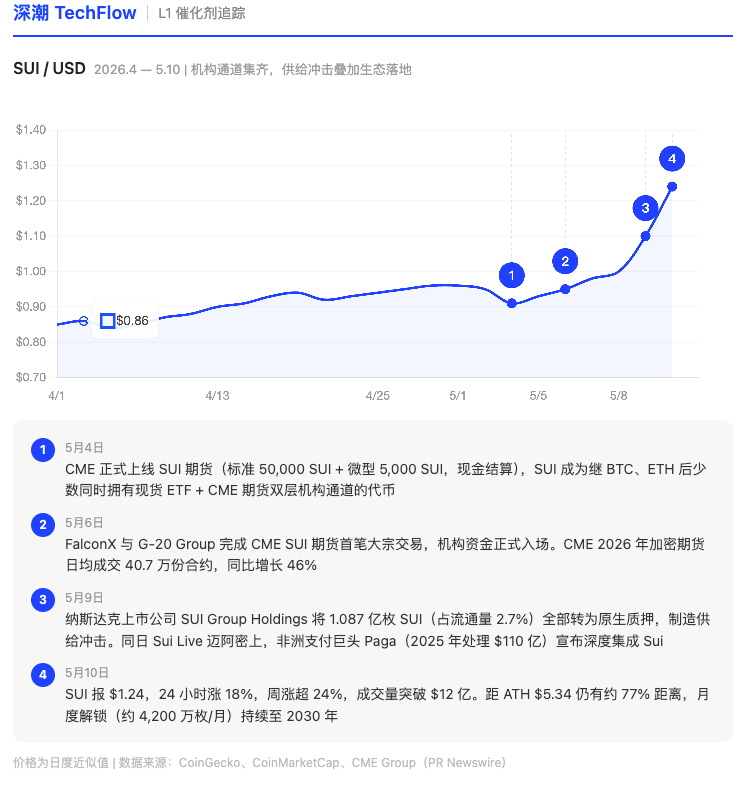
- CME Futures Launch (May 4): Standard contracts (50,000 SUI) and micro contracts (5,000 SUI), cash-settled. FalconX and G-20 Group completed the first block trade on May 6. Starting May 29, CME’s full suite of crypto derivatives will operate 24/7.
- Corporate Staking Announcement (May 9): Nasdaq-listed SUI Group Holdings pledged its entire holding of 108.7 million SUI (2.7% of circulating supply) as native staking—prompting a 13% price jump that day.
- Emerging-Market Payments Deployment (May 9): At Sui Live Miami, Nigerian fintech firm Paga announced deep integration with Sui—including plans to leverage the native stablecoin USDsui to offer users dollar-denominated accounts and tokenized bonds. Paga processed $11 billion in transactions in 2025.
Per CryptoNews analysis, SUI now boasts a complete “three-tier institutional access architecture”: spot ETFs enable passive allocation, CME futures support active hedging, and staking products deliver yield. Eighteen months ago, only BTC and ETH possessed such a structure.
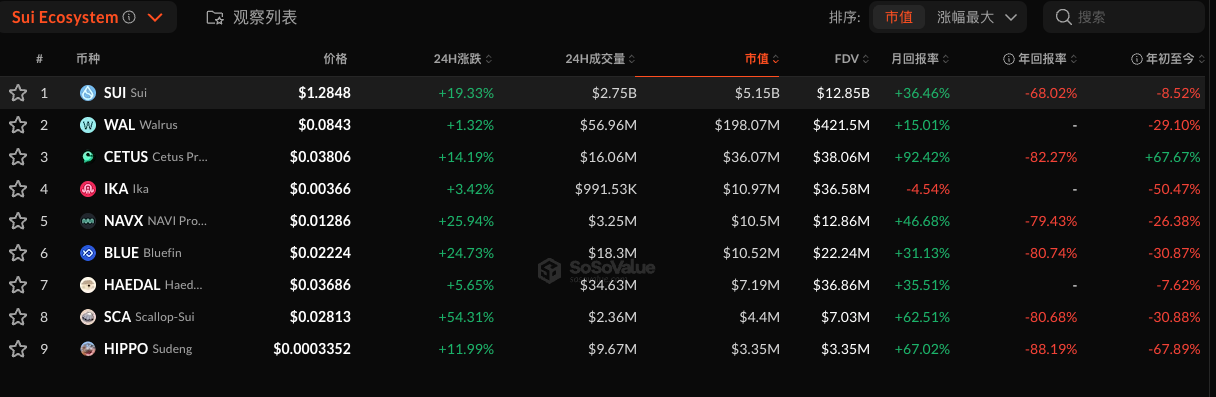
As of May 10, SUI traded at $1.24—up over 24% for the week—with trading volume exceeding $1.2 billion. Notably, SUI dipped slightly to $0.91 on the day CME futures launched, then rallied strongly five days later—coinciding with the corporate staking announcement and Paga partnership. Meanwhile, tokens across the SUI ecosystem also enjoyed broad-based gains.
Can the L1 Rally Spread to Broader Alts?
Viewed side-by-side, SUI and TON differ fundamentally in their catalyst structures—yet share a key commonality: both rallies are being driven by project-specific, verifiable fundamental developments—not macro liquidity or broad market sentiment (beta).
Returning to the macro picture, none of the conditions required to confirm a broad altseason have yet been met. According to Phemex’s historical analysis, reliable rotation signals require BTC dominance to fall below 54% and remain there for at least two weeks—and the Altseason Index to surpass 75. With current dominance at 60% and the index at 35, both thresholds remain clearly out of reach.
A historical reference point is instructive:
At the end of 2019 and again at the end of 2020, BTC dominance was elevated while the Altseason Index remained low—yet both periods were followed by major altcoin rallies 2–6 months later.
In those cycles, the initial moves were led by top-tier projects with strong independent catalysts, after which capital gradually rotated into mid- and small-cap tokens. The current movements in SUI and TON may thus represent the early phase of exactly this pattern—“individual projects leading, broad rotation pending confirmation.”
The ducks have already moved—the water is warming. But the ice on the river surface hasn’t fully melted yet.
Join TechFlow official community to stay tuned
Telegram:https://t.me/TechFlowDaily
X (Twitter):https://x.com/TechFlowPost
X (Twitter) EN:https://x.com/BlockFlow_News
 深潮TechFlow


