








Backed by Bitcoin for Stable High Returns—How Does This New Product Achieve It?
TechFlow Selected TechFlow Selected
Backed by Bitcoin for Stable High Returns—How Does This New Product Achieve It?
Annualized 11.5%, monthly cash dividends.
 Navigating Web3 tides with focused insights
By James Lavish, Hedge Fund Manager and Independent Director of Strive
Translated by Luffy, Foresight News
Imagine a security that pays you 11.5% annually—in cash—every single month. Real money lands directly in your account each month, while its price remains virtually unchanged. Its price chart is uneventful, yet its yield is highly attractive—and the entire product is fully backed by Bitcoin.
Michael Saylor has dubbed this new asset class “Digital Credit,” recently comparing it on X to a commercial airliner—with STRC as its flagship symbol. Frankly, this is the most innovative income-generating financial instrument I’ve encountered in recent years.
Strategy launched this product first; Strive soon followed with its own comparable offering, SATA. Both are now live—and Bitcoin investors are pouring in.
Yet mainstream financial media either remain baffled or outright dismiss it. The same asset elicits two diametrically opposed assessments: some hail it as an innovation masterpiece; others label it a scam or bubble.
This impossibly high-yield product is publicly listed—yet professional institutions still struggle to definitively assess its merits or risks.
Over the past few months, my inbox has been flooded with reader questions—all revolving around the same core concerns: Is this product legitimate? Is it genuine yield—or a trap?
This past Tuesday, I participated in Strategy’s Q1 earnings call as an analyst—and STRC was the central topic of discussion. Combined with my year-long experience serving as an independent director of Strive and my direct involvement in designing the SATA product, I’ve written this comprehensive article to unpack the underlying mechanics once and for all.
What Is Digital Credit?
For clarity, this article focuses primarily on STRC. As noted earlier, Strive’s SATA is nearly identical in structure. We’ll later compare their differences—but STRC remains our main reference point.
Digital Credit is, at its core, a perpetual preferred stock backed by Bitcoin reserves. It can be broken down into three essential components—equity, preferred stock, and fixed income—plus one foundational innovation. Let’s examine each in turn.
STRC is fundamentally an equity instrument: holding STRC means owning a portion of Strategy, the issuing company. It trades freely on exchanges under the same rules as ordinary stocks.
Within the issuer’s capital structure, STRC ranks senior to common stock in terms of liquidation priority. The hierarchy—from highest to lowest—is: senior debt → preferred stock → common stock, with residual value going only to common shareholders. In bull markets, this distinction may seem negligible; but during crises, liquidation priority becomes critical.
In other words, STRC holds higher claim priority than MSTR common stock, lower than convertible bonds, and equal to other preferred shares. Its robust claim rights offer strong protection—especially appealing to long-term Bitcoin bulls.
This structure benefits the issuer as well. During market downturns, the company may defer dividend payments; and compared to issuing common stock, raising capital via preferred stock is less dilutive and carries lower financing costs.
Preferred dividends are calculated as a fixed percentage of the par value—not your purchase price—mirroring bond logic.
STRC’s par value is $100, with a current dividend rate of 11.5% of par. Regardless of secondary-market price fluctuations, each share delivers a fixed annual cash dividend of $11.50.
If you buy at par ($100), your annualized yield is exactly 11.5%. If you buy at a $90 discount, you still receive $11.50 per share annually—yielding an effective 12.78% return. Even better: if Strategy redeems STRC in the future at its $100 par value, you’ll pocket not only steady dividends but also a $10 capital gain per share.
This illustrates the difference between “coupon yield” and “current yield.” A key advantage of perpetual preferred stock is that buying at a discount naturally boosts your effective yield—though, as we’ll explain later, this effect is comparatively muted for STRC versus most other preferreds.
Now let’s address the novel component: the Bitcoin reserve backing.
A year ago, every preferred stock on the market was backed by traditional corporate assets—bank loan portfolios, REIT-owned real estate, telecom operating cash flows—relying on core business profits to fund dividends.
Digital Credit completely redefines the collateral base: instead, it uses on-chain, publicly verifiable Bitcoin reserves as its foundational value anchor.
Strategy previously issued other preferred structures for different purposes—but STRC stands apart: it is the only one designed explicitly as a perpetual preferred stock with a floating-rate dividend, engineered to trade near par and deliver stable cash payouts. Only this specific structure qualifies as true Digital Credit; other similar instruments do not belong to this category.
Brief Comparison With SATA
Strive’s SATA, launched last year, is a direct Digital Credit counterpart—nearly identical in structure to STRC, differing only in scale, liquidity, and yield.
Strive maintains a leaner balance sheet with virtually no debt. SATA’s total outstanding amount stands at $496 million; the company holds 15,000 BTC (valued at $1.2 billion) plus $148 million in cash reserves—enough to cover approximately 2.3 years of dividend obligations.
Given its smaller overall size, SATA exhibits weaker liquidity. As compensation for this liquidity discount, its dividend is higher—currently yielding 13% annually.
Many investors choose to hold both STRC and SATA in combination—to diversify away from single-issuer risk while further boosting portfolio-level returns.
The structural design, target investor profile, and risk framework discussed below for STRC apply equally to SATA—only scale, liquidity, and yield differ slightly.
Now, back to STRC.
So far, we have established three facts: STRC is a perpetual preferred stock; it pays dividends in cash, with a $100 par value and a current dividend rate of 11.5%; and its entire structure is supported by Bitcoin reserves held on the issuer’s balance sheet.
That leads us to the most critical question: How does Strategy sustain stable, monthly $11.5% cash dividends over the long term?
Understanding the Underlying Design Logic
To grasp this product, imagine yourself boarding a commercial airliner.
Saylor compares STRC to a commercial jet—its meaning is straightforward: commercial aviation’s defining feature is stability. Passengers simply sit, read, or sip coffee—hardly feeling any turbulence. That smooth ride is made possible only by layers of precise engineering and redundant systems working behind the scenes.
Similarly, STRC’s user experience is deliberately serene—its underlying architecture is what makes that serenity possible.
The full design comprises four core modules: fuel, autopilot, airframe, and seatbelt. After reading this section, you’ll be able to independently assess its profitability and dividend sustainability.
Fuel: The Actual Yield Investors Receive
We’ve already computed the baseline yield: $100 par value, 11.5% annualized, delivering $11.50 per share annually in cash—paid monthly at ~$0.96 per share.
According to Strategy’s Q1 2026 earnings report, STRC’s nominal issuance size totals $8.54 billion. At 11.5%, the company must distribute nearly $982 million in dividends annually—close to $1 billion flowing to holders each year.
This is the “fuel cost” required to keep the “airliner” aloft. The central question remains unchanged: Where does the company source nearly $1 billion in annual dividend payments? Let’s now examine the second design pillar—which answers another key question in your mind:
If STRC is merely a preferred stock, why does its price barely fluctuate?
Autopilot: Floating Dividend Mechanism Anchoring Price Near Par
Ordinary preferred stocks behave like long-duration bonds: fixed dividends mean rising market rates push prices down, falling rates lift them—forcing investors to absorb large price swings.
STRC operates differently: its dividend rate floats, adjustable monthly by the board of directors. The prospectus explicitly states its purpose: to maintain STRC’s trading price close to its $100 par value.
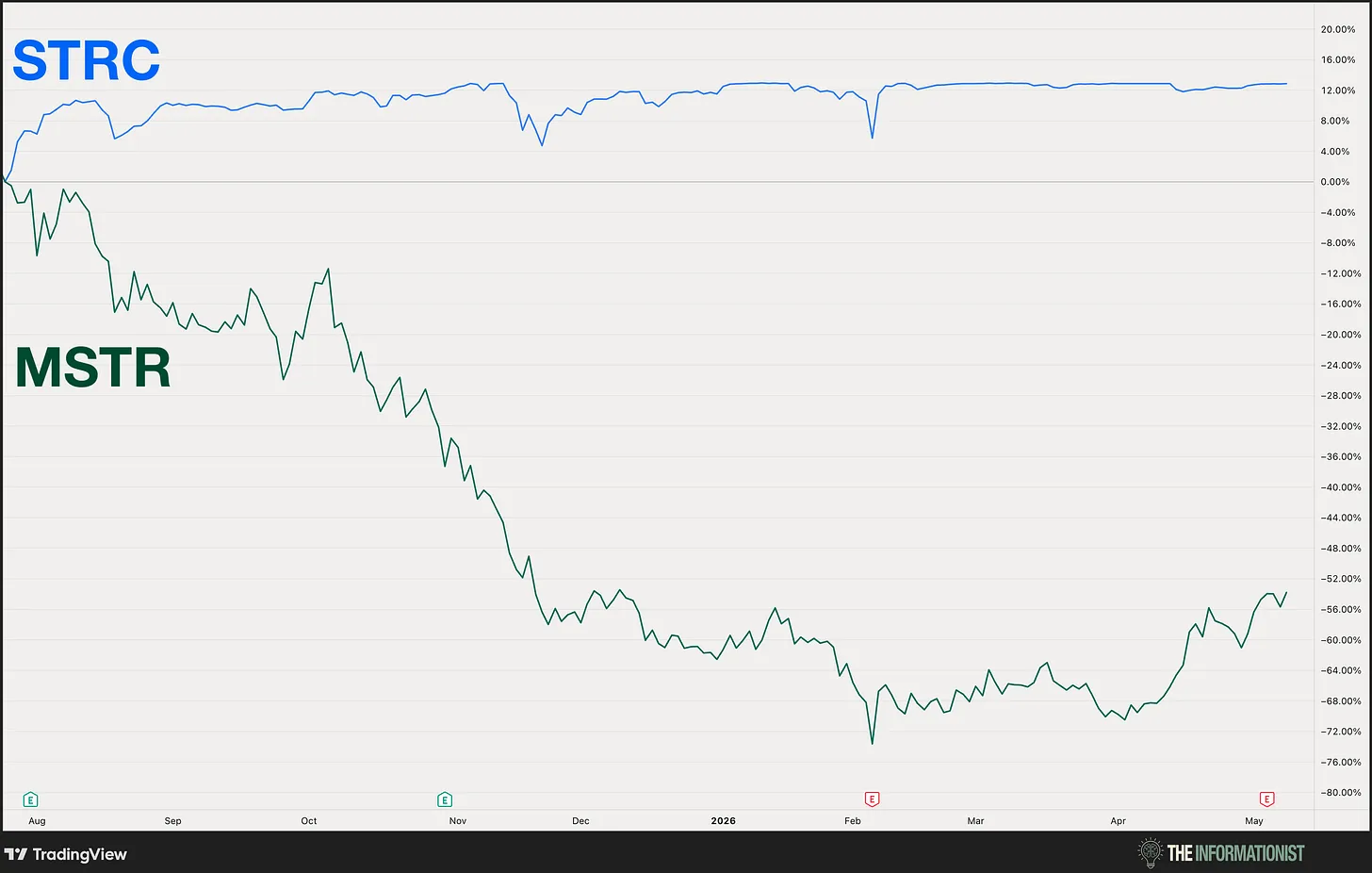
Its operational logic is clear: STRC launched in July 2025 with an initial dividend rate of just 9.0%; by May 2026, that rate had risen to 11.5%. During its first nine months—when price faced downward pressure—the company incrementally raised the dividend to attract buyers and pull the price back toward $100.
The price chart makes this vividly clear: STRC behaves like a smoothly cruising airliner—modestly spiking post-launch, then stabilizing in a tight range—while MSTR common stock resembles a volatile rocket, surging and plunging dramatically. Yet both rely on the exact same Bitcoin balance sheet—producing entirely divergent price behaviors.
Bitcoin’s underlying price volatility remains intact; the product design doesn’t eliminate volatility—it relocates it.
In MSTR common stock, volatility manifests directly on the price chart: sharp rallies, steep corrections, prolonged consolidation—then another surge. Your trading experience *is* that volatility.
In STRC, the floating rate absorbs that same volatility and converts it into yield variability. The share price stays anchored near $100—while the dividend rate itself floats. You receive cash dividends monthly, and your stock’s price remains essentially unchanged.
Reinforced Airframe: What Supports This Entire Structure
An airliner’s safety depends on its airframe integrity—and Digital Credit’s foundation differs fundamentally from traditional preferreds.
Traditional preferreds rely on operating cash flow: bank lending income, utility revenues, or REIT rental income—dividends funded by ongoing business operations.
STRC follows a radically different logic: Strategy is, at its core, a Bitcoin reserve company. Its latest disclosed holdings stand at 818,334 BTC—valued at ~$66 billion at current prices. This massive asset base forms the solid airframe supporting STRC and all other capital instruments.
Back to the core question: Why can it sustain 11.5% dividends long term? Strategy’s Q1 earnings presentation outlines two conservative assumptions for Bitcoin’s long-term annualized return:
- Optimistic equity scenario (MSTR price appreciation logic): 30% CAGR;
- Conservative credit stress test (STRC risk assessment): 10% CAGR.
Currently, total annual dividend and interest payments across all Strategy preferreds and convertible bonds amount to $1.488 billion. Meanwhile, its $66 billion Bitcoin asset base yields:
- At the conservative 10% CAGR: ~$6.6 billion in annual asset appreciation;
- At the optimistic 30% CAGR: nearly $19.8 billion annually.
Under either assumption, asset growth dwarfs fixed annual outlays.
But wait—STRC’s 11.5% dividend rate exceeds the conservative 10% Bitcoin return assumption by 1.5 percentage points. That’s precisely why Strategy holds an additional $2.25 billion in cash reserves.
If Bitcoin enters a multi-year deep bear market—slowing asset appreciation significantly—this cash cushion covers 18.1 months of full dividends without selling Bitcoin or issuing new common stock at unfavorable prices, allowing Strategy to weather the downturn smoothly.
This structure works because three layers reinforce one another:
- A vast Bitcoin asset base far exceeding annual expenses ($66 billion);
- A U.S. dollar cash buffer to withstand bear markets ($2.25 billion);
- Long-term Bitcoin appreciation gains that comfortably exceed dividend costs.
Seatbelt: Legal Safeguards for Extreme Scenarios
Beyond fuel, autopilot, and airframe lies a fourth layer of protection embedded in the prospectus legal terms—like an airliner’s seatbelt.
STRC is a cumulative preferred stock—a crucial attribute: if the company defers dividends, unpaid amounts don’t expire—they accumulate with compounding interest at the prevailing rate until fully paid.
The prospectus also explicitly stipulates: no dividends or distributions may be made to MSTR common shareholders until *all* accumulated STRC dividends are fully settled. This is the legal safety net for investors.
Many ask: Will this safeguard ever be triggered? With $2.25 billion in cash reserves and asset size vastly exceeding annual liabilities, the probability is extremely low. But the clause is clearly spelled out—ensuring preparedness for extreme black-swan events.
Tax Logic Addendum
STRC investors do not pay full tax on each dividend in the year received. Strategy classifies STRC dividends as “return of capital”: rather than taxing them as ordinary income, they reduce your cost basis—deferring tax liability.
For high-tax-bracket investors, this deferral meaningfully enhances after-tax returns. The sole tax cost arises upon sale: your lowered cost basis generates capital gains; if held over one year, those gains qualify for long-term capital gains tax rates.
A simple example (assuming price remains at par $100):
- Buy at $100;
- Hold two years, receiving $11.50 annually = $23 total;
- No tax due in the years dividends are received;
- Sell at $100—pay capital gains tax only on the $23 gain.
This is especially advantageous for long-term holders and high-tax individuals.
At this point, the internal logic of the “commercial airliner” is fully unpacked. Fuel is the tangible 11.5% monthly cash yield; autopilot is the floating dividend mechanism—converting price volatility into yield variability and anchoring price stability; the airframe is Strategy’s multibillion-dollar Bitcoin balance sheet; and the seatbelt is the legal safeguards—cumulative dividends and senior liquidation rights. So long as Bitcoin’s long-term annualized return approximates Strategy’s conservative 10% assumption, the entire yield logic remains self-sustaining.
Who Is STRC Really For?
Having grasped how it works, the next pivotal question is: Is this product right for *you*?
Every mature financial product targets a specific investor profile—not everyone is a fit.
Ideal Investor Profile #1: Income-Substitution Investors
This is the largest and most natural fit. You hold idle cash, recently realized proceeds, or long-standing allocations to money market funds and short-term Treasuries—or you’re retired and depend on reliable cash flow, watching traditional fixed-income yields consistently trail inflation and erode purchasing power.
You seek stable, real-asset appreciation—outpacing both dollar depreciation and actual inflation. STRC was built precisely for this goal: delivering substantially higher, stable cash yields than traditional fixed income—while adding the bonus of price stability.
Ideal Investor Profile #2: Bitcoin-Bullish Investors Who Can’t Tolerate High Volatility
You’ve long believed in Bitcoin’s long-term thesis—you already hold spot Bitcoin or Bitcoin ETFs in small amounts—but you simply cannot stomach MSTR common stock’s violent swings. You won’t allocate retirement savings to spot Bitcoin, nor will you lose sleep monitoring positions overnight.
STRC offers a fresh alternative: gaining exposure to the Bitcoin reserve thesis—without enduring Bitcoin-grade volatility. It’s like flying smoothly on a commercial jet across the same Bitcoin market airspace—rather than riding a wildly accelerating rocket. For many Bitcoin believers who fear volatility, STRC is the first asset they can confidently hold long term—and sleep soundly through the night.
Ideal Investor Profile #3: Tax-Optimization-Focused High-Net-Worth Investors
If you occupy a high federal tax bracket, the return-of-capital treatment discussed earlier materially reshapes your after-tax returns. STRC’s tax advantages over conventional taxable fixed-income products are pronounced. Under long-term holding assumptions, its after-tax yield decisively outperforms comparable taxable income assets—a key focus for professional wealth managers.
Ideal Investor Profile #4: Analytical, Deep-Dive Investors
You diligently read prospectuses and internalize product terms; you understand cumulative dividends, capital structure seniority, perpetuality, floating rates, and cash reserve mechanics; you see clearly how the full architecture balances strengths and protections—and avoid chasing yield blindly.
If this describes you—and you truly comprehend the product’s essence—STRC fits naturally into your portfolio. Understanding first, then investing, is the most important threshold.
Not Suitable For #1: Growth-Seeking, “Moonshot” Investors
If you hope to double your money during a Bitcoin bull run, STRC is categorically unsuitable. Its design intentionally sacrifices upside price potential to secure stability. The floating mechanism anchors price during downturns—and suppresses upside during rallies. To capture Bitcoin’s growth upside, MSTR common stock is the vehicle; STRC’s fundamental purpose is stability—not a flaw, but its core identity.
Not Suitable For #2: Absolute-Zero-Risk Investors
Frankly, no asset offers absolute zero risk—not even U.S. Treasuries. STRC’s high yield inherently carries commensurate risk. Strategy explicitly warns: STRC is not a bank deposit, carries no FDIC insurance, and lacks regulatory safeguards equivalent to money market funds or short-duration bonds—it cannot be equated with principal-protected products.
Its proper classification is a high-yield, rigorously risk-managed—but still risky—asset. Its architecture implements robust risk controls, yet cannot eliminate risk entirely. For absolute principal protection backed by government credit, only Treasuries or money market funds qualify.
Not Suitable For #3: Investors Who Don’t Understand the Mechanics—and Chase Yield Blindly
If you can’t clearly explain—using plain language—what STRC is and how it pays dividends, then it’s premature to invest.
Digital Credit is a brand-new asset class, born only a year ago. Not understanding it isn’t a failure—don’t force participation. Re-read this article, consult official documents, speak with a financial advisor—taking three months to reflect before deciding is perfectly reasonable. The product isn’t disappearing.
The worst mistake is “buy first, research later.” The correct sequence is always: understand first, then allocate. If you’ve reached this point and grasp the full design logic, you’ve met the foundational requirement. If it still feels obscure, take more time to study and absorb.
Where Do the Risks Lie?
Every sophisticated investor asks, before engaging with any new product: What are the risks? All income-generating assets trade risk for return. Short-duration Treasuries yield 3.7% with minimal risk—while STRC’s 11.5% yield necessarily implies higher risk. Let’s objectively dissect both its advantages and real-world risks.
Four Core Advantages
- High Yield: 11.5% annualized, paid monthly—4–7 percentage points above traditional preferreds;
- Price Stability: Implied volatility ~6%, versus ~59% for MSTR common stock—dramatically different user experiences;
- Tax Efficiency: Return-of-capital treatment defers taxation, lifting after-tax returns meaningfully above comparable taxable income assets;
- Capital Structure Protection: Cumulative dividends, seniority over common stock, and Bitcoin asset claim rights in liquidation—all explicitly codified in the prospectus.
These four advantages explain the inflow of capital. Now, let’s objectively examine the four real risks.
Four Real Risks
Risk #1: Bitcoin Enters a Multi-Year Bear Market
Strategy’s $2.25 billion cash reserve covers 18.1 months of full dividends without touching Bitcoin assets; its $66 billion Bitcoin holdings could fund dividends for 44 years at current prices.
The company also openly acknowledges: selling Bitcoin remains a contingency tool to ensure dividend continuity—further reinforcing structural resilience.
Risk #2: Long-Term Loss of Capital Market Access
The entire Digital Credit flywheel relies on: timely preferred stock issuances → funding Bitcoin purchases → expanding reserve assets → sustaining dividends.
If external factors—regulation, credit cycles, or industry reputation—permanently cut off access to capital markets, the flywheel slows. Fortunately, current asset size already dwarfs annual outlays—so short-term structural integrity remains intact. But a permanent shutdown of financing channels would alter long-term yield assumptions. My view: probability is low.
Risk #3: Dividend Deferral and Accumulation
Under extreme duress, the board may defer STRC dividends; unpaid amounts accrue interest monthly at the prevailing rate—and must be fully repaid before any common-stock dividends resume. Your principal claim remains intact.
However, for income-dependent investors relying on monthly cash flow, a dividend interruption directly disrupts daily finances. While the legal safeguard preserves principal rights, it doesn’t guarantee uninterrupted monthly cash flow during downturns.
From Strategy’s perspective, arbitrarily deferring dividends would severely damage future fundraising credibility and product trust—so it would only occur in dire, exceptional circumstances. Actual trigger probability is extremely low.
Risk #4: Tax and Regulatory Policy Shifts
The return-of-capital classification is subject to annual reassessment—its continuation isn’t guaranteed. The broader regulatory framework for Bitcoin-reserve companies remains evolving: recent trends are favorable, but future policy shifts or regulatory pivots introduce uncertainty.
Probability is low in the near term—but it remains a necessary consideration.
Summary: Four advantages are transparent and quantifiable; four risks are likewise quantifiable and explicitly disclosed in official filings—no hidden landmines.
Are You Ready to Board This “Yield Airliner”?
We’ve fully deconstructed the product’s architecture, ideal and unsuitable investor profiles, yield advantages, and real risks. Whether to allocate ultimately rests entirely with you.
I won’t make investment decisions for you—I’m here solely to clarify the mechanics, weigh pros and cons, and highlight risks. The rest is yours to decide—based on your personal portfolio context and consultation with your financial advisor.
More importantly, I want to leave you with a longer-term insight: Digital Credit is a brand-new asset class that didn’t exist a year ago. Today, only two products exist—STRC and SATA. Over the next one to two years, more institutions will launch similar offerings—each varying in structure, yield, and detail.
When that happens, you’ll need only apply today’s four core evaluation criteria to quickly assess any new entrant:
- What assets back the dividends—and are they publicly verifiable?
- How is the dividend rate set—and what mechanism anchors price stability?
- Where does the instrument rank in the issuer’s capital structure for liquidation priority?
- What legal and financial safeguards exist to protect investors in extreme scenarios?
This analytical framework applies not only to today’s STRC and SATA—but to every future Digital Credit product.
The greatest value in deeply understanding a new product isn’t whether to buy it—but mastering a reusable evaluation framework to confidently navigate the flood of similar assets arriving tomorrow.
Join TechFlow official community to stay tuned
Telegram:https://t.me/TechFlowDaily
X (Twitter):https://x.com/TechFlowPost
X (Twitter) EN:https://x.com/BlockFlow_News
 @jameslavish


