Crypto Morning Brief: Strategy remains in Nasdaq 100; major token unlocks for ZRO, ARB, STRK, and others this week
TechFlow Selected TechFlow Selected
Crypto Morning Brief: Strategy remains in Nasdaq 100; major token unlocks for ZRO, ARB, STRK, and others this week
Infrared, Berachain's liquid staking protocol, announces TGE on December 17.
 Navigating Web3 tides with focused insights
Author: TechFlow
Yesterday's Market Dynamics
Trump: Prefers Wach or Hassett to lead the Fed, interest rates should not exceed 1% within a year
U.S. President Trump said in an interview on Friday in the Oval Office: "Both Kevins (Wach and Hassett) are outstanding, and the other candidates are also excellent."
According to sources, Trump held a 45-minute meeting with Wach at the White House on Wednesday, pressuring him on whether he could guarantee support for rate cuts if appointed Fed chair. Trump confirmed the report during the interview: "He believes we must cut rates, and everyone I've spoken to agrees." Trump stated that he believes the next Fed chair should consult him when setting interest rate policy.
When asked about the desired interest rate level one year from now, Trump said: "1%, maybe even lower. We should have the lowest interest rates in the world." Rate cuts would help the U.S. Treasury reduce financing costs on its $30 trillion government debt.
U.S. SEC Releases Cryptocurrency Custody Guidelines
According to Cointelegraph, the U.S. Securities and Exchange Commission (SEC) issued an investor bulletin on Friday outlining best practices and common risks associated with different forms of cryptocurrency storage.
The guidelines detail the pros and cons of various custody methods, including self-custody versus third-party custodianship. For investors using third-party custodians, the SEC recommends understanding custodial policies, including whether assets are "rehypothecated" or commingled with other clients' assets.
The guidelines also analyze hot wallets and cold wallets. Hot wallets are internet-connected but vulnerable to hacking, while cold wallets offer offline storage that is more secure but risk permanent loss due to device failure or private key exposure.
Ripple, BitGo, Fidelity, Paxos, Circle Receive Conditional Trust Bank Charter Approval
According to crowdfundinsider, the Office of the Comptroller of the Currency (OCC) has conditionally approved trust bank charters for Ripple, BitGo, Fidelity Digital Assets, Paxos, and Circle.
"Conditional approval" is a preliminary form of recognition indicating that the OCC has reviewed the applications and found the companies generally compliant with regulatory requirements such as capital adequacy, risk management frameworks, and business plans—but it is not final licensing. The firms must meet specific conditions within a set timeframe before transitioning to full operational status. Once all conditions are satisfied, the OCC will issue final, unconditional national trust bank charters, allowing immediate exercise of trust powers, including expanded core operations such as acting as trustees managing client assets, processing payment settlements, holding digital assets (e.g., stablecoin reserves), and providing related financial services. However, trust bank charters differ from full-service banks and do not permit deposit-taking or lending. They may apply for Federal Reserve master accounts, accelerating clearing and enabling access to traditional financial systems, further advancing integration between crypto and traditional finance.
Moonbirds Announces BIRB Token Launch in Q1 Next Year
According to official news, Moonbirds will launch the BIRB token on Solana in Q1 2026.
Berachain Liquidity Staking Protocol Infrared Announces TGE on December 17
According to an official announcement, Berachain’s liquidity staking protocol Infrared has released details of its IR token airdrop.
The airdrop targets early community members, participants in the Boyco pre-deposit event, and users involved in community activities. Users can claim their airdrop in advance through centralized exchange pre-deposit procedures (note: tokens will only be received on TGE day). The pre-deposit window runs from December 13, 12:00 UTC to December 15, 17:00 UTC. Users must initiate the process via the Infrared website, select an exchange, and submit their user ID.
The IR token serves three main functions: staking to obtain sIR for governance voting rights; revenue sharing via a buyback mechanism where a portion of protocol fees flows into the "Red Fund" to repurchase IR tokens; and token issuance to optimize protocol efficiency and income.
Non-exchange claims will open on TGE day, with key dates: IR token listing at 08:00 UTC on December 17, and all claims permanently closing at 00:00 UTC on January 12, 2026.
Prior news: Infrared, the first liquidity staking protocol in the Berachain ecosystem, completed a $14 million Series A funding round led by Framework Ventures.
Coinbase Plans Internal Prediction Market, Kalshi Likely Sole Initial Operator
According to CNBC citing sources, cryptocurrency exchange Coinbase is preparing to launch an internal prediction market supported by prediction platform Kalshi. This move represents part of Coinbase’s strategy to expand its asset class offerings amid some investor hesitation toward digital assets.
The source said Coinbase and Kalshi will formally announce their partnership soon, possibly as early as next week. While the agreement is non-exclusive, Kalshi will be Coinbase’s sole prediction market operator at launch.
Separately, The Information reported that Coinbase will unveil the product at its "Coinbase System Update" event on December 17. Bloomberg also noted that Coinbase plans to announce tokenized stock products during the same event.
Coinbase declined to confirm the reports with CNBC but said to stay tuned for its upcoming event.
OKX: Solid Evidence Shows OM Price Volatility Caused by External Manipulation, Multiple Legal Proceedings Underway
According to an OKX official post on social media, solid evidence has been found showing multiple linked accounts colluded to borrow large amounts of USDT using OM collateral, artificially inflating the price. After risk control teams intervened, the parties refused to cooperate, prompting OKX to take over the relevant accounts. Shortly afterward, OM prices plunged. OKX liquidated only a minimal amount of OM, with all losses fully covered by the OKX Safety Fund.
Third-party analyses show the price collapse was primarily triggered by perpetual contract trading outside OKX platforms, raising questions about the origin of abnormal OM holdings and highly concentrated token ownership. The OKX Safety Fund operated exactly as designed.
OKX has now submitted complete evidence to regulators and law enforcement agencies, and multiple legal proceedings are underway.
Wang Yongli: China's Policy Direction to Strictly Contain Virtual Currencies Is Now Fully Clear
Wang Yongli, former vice president of the Bank of China, wrote in a public article: "On November 28, the People's Bank of China and 12 other departments jointly convened the 'Coordination Meeting on Cracking Down on Virtual Currency Trading and Speculation,' clearly stating that stablecoins are a form of virtual currency and emphasizing the continued adherence to prohibitive policies against virtual currencies, with ongoing crackdowns on illegal financial activities related to them. Thus, China's strategic direction—advancing digital RMB development while firmly curbing virtual currencies—is now fully clear.
We must accelerate innovation and widespread domestic and international adoption of digital RMB to quickly establish its unique advantages in global payments and forge a successful path for digital currency development in China."
Tom Lee: Bitmine Will Never Sell Its Held ETH
According to Decrypt, Tom Lee, chairman of Ethereum treasury company BitMine, said: "Bitmine is approaching 4% ownership of Ethereum’s total supply, and we believe the company will never sell these ETH. If we were to stake them today, we would generate over $1 million in net income daily."
Strategy to Remain in Nasdaq 100 Index
According to Reuters, despite growing scrutiny over its massive Bitcoin holdings, Strategy (formerly MicroStrategy) will continue to be included as a constituent in the Nasdaq 100 Index. The annual index rebalancing confirms that Strategy has not been removed and will retain its position upon the new adjustments taking effect.
The report notes that market attention centers on Strategy’s business model, which is heavily dependent on Bitcoin price volatility, though this has not affected its current standing in the Nasdaq 100.
Michael Saylor retweeted news confirming Strategy’s retention in the Nasdaq 100 and responded: "We’ll keep accumulating Bitcoin until the complaints stop."
Michael Saylor Posts Bitcoin Tracker Info Again, Possibly Signaling New BTC Accumulation Disclosure
Strategy founder Michael Saylor has once again posted information related to the Bitcoin Tracker.
Based on previous patterns, Strategy typically discloses new Bitcoin accumulation the day after such posts.
This Week ZRO, ARB, STRK and Other Tokens Face Large Unlock Events
According to Token Unlocks data, major token unlocks are expected this week for ZRO, ARB, STRK, and others:
ZRO will unlock 25.71 million tokens on December 20, worth approximately $37.79 million, representing 6.79% of circulating supply;
ARB will unlock 92.65 million tokens on December 16, worth approximately $19 million, representing 1.90% of circulating supply;
STRK will unlock 127 million tokens on December 15, worth approximately $13.2 million, representing 5.07% of circulating supply;
SEI will unlock 55.56 million tokens on December 15, worth approximately $6.93 million, representing 1.08% of circulating supply;
LISTA will unlock 33.44 million tokens on December 20, worth approximately $5.34 million, representing 6.85% of circulating supply.
Market Trends
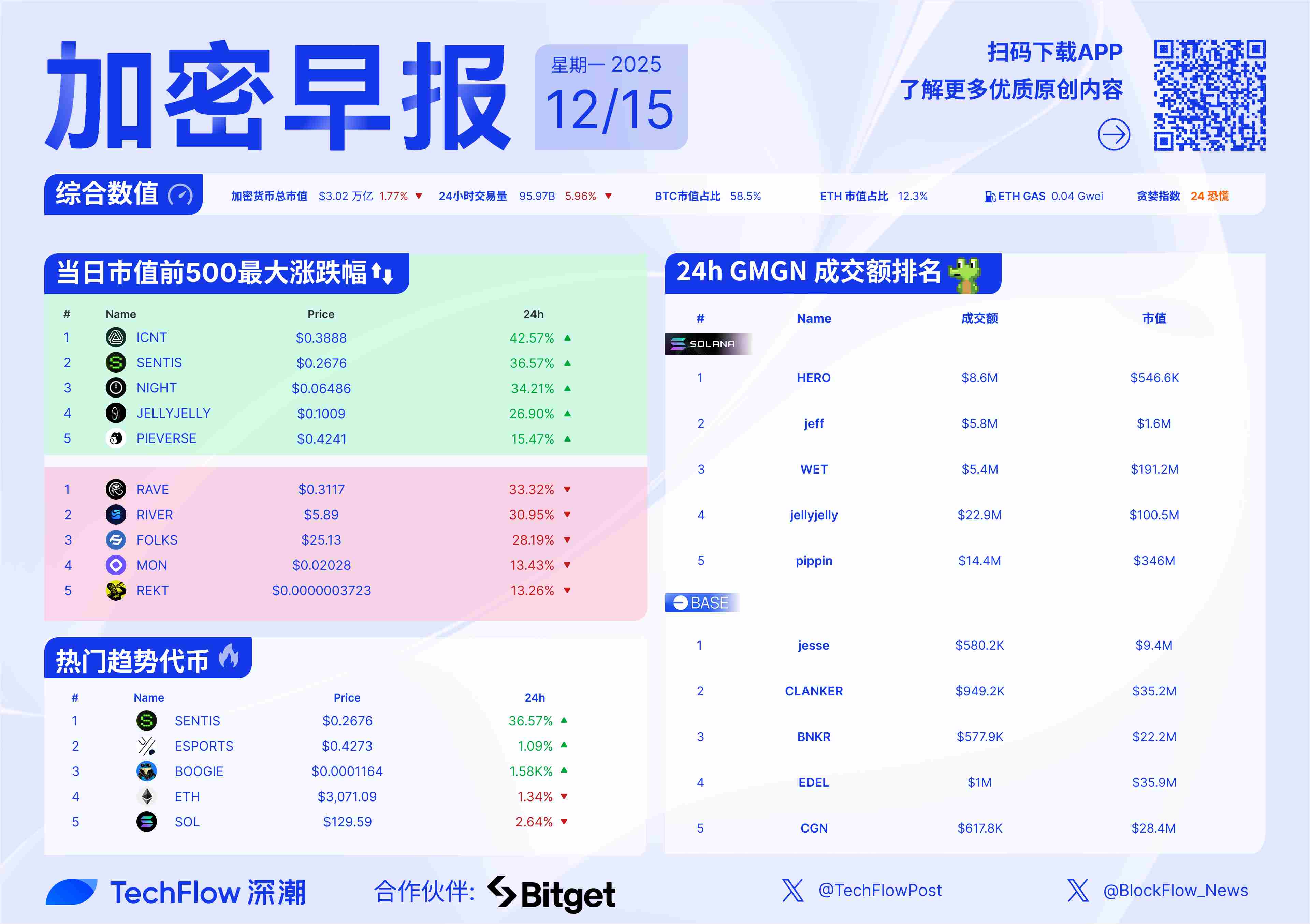
Suggested Reading
Silver Crisis: When Paper Markets Begin to Fail
This article analyzes the sharp volatility in silver markets and its underlying causes, revealing the crisis behind rising silver prices and structural market issues. It points out that due to financialization, trust in the silver market’s "paper system" is gradually eroding, physical demand is increasing, and market manipulation phenomena along with JPMorgan's pivotal role are also discussed in detail.
x402 V2 Launch: When AI Agents Get “Credit Cards,” Which Projects Will Be Revalued?
This article thoroughly examines the x402 V2 protocol in the crypto space and its profound impact on AI agent financial behavior. Core updates in x402 V2 include deferred payments, cross-chain compatibility, and hybrid payment rails, aiming to build a financial infrastructure suitable for machine-driven commerce. The article also analyzes related narratives and potential investment opportunities, exploring future trends in AI economies.
a16z’s Vision for Crypto in 2026: These 17 Trends Will Reshape the Industry
This article compiles 17 key trends for the future of crypto, summarized by multiple partners at a16z, covering insights on privacy tech, prediction markets, stablecoins, blockchains, tokenized assets, and the convergence of AI and crypto. These trends will profoundly influence technological advancement, financial innovation, and socioeconomic developments in the crypto industry.
Oracle Drops 40%: Can Overbuilding AI Infrastructure Drag Down Tech Giants?
This article discusses how Oracle and other tech giants face significant challenges in building AI infrastructure. Despite AI being seen as a critical future direction, these giants face pressure from massive capital investments, rising debt, and uncertain market demand. Whether AI infrastructure will deliver expected returns remains to be seen, and the market continues to question the sustainability of both startups and established players.
Burry Warns: Fed’s RMP Aims to Conceal Banking System Fragility, Essentially a QE Restart
This article focuses on the Federal Reserve’s latest Reserve Management Purchase (RMP) program and its implications for the banking system and financial markets. Michael Burry warns that this move is effectively covert quantitative easing (QE), intended to mask banking sector fragility. The article analyzes repo market volatility, concerns over funding tightness, and the potential impact of expanding the Fed’s balance sheet, while also discussing the banking system’s reliance on central bank liquidity.
Join TechFlow official community to stay tuned
Telegram:https://t.me/TechFlowDaily
X (Twitter):https://x.com/TechFlowPost
X (Twitter) EN:https://x.com/BlockFlow_News
 深潮TechFlow