From MicroStrategy to Blockstream: How Corporate Bitcoin Accumulation Is Reshaping the Crypto Market Landscape
TechFlow Selected TechFlow Selected
From MicroStrategy to Blockstream: How Corporate Bitcoin Accumulation Is Reshaping the Crypto Market Landscape
Corporate Bitcoin accumulation is, at its core, a high-stakes gamble on “time.”
 Navigating Web3 tides with focused insights
By Nikka, WolfDAO
Part I: A Deep Dive into HODLing Behavior
1.1 Strategy (MSTR): Leveraged Conviction Injection
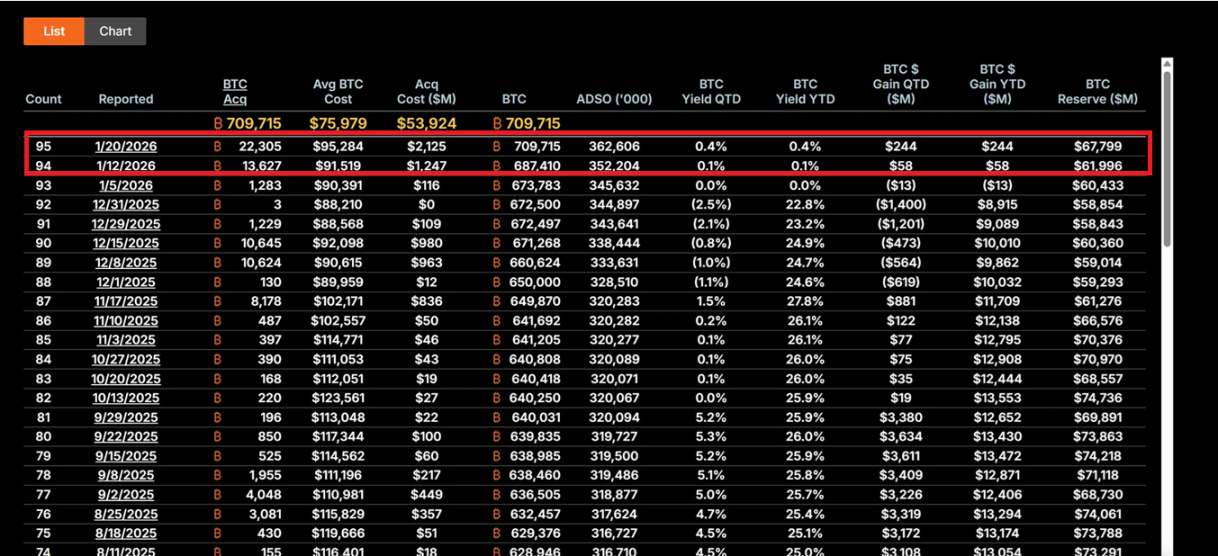
Under CEO Michael Saylor’s leadership, Strategy has fully transformed itself into a Bitcoin-holding vehicle. Between January 12–19, 2026, the company purchased 22,305 BTC at an average price of approximately $95,500, totaling $2.13 billion—the largest single purchase in the past nine months. As of now, MSTR holds a total of 709,715 BTC, with an average acquisition cost of $75,979, representing a cumulative investment of nearly $53.92 billion.
Its core strategy is built upon the “21/21 Plan”—raising $21 billion each via equity financing and fixed-income instruments to fund continuous Bitcoin purchases. This model does not rely on operating cash flow; instead, it leverages capital markets’ “leverage effect”: issuing shares, convertible bonds, and at-the-market (ATM) offerings to convert fiat-denominated debt into deflationary digital assets. This strategy causes MSTR’s stock volatility to typically be 2–3 times that of Bitcoin’s price movement, making it the market’s most aggressive “BTC proxy” instrument.
Saylor’s investment philosophy is rooted in profound confidence in Bitcoin’s scarcity. He views BTC as “digital gold” and an inflation hedge. Amid current macroeconomic uncertainty—including Federal Reserve policy volatility, tariff-driven trade wars, and geopolitical risks—this countercyclical accumulation reflects institutional-grade long-termism. Even after its stock price declined 62% from its peak, MSTR remains viewed by value investors as an “extreme discount” buying opportunity.
Should Bitcoin’s price rebound to $150,000, MSTR’s holdings would be worth over $10.64 billion, and its stock price—amplified by leverage—could exhibit 5–10x elasticity. Yet the downside risk is equally pronounced: if BTC falls below $80,000, debt servicing costs (with annualized interest rates of 5–7%) could trigger liquidity stress, forcing strategic recalibration—or even liquidation risk.
1.2 Bitmine Immersion Technologies (BMNR): A Staking-Driven Productivity Model
BMNR, under Tom Lee’s leadership, pursues a fundamentally different path. The company positions itself as the “world’s largest Ethereum Treasury company.” As of January 19, it holds 4.203 million ETH, valued at approximately $13.45 billion. Crucially, 1,838,003 ETH are actively staked. At current annualized staking yields of 4–5%, this generates roughly $590 million in annual cash-flow income.
This “staking-first” strategy provides BMNR with intrinsic value cushioning. Unlike MSTR’s pure price exposure, BMNR earns recurring yield through network participation—akin to holding high-yield bonds while capturing Ethereum ecosystem growth upside. Between Q4 2025 and Q1 2026, BMNR added 581,920 ETH to its staked position, demonstrating sustained commitment to the network’s long-term value.
BMNR’s ecosystem expansion strategy also merits attention. The company plans to launch the MAVAN staking solution in Q1 2026, offering ETH management services to institutional investors and building an “ETH per share” growth model. Additionally, its $200 million investment in Beast Industries on January 15—and shareholder approval for expanded share issuance authority—pave the way for potential M&A activity (e.g., acquiring smaller ETH-holding firms). BMNR also holds 193 BTC and $22 million in equity of Eightco Holdings, bringing its total crypto and cash assets to $14.5 billion.
From a risk-management perspective, BMNR’s staking yield offers downside protection. Even if ETH trades sideways around $3,000, staking returns can still offset part of the opportunity cost. However, should Ethereum network activity remain persistently weak—causing staking APY to decline—or should ETH fall below key support levels, BMNR’s NAV discount may widen further (its current share price stands at ~$28.85, down over 50% from its peak).
1.3 Strategy Comparison and Evolution
The two companies represent two archetypal paradigms of corporate HODLing. MSTR embodies an offensive, high-risk/high-reward leveraged model, relying entirely on Bitcoin price appreciation to deliver shareholder value. Its success rests on conviction in BTC’s long-term supply scarcity and macro monetary debasement trends. BMNR, by contrast, follows a defensive, yield-oriented ecosystem model—building diversified revenue streams via staking and services, thereby reducing dependence on single-asset price volatility.
Notably, both companies have learned from 2025 and shifted toward more sustainable financing models. MSTR avoids excessive equity dilution, while BMNR reduces reliance on external funding by leveraging staking income. This evolution signals a broader shift—from corporate crypto allocation as an “experimental allocation” to a “core financial strategy”—and marks the arrival of the 2026 era, defined by “institution-led adoption, not retail FOMO.”
II: Multi-Dimensional Market Impact
2.1 Short-Term Impact: Bottom Signal and Sentiment Recovery
MSTR’s massive purchases are often interpreted by the market as confirmation of a Bitcoin bottom. Its mid-January $2.13 billion buy-in drove Bitcoin ETF inflows to $844 million on a single day—demonstrating institutional capital flowing back in step with corporate HODLing. This “corporate anchoring” effect is especially vital during periods of fragile retail sentiment: when the Fear & Greed Index registers “extreme fear,” MSTR’s persistent buying provides psychological support to the market.
BMNR’s Ethereum accumulation likewise exerts catalytic influence. Its strategy echoes BlackRock’s and other traditional finance giants’ bullish outlook on Ethereum’s dominance in real-world asset (RWA) tokenization. This could spark a “second wave of ETH Treasuries,” with companies like SharpLink Gaming and Bit Digital already following suit—accelerating staking adoption and ecosystem M&A trends.
Investor sentiment is shifting from panic toward cautious optimism. Such sentiment recovery exhibits self-reinforcing characteristics in crypto markets—and may sow the seeds for the next upward cycle.
2.2 Medium-Term Impact: Volatility Amplification and Narrative Divergence
However, the leveraged nature of corporate HODLing also magnifies market risk. MSTR’s highly leveraged model may trigger chain reactions during further Bitcoin corrections. With its stock beta exceeding BTC’s by more than 2x, any price decline is amplified—potentially triggering passive sell-offs or liquidity crises. This “leverage transmission” effect triggered a similar liquidation wave in 2025, when multiple leveraged holders were forced to unwind positions amid rapid price declines.
Although buffered by staking yield, BMNR faces its own challenges. Prolonged Ethereum network inactivity could depress staking APY, eroding its “productive asset” advantage. Moreover, if the ETH/BTC ratio remains persistently weak, BMNR’s NAV discount may deepen—creating a negative feedback loop.
A deeper impact lies in narrative divergence. MSTR reinforces Bitcoin’s positioning as a “scarce safe-haven asset,” attracting conservative investors seeking macro hedges. BMNR, meanwhile, advances Ethereum’s “productive platform” narrative—highlighting its utility in DeFi, staking, and tokenization. This divergence may cause BTC and ETH to decouple across macro scenarios: e.g., BTC may outperform during liquidity tightening due to its “digital gold” attributes, whereas ETH may command a premium during innovation cycles driven by ecosystem expansion.
2.3 Long-Term Impact: Financial Paradigm Reshaping and Regulatory Adaptation
From a long-term perspective, MSTR’s and BMNR’s actions may reshape corporate financial management paradigms. Should the U.S. CLARITY Act pass successfully—clarifying accounting treatment and regulatory classification for digital assets—it would significantly lower compliance costs for corporate crypto allocations. The Act could catalyze Fortune 500 companies to allocate over $1 trillion into digital assets, shifting corporate balance sheets away from traditional “cash + bonds” portfolios toward “digital productive assets.”
MSTR has become the textbook case of a “BTC proxy,” with its market-cap-to-NAV premium mechanism dubbed the “reflexive flywheel”: issuing shares at a premium to acquire more BTC, increasing BTC-per-share, thereby lifting the stock price—and reinforcing the cycle. BMNR, in turn, provides a replicable template for ETH Treasuries—demonstrating how staking yield can generate sustained shareholder value.
This may also ignite an industry consolidation wave. BMNR’s shareholder-approved share issuance authority for M&A purposes opens the door to acquiring smaller ETH-holding firms—potentially forming “Treasury giants.” Weaker HODLers may be compelled to sell or merge under macro pressure, yielding a “survival-of-the-fittest” market structure. This signals crypto’s structural transition—from “retail-dominated” to “institution-led.”
Yet this process is not without risk. Should the regulatory environment deteriorate (e.g., the SEC adopts a hardline stance on digital asset classification) or macro conditions unexpectedly worsen (e.g., the Fed hikes rates aggressively due to inflation rebound), corporate HODLing could shift from a “paradigm shift” to a “leverage trap.” Historically, similar financial innovations have triggered systemic crises when met with regulatory crackdowns or market reversals.
III: Core Questions Explored
3.1 Corporate HODLing: A New Golden Age or a Leverage Bubble?
The answer hinges on perspective and time horizon. From an institutional investor standpoint, corporate HODLing represents a rational evolution in capital allocation. Amid global debt expansion and growing concerns over currency debasement, allocating part of the portfolio to scarce digital assets carries strategic merit. MSTR’s “intelligent leverage” is not gambling—it leverages capital market tools to convert equity premiums into digital asset accumulation, a sustainable approach so long as equity markets continue endorsing its strategy.
BMNR’s staking model further validates the “productivity” attribute of digital assets. Its $590 million in annual staking yield not only provides cash flow but also enables financial resilience amid price volatility—resembling high-yield bond ownership enhanced by network growth upside, and showcasing crypto assets’ potential beyond “pure speculation.”
Yet critics’ concerns are not unfounded. Current corporate HODLing leverage ratios are indeed at historic highs: $9.48 billion in debt and $3.35 billion in preferred stock pose burdens under macro headwinds. The 2021 retail bubble remains a cautionary tale—when many highly leveraged participants suffered severe losses during rapid deleveraging. If today’s corporate HODLing wave merely shifts leverage from retail to corporate balance sheets—without fundamentally altering risk architecture—the outcome may prove equally devastating.
A more balanced view holds that corporate HODLing sits in a “period of institutional transition.” It is neither a simple bubble (given its fundamental support and long-term logic) nor an immediate golden age (given persistent regulatory, macro, and technological risks). Execution is key—can sufficient market recognition be achieved before regulatory clarity arrives? Can financial discipline be maintained under macro stress? Can technological and ecosystem innovation substantiate digital assets’ long-term value?
Conclusion and Outlook
MSTR’s and BMNR’s HODLing behavior marks crypto’s entry into a new phase—not a retail-driven speculative frenzy, but a rational, institutionally anchored strategic allocation. Though pursuing divergent paths—MSTR’s leveraged conviction injection versus BMNR’s staking-driven productivity model—both demonstrate unwavering commitment to digital assets’ long-term value.
Corporate HODLing is, at its core, a high-stakes wager on “time.” It bets that regulatory clarity will arrive before liquidity dries up; that price appreciation will outpace debt maturity; and that market faith will withstand macro headwinds. There is no middle ground—either digital asset allocation proves to be the paradigm-shifting evolution of 21st-century corporate finance, or it becomes yet another cautionary tale of excessive financialization.
Markets stand at a crossroads. To the left lies a mature, institution-led market; to the right, a chasm of leverage collapse and forced liquidations. The answer will likely unfold within the next 12–24 months—and we are all witnesses to this experiment.
Join TechFlow official community to stay tuned
Telegram:https://t.me/TechFlowDaily
X (Twitter):https://x.com/TechFlowPost
X (Twitter) EN:https://x.com/BlockFlow_News
 @10xWolfdao