MSTR's Ordeal: Short-Selling and Palace Intrigues
TechFlow Selected TechFlow Selected
MSTR's Ordeal: Short-Selling and Palace Intrigues
MSTR's structure is fragile—long on volatility, short on time.
 Navigating Web3 tides with focused insights
Author: Lin Wanwan
MSTR (Strategy) holders probably haven't been sleeping well lately.
This once-deified "Bitcoin central bank" has seen its stock bloodied. As Bitcoin rapidly pulled back from its all-time high of $120,000, MSTR’s share price and market cap shrank sharply in a short period—plunging over 60%. Strategy may even be removed from the MSCI stock index.
The coin price correction and halved stock price are just surface symptoms. What truly worries Wall Street is that increasing signs suggest MSTR is being drawn into a battle for monetary power.
This isn’t an exaggeration.
Over recent months, seemingly unrelated events have begun to connect: JPMorgan was accused of abnormally intensifying its short position against MSTR; users encountered settlement delays when transferring MSTR shares out of JPM; derivatives markets repeatedly suppressed Bitcoin; policy discussions around a "Treasury-backed stablecoin" and a "Bitcoin reserve model" quickly heated up.
And these aren’t isolated incidents.
MSTR stands at the fault line between two American monetary systems.
One side of this palace intrigue is the old system: the Federal Reserve + Wall Street + commercial banks (with JPMorgan at its core); the other side is an emerging new system: the Treasury Department + stablecoin infrastructure + a financial system using Bitcoin as long-term collateral.
Within this structural conflict, Bitcoin isn’t the target—it’s the battleground. And MSTR is the critical bridge: it converts traditional institutions’ dollars and debt structures into Bitcoin exposure.
If the new system succeeds, MSTR becomes the core adapter; if the old system holds firm, MSTR becomes a node that must be suppressed.
Therefore, MSTR’s recent plunge isn’t simply an asset fluctuation—it’s the convergence of three forces: natural adjustment in Bitcoin prices; inherent fragility in MSTR’s own risk structure; and spillover conflict from power shifts within the dollar system.
Bitcoin strengthens the Treasury’s future monetary architecture while weakening the Fed’s. The government faces a tough choice: to maintain opportunities for low-cost accumulation, they need JPM to keep suppressing Bitcoin.
Thus, the hunt against MSTR is systematic. JPMorgan knows this game too well—because they wrote the rules. They’ve placed MSTR on the dissection table, clearly exposing its veins (cash flows), bones (debt structure), and soul (market faith).
We now dissect four possible "death poses" facing MSTR—four carefully prepared death warrants from the old order.
Pose One: Opportunistic Raid
This is the most intuitive and widely discussed scenario: if BTC keeps crashing, MSTR's leverage magnifies losses, driving its stock lower until it loses refinancing ability, triggering a chain collapse.
The logic is simple—but not the core issue.
Everyone knows “if BTC falls too much, MSTR gets into trouble,” but few understand exactly how far it needs to fall before MSTR shifts from “rock solid” to “untenable.”

MSTR’s balance sheet hinges on three key figures:
Total BTC holdings exceed 650k coins (about 3% of total Bitcoin supply)
Average cost basis around $74,400
Some debt carries implicit price risk (not liquidation-based, but impacts net assets)
Many “MSTR will go to zero” narratives treat it like a leveraged exchange futures contract with a forced liquidation level. But in reality: MSTR has no liquidation price—only a “narrative liquidation price.”
What does that mean?
Even if creditors don’t force liquidation, the market can crash its stock. When the share price drops below a certain point, MSTR can no longer issue bonds or convertible notes to buy more BTC.
The old guard, led by JPMorgan, is teaming up through U.S. equity options markets to short MSTR. Their tactic is straightforward: capitalize on Bitcoin’s pullback to aggressively dump MSTR shares and spread panic. Their sole objective: shatter Michael Saylor’s myth.
This is MSTR’s first breaking point: Bitcoin falling so much that outsiders refuse to give it more money.
Pose Two: Debt Knocking at the Door
Before discussing convertible bonds, we must first understand how CEO Michael Saylor performs his “magic trick.”
Many beginners think MSTR only buys Bitcoin with profits—wrong. MSTR plays an extremely bold “leverage arbitrage game.”
Saylor’s core strategy: issue convertible notes, borrow USD, buy Bitcoin.
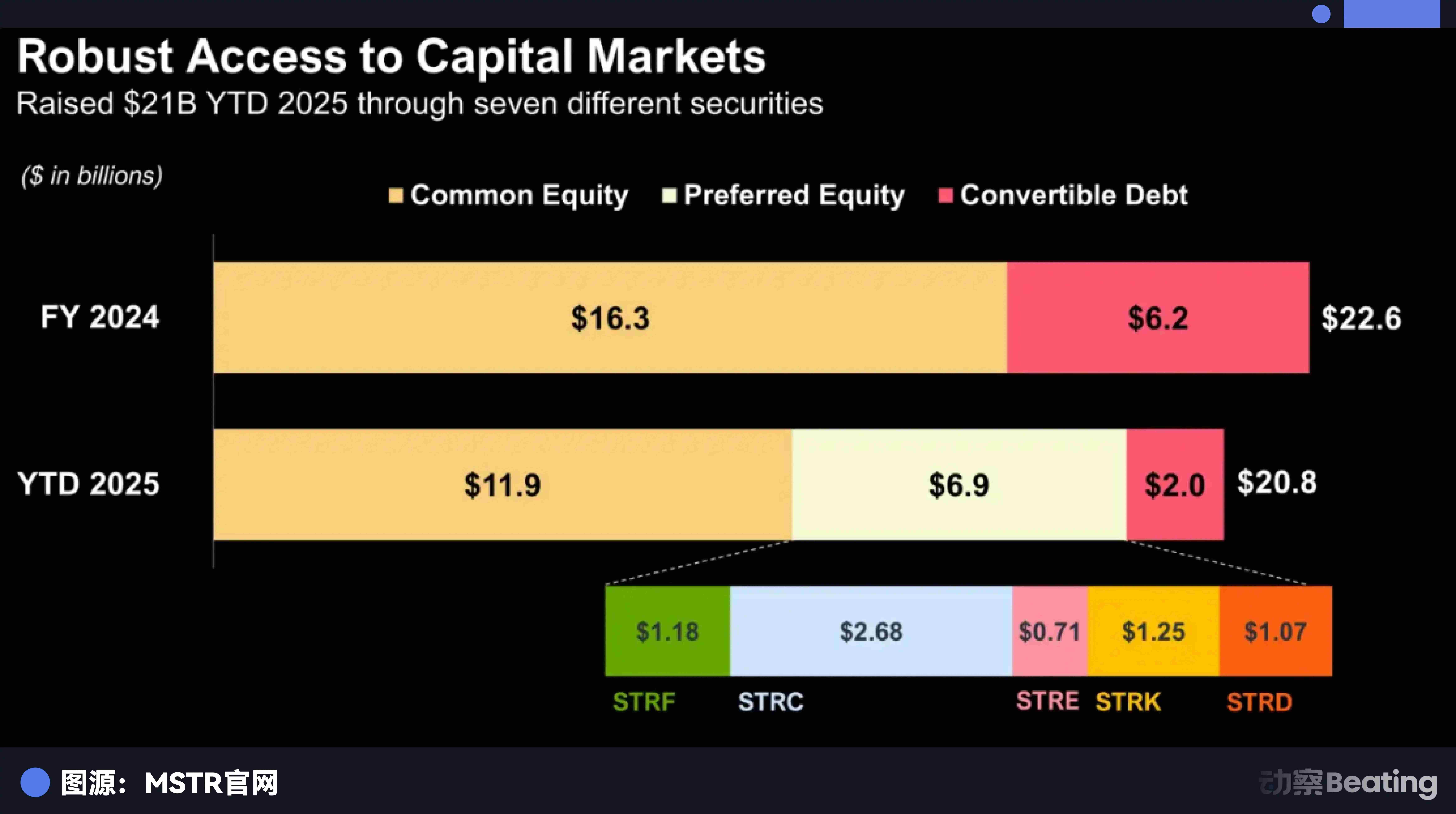
MSTR has raised $20.8 billion in funding this year—an exceptionally rare scale among U.S. listed companies. Funding sources include $11.9 billion via common stock, $6.9 billion via preferred shares, and $2 billion via convertible bonds.
This sounds ordinary, but the devil is in the details.
These bonds offer extremely low interest rates (some under 1%)—why would investors buy them? Because they come with a “call option.” If MSTR’s stock rises, bondholders can convert their debt into shares and profit handsomely; if the stock doesn’t rise, MSTR repays principal and interest at maturity.
This creates the famous “flywheel”: issue debt to buy BTC, BTC price rises, MSTR stock surges, bondholders win, high stock premium enables more debt issuance, buying even more BTC.
This is the so-called “spiral upward.” But wherever there is upward spiral, there must also be a death spiral.
This failure mode is called “forced deleveraging amid liquidity drought.”
Imagine a future year where Bitcoin enters a prolonged sideways phase (no crash needed—just stagnation). Old bonds mature. Bondholders look: MSTR’s stock has fallen below the conversion price.
Bondholders aren’t philanthropists—they’re Wall Street vampires. They won’t convert bonds into shares. Instead, they coldly say: “Pay us back. In cash.”
Does MSTR have cash? No. All its cash has been converted into Bitcoin.
Now MSTR faces a desperate choice: either refinance—issue new debt to repay old debt. But due to low BTC prices and poor market sentiment, new bond interest rates would be prohibitively high, consuming the meager cash flow from software operations.
Or sell Bitcoin to repay debt.
Once MSTR is forced to announce “selling Bitcoin to repay debt,” it detonates a nuclear bomb in the market.
The market panics: “The hardcore bull has surrendered!” Panic drives BTC price down, which crashes MSTR’s stock, causing more bonds to fail conversion, prompting more bondholders to demand repayment.
This is a “Soros-style” attack moment.
This failure mode is the most dangerous—not requiring a Bitcoin crash, only time. When debt maturity meets market silence, the sound of broken funding chains will be sharper than shattered glass.
Pose Three: Kill the Faith
If the second pose is “running out of money,” the third is “running out of believers.”
This is currently MSTR’s biggest vulnerability—and the blind spot most retail investors overlook: premium rate.
Let me do the math. You buy one MSTR share today for $100. But within that $100, only $50 represents actual Bitcoin value. What is the remaining $50?
Air. Or more politely, “faith premium.”
Why are people willing to pay double to own Bitcoin?
Before spot ETFs like BlackRock’s IBIT existed, it was because there was no alternative—regulated institutions could only buy stocks. After spot ETFs launched, people still bought MSTR because they believed Saylor could use debt issuance to “feed the coin” and outperform simple hodling.
But this logic has a fatal flaw.
MSTR’s stock price rests entirely on the narrative: “I can borrow cheap money to buy BTC.” Once that narrative breaks, the premium collapses.
Imagine: what if Wall Street keeps suppressing MSTR, and the White House pressures it to surrender holdings? What if the SEC suddenly issues a ruling stating “public company Bitcoin holdings are non-compliant”?
In that instant, faith evaporates.

This failure mode is called a “double whammy.”
At that moment, the market asks a soul-searching question: “Why should I pay $2 for something worth $1? Why not just buy BlackRock’s ETF? Theirs is 1:1.”
Once this thought becomes consensus, MSTR’s premium ratio could rapidly fall from today’s 2.5x or 3x down to 1x—or even below, to 0.9x (a discount), given corporate operational risks.
This means even if Bitcoin’s price doesn’t drop a penny, MSTR’s stock could still halve instantly.
This is narrative collapse. It’s not as bloody as default, but more soul-crushing. You watch your Bitcoin holding stay flat, yet your MSTR position shrinks 60%—you start questioning reality. This is “valuation kill.”
Pose Four: Lock the Door and Beat the Dog
The fourth pose is the most hidden, least known—but ironically the most telling.
What is MSTR desperately doing now? Trying to inflate its market cap to enter more indices—like MSCI and Nasdaq, and ideally the S&P 500.
Many cheer: “Once in the S&P 500, tens of trillions in passive funds will have to buy it—then the stock becomes a perpetual motion machine!”
As the old saying goes: fortune often hides misfortune.
By entering U.S. indices, MSTR is no longer just a single-stock play—it has become a cog in the U.S. financial system. Wall Street manipulates by shorting MSTR on one hand, while spreading rumors of its potential index removal on the other, triggering retail panic selling.
MSTR is now trapped. It tried to use Wall Street’s money, but ended up locked in by Wall Street’s rules.
It sought to rise using Wall Street’s game—yet might ultimately die by that same game.
Epilogue: Palace Intrigue Destiny
Michael Saylor is a genius—and a madman. He saw through the essence of fiat depreciation and seized the era’s opportunity. He transformed an unremarkable software company into a Noah’s Ark carrying dreams of millions of gamblers.
But the scale of Bitcoin he controls has long exceeded what the company alone can sustain.
Many now speculate the U.S. government might directly invest in MSTR.
Possible methods include swapping U.S. Treasuries directly for MSTR equity, supporting MSTR in issuing government-backed preferred shares, or even direct administrative intervention to forcibly upgrade its credit rating.
The climax of this drama hasn’t fully arrived. The palace struggle between old and new financial orders continues. MSTR’s structure is fragile—bet on volatility, bet against time.
All it takes is for Wall Street to remove one screw from MSTR, and any of the four scenarios we described—price collapse, debt default, premium wipeout, or index delisting—could rapidly destabilize its entire structure.
Yet conversely: when all parts function together, it could become one of the most explosive assets in global capital markets.
This is both MSTR’s allure—and its peril.
Join TechFlow official community to stay tuned
Telegram:https://t.me/TechFlowDaily
X (Twitter):https://x.com/TechFlowPost
X (Twitter) EN:https://x.com/BlockFlow_News
 BlockBeats