Bitcoin Holdings Surpass BlackRock—How Is STRC Becoming Strategy’s “Cash Printer 2.0”?
TechFlow Selected TechFlow Selected
Bitcoin Holdings Surpass BlackRock—How Is STRC Becoming Strategy’s “Cash Printer 2.0”?
Funding capacity does not equate to the execution path; whether Bitcoin can cooperate is the true variable.
 Navigating Web3 tides with focused insights
Author: TechFlow
On April 20, Saylor posted a screenshot on X showing Strategy’s Bitcoin holdings tracker, captioned with three words: “Think Even Bigger.”
Twenty-four hours later, the answer was revealed: 34,164 bitcoins, valued at $2.54 billion, with an average purchase price of $74,395 per coin—the third-largest single transaction in history and the largest weekly purchase so far this year.
More importantly, another number: 815,061.
This is Strategy’s total Bitcoin holdings as of April 19. Across the Atlantic, BlackRock’s IBIT—the world’s largest spot Bitcoin ETF—holds 802,823 bitcoins.
Saylor’s company has officially surpassed BlackRock in Bitcoin holdings.
Two Logics, Two Machines
To grasp the significance of this milestone, we must first understand how these two institutions accumulated their Bitcoin.
BlackRock’s IBIT operates like a pump. It draws funds from retail and institutional investors into the market and converts them into Bitcoin purchasing power. Over the past week, IBIT saw net inflows of approximately $900 million, translating to roughly 12,000 newly acquired bitcoins. This mechanism’s ceiling is market sentiment: capital floods in during bull markets and exits during bear markets, causing IBIT’s holdings to ebb and flow with the tides.
Strategy is something entirely different. It does not wait for money to flow in—it proactively raises capital to buy Bitcoin.
This $2.54 billion purchase was financed through the following structure: 21,795,389 shares of STRC preferred stock, raising $2.176 billion; and 2,165,000 shares of common stock, raising $366 million.
85% came from STRC; 15% from MSTR common stock.
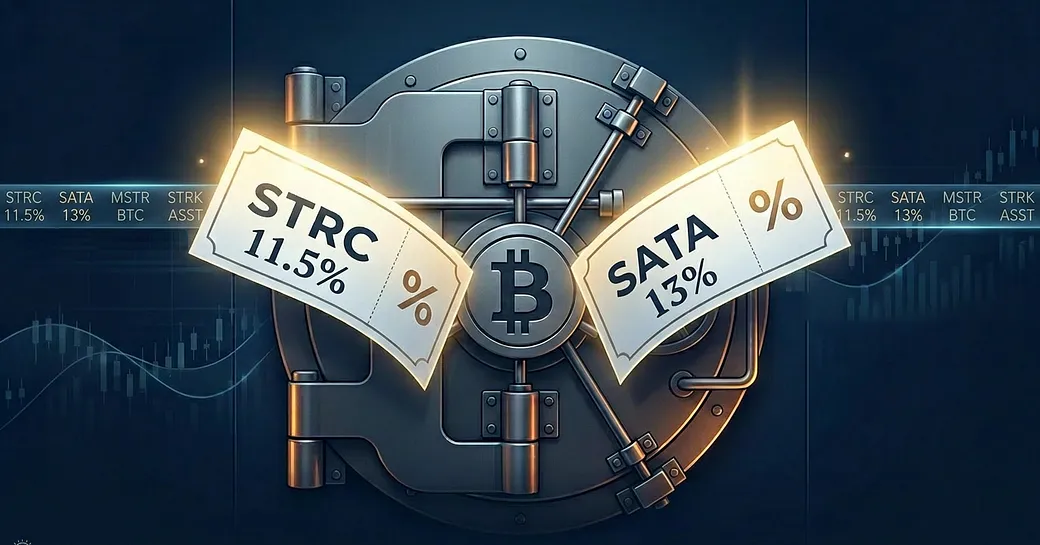
What Is STRC? Saylor’s “Printing Press 2.0”
Strategy’s Bitcoin accumulation history can be divided into two eras.
From 2020 to 2024, it relied on convertible bonds. Strategy issued zero-coupon or low-coupon convertible bonds to institutional investors, used the proceeds to buy Bitcoin, and bet that Bitcoin’s price appreciation would outpace debt servicing costs. This strategy worked—but had ceilings: convertibles have maturity dates, each issuance depends on timing windows, and deteriorating interest-rate environments shrink available headroom. A more fundamental issue is that convertible bondholders are creditors—not Bitcoin believers—and ultimately expect repayment of principal.
In late 2025, Strategy launched STRC: perpetual preferred stock with a fixed par value of $100 and a floating dividend. The word “perpetual” is key—no maturity date, no obligation to repay principal, only the ongoing commitment to pay dividends. Saylor himself dubbed this the company’s “iPhone moment.”
Its mechanical logic works as follows:
Strategy issues STRC shares publicly at $100 per share. Buyers receive a promise: an annual floating dividend, with the dividend rate dynamically adjusted based on STRC’s market price—aiming to keep STRC trading near its $100 par value. Strategy uses all proceeds exclusively to purchase Bitcoin.
This design incorporates an automatic voltage regulator. If STRC trades below $100, it signals insufficient dividend appeal to the market, prompting Strategy to raise the dividend and pull the price back up. If STRC trades above $100, it signals overheated demand, prompting Strategy to lower the dividend and curb the premium. Price remains clamped near par by this “scissor mechanism,” keeping Strategy’s issuance window perpetually open.
Last week, STRC’s single-day trading volume peaked at $750 million, with average daily volume exceeding $300 million—making it nearly the most liquid preferred stock in the U.S. market. But liquidity is only skin-deep; the machine’s true engine relies on three simultaneously satisfied conditions.
Condition One: STRC Must Trade at Its $100 Par Value.
This is the system’s physical on/off switch. Strategy only actively issues new STRC shares when the market price equals $100. Issuing below par means Strategy is discounting its own financing capacity—effectively exchanging $90 for every $100 of capital used to buy Bitcoin, instantly worsening its cost structure. In March this year, STRC traded below par for three consecutive days. The flywheel didn’t stall—but Strategy was forced to raise dividends, increasing its financing cost to restore the price.
Condition Two: MSTR Common Stock’s Market-to-NAV Ratio (mNAV) Must Exceed 1x.
Strategy’s ultimate goal isn’t merely buying Bitcoin—it’s increasing “Bitcoin per share.”
When MSTR’s market capitalization exceeds the market value of its Bitcoin holdings (mNAV > 1), issuing common stock to buy Bitcoin is economically rational: exchanging overvalued paper for tangible assets increases Bitcoin-per-share and benefits existing shareholders. But once mNAV falls below 1, the logic flips entirely: issuing common stock becomes de facto discounted liquidation—each new share dilutes Bitcoin-per-share, inflicting real harm. Following this purchase announcement, MSTR’s stock fell 2.5%, with mNAV hovering just above 1.0—the machine’s most sensitive current reading.
Condition Three: Bitcoin’s Price Cannot Decline Sustainedly.
This is the most fundamental—and hardest-to-hedge—variable.
Strategy’s balance sheet consists almost entirely of Bitcoin. With a $6.156 billion acquisition cost basis, the current market value of its holdings sits roughly at breakeven. Should Bitcoin’s price remain persistently below its average acquisition price of $75,527, two things occur simultaneously: Strategy’s net asset value shrinks, and STRC’s credit backing weakens—investors begin questioning “whether this company can sustainably pay dividends,” triggering STRC’s descent below par and activating Condition One’s alarm.
Put more plainly: this machine requires Bitcoin’s price to stay at a level convincing the market that “Strategy’s assets can cover its liabilities.”
Capital markets research firm NYDIG describes this structure as a self-reinforcing feedback loop: STRC maintains par → Strategy raises funds to buy Bitcoin → Bitcoin balance sheet expands → STRC’s credit backing strengthens → further issuance continues. When all three conditions hold, the flywheel spins faster and faster. When any one condition loosens, the flywheel doesn’t stop immediately—it begins consuming reserves: raising dividends, cutting common-stock issuance, relying on remaining financing capacity—betting Bitcoin’s price rebounds before buffers run dry.
This $2.54 billion purchase was fully funded and deployed within just two days—Monday and Tuesday. From issuance to execution: two days, $2.5 billion. Such speed has virtually no precedent in public markets. It is itself proof of the flywheel’s health—when all three conditions align, this machine can operate faster than anyone imagined.
The Questions Hanging in Midair
This machine isn’t risk-free—and its risks are subtler than most imagine.
BitMEX Research noted in a report that STRC-related risks are “far greater than those of short-term U.S. Treasuries.” But a more precise framing is: STRC’s risk lies not in whether Strategy defaults, but in who bears losses if the flywheel loses momentum.
The answer is STRC holders. Strategy can cut dividends without triggering legal default—a core distinction between perpetual preferred stock and bonds. Dividend cuts cause STRC to trade below par, delivering paper losses to investors—yet Strategy avoids bankruptcy.
This structure channels market pressure onto investors, not the issuer. That’s Saylor’s brilliance—and why he’s called a “financial engineer,” not merely a “Bitcoin believer.”
Saylor’s current target is to accumulate 1 million bitcoins by the end of 2026. He still needs about 185,000 more. Given STRC’s current issuance capacity (~$19.46 billion) and MSTR common stock capacity (~$26.7 billion), the financing headroom makes this goal appear attainable.
Yet financing capacity ≠ execution path. Whether Bitcoin cooperates remains the true variable.
Join TechFlow official community to stay tuned
Telegram:https://t.me/TechFlowDaily
X (Twitter):https://x.com/TechFlowPost
X (Twitter) EN:https://x.com/BlockFlow_News
 深潮TechFlow