Zcash Privacy Coin Trust Crisis: After Claude Discovered a Vulnerability, Arthur Hayes Dumped His Holdings; Core Developer Josh Swihart’s Latest Response Fully Analyzed
TechFlow Selected TechFlow Selected
Zcash Privacy Coin Trust Crisis: After Claude Discovered a Vulnerability, Arthur Hayes Dumped His Holdings; Core Developer Josh Swihart’s Latest Response Fully Analyzed
The decline of ZEC was just waiting for a catalyst—and the black swan event arrived.
 Navigating Web3 tides with focused insights
Author: Kuli, TechFlow
Zcash ($ZEC), the longest-standing privacy-focused cryptocurrency, has long centered its narrative on “verifiable privacy + a fixed 21-million supply cap.”
But recently, a critical vulnerability—discovered with assistance from Claude Opus 4.8, the currently unreleased most powerful AI model—shattered this foundation of trust:
The Orchard privacy pool in Zcash’s design allows for the forgery and inflation of ZEC.
Specifically, security researcher Taylor Hornby, commissioned by Shielded Labs to audit cryptographic protocols, used Anthropic’s newly released Claude Opus 4.8 model to successfully generate an unlimited quantity of undetectable counterfeit ZEC in a local environment.
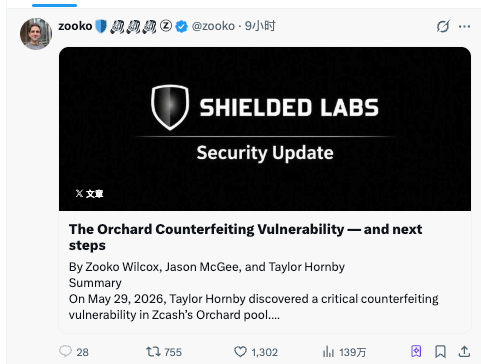
The root cause lies in an overly permissive rule within the Orchard circuit—the “rulebook” governing transactions—which causes the proof engine to accept fraudulent transactions as valid.
The issue was urgently patched on June 1–2 and fully disclosed publicly on June 5 by Zcash founder Zooko Wilcox and Shielded Labs. Within 24 hours of disclosure, ZEC’s price plummeted 26%–36%, triggering an immediate collapse in bullish confidence.
More symbolically, prominent trader Arthur Hayes—who previously listed ZEC as the second-largest holding in his “Holy Trinity” family fund—publicly confirmed he had fully liquidated his position. His rationale reflects deep concerns about privacy requirements:
“Although the probability of exploitation is extremely low, the narrative of privacy standing against AI, governments, and big tech demands perfection—not merely ‘probably safe.’”
Amid widespread market skepticism, Josh Swihart—founder and CEO of the Zcash Open Development Lab (ZODL) and de facto leader of Zcash’s core development team—posted a response whose title reads more like a public confession and plea for forgiveness:
Never Again.
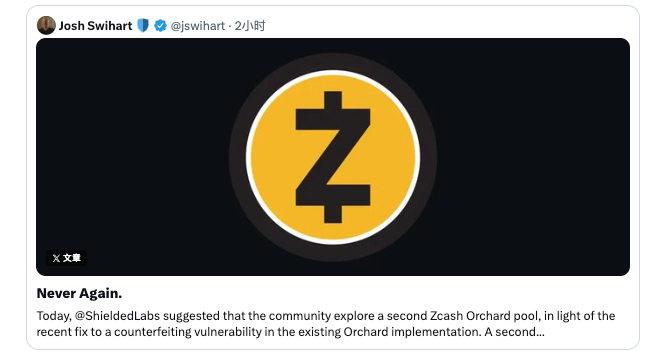
Below is the full Chinese translation of Josh Swihart’s post:
Today, Shielded Labs has proposed that the community explore establishing a second Zcash Orchard pool to address the recent forgery vulnerability discovered in the existing Orchard implementation—and subsequently patched. In principle, such a second Orchard pool could be deployed during the NU7 network upgrade scheduled for late July.
I will not take a firm stance on whether a second Orchard pool *should* be created. A more meaningful question is: How do we ensure this type of vulnerability never happens again?
The best answer—as Sean previously stated—is formal verification. For non-technical readers: A shielded (privacy-preserving) Zcash transaction includes a “proof” demonstrating that it strictly adheres to protocol rules—rules codified in a “rulebook” (i.e., the circuit), which defines what constitutes a valid transaction.
This latest Orchard vulnerability stems from one rule in that rulebook being written too loosely, causing the system to accept false information while still passing validation. As a result, the system can theoretically be tricked into treating fake transactions as genuine—meaning someone could, in theory, forge ZEC within the Orchard pool.
This is a flaw in the rulebook itself, not in the underlying cryptography or the proof-generation engine. As Sean noted, shielded pools conceal amounts and transaction history—that’s the essence of privacy.
Yet precisely because of this, you cannot directly verify values as you would on a transparent ledger. The only way to guarantee no counterfeiting occurs is via mathematical proof: every transaction must strictly follow the rules. Since the problem resides in the rulebook, the proof engine itself is largely irrelevant—the critical factor is how the rules are written.
The Orchard rulebook is highly complex. To prioritize speed, it incorporates many special-case optimizations—powerful, yet extremely cumbersome and difficult to audit comprehensively. An overly permissive rule is hard to spot—even after multiple rounds of expert-level security audits and reviews, this one was missed.
Formal verification solves exactly this problem.
It uses mathematical proofs to distill the human-auditable portion of the rulebook into concise, readable statements, then enables computers to exhaustively verify whether the entire rulebook matches those statements. Today’s AI tools can even assist in writing these proofs.
This dramatically simplifies auditing: reviewers need only examine a small, clear specification and run an unfalsifiable checker. We no longer rely on human eyes to “spot” issues—we instead use proofs to guarantee their absence.
Trust rests solely on foundational cryptographic assumptions and a tiny, well-defined specification—a current industry standard. Tachyon is being built using formal verification, adopting a simpler, more unified rulebook with far fewer special cases and less complexity than Orchard, enabling full mathematical verification of the entire rulebook.
Yet, as Sean pointed out, several teams are already performing formal verification on the existing Orchard circuit. If successful, deploying a formally verified second Orchard pool before Tachyon may represent the optimal near-term path.
Tachyon is cleaner—but a formally verified Orchard could serve as an excellent transitional solution, ensuring this class of vulnerability never recurs. Thanks to Sean Bowe for his review and feedback.
Josh’s response does not downplay the severity of the vulnerability; instead, it shifts focus toward the long-term solution: formal verification + Tachyon, the next-generation, simplified circuit.
From a PR perspective, candidly acknowledging the problem and presenting a concrete remediation plan is both technically sound and emotionally appropriate.
Yet amid the broader crypto market’s ongoing downturn, Zcash’s own issues accelerate holders’ capitulation—less a case of selling without justification, and more of seizing a ready-made reason to sell.
After all, speculators may care little about technical fixes; black swans act as catalysts for price declines.
Rapid patching and transparent disclosure are positives—but “inability to definitively prove innocence” combined with large holders exiting means short-term narratives and pricing remain under pressure. Long term, if formal verification succeeds, Zcash may reclaim its status as the “hardest privacy coin”—but that, too, takes time.
Join TechFlow official community to stay tuned
Telegram:https://t.me/TechFlowDaily
X (Twitter):https://x.com/TechFlowPost
X (Twitter) EN:https://x.com/BlockFlow_News
 深潮TechFlow