








Viewpoint: The current AI supercycle will last 15 years, yet most people are still in the FOMO Phase I stage for stocks.
TechFlow Selected TechFlow Selected
Viewpoint: The current AI supercycle will last 15 years, yet most people are still in the FOMO Phase I stage for stocks.
Phase One is complete; Phase Two is in pricing; Phase Three is where you should be.
 Navigating Web3 tides with focused insights
Author: Rand Group (@cryptorand)
Translated and edited by TechFlow
TechFlow Intro: Crypto KOL Rand Group breaks down the AI supercycle into four phases—from chips to infrastructure, then robotics, and finally platform software—identifying key assets and risk-reward profiles for each. His view: Phase One (semiconductors) has concluded; Phase Two (power/cooling/networking) is now being priced in; and the true asymmetric opportunity lies in Phase Three—robotics, space, defense, and nuclear energy.
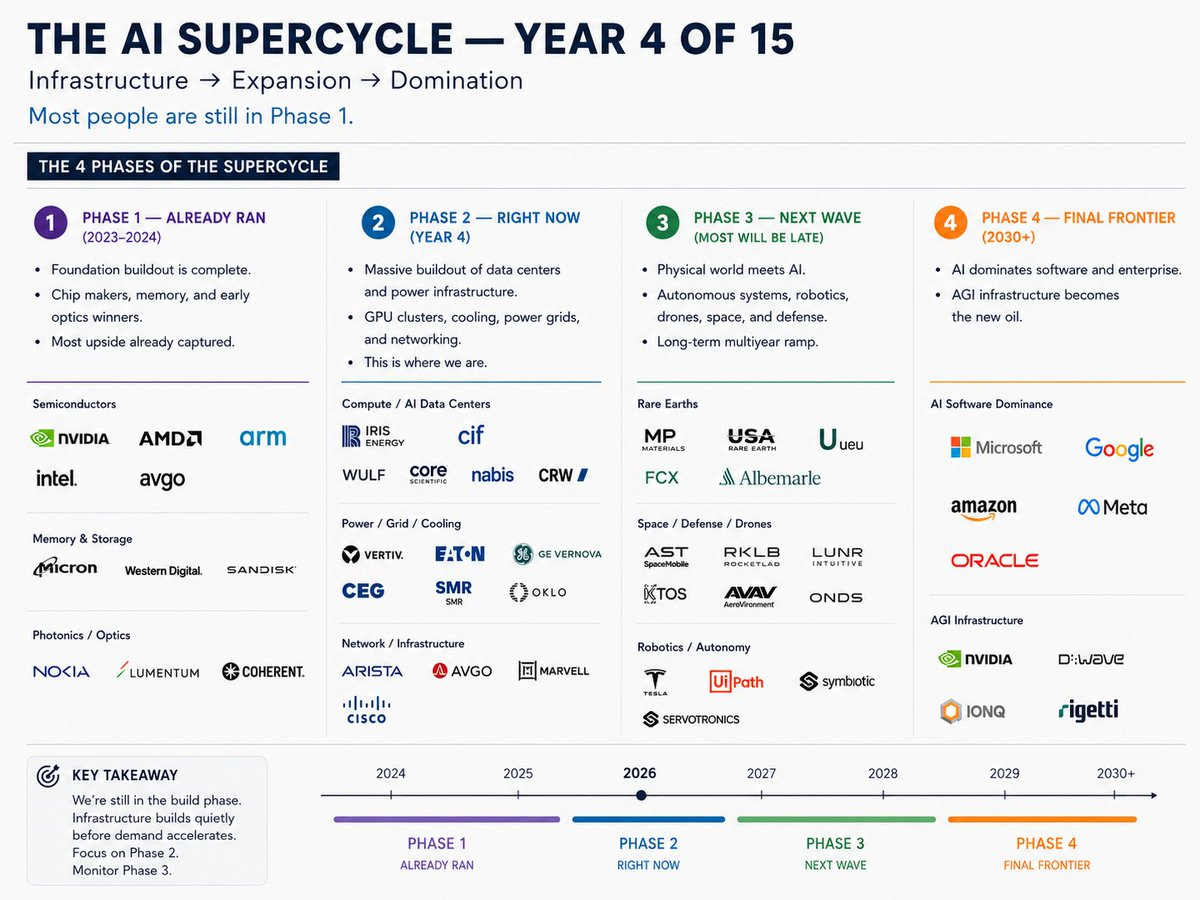
The AI supercycle will last 15 years. We are now in Year Three.
Most investors are still buying stocks from Phase One—but truly smart money has already rotated into Phase Three.
I’ve divided the entire cycle into four phases, highlighting the most critical assets in each.
The AI supercycle is the largest investment theme of our generation—bigger than mobile internet, bigger than cloud computing. A structural transformation lasting 15 years will reshape every industry across the global economy. Hyperscale cloud providers have already committed $725 billion in capital expenditures for 2026—nearly double last year’s figure. Microsoft, Google, Amazon, and Meta each plan over $100 billion.
This is not speculation.
🔴 Phase One: Completed (2023–2025)
The foundational layer is complete. AMD rose 78% in 2025; NVDA gained 39%; Intel just delivered an explosive Q1, pushing the Philadelphia Semiconductor Index above 10,000 points for the first time. Chips continue to drive every phase—but the historic entry opportunity has passed, and the risk-reward ratio has compressed.
Key Assets: NVDA, AMD, ARM, INTC, AVGO, MU, GLW
Sectors: Semiconductors, memory, photonics/optics
Status: Foundational layer complete—still growing, but already priced in.
🟡 Phase Two: Construction Peak (2025–2027)
The phase where most investors are just waking up. CEG acquired Calpine, becoming the largest private U.S. power producer at 55 GW. GEV surged over 200% in one year. VRT co-designed cooling solutions for NVIDIA’s Rubin architecture. GLW rose 74% this year on fiber-optic demand. Small Modular Reactors (SMRs) in nuclear energy are the biggest dark horse—OKLO, SMR, and BWXT are directly positioning themselves to power data centers.
Upside remains—but the most obvious names have already moved.
Key Assets: CEG, GEV, VRT, VST, TLN, ANET, GLW, MOD, EQIX, OKLO, SMR, BWXT, NNE
Sectors: Power/grid, thermal management, networking, SMR nuclear construction peak
Note: SMR nuclear energy is a hidden major opportunity.
🟡 Phase Three: Positioning Window (2026–2028)
The phase where AI moves beyond data centers and enters the physical world. Most people will be late.
Tesla is converting its Fremont factory into an Optimus robot production line, with $25 billion in capex and a target for mass production in H2 2026. Rocket Lab set a record $602 million in revenue, with $1.85 billion in backlog. LUNR rose 47% this year, holding $943 million in contracts. KTOS’s Valkyrie drone was selected by the U.S. Marine Corps.
The positioning window is open—right now.
Key Assets: TSLA, RKLB, LUNR, KTOS, AVAV, PATH, ISRG, MP, FCX, ALB, ASTS
Sectors: Robotics/autonomous vehicles, space/defense/drones, rare earths
Assessment: This is where the asymmetric risk-reward ratio lies.
🟢 Phase Four: Endgame (2028+)
The endgame. Microsoft’s capex: $190 billion; Alphabet’s: $190 billion; Amazon’s: $200 billion; Meta’s: $145 billion. Google Cloud’s backlog exceeds $460 billion. What they’re building is AI software dominance and AGI infrastructure. Quantum computing remains early—but IONQ and D-Wave are already laying foundations.
Platforms that control the software layer win the entire supercycle.
Key Assets: MSFT, GOOGL, AMZN, META, ORCL, IONQ
Sectors: AI software dominance, AGI infrastructure—a decade-level thesis
Strategy: Buy on dips.
Core Conclusions
- Phase Two is confirmed (hyperscale cloud providers’ $725 billion capex)
- Phase Three is where smart money is currently deploying—robotics, space, defense, nuclear energy
- SMRs are the core trade from 2026 to 2028
- Most investors will rotate into these names approximately 12 months late
A 15-year supercycle—not a single trade. Phase One is over. Phase Two is being priced in. Phase Three is where you need to be.
Join TechFlow official community to stay tuned
Telegram:https://t.me/TechFlowDaily
X (Twitter):https://x.com/TechFlowPost
X (Twitter) EN:https://x.com/BlockFlow_News
 @cryptorand


