








Even with the CLARITY Act exerting pressure, is the market overreacting to Circle’s stock price?
TechFlow Selected TechFlow Selected
Even with the CLARITY Act exerting pressure, is the market overreacting to Circle’s stock price?
Even under fairly conservative assumptions, Circle remains an attractive investment.
 Navigating Web3 tides with focused insights
By Matt Hougan, Bitwise
Translated by AididiaoJP, Foresight News
Even accounting for recent concerns sparked by the CLARITY Act, I estimate Circle’s valuation could reach $75 billion by 2030 under conservative assumptions.
One of the questions we’re asked most frequently is: “How do you invest in stablecoins?”
Typically, we recommend focusing on crypto assets that support the stablecoin ecosystem—such as Ethereum, Solana, and Chainlink—or on crypto companies operating in this space, such as Circle and Coinbase. Because it’s difficult to predict which players will benefit most from stablecoin adoption, a reasonable view is that investing across the entire sector makes sense.
Yet among all these options, one opportunity stands out: Circle—the issuer of USDC, the world’s second-largest stablecoin. It is the only publicly traded company whose business is purely focused on stablecoins. In my view, it’s the most direct way to gain exposure.
So—is Circle a worthwhile investment?
Today is an opportune moment to answer that question, as the stock has recently dropped sharply (down 20% on Tuesday) following news that the latest draft of the CLARITY Act restricts platforms’ ability to pay interest income to stablecoin users. I believe the market’s reaction is overblown.
To illustrate why, let’s take a step back and examine Circle’s future at a macro level.
Three Key Questions That Will Determine Circle’s Future
1. How large will the stablecoin market become?
The first question concerns the potential size of the stablecoin market. Multiple forecasts exist, but the most widely cited is Citigroup’s report. Its “base case” projects $1.9 trillion in stablecoin assets under management (AUM) by 2030; its “bull case” projects $4 trillion.
The CLARITY Act news does not alter this base-case forecast. To date, interest income has not been the primary driver of stablecoin growth—most stablecoin holdings currently earn no interest. Stablecoins have gained broad adoption because they enable efficient, reliable global fund transfers—used for trade settlement, collateral in lending, and as alternatives to volatile fiat currencies.
Convenience is money’s core utility—and that’s where stablecoins excel. Today, the average U.S. savings account yields ~0.60%, and the average checking account yields ~0.07%. Users hold funds in such accounts not for yield, but for utility. If the global financial system continues migrating toward blockchain-based infrastructure, I expect stablecoins to play an increasingly central role in that transition—regardless of whether they pay interest.
In my judgment, Citigroup’s base-case projection is actually conservative. Still, to maintain conservatism in our analysis, we’ll use $1.9 trillion as our baseline going forward.
2. What share of the market will Circle’s USDC capture?
Currently, Circle’s USDC commands 25% of the stablecoin market—second to Tether’s USDT.
(Why not invest in Tether? Because Tether is a private company—not publicly investable.)
Stablecoin Market Capitalization Distribution
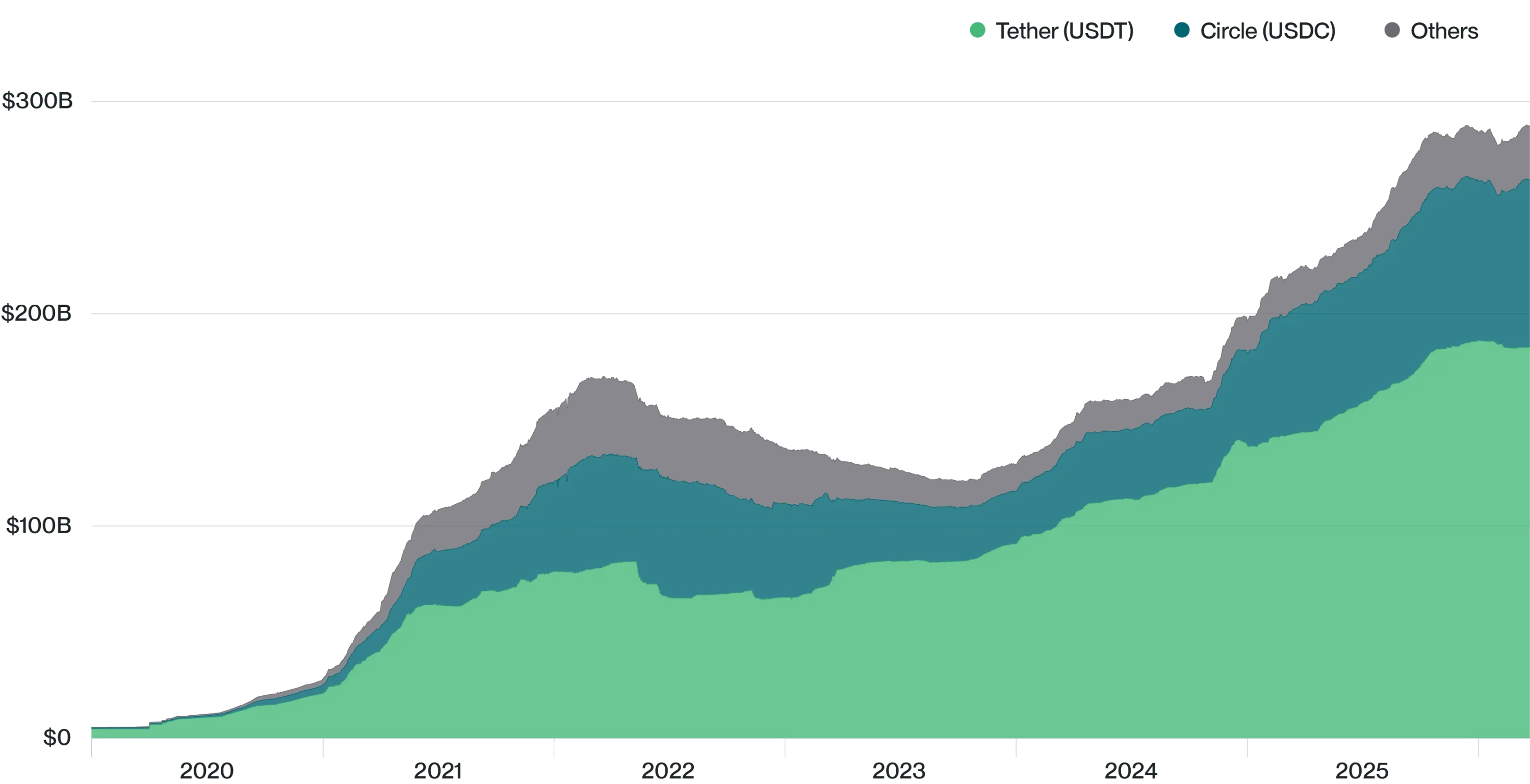
Source: Bitwise Asset Management, data from The Block. Period covered: January 1, 2020–March 23, 2026. Note: “Others” includes BUSD, crvUSD, DAI, FDUSD, FEI, FRAX, GHO, GUSD, LUSD, MIM, PYUSD, TUSD, USDD, USDe, USDP, and USDS.
A common view holds that Circle’s market share will gradually erode as major institutions—including U.S. banks, Stripe, and Wells Fargo—enter the stablecoin space.
I’m skeptical. Historically, innovative companies have often successfully defended early market leadership.
For example:
- In 1976, Vanguard—a then-unknown firm—launched the world’s first index fund. Today, Vanguard leads global passive asset management.
- In 1993, State Street launched SPY—the first U.S. ETF—even though it was not then a dominant player in asset management. SPY remains the world’s most actively traded ETF, with over $650 billion in AUM.
- In 1996, Barclays Global Investors—a little-known asset manager—launched the first international ETF series. Acquired by BlackRock for $12 billion, its business evolved into iShares, now managing $5 trillion.
We’re already seeing early signs of Circle defending against well-known competitors: In 2023, PayPal launched its stablecoin PYUSD with great fanfare—but the product has underperformed, with PYUSD capturing just over 1% market share today.
Of course, there are cases where large incumbents overtook pioneers—for instance, in money market funds, fast-followers like Fidelity, Vanguard, and Federated Hermes captured most of the market from the original innovator, Reserve Fund Group. This warrants attention—especially given the similarities between money market funds and stablecoins: both pool dollar deposits and invest them in high-quality short-term securities like U.S. Treasuries.
Still, I don’t believe large banks can easily displace Circle. In fact, Circle’s market share could expand. While Circle holds only ~25% of the overall stablecoin market, its share in the regulated segment is far higher (Tether’s USDT dominates offshore markets). Though precise figures are unavailable, I estimate Circle’s share of the regulated market exceeds 80%. If stablecoin AUM growth comes predominantly from regulated markets—as banks, fintechs, and corporates prefer onshore, regulated stablecoins—Circle’s share could meaningfully exceed its current 25%.
However, for conservatism, I’ll balance these opposing forces and assume Circle maintains its current 25% share.
3. What will Circle’s profit margin be?
The final—and most complex—question: How much income can Circle generate from its deposited assets?
Currently, Circle retains all interest income generated by the U.S. Treasuries backing USDC. At current rates, this means its $80 billion in AUM generates ~4% annual yield.
But this figure doesn’t reflect Circle’s actual income-generating capacity, because it must pay distribution fees to acquire those assets. For example, USDC was co-developed with Coinbase and serves as the exchange’s flagship stablecoin. Under their agreement, Circle pays Coinbase all interest earned on USDC held on Coinbase’s platform; Coinbase then passes most of that back to users. Circle has similar distribution agreements with other exchanges. Its rationale: paying fees to select distribution partners kickstarts a virtuous marketing cycle—drawing assets directly onto Circle’s own platform, where it captures a higher share of revenue or monetizes them in other ways later.
Overall, Circle currently pays ~60% of its revenue to distribution partners. That implies an effective “take rate” of ~1.6% at current rates.
Is this sustainable? Two factors matter.
First, interest rates. Circle’s interest income moves directly with benchmark rates—Fed hikes help; cuts hurt.
Second, competition. In a hypothetical market with hundreds of stablecoins—and users freely switching between USDC, WFUSD, BAUSD, PYUSD, etc.—Circle’s ability to retain interest income would face pressure. Basic economics suggests competition compresses margins.
Yet I remain skeptical. Markets that should be “perfectly efficient” rarely are in practice. Charles Schwab earns billions annually from the spread between what it pays depositors and what it earns on those deposits—even though customers could easily switch to higher-yielding alternatives. But customers don’t always act, because their core value proposition isn’t yield—it’s convenience, trust, and integration. USDC is similar: users hold it primarily for its wide usability and credibility—not for yield. That stickiness won’t vanish overnight.
I’d also note that the current CLARITY Act draft may actually improve Circle’s margins—by making it harder to distribute interest income to stablecoin holders.
All told, I expect Circle’s margins to face increasing pressure as competition intensifies—and the company may need to shift its revenue model, which it’s already pursuing. For this analysis, I’ll assume its take rate halves—to 0.8%.
Conclusion
Answering these three questions doesn’t capture Circle’s full business scope. As noted earlier, Circle has launched its own blockchain, continues innovating in payments technology, and is rapidly growing non-interest revenue. But I believe examining the company through these three lenses offers an effective 80/20 approach to valuing its stock.
Based on these conservative assumptions—$1.9 trillion in market size, 25% market share, and a 0.8% take rate—Circle’s pre-distribution-cost, pre-other-expense revenue would be $3.8 billion. Its actual operating expenses are relatively low today ($144 million in 2025). Even if those costs triple by 2030, roughly $2.7 billion in post-tax income would remain available for net profit. Valuing that at the S&P 500’s current average P/E ratio (28x) yields a $75 billion valuation for Circle.
That figure is meaningful—it’s about double Circle’s current valuation. That’s respectable, but given market volatility, whether it’s worth investing merits further consideration.
Note that at every step above, I’ve chosen conservative assumptions. If stablecoin growth reaches Citigroup’s bull-case scenario—or if Circle grows its market share (as recent performance suggests)—or if it sustains its current take rate or unlocks new revenue streams—its valuation would be significantly higher.
Overall, I can envision scenarios where Circle’s 2030 value far exceeds—and also falls short of—my rough estimate. The value of this analysis lies in showing Circle’s current valuation sits within a reasonable range. If stablecoin adoption unfolds as broadly expected, Circle remains an attractive investment—even under quite conservative assumptions.
Join TechFlow official community to stay tuned
Telegram:https://t.me/TechFlowDaily
X (Twitter):https://x.com/TechFlowPost
X (Twitter) EN:https://x.com/BlockFlow_News
 @BitwiseInvest


