








Circle’s Annual Revenue Hits $2.7 Billion, Yet It Posts a Net Loss—Coinbase Is the Biggest Winner Behind USDC
TechFlow Selected TechFlow Selected
Circle’s Annual Revenue Hits $2.7 Billion, Yet It Posts a Net Loss—Coinbase Is the Biggest Winner Behind USDC
At its core, Circle is an interest-rate-sensitive financial infrastructure company that earns income from reserve interest—not from software platform subscriptions or transaction fees.
 Navigating Web3 tides with focused insights
Author: insights4vc
Translation & Editing: TechFlow
TechFlow Intro: Circle has listed on the New York Stock Exchange under the ticker CRCL. But what kind of business is it, exactly? This article dissects Circle’s revenue structure, reserve model, revenue-sharing arrangement with Coinbase, and the growth status of USDC and EURC—based on its FY2025 annual report.
The author’s core conclusion: Circle is fundamentally an interest-rate-sensitive financial infrastructure company that earns income from reserve interest—not subscription or transaction fees from a software platform. This insight directly shapes how the company should be valued.
Full Text Below:
Understanding Circle begins with recognizing it as a “reserve-income company,” not a scaled software or payment-fee platform. Its profitability is highly dependent on stablecoin balances, short-term interest rates, and the portion of reserve income it retains after paying substantial distribution fees.
Circle’s FY2025 data makes this clear: total revenue plus reserve income amounted to $2.747 billion, of which reserve income contributed $2.637 billion and other revenue just $110 million. Thus, Circle’s recent financial performance hinges primarily on three variables: average USDC circulation, actual yield on reserves, and the economic structure of its partner distribution agreements—especially the contract with Coinbase.
Total revenue and reserve income rose strongly from $1.676 billion in FY2024 to $2.747 billion in FY2025. Reserve income increased from $1.661 billion to $2.637 billion; other revenue grew from $15 million to $110 million. Even so, Circle reported a net loss attributable to common shareholders of $70 million for FY2025, and operating expenses surged significantly—including $845 million in compensation costs.
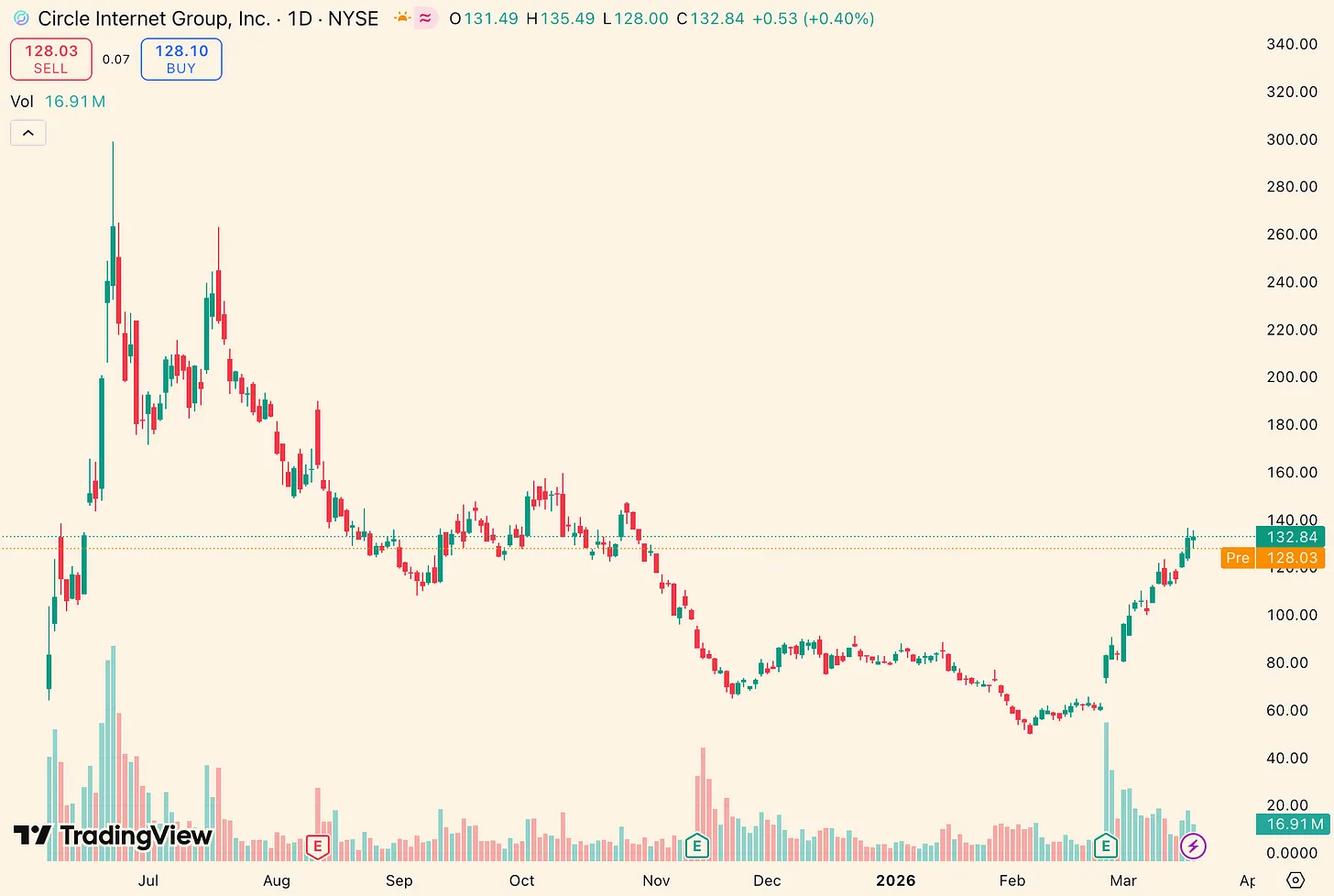
Figure: Circle’s Key FY2025 Financial Metrics
The central debate for 2026 is not whether Circle is expanding its footprint—but whether that expansion will translate meaningfully into financial results. The key variables remain: whether USDC balances can continue growing; how reserve yields evolve amid falling interest rates; whether distribution costs will remain structurally high; and how quickly new revenue streams—including CCTP, CPN, and USYC—can scale relative to the growth rate of the reserve-income base.
At present, Circle’s strategic boundaries are clearly broadening—but its core investment framework remains unchanged: it is still a financial infrastructure company whose earnings are dominated by reserve income, not diversified platform monetization—and one highly sensitive to both interest rates and balance size.
Circle Business Overview
Circle is a fintech company listed on the NYSE under the ticker CRCL. On March 9, 2026, it filed its FY2025 annual report (Form 10-K), covering the period ended December 31, 2025. Circle’s FY2025 balance sheet shows “deposits from stablecoin holders” of $74.9 billion—a figure that directly underscores that the company’s economic core remains the scale management of reserve-backed stablecoins, not a traditional pure-software model.
From an analytical perspective, Circle can be broken down into four layers:
First, a stablecoin issuer—its primary products being USDC and EURC—with liabilities represented by circulating stablecoins and assets comprising segregated reserve assets held on behalf of users. Second, a reserve-income business—monetizing those reserve assets through interest and dividend income. Third, a developer, payments, and infrastructure layer—focused on enhancing stablecoin use cases and transaction density. Fourth, a broader strategic vision centered on building an “internet financial system,” including Arc, the Circle Payments Network (CPN), and tokenized asset infrastructure.
Yet disclosed data confirms that, financially, it is still the reserve-income model—not scaled software or transaction-fee businesses—that truly drives results. Total revenue and reserve income totaled $2.747 billion in FY2025, of which reserve income accounted for $2.6368 billion; non-reserve components remain comparatively modest.
This distinction is critical for valuation. While Circle’s strategic narrative is broadening, its revenue structure does not yet support treating it as a “software-platform re-rating” story. Previously disclosed data showed that “other products” revenue constituted only 1% of total revenue in 2024. Management did note, however, accelerated growth in other revenue in 2025—Q4 2025 other revenue reached $37 million, up $34 million year-on-year. That is a positive directional signal—but insufficient to displace the centrality of reserve balances, reserve yields, and partner economics in driving profitability.
Another strategic pillar is regulatory positioning. Circle disclosed that in December 2025, it received conditional approval from the Office of the Comptroller of the Currency (OCC) to establish a national trust bank named First National Digital Currency Bank, N.A. Management characterized this as an important step toward strengthening USDC infrastructure and potentially expanding regulated custody and reserve-management capabilities. This may enhance regulatory sustainability and institutional confidence in reserve governance—but it is not yet a disclosed profit driver.
Business Model and Economic Structure
Circle’s business model is determined by two variables: the scale of circulating stablecoins and the yield on reserve assets. The company explicitly defines reserve income as a function of reserve balances and reserve return rates.
Reserve income was $2.6368 billion in FY2025, up from $1.6611 billion in FY2024. By contrast, other revenue in FY2025 was only $109.8 million (versus $15.2 million in FY2024), with subscription and services revenue at $84.8 million—the largest non-reserve component. This confirms Circle’s profit structure is extremely sensitive to interest rates and balance growth—even though ancillary revenue has begun scaling from a low base.
Reserve management is conservative. Circle disclosed that, as of June 30, 2025, approximately 87% of USDC reserves were held in the Circle Reserve Fund—a Rule 2a-7 compliant government money market fund managed by BlackRock and custodied by BNY Mellon. The remainder is held as cash in accounts serving USDC holders, primarily at globally systemically important banks. The reserve construction logic prioritizes liquidity, capital preservation, transparency, and compliance—not yield maximization.
Circle’s economic structure is also deeply shaped by distribution arrangements—particularly its agreement with Coinbase. Reserve income is booked on a gross basis, but the company incurs significant downstream payments via distribution and transaction costs. This means a substantial portion of gross reserve revenue is paid out through the distribution layer before reaching operating expenses.
Data reflects this: FY2025 revenue less distribution and transaction costs (RLDC) stood at $1.083 billion, while total revenue and reserve income totaled $2.747 billion—meaning most gross monetization flows out through the distribution layer. This is critically important for modeling. Circle is not a pure beneficiary of rising interest rates or growing USDC balances—growth in reserve monetization does not translate one-to-one into retained profitability. Per Circle’s earlier sensitivity disclosures, using an average reserve yield of 4.26% as of June 30, 2025, a 100-basis-point change would shift reserve income by ~$618 million, while distribution and transaction costs would move by ~$315 million. In other words, much of the upside from higher reserve yields is shared away—only the residual flows into RLDC before operating expenses. For institutional analysis, RLDC is a more useful intermediate profitability metric than reserve income alone.
Reported earnings quality in FY2025 was also materially affected by non-core and non-cash items. Circle reported a net loss from continuing operations of $70 million for FY2025, yet adjusted EBITDA was $582 million. The gap stems largely from substantial equity-based compensation tied to IPO-related vesting conditions. Circle stated in its FY2025 earnings release that results were significantly impacted by $424 million in IPO-related equity compensation—specifically, $423.8 million in RSU expense recognized upon satisfaction of performance conditions triggered when trading began on the NYSE. Therefore, GAAP net income is not the optimal lens for assessing underlying unit economics or profitability.
The single most important—and often underestimated—element of Circle’s business model is its arrangement with Coinbase.
When USDC launched in 2018, Circle and Coinbase jointly formed a consortium to govern the stablecoin. That structure dissolved in 2023, with Circle assuming sole issuance authority. Yet Coinbase retained an exceptionally favorable revenue-sharing agreement.
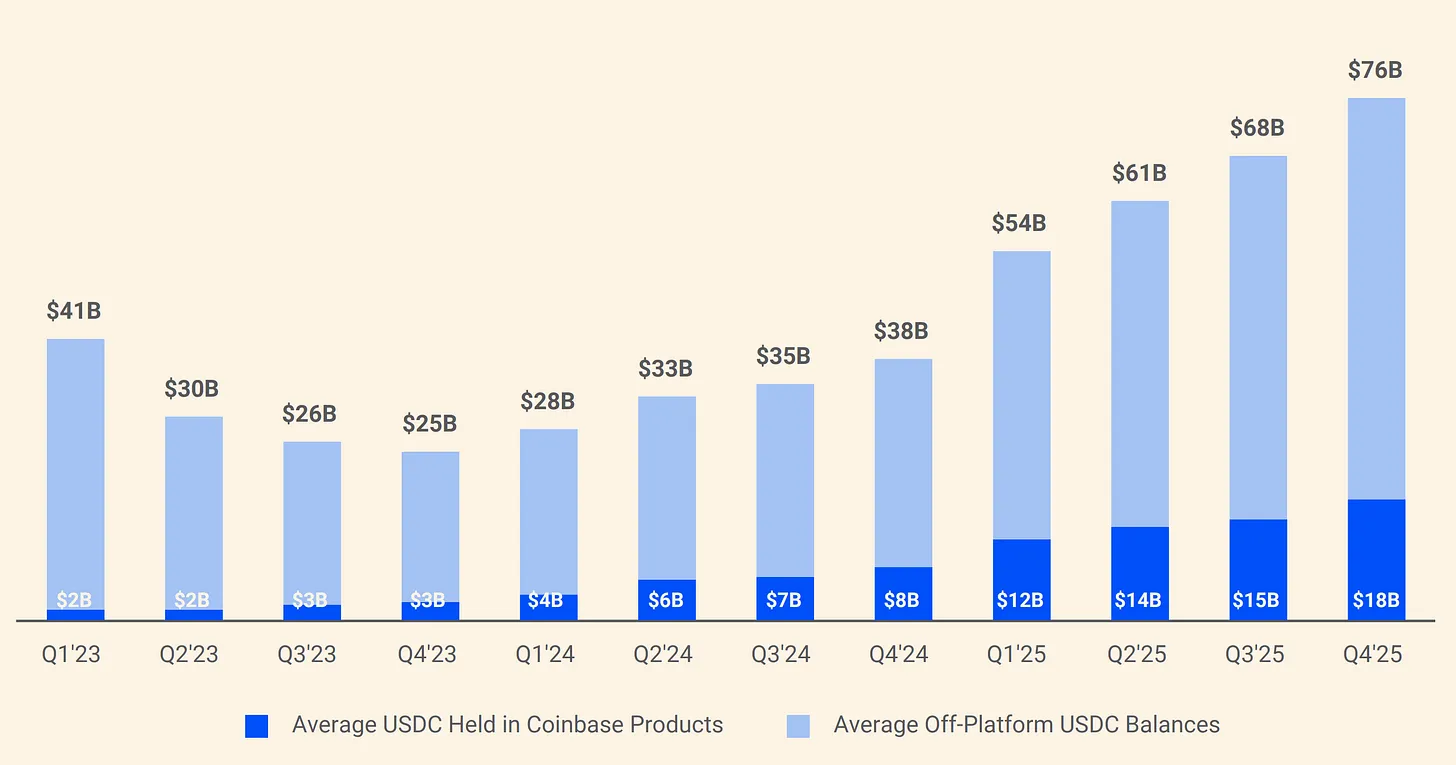
Figure: Circle–Coinbase USDC Reserve Income Sharing Structure
Per the agreement, 100% of reserve income generated from USDC held on Coinbase’s platform goes to Coinbase; for USDC held elsewhere, 50% goes to Coinbase. In 2024, of Circle’s $1.01 billion in total distribution costs, $908 million went to Coinbase. Put simply, for every dollar Circle earns, roughly $0.54 flows to a company that neither issues USDC nor manages its reserves. As of early 2025, Coinbase held 22% of total USDC supply—up from just 5% in 2022. As USDC becomes increasingly concentrated on Coinbase, Circle’s payout burden rises accordingly.
In sum, Circle should currently be viewed as an interest-rate-sensitive financial infrastructure company driven primarily by stablecoin-centric reserve income—not a software platform whose economics are mainly driven by subscriptions or transaction revenues. Platform option value is becoming increasingly tangible—especially around Arc, CPN, and non-reserve revenue streams. But Circle’s disclosed FY2025 revenue structure still supports an analytical framework centered on reserve balances, reserve yields, and distribution-sharing mechanics. Until non-reserve revenue constitutes a materially larger share of total revenue, the reserve-income model remains Circle’s dominant profitability driver—and the core of its valuation debate.
Deep Dive: USDC and EURC
USDC
USDC remains Circle’s core economic engine entering 2026. Circle’s FY2025 annual report discloses that, as of December 31, 2025, USDC circulation stood at $75.266 billion. Circle’s USDC product page later indicated circulation reached $79.2 billion as of March 16, 2026. This implies an increase of ~$3.9 billion—or ~5.2%—between year-end and mid-March. Not explosive growth, but solid evidence of continued net expansion atop already strong 2025 fundamentals.
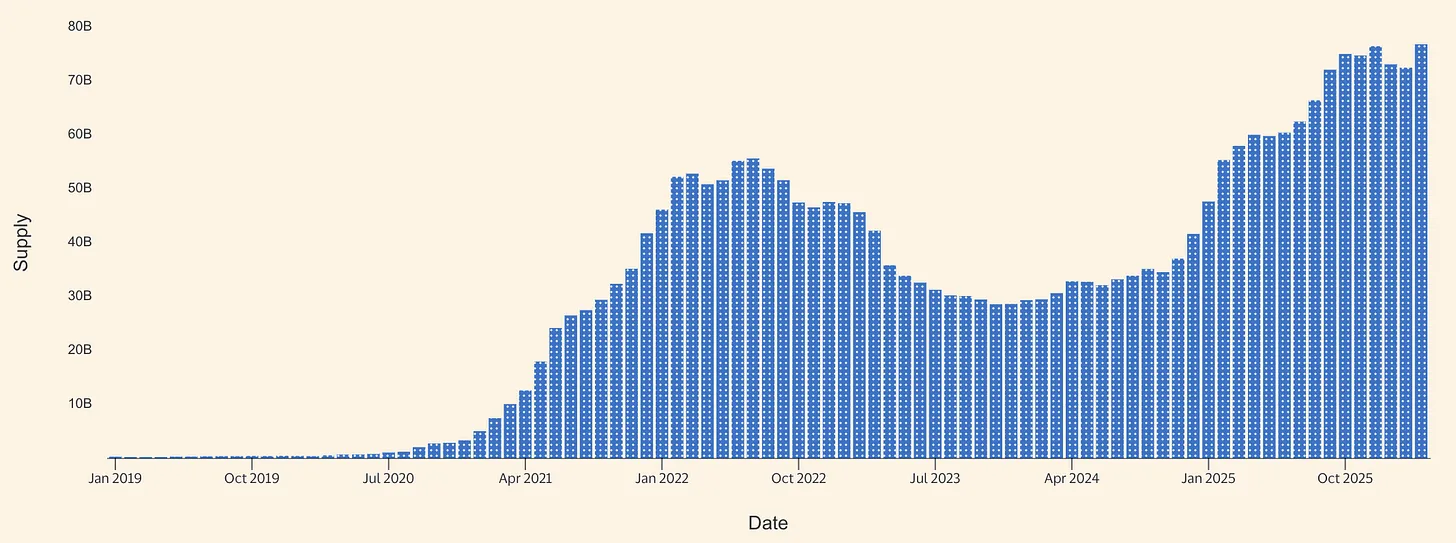
Figure: USDC Stablecoin Supply (Source: Allium)
Circle’s FY2025 disclosures point to a robust growth year for USDC. In Q4 2025, USDC circulation grew 72% year-on-year to $75.3 billion, while on-chain transaction volume surged 247% year-on-year to $11.9 trillion. Average USDC circulation for FY2025 was $64.87 billion—up from $33.342 billion in FY2024—yet FY2025 reserve yield was 4.1%, down from FY2024’s 5.0%. The key inference: 2025’s revenue expansion was driven by balance growth—not yield tailwinds—as reserve yield declined year-on-year.
Circle also disclosed operational metrics indicating USDC functions as a high-velocity monetary instrument—not static collateral. FY2025 USDC minting totaled $257.5 billion and redemptions $226.1 billion; end-of-year stablecoin market share stood at 28% (per third-party market-cap data); and active wallets numbered 6.8 million (per Circle’s own definition). The magnitude of minting/redemption volumes relative to end-of-period supply signals substantial transactional turnover—likely stemming from exchange settlement, liquidity routing, collateral management, and DeFi-related capital flows—not simple buy-and-hold reserve logic. Circle has not publicly broken down these use-case contributions.
The USDC payments narrative is gaining credibility—but remains early-stage relative to the reserve-income model. Visa has officially rolled out USDC settlement functionality in the U.S. for select card issuers and acquirers, enabling settlement of certain VisaNet obligations on specific blockchains—including outside traditional banking hours. Circle views this as validation that USDC can serve as a continuous-settlement asset—not merely a crypto-native transaction tool. Even though current scale remains tiny relative to Visa’s overall network, the analytical significance is substantial: it represents one of the clearest public signals that USDC is being positioned as part of real-world back-end payment infrastructure.
Distribution partnerships targeting consumers and SMEs are also expanding. On December 18, 2025, Circle announced a partnership with Intuit to integrate USDC functionality into TurboTax, QuickBooks, and Credit Karma. Strategically, this reinforces Circle’s thesis that USDC is moving beyond exchanges and crypto-native users into mainstream financial workflows. Yet monetization pathways remain opaque—Circle has not disclosed pricing, commission rates, or revenue-sharing structures for this integration, so distribution progress should not be misread as proof of high-margin payment revenue.
At the market-structure level, Circle and Polymarket announced on February 5, 2026, that Polymarket will migrate from bridged USDC (USDC.e) on Polygon to native USDC over the coming months. This development signals Circle’s broader push to reduce reliance on bridged liquidity and expand native USDC issuance across chains. Native issuance improves redemption transparency, lowers cross-chain bridging operational complexity, and better aligns with a regulation-first posture. At the same time, the very need for such migrations reveals structural challenges facing stablecoins: fragmented cross-bridge and cross-chain liquidity remain adoption friction—not just technical footnotes.
Overall, USDC is a hybrid instrument: first and foremost, a major exchange and venue settlement asset; second, a high-speed on-chain dollar used for collateral, liquidity routing, and crypto-market infrastructure; third, an emerging institutional settlement rail in select integrations. Evidence of payments-rail growth is improving—especially via Visa settlement, Intuit integration, and Circle’s broader infrastructure build-out. Yet Circle’s disclosed primary economic driver remains reserve income earned on USDC reserves—not explicit transaction-fee monetization from payment activity.
EURC
EURC is strategically important—even if its direct economic contribution remains limited. The European regulatory context is especially relevant here. MiCA (EU Regulation 2023/1114) entered into force in 2023, with rules for asset-referenced tokens and e-money tokens applying from June 30, 2024, and the broader regime fully effective from December 30, 2024. This timeline matters: euro-denominated stablecoins gained “regulatory-compliance rating eligibility” earlier than many adjacent crypto asset services—boosting institutional and exchange confidence in regulated issuers supporting compliant euro stablecoin products.
Circle disclosed that, as of December 31, 2025, EURC circulation stood at €309,608,590. As of March 16, 2026, Circle’s EURC page showed circulation at €382.8 million. This implies growth of ~€73 million—or ~23.6%—between year-end and mid-March. Absolute volume remains small versus USDC, but the growth rate is meaningful—indicating EURC is gaining traction from a low base.
The broader euro stablecoin market remains tiny. Reuters reported in September 2025—citing data from the Bank of Italy—that euro-denominated stablecoin supply totaled only ~$620 million, versus ~$300 billion in global stablecoin supply at the time. Even accounting for subsequent growth, Circle’s reported EURC circulation of €382.8 million as of March 2026 suggests EURC is likely among the top euro stablecoins by supply.
Circle positions EURC as MiCA-compliant, supporting Avalanche, Base, Ethereum, Solana, and Stellar—and commits to publishing monthly attestation reports. Strategically, EURC’s value to Circle may exceed its current direct financial contribution: it helps establish Circle’s European regulatory standing, supports on-chain euro–dollar workflows alongside USDC, and provides option value as European digital monetary policy priorities intensify. A late-2025 Reuters report also noted that European institutions and policymakers are increasingly focused on building alternatives to dollar-dominated stablecoin infrastructure—supporting this option-value thesis.
Over the next 12–24 months, EURC is better viewed as an enabler—not an independent profit driver. Its base scale remains under €500 million, and Circle does not disclose EURC-specific revenue data. For EURC to become financially material, three things may be needed: substantive growth in euro-denominated float, payment and financial adoption beyond crypto-native capital markets, and a distribution path that avoids replicating the heavy economic sharing seen in the USDC model. In other words, EURC may already be strategically important—but it is not yet a core financial driver.
FY2025 Financial Analysis and Key Metrics
Circle’s FY2025 financial data reaffirms that the company is, first and foremost, a reserve-income business. Total revenue and reserve income totaled $2.747 billion in FY2025—up from $1.676 billion in FY2024. Reserve income was $2.637 billion (up from $1.661 billion in FY2024); other revenue was $110 million (up from $15 million in FY2024). Year-on-year growth came almost entirely from reserve-income expansion—not a broad shift in revenue structure toward software or transaction-fee models.
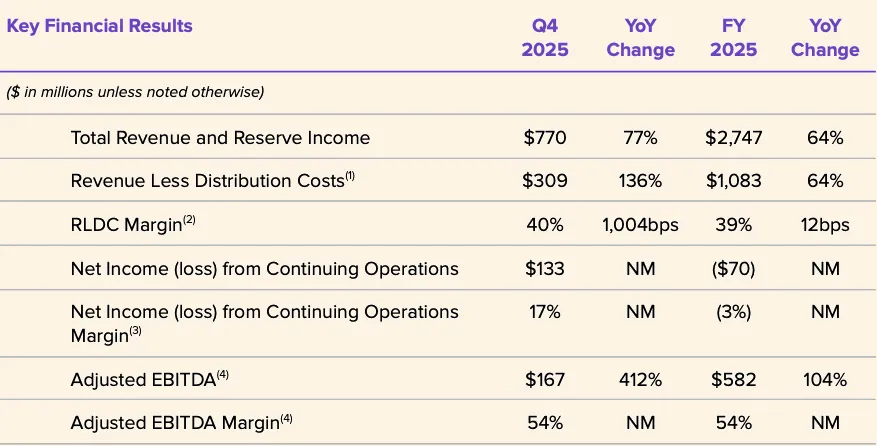
Figure: Circle’s FY2025 Revenue Composition
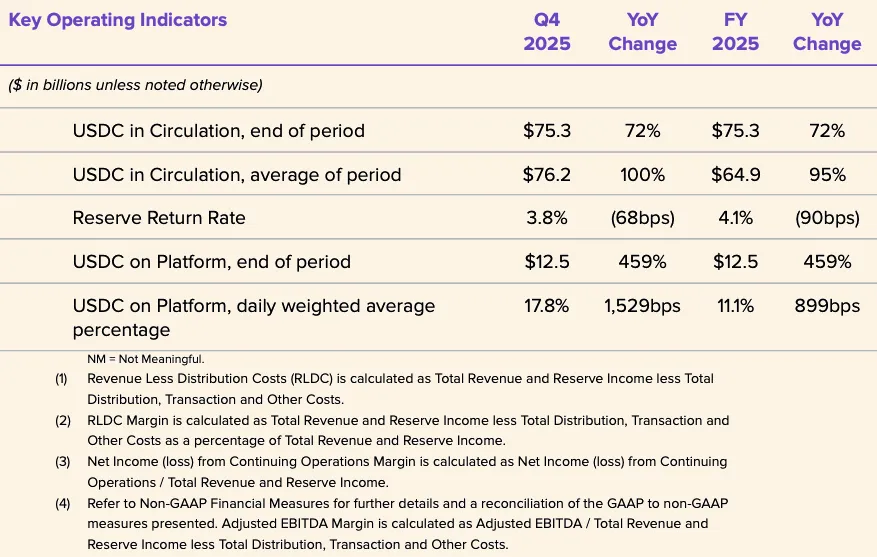
Figure: Circle’s FY2025 Cost Structure Breakdown
The cost structure is likewise integral to the underwriting framework. FY2025 distribution and transaction costs totaled $1.662 billion—up from $1.011 billion in FY2024. Operating expenses rose from $492 million to $1.179 billion—including $845 million in compensation costs (up from $263 million the prior year). This confirms that gross profitability generated by higher reserve income is heavily diluted by partner payouts—and further eroded by sharply rising operating costs.
To assess operating leverage, RLDC is more useful than top-line revenue. Circle reported FY2025 RLDC of $1.083 billion—up from $659 million in FY2024; RLDC margin remained flat at 39% in both years. This stability is notable: it implies distribution costs scale broadly in line with reserve income—higher rates and larger balances have not translated into structurally improved retained economics. In other words, Circle achieved growth—but its core economic share retained post-distribution has not meaningfully improved.
A clearer signal of operating leverage appears in management’s adjusted metrics—not GAAP reporting. Circle disclosed FY2025 adjusted operating expenses of $508 million, and guided FY2026 adjusted operating expenses of $570–585 million under its new definition. This signals the company plans to continue investing in growth—not pivot to near-term harvesting.
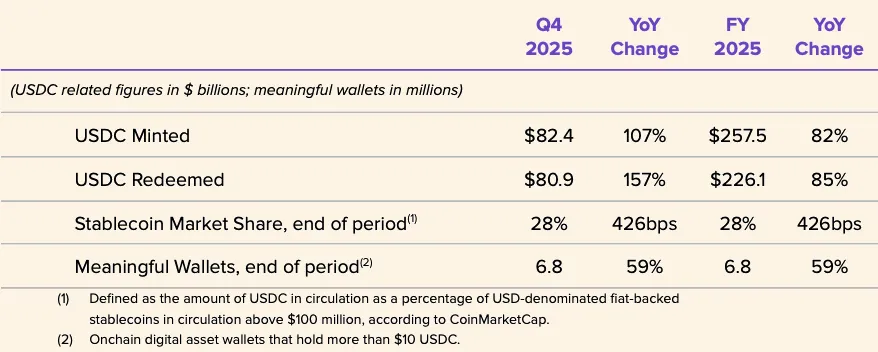
Figure: Circle’s FY2025 Balance Sheet Key Items
The balance sheet also supports this specific business-model interpretation. As of December 31, 2025, Circle reported $75.068 billion in cash and cash equivalents segregated for stablecoin holders—and $74.913 billion in deposits from stablecoin holders. This structure aligns with a reserve-backed issuance model built around segregated balances—not a traditional loan-based balance-sheet model.
Analytically, this positions Circle structurally closer to a narrow-spread business than a high-commission fintech—with the key caveat that reserves are described as held for token holders and intended to be bankruptcy-remote under Circle’s disclosed structure.
Q1 2026 Preview and FY2026 Bull/Base/Bear Scenarios
Entering Q1 2026, the interest-rate environment is less favorable than at the peak of this cycle. As of March 16–17, 2026, the Fed’s effective federal funds rate stood at 3.64%, and SOFR at 3.65%. Circle’s own sensitivity framework uses an average yield of 3.64% as of December 2025 as its reference point. This implies that the reserve-return environment in early 2026 remains meaningfully below FY2024’s reported 5.0% reserve yield—and closer to late-2025 levels. If Circle wants to sustain reserve-income growth, balance growth must shoulder more of the load.
At least on the balance front, Q1 2026 starts constructively. Circle disclosed that, as of March 16, 2026, USDC circulation stood at $79.2 billion—up from $75.266 billion at year-end—and EURC rose from €309.6 million to €382.8 million. This suggests average stablecoin balances for Q1 may improve relative to Q4 exit levels—partially offsetting the lower-yield environment.
Management’s FY2026 guidance points to continued revenue diversification—but no fundamental change in the economic model. Specifically: other revenue of $150–170 million; RLDC margin of 38–40%; and adjusted operating expenses of $570–585 million. There are two signals here: first, management expects non-reserve revenue to grow; second, even per its own guidance, these revenues remain small relative to the reserve-income engine.
Bull Case. USDC circulation continues expanding in Q1 and Q2—driven by growth in institutional settlement usage, higher on-chain velocity, and incremental distribution progress. Under this scenario, reserve income could remain resilient even if actual yields hold at late-2025/early-2026 short-end levels. Distribution costs would rise accordingly—but the retained economics post-distribution may still suffice to absorb higher planned operating expenses while maintaining margins at or near guidance ranges. This is essentially a “float growth offsets rate compression” scenario. Current balance trends and the still-expanding ecosystem support this case—but it depends on sustained transaction volume and adoption momentum.
Base Case. As trading activity and DeFi usage normalize, USDC circulation growth slows to low-single-digit quarterly sequential growth. Reserve yield anchors near the short-end ~3%, broadly aligned with EFFR and SOFR. Under this scenario, reserve income stabilizes or rises modestly (depending on average balances), but distribution costs remain elevated due to unchanged partner-sharing structures. RLDC margin thus stays within the company’s 38–40% guidance range—top-line progress is modest, but structural margin expansion remains limited.
Bear Case. USDC circulation stagnates or declines due to risk-aversion contraction, exchange outflows, or market-share pressure—while rates fall further from already-low levels. Per Circle’s own sensitivity framework, lower yields reduce reserve income, and mechanically reduce some distribution costs—but the net effect is weaker RLDC. This problem is more acute because Circle enters FY2026 with a higher expense plan—meaning weakening float and yields expose the company more directly to dual pressures: concentration risk with partners and operating-cost rigidity.
Strategic Positioning and Competitive Landscape
The most accurate characterization of Circle is: a regulated digital currency network operator operating across two layers—a current financially dominant issuer-and-reserve-management core, and a strategically important—but economically non-dominant—periphery of applications, interoperability, and developer services. This distinction matters because, until non-reserve revenue becomes substantially larger, Circle’s valuation, earnings sensitivity, and risk profile remain tightly bound to monetary policy and stablecoin market structure.
The most important strategic option today is the Circle Payments Network (CPN). Circle introduced CPN in April 2025 and disclosed that, as of February 20, 2026, 55 financial institutions had registered and 74 were undergoing qualification—with an annualized transaction volume of $5.7 billion on a 30-day rolling basis. These are meaningful early signals of network formation and institutional interest. Yet without disclosed fee structures, revenue contributions, or margins, CPN remains easier to validate strategically than financially.
Another credible non-reserve monetization path is interoperability tools. Circle disclosed launching CCTP V2 in March 2025, with fast-transfer functionality generating transaction fees when customers opt in. This is one of the stronger non-reserve monetization paths—because it prices a specific technical capability, rather than relying solely on eventual usage translating to value. Even so, Circle’s disclosed FY2025 transaction revenue remains minimal—currently negligible relative to reserve income.
The USYC segment—acquired via Hashnote—is also strategically noteworthy. Circle describes USYC as representing on-chain money market fund shares, primarily used as collateral in digital asset markets—and discloses earning fees including performance fees.
This is a logical extension of USDC—it serves interest-bearing collateral and margin needs that stablecoins alone cannot fully address. Yet the market lacks separate public disclosure on USYC assets, revenue, or profitability—so it remains more of a strategic building block than an independently modelable driver.
On competition, Circle’s most direct rival in the dollar stablecoin space remains Tether. A February 2026 Reuters report cited USDT circulation of ~$184 billion—giving Tether a massive scale advantage.
Circle’s differentiation remains clear: public-company disclosure standards, reserve-asset constraints more aligned with emerging regulatory expectations, and stronger positioning with regulated institutions and payment networks. In this sense, Circle’s competitive advantage lies less in absolute scale—and more in institutional credibility and regulatory legibility.
Another competitor is PayPal’s PYUSD. On March 17, 2026, PayPal announced PYUSD’s expansion to 70 global markets. PYUSD’s strategic relevance lies in its embeddedness within a global consumer and merchant payment distribution network—a very different market-entry advantage compared to Circle’s exchange- and infrastructure-heavy expansion path.
Circle’s current advantages include deeper USDC liquidity, greater scale, and stronger crypto-market integration; PYUSD’s differentiation is native wallet and merchant distribution embedded within a mainstream payment platform.
The European competitive landscape may become more challenging in the future. Reuters reported that multiple major European banks—including ING, UniCredit, and BNP Paribas—formed a company to launch a euro stablecoin in H2 2026, while policymakers openly discuss strengthening euro-denominated digital currencies to counter dollar dominance.
This poses a medium-term competitive threat to EURC—because bank-led euro stablecoins could combine regulatory credibility with embedded enterprise and banking distribution. As of March 2026, however, this remains a future competitive risk—not an immediate supply-side substitute.
Conclusion
Circle’s FY2025 data continues to support viewing it primarily as a reserve-income business—where profitability is dominated by stablecoin balances, reserve yields, and partner economic structures—while software or payment monetization remains far from disruptive to that structure.
USDC and EURC continue expanding; new initiatives like CCTP, CPN, and USYC improve the strategic narrative—but these businesses remain financially insignificant relative to the reserve-income base.
Therefore, the core underwriting framework remains focused on float growth, interest-rate sensitivity, and the structural weight of distribution costs—especially those tied to Coinbase.
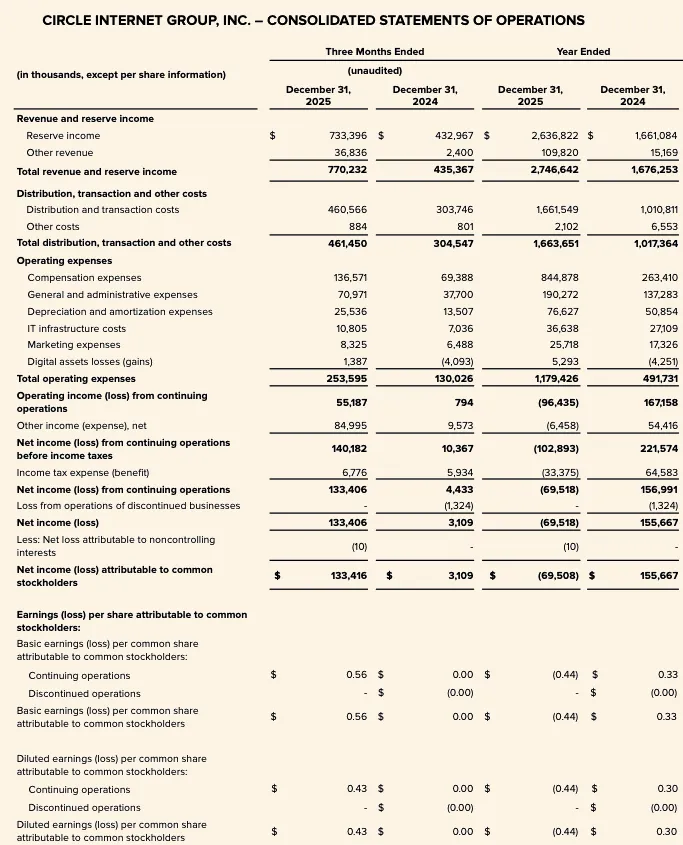
Figure: Circle Internet Group Inc — Consolidated Statement of Operations
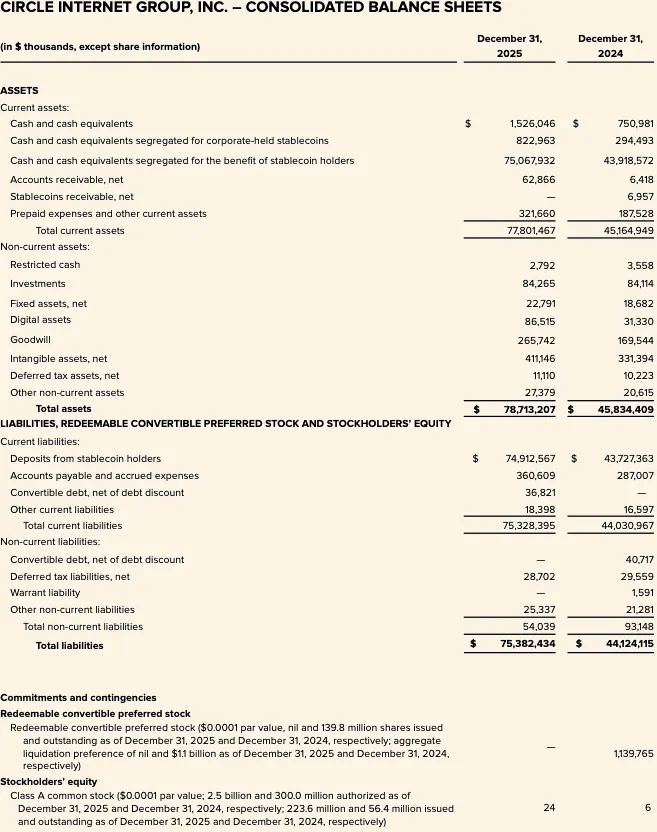
Figure: Circle Internet Group Inc — Consolidated Balance Sheet (I)
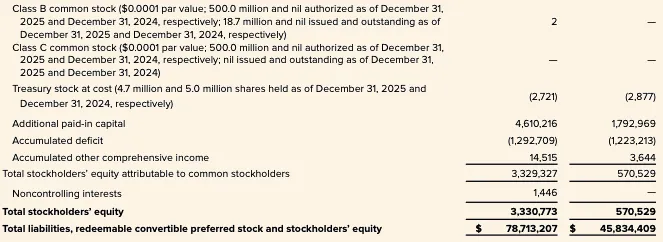
Figure: Circle Internet Group Inc — Consolidated Balance Sheet (II)
Join TechFlow official community to stay tuned
Telegram:https://t.me/TechFlowDaily
X (Twitter):https://x.com/TechFlowPost
X (Twitter) EN:https://x.com/BlockFlow_News
 @insights4vc


