








Anthropic Rejects Chinese Think Tank’s Access to Its Most Advanced AI Model, Mythos, Intensifying U.S.-China AI Competition
TechFlow Selected TechFlow Selected
Anthropic Rejects Chinese Think Tank’s Access to Its Most Advanced AI Model, Mythos, Intensifying U.S.-China AI Competition
The underlying software running across numerous Chinese banks, energy enterprises, and government agencies overlaps significantly with the systems in which Mythos discovered vulnerabilities.
 Navigating Web3 tides with focused insights
Author: Claude, TechFlow
TechFlow Intro: According to a New York Times report on May 12, a representative from a Chinese think tank requested, during a closed-door meeting in Singapore last month organized by the Carnegie Endowment for International Peace, that Anthropic grant access to its Claude Mythos model—an offer Anthropic rejected on the spot.
The incident was subsequently reported to the White House, prompting high alert within the U.S. National Security Council (NSC).
Mythos, Anthropic’s most powerful AI model released in April this year, is regarded as “digital-weapons-grade” technology due to its offensive and defensive cybersecurity capabilities. It is currently accessible to only around 40 U.S. and U.K. institutions. At the time of this incident, the Trump administration was drafting an executive order on AI regulation; this week, Trump is also scheduled to visit China with a business delegation to discuss AI-related topics.
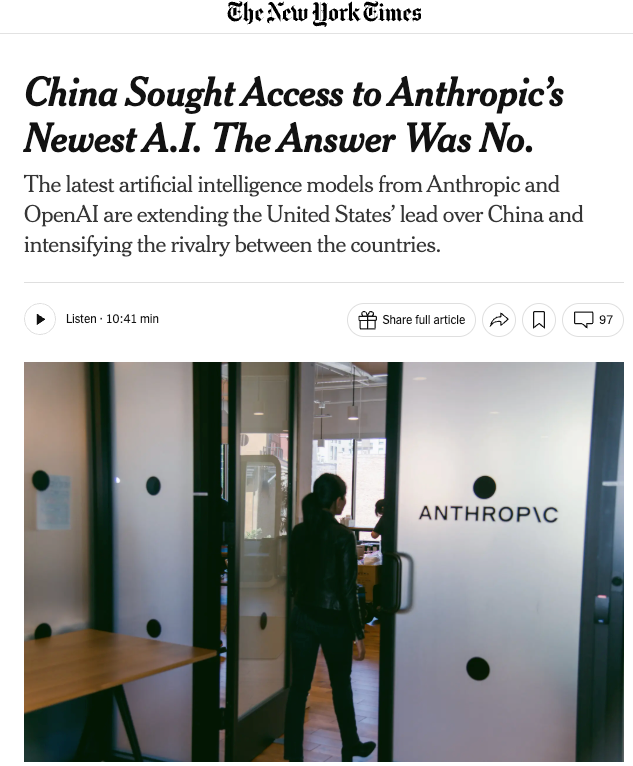
A closed-door dialogue in Singapore has become the latest flashpoint in the U.S.-China AI rivalry.
According to a New York Times report on May 12, during an off-the-record meeting in Singapore last month hosted by the Carnegie Endowment for International Peace, a representative from a Chinese think tank approached Anthropic officials during a break and requested that the company relax its policy to allow Chinese entities access to its newest and most powerful AI model, Claude Mythos.
Anthropic declined the request immediately.
This was not an official diplomatic request from the Chinese government. However, according to multiple media reports, after news of the incident reached Washington, officials at the Trump administration’s National Security Council (NSC) responded with heightened vigilance, viewing it as yet another signal of China’s persistent pressure in the AI domain.
Mythos: A “Digital Weapon” Far More Capable Than Its Predecessors—and Strictly Restricted
To grasp the significance of this incident, one must first understand Mythos itself.
Claude Mythos Preview was officially launched on April 7, 2026—but not for public use. Anthropic restricted access to the model under a cybersecurity defense initiative called “Project Glasswing,” granting access to approximately 40 institutions only. Partners include Amazon, Apple, Microsoft, CrowdStrike, Cisco, NVIDIA, JPMorgan Chase, and the Linux Foundation.
According to Anthropic’s official blog and a TechCrunch report dated April 7, Mythos autonomously discovered thousands of zero-day vulnerabilities—previously unknown security flaws—in internal testing, affecting all major operating systems and mainstream web browsers; some of these vulnerabilities had existed for up to 27 years. In cybersecurity benchmarks such as CyberGym, Mythos significantly outperformed its predecessor, Claude Opus 4.6. Its SWE-bench verification score reached 93.9%, compared to Opus 4.6’s 80.8%.
China Excluded—and Labeled an “Adversarial Nation”
Anthropic classifies China as an “adversarial nation.” Its services are already unavailable in mainland China, and Mythos’s restricted rollout explicitly excludes Chinese institutions.
According to a three-part series published by the South China Morning Post from late April to early May, China’s response to the Mythos incident has been multifaceted. Officially, Beijing has exercised restraint—issuing no major public statements nor strong reactions. Some Chinese AI insiders have even questioned whether Anthropic is manufacturing marketing hype by citing security risks to restrict model access exclusively to U.S. enterprises.
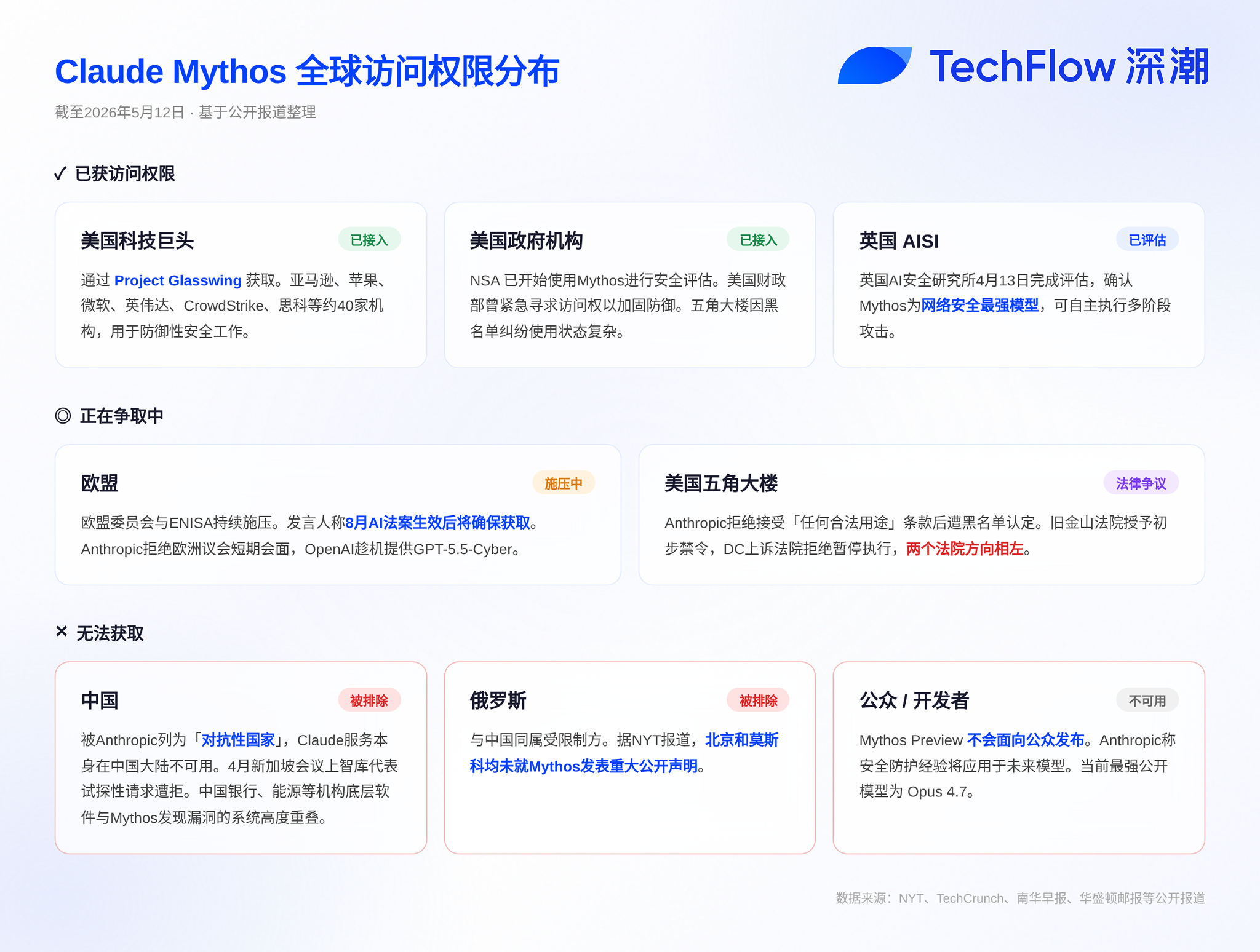
By contrast, the cybersecurity industry reacted very differently. Following Mythos’s release, shares of Chinese cybersecurity firms—including Qihoo 360, Sangfor Technologies, and Qi An Xin—rose for several consecutive days, reflecting market expectations of accelerated demand for AI-driven cybersecurity solutions.
Austin Zhao, Senior Research Manager at IDC China, told the South China Morning Post that “a Chinese equivalent of Mythos will certainly emerge,” but acknowledged that domestic cybersecurity models overall still “lag far behind Mythos.” Still, he noted, China’s model capabilities are rapidly improving—a trend that is irreversible. IDC forecasts that China’s AI-powered cybersecurity market will grow from RMB 1.58 billion in 2025 to RMB 59.35 billion (approximately USD 8.7 billion) by 2030—a more than 37-fold increase.
The practical challenge lies in the fact that the underlying software running across numerous Chinese banks, energy companies, and government agencies overlaps heavily with the systems whose vulnerabilities Mythos uncovered. Yet, for now, China holds no seat at this table of defensive upgrades.
White House Alarm and Policy Maneuvering: Executive Order in the Works, Trump to Visit China This Week
The alarm triggered by the Singapore closed-door meeting is unfolding against a broader backdrop of policy contestation.
According to a Washington Post report on May 11, sharp divisions have emerged within the Trump administration over AI regulation. On one side, national security officials—including those from the NSA and the Office of the Director of National Intelligence—are pushing for intelligence agencies to conduct security assessments before AI models are publicly released. On the other, the Department of Commerce favors retaining assessment authority within its own purview. Kevin Hassett, Director of the White House National Economic Council, revealed in a Fox Business interview last week that the administration is exploring issuing an executive order to establish a clear roadmap for AI model security assessments—akin to the FDA’s pre-market review process for pharmaceuticals.
Meanwhile, Trump is set to travel to China this week, where AI-related topics are expected to be discussed.
According to an Axios report on May 12, U.S. officials expressed hope that “leadership-level meetings could open channels for dialogue to explore whether formal communication mechanisms on AI matters should be established.” However, Melanie Hart, Senior Director of the Global China Center at the Atlantic Council, cautioned that during the Biden administration, China’s participation in AI security dialogues largely involved “gathering U.S. information rather than engaging seriously in discussions about AI defense”—and that attendees were often foreign ministry officials lacking deep technical expertise in AI.
Join TechFlow official community to stay tuned
Telegram:https://t.me/TechFlowDaily
X (Twitter):https://x.com/TechFlowPost
X (Twitter) EN:https://x.com/BlockFlow_News
 深潮TechFlow


