








Study Debunks the AI Layoff Myth: 80% of Companies That Laid Off Workers Did Not Profit From It
TechFlow Selected TechFlow Selected
Study Debunks the AI Layoff Myth: 80% of Companies That Laid Off Workers Did Not Profit From It
In fact, companies that achieve high returns are those that use AI to amplify employee productivity rather than replace employees.
 Navigating Web3 tides with focused insights
Author: Claude, TechFlow
TechFlow Intro: A Gartner survey of 350 enterprises with annual revenues exceeding $1 billion found that 80% of those deploying AI or automation technologies have implemented layoffs—but there is no positive correlation between layoff rates and return on investment (ROI). Companies cutting more jobs are not earning more than those cutting fewer.
By contrast, the companies achieving the highest ROI are those using AI to amplify employee output—not replace workers. Meanwhile, nearly 50,000 jobs were eliminated due to AI in the first four months of 2026, with tech-sector layoffs hitting their highest level since 2023.
The corporate logic of using AI to replace employees is being refuted by data.
According to a Fortune report published on May 11, research and advisory firm Gartner surveyed 350 global enterprise executives and found that companies aggressively cutting staff under the banner of AI are not achieving better financial returns. The surveyed enterprises all reported annual revenues above $1 billion and had already piloted or deployed AI agents, intelligent automation, or autonomous technologies.
Helen Poitevin, Vice President and Lead Analyst for this study at Gartner, told Fortune: “Focusing solely on layoffs to extract AI value is shortsighted. Chasing ROI purely through headcount reduction is likely to steer most enterprises down a dead-end path with limited returns.”
This survey was completed in Q3 2025. Its conclusion is blunt and striking: Layoffs create budgetary space—not ROI.
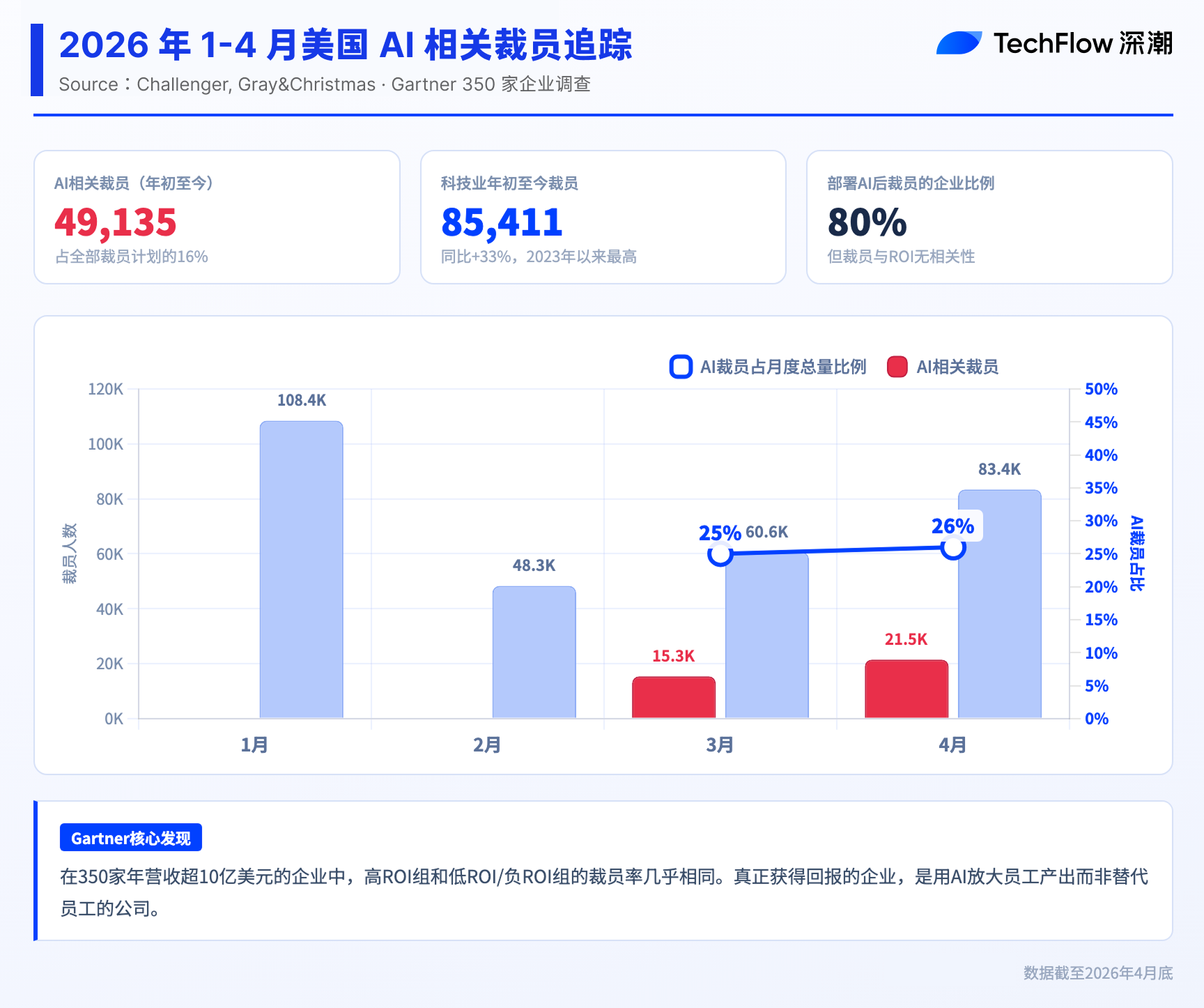
80% of Companies Cut Jobs—but Cutting More Doesn’t Mean Earning More
Gartner’s core finding: Among enterprises that have deployed autonomous business capabilities, approximately 80% reported layoffs. Yet there is virtually no difference in layoff ratios between high-ROI and low-ROI (or even deteriorating-performance) enterprises.
In other words, statistically, there is no discernible causal relationship between laying off staff and profitability.
The survey shows that the highest-performing enterprises pursue the opposite strategy. They position AI as a “people amplifier,” leveraging technology to enhance existing employees’ productivity—not directly replacing human labor. Poitevin terms this model the “human-amplified business”: AI empowers humans rather than displacing them.
In another independent Gartner survey targeting CEOs, roughly one-third of executives expect AI to assist—rather than independently make—human decisions, while another 27% anticipate AI operating autonomously with minimal or no human intervention. This divergence in strategic direction is widening.
Nearly 50,000 Jobs Cut Due to AI in First Four Months of 2026; Tech Sector Layoffs Hit Three-Year High
Gartner’s findings sharply contrast with current labor-market realities.
According to the latest report released in May by Challenger, Gray & Christmas—a career transition and outplacement firm—AI has ranked as the top reason for U.S. corporate layoffs for two consecutive months. In April 2026 alone, 21,490 positions were eliminated due to AI, accounting for 26% of the month’s total 83,387 layoffs. Cumulatively, from January through April 2026, AI-driven job cuts reached 49,135—approximately 16% of the year’s total layoffs, up from 13% at the end of March.
Andy Challenger, Chief Revenue Officer at Challenger, offered a pithy summary: “Whether individual roles are truly replaced by AI or not, their budgets have already been reallocated to AI.”
By industry, technology is the hardest hit. In April, the tech sector cut 33,361 jobs; year-to-date cuts totaled 85,411—a 33% increase year-on-year and the highest for this period since 2023. Cognizant plans to cut 12,000–15,000 global jobs; Cloudflare laid off ~1,100 employees (about 20% of its workforce); Coinbase reduced staff by 14%; and Snap eliminated 1,000 positions—all citing AI as a core driver.
Contrasting this wave of layoffs is a sharp contraction in hiring. In April, companies announced only 10,049 new hires—a 69% drop month-on-month and a 38% decline year-on-year.
“AI Washing” Layoffs: How Many Are Truly Driven by AI?
A recurring question is: Of the layoffs attributed to AI, how many are genuinely AI-driven?
Sam Altman, CEO of OpenAI, raised this issue directly in a February interview. He acknowledged the phenomenon of “AI washing”: companies rebranding layoffs they would have executed anyway as AI-driven structural adjustments. “I don’t know the exact proportion, but AI washing does exist—people are blaming AI for layoffs they would have carried out regardless,” Altman said.
Deutsche Bank analysts noted in a recent research report that “AI redundancy washing will be a defining feature of 2026,” with large enterprises using AI as rhetorical cover for layoffs actually driven by tariffs, economic uncertainty, or other cost pressures.
Gartner’s Poitevin offers a more moderate interpretation: Current AI-related layoffs resemble “testing the waters” rather than true structural transformation. “In our view, these are largely one-off, small-scale experiments—not practices capable of delivering full ROI on AI investments.”
Long-Term Forecast: AI Will Become a Net Job Creator by 2028–2029
Gartner’s stance is distinctly dual-edged.
Short-term data is discouraging. Earlier Gartner research indicates AI agents achieve success rates of only ~30–35% on standard office tasks. Gartner also forecasts that over 40% of AI agent projects will be canceled by end-2027 due to ballooning costs, unclear business value, and inadequate risk management.
Yet Gartner delivers an optimistic long-term outlook: Autonomous businesses will become net job creators between 2028 and 2029, giving rise to new occupations that AI cannot fulfill. Poitevin emphasizes: “Over the long term, autonomous businesses will generate more jobs for humans—not fewer. Structural factors such as demographic decline and high-trust consumer scenarios will ensure human capital remains central to operating, governing, and scaling autonomous systems.”
On spending, Gartner forecasts AI agent software expenditure will surge from $8.64 billion in 2025 to $20.65 billion in 2026 and further to $37.63 billion in 2027. Even amid widespread project failures, capital continues to flood in.
This creates a paradoxical yet real situation: Layoffs yield no ROI; AI project failure rates remain high—and yet no one is willing to step off the train.
Join TechFlow official community to stay tuned
Telegram:https://t.me/TechFlowDaily
X (Twitter):https://x.com/TechFlowPost
X (Twitter) EN:https://x.com/BlockFlow_News
 深潮TechFlow


