








Samsung’s 40,000-employee strike countdown: 8 days left; retail investor communities claim Micron will see “$1,300”?
TechFlow Selected TechFlow Selected
Samsung’s 40,000-employee strike countdown: 8 days left; retail investor communities claim Micron will see “$1,300”?
Only three companies worldwide can produce HBM4; one of them is set to halt production for 18 days. As the sole supplier with a U.S.-based factory, Micron will be the biggest beneficiary.
 Navigating Web3 tides with focused insights
Author: Wednesday, TechFlow
TechFlow Introduction: The final round of negotiations between Samsung Electronics and its union officially broke down on May 13, triggering a 40,000-worker strike set to begin on May 21. Immediately thereafter, Reddit’s WallStreetBets community flooded with bullish posts on Micron Technology (MU), arguing that only three companies globally can produce HBM4—and one of them will halt production for 18 days. As the sole supplier with manufacturing facilities in the United States, Micron stands to benefit most.
Micron’s stock has surged roughly 140% over the past month. Deutsche Bank has set a $1,000 price target, while retail investors are calling for $1,300. Yet at its core, this is a binary bet: if the strike is resolved, the rally thesis could reverse instantly.
Negotiations between Samsung Electronics and its labor union formally collapsed on May 13, placing an 18-day strike involving over 40,000 employees on the brink of commencement.
This news swiftly ignited trading enthusiasm among U.S. retail investors regarding the memory chip supply chain, with Micron Technology (NASDAQ: MU) emerging as the central focus.
Hot Reddit Post: “Micron Is the Purest Play on the Imminent Samsung Strike”
A post published in the U.S. equities section quickly garnered over 500 upvotes, with the headline boldly declaring, “MU is the cleanest play on the imminent Samsung strike.”
The author, willbabu, structures their core argument into four layers:
First, HBM4 is the single greatest bottleneck across the entire AI infrastructure stack. Only three companies worldwide—Samsung, SK Hynix, and Micron—can manufacture it. Should Samsung halt operations for 18 days, re-starting its production lines would take weeks—not days—meaning the real-world impact extends far beyond those 18 days.
Second, although SK Hynix leads the HBM market, its DRAM, NAND, and HBM capacity is fully committed to NVIDIA through contracted pricing until the end of 2026. When spot prices surge, SK Hynix literally has no inventory to sell. While Micron’s HBM output is also sold out through 2026, it holds a critical distinction: if Samsung suspends production for 18 days, spot DRAM and NAND prices will spike—and Micron possesses significantly greater standard DRAM and NAND capacity than SK Hynix, allowing it to directly capture pricing upside.
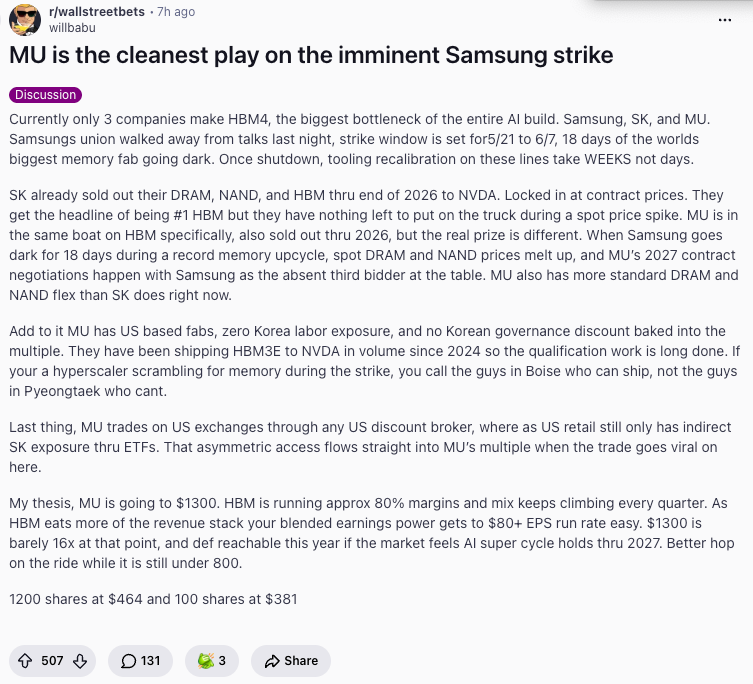
Third, Micron holds structural advantages SK Hynix lacks: domestic U.S. fabrication facilities (in Boise, Idaho), zero exposure to Korean labor risks, and no governance discount associated with Korean chaebol structures. The original post puts it bluntly: “If you’re a hyperscale cloud provider urgently needing memory chips during the strike, who do you call—the person in Boise who can ship, or the one in Pyeongtaek who can’t?”
Fourth, Micron trades directly on U.S. exchanges, whereas U.S. retail investors can only hold SK Hynix indirectly via ETFs. This “asymmetric accessibility” means that when the Samsung-strike trade spreads across retail communities, capital flows disproportionately into Micron.
The author discloses holding 1,200 shares (average cost: $464) plus 100 shares (average cost: $381), targeting $1,300 per share. Their calculation assumes HBM maintains ~80% gross margins, with its revenue contribution steadily rising—pushing blended EPS comfortably above $80. At $1,300, the forward P/E ratio would be only ~16x.
Samsung Negotiations Collapse; Strike Enters Final Countdown
Retail enthusiasm is grounded in reality.
According to The Korea Times on May 13, the final mediation session between Samsung Electronics and its largest union officially broke down that day. The union demanded that 15% of Samsung’s operating profit be allocated as employee bonuses and enshrined in the labor contract; Samsung countered with a 10% proposal, which the union rejected. Sharp disagreement persists over how AI-related performance bonuses should be distributed.
The strike is scheduled for May 21–June 7, affecting over 40,000 employees—most from semiconductor manufacturing units. Analysts cited by The Korea Times estimate daily losses may reach ₩1 trillion (~$671 million). Samsung has filed for an injunction at Suwon District Court to block the strike; a ruling is expected before the strike commences.
According to Jefferies Research, this strike could disrupt ~3% of global memory chip capacity. JPMorgan estimates Samsung’s full-year operating profit could fall by over ₩40 trillion as a result. More seriously, prolonged shutdowns risk alienating key customers such as NVIDIA.
Micron Surges 140% in One Month; Wide Divergence Between Institutional and Retail Price Targets
The market is already pricing in this supply shock.
Micron’s stock climbed from a March low near $310 to an intraday 52-week high of $818.67 on May 11—a gain of ~140% in one month—with its market cap surpassing $900 billion. It pulled back to ~$766 on May 12. Per Yahoo Finance, Micron reported $23.9 billion in revenue for its most recent fiscal quarter (Q2 FY2026), up 196% year-on-year, and EPS of $12.20—32.8% above consensus.
On the institutional side, Deutsche Bank raised its Micron price target to $1,000—the highest on Wall Street. Analyst Sidney Ho argues that AI-driven HBM demand represents a structural trend, and supply tightness may persist through 2028.
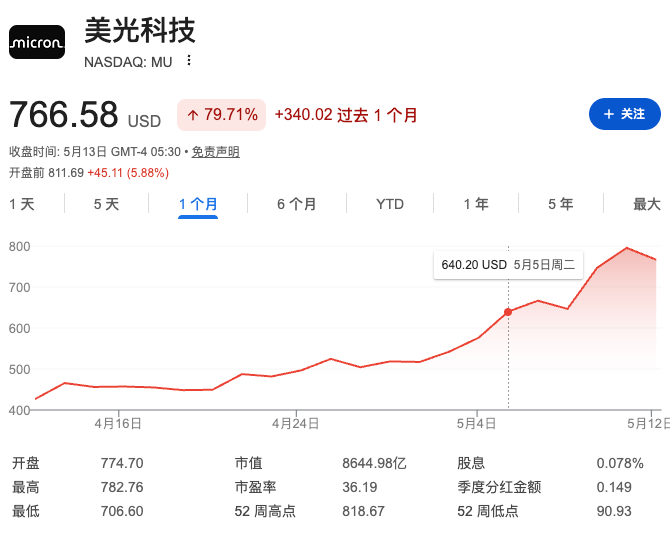
Yet the Wall Street consensus target remains just $581.89—well below the current share price—highlighting significant institutional skepticism toward current valuations. Meanwhile, the $1,300 target floated by WallStreetBets retail investors dwarfs any institutional forecast.
Core Risk: Resolution Equals Reversal
The biggest risk of this trade is also crystal clear: it is, at heart, a binary bet.
ainvest notes that Micron’s stock rose 75% over the prior month (a timeframe slightly earlier than the latest surge), and that a resolution to the Samsung strike would pose severe reversal risk. JPMorgan likewise warns investors that the ultimate outcome of the labor dispute is the market’s upcoming “clearing event,” and directional bets carry exceptionally high risk until then.
The memory chip market is inherently cyclical. Even absent the strike, memory contract prices are projected to rise ~60% this year. If the strike occurs, it adds further pressure atop an already strained supply-demand balance; if it does not occur, markets must reassess how much “strike premium” is embedded in current pricing.
Samsung still retains the possibility of reaching a last-minute agreement before May 21—though the probability appears low at present.
Join TechFlow official community to stay tuned
Telegram:https://t.me/TechFlowDaily
X (Twitter):https://x.com/TechFlowPost
X (Twitter) EN:https://x.com/BlockFlow_News
 深潮TechFlow









