The $13 Trillion Repurchase Market Is Being Quietly Rewritten by Blockchain
TechFlow Selected TechFlow Selected
The $13 Trillion Repurchase Market Is Being Quietly Rewritten by Blockchain
A blockchain revolution is unfolding in critical areas beyond the public eye.
 Navigating Web3 tides with focused insights
By Anna Irrera, Bloomberg
Translated by Chopper, Foresight News
JPMorgan Chase has spent hundreds of millions of dollars over more than a decade developing blockchain-based systems—an innovation once heralded as transformative for financial markets but slow to deliver industry-wide change. Yet now, in one critical area, banks and blockchain technology have achieved a tangible breakthrough: the repurchase agreement (repo) market.
The repo market—worth nearly $13 trillion—is not Wall Street’s most glamorous arena, yet it serves as the financial system’s circulatory system, keeping global capital flowing. A repo agreement is, in simple terms, a short-term cash loan secured by government bonds, typically overnight. It provides the essential short-term funding underpinning trading, settlement, and market-making activities across the entire financial system.
Today, JPMorgan Chase and its Wall Street peers have discovered that blockchain—the foundational technology behind cryptocurrencies—aligns exceptionally well with repo operations. It enables precise, customizable transactions; accelerates the movement of cash and collateral; enhances flexibility in fund allocation; helps traders activate idle capital and improve funding efficiency; and simultaneously hedges market risk.

Eddie Wen, Global Head of Digital Markets at JPMorgan Chase, said: “Applying blockchain solutions to repo is logically sound.” As one of the largest repo dealers globally, JPMorgan has seen clients use this product daily, Wen added.
Six years ago, JPMorgan officially launched its blockchain-based financing product. To date, the platform has processed approximately $3 trillion in repo transactions. Currently, it handles hundreds of millions of dollars in client repo financing daily, while internal cross-departmental repo trades average around $5 billion per day.
For a firm whose traditional repo market volume averages hundreds of billions of dollars daily, this scale remains small in percentage terms—but marks a pivotal step: the formal embrace of blockchain by an industry leader.
Industry-Wide Rush into Tokenized Repo
Beyond JPMorgan, institutions including HSBC, market makers DRW Holdings and Virtu Financial, financial infrastructure provider Broadridge, and trading platform Tradeweb are collectively ramping up investment in tokenized repo. Daily tokenized repo transaction volumes across major blockchain platforms now reach several hundred billion dollars. While participation depth and trading frequency vary across firms, entering the space has become an industry-wide consensus.
Objectively speaking, the market won’t transform overnight. Tokenized repo volumes remain dwarfed by those of the traditional market. Widespread adoption requires broader uptake by banks, dealers, and financial infrastructure providers using interoperable systems. Meanwhile, new regulatory mandates—including mandatory central clearing for repos—pose additional near-term hurdles, requiring most institutions to prioritize integration with existing operational workflows.
Yet even in its early stages, growth momentum is unmistakable. Most other blockchain applications in capital markets remain confined to pilots or conceptual testing—whereas institutional deployment of blockchain in repo already far exceeds mainstream financial use cases. Tokenized repo has thus emerged as one of the most mature and potentially transformative blockchain applications within traditional finance.
Elisabeth Kirby, Head of Market Structure at Tradeweb—which launched its blockchain repo platform late last year—put it plainly: “This isn’t a proof-of-concept or a ‘wait-and-see’ pilot. It’s a real growth vertical.”
Why Now?
Tokenized repo activity has visibly accelerated over the past year, driven by a confluence of favorable factors. Blockchain networks have moved from testing environments into live production use; regulators have shown markedly increased openness to migrating repo operations onto blockchains—a shift made especially critical given the Federal Reserve’s pivotal role during market stress. A more crypto-friendly policy environment under the Trump administration further encouraged Wall Street institutions to expand their digital asset initiatives.
At the same time, more clients are experiencing blockchain’s advantages firsthand—fundamentally shifting industry perception: blockchain is no longer viewed merely as a niche tool for crypto enthusiasts, but rather as a general-purpose financial infrastructure capable of streamlining processes and lowering operational costs.
Yuval Rooz, CEO of digital asset firm Digital Asset Holdings, stated: “The biggest shift is that the industry has moved beyond debating whether the technology works—and is now focused on how fast we can scale it.” Digital Asset is backed by JPMorgan, Goldman Sachs, DRW, Citadel Securities, and Virtu. Its Canton network has become one of the most widely adopted blockchain infrastructures in traditional finance.
In February this year, the Canton network executed multiple cross-border repo transactions using tokenized UK gilts as collateral. Its technology also powers Broadridge’s distributed ledger repo platform, serving institutions including UBS, HSBC, and Société Générale.
Bloomberg L.P.—parent company of Bloomberg News—recently partnered with data provider Kaiko to integrate Bloomberg data into the Canton network, supporting tokenized U.S. Treasury and on-chain repo trading.
How It Works: Traditional Repo vs. Tokenized Repo
Platform models differ slightly, but the core distinction lies in how cash and securities flow.
Traditional repo markets operate within fixed opening, order-entry, and closing hours—halting entirely overnight and on weekends. Operations rely heavily on intermediaries to manage collateral and settlement, resulting in numerous manual steps and high fees. Ad-hoc changes often require phone calls and coordination. Cross-border trades are particularly cumbersome due to time-zone mismatches and holiday calendars—idle funds may sit unused for hours. Transactions frequently fail or get canceled due to missed deadlines, insufficient collateral, or system outages.
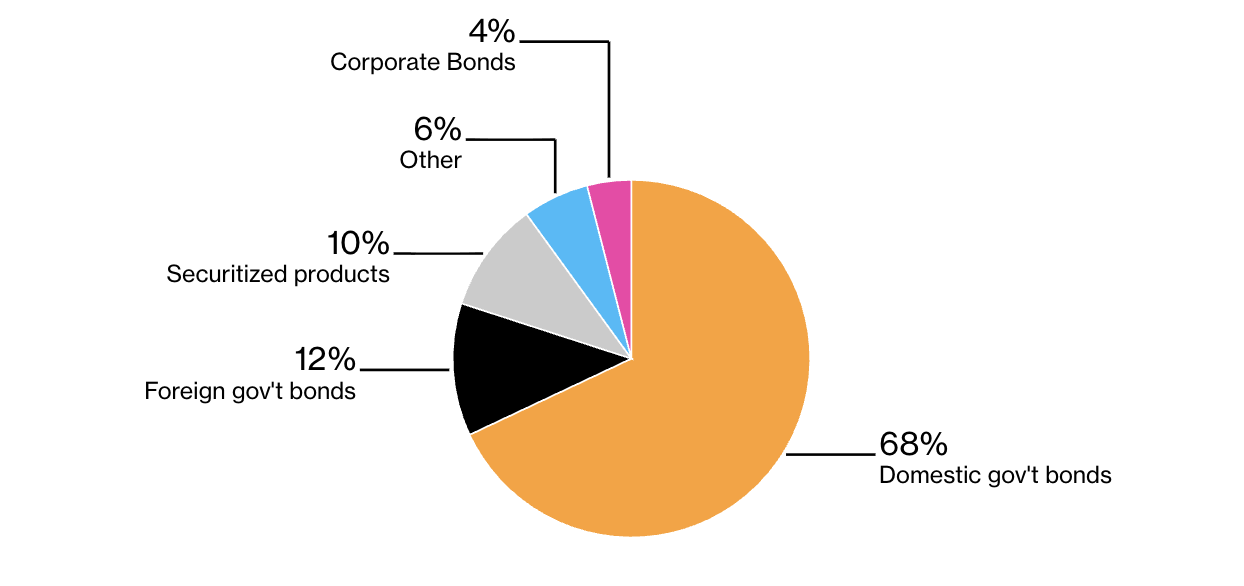
Composition of Collateral Types in Global Repo Transactions
Tokenized repo solves all these pain points. Borrowers initiate financing requests via a digital interface; upon lender confirmation, both cash and securities are represented as on-chain tokens. Once both parties confirm, the transaction is recorded immutably on the ledger, with terms automatically enforced and fully auditable end-to-end. The most fundamental advantage? 24/7, 365-day availability—unconstrained by traditional business hours.
Sonali Das Theisen, Global Head of Electronic Trading & Market Strategy for Fixed Income, FX, and Commodities at Bank of America, commented: “Blockchain effectively reduces friction in capital flows—and the industry’s shift in this direction is inevitable.”
Real Financial Benefits
For repo market leaders, blockchain adoption delivers tangible financial gains. Banks like JPMorgan not only reduce fees and processing time but also lower capital requirements imposed by stringent regulations.
Broadridge’s latest analysis shows that if large banks migrate 15% of their repo activity onto blockchain, their daily liquidity buffers could shrink by 8%–17%. Exact savings depend on institution size, geographic footprint, asset composition, and risk appetite—but overall, substantial amounts of idle capital would be freed up.
Citing data from an unnamed major European bank, Broadridge’s research report notes the bank holds roughly €1.1 billion (about $1.3 billion) daily to meet intraday liquidity needs. A 15% reduction in buffer holdings would release approximately €175 million for redeployment—or reduce reliance on external funding.
Horacio Barakat, Global Head of Digital Innovation at Broadridge, said: “The capital savings are significant—even marginal optimizations can yield tens of millions of dollars in annual cost reductions.” Its platform processed an average of $368 billion in repo volume per day in April, nearing $8 trillion monthly—up 268% year-on-year.
Industry ecosystems are also moving toward standardization. DTCC—the core U.S. clearinghouse—recently announced plans to tokenize highly liquid assets under its custody, including U.S. Treasuries, Russell 1000 constituents, and ETFs. This will dramatically expand the pool of eligible collateral for tokenized repo, allowing institutions to directly reuse existing custodied assets on blockchain ledgers—greatly lowering entry barriers.
Enabling 24/7 Trading for Traditional Assets
Industry insiders say innovations like tokenized repo are vital enablers for traditional assets to achieve true 24/7 trading. Nasdaq has unveiled plans for round-the-clock trading, while NYSE is developing a tokenized continuous trading platform.
Don Wilson, Founder of DRW, noted: “As markets evolve toward 24/7 operation, the ability to borrow cash anytime becomes essential—and on-chain repo is the foundational infrastructure enabling that shift.” As an early investor in Digital Asset, DRW has completed multiple tokenized transactions on the Canton network over the past year.

Don Wilson, Founder of DRW
All new technologies face common challenges—and large-scale blockchain adoption in repo is no exception. Though Canton has become mainstream, the industry still hosts multiple isolated, non-interoperable blockchain systems. Institutions must adapt to multiple platforms and invest heavily in engineering and operations—fragmenting liquidity and diluting transaction volumes. Second, blockchain systems have yet to undergo full market cycles or extreme stress tests. Traditional repo markets weathered multiple crises post-2008, whereas on-chain systems haven’t yet faced real-world scenarios such as midnight system failures or extreme market volatility.
Moreover, traditional traders are deeply accustomed to existing—but inefficient—processes, where rules, error tolerance, and contingency protocols are well-established norms. On-chain trading, by contrast, operates strictly by code: no room for ad hoc adjustments or human discretion.
Sandy Kaul, Head of Innovation at Franklin Templeton, candidly admitted: “Traditional operations leave ample room for flexibility and buffer—on-chain, there’s zero margin for error. Everything is hardcoded. You can’t negotiate an extra five minutes.”
Nonetheless, industry participants widely view these issues as implementation hurdles—not reasons to retreat. “We’re at a pivotal inflection point,” they say. “Blockchain’s entry into traditional financial repo markets has officially begun.”
Join TechFlow official community to stay tuned
Telegram:https://t.me/TechFlowDaily
X (Twitter):https://x.com/TechFlowPost
X (Twitter) EN:https://x.com/BlockFlow_News
 @Bloomberg