What Is Doubao Thinking About Introducing Paid Subscriptions in the Chinese Market?
TechFlow Selected TechFlow Selected
What Is Doubao Thinking About Introducing Paid Subscriptions in the Chinese Market?
Up to $5,088 per year.
 Navigating Web3 tides with focused insights
Doubao is also introducing paid plans.
On May 4, Doubao quietly updated its App Store page with details about its upcoming paid subscription service. The announcement stated that, to better serve professional users, Doubao will retain its free tier while launching a paid subscription system offering enhanced services—available in three tiers: Standard ($9.40/month), Enhanced ($27.70/month), and Professional ($69.20/month).
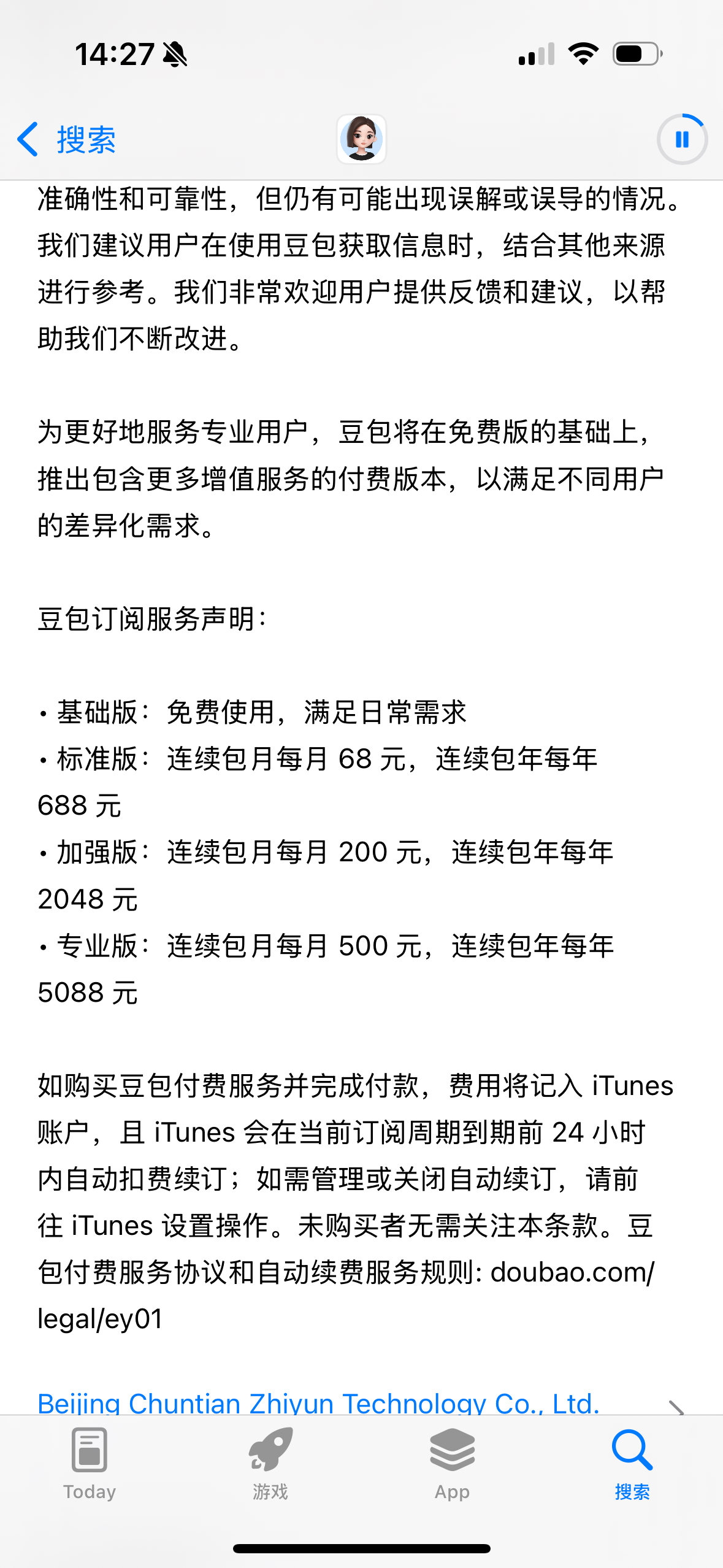
Image source: GeekPark
The news immediately sparked widespread discussion. Some users expressed concern over the potential end of free benefits; others criticized the pricing as unexpectedly high; still others had long anticipated this move. After all, sustaining a product with 320 million monthly active users (MAUs) and 1.8 billion daily conversations solely on a free model simply isn’t financially sustainable.
Fundamentally, this is something the entire industry “can foresee—and execute”: the unsustainability of China’s large-language-model (LLM) free-tier model is an open secret. Leading players have already begun experimenting with monetization, and ByteDance—holding the largest consumer AI user base in China—has never faced technical or capability constraints in launching subscriptions. It was always just a matter of timing.
So, amid broad consensus that consumer-facing subscription businesses are notoriously difficult in China—and with LLM pricing wars already driven down to rock-bottom—can Doubao’s latest commercial push actually succeed?
The Free Foundation—and Up to $5,088/year
According to reports, Doubao’s paid features will focus primarily on complex tasks and productivity use cases—such as PPT generation, data analysis, and video production. As model capabilities continue improving, the product is increasingly capable of handling high-value, complex workloads. However, such tasks demand significantly more compute resources and inference time—prompting Doubao to introduce paid plans to meet these demanding scenarios.
As for the free version, Doubao’s official response states: “Doubao has always provided free services. Building upon this foundation, we are exploring additional value-added services to meet diverse user needs. Specific implementation details remain under testing, and full information will be released via official channels upon launch.”
In other words, users can continue using Doubao for free to perform everyday tasks—including information lookup, basic writing, routine Q&A, and academic tutoring. The paid tier’s core logic centers on delivering “value-added services,” without disrupting the day-to-day experience of ordinary users.
This strategy is hardly novel. Global AI leaders like ChatGPT and Claude all employ a “free base + premium upgrade” tiered model: first, build user habits and mental models through free features; then, monetize by offering advanced capabilities to users willing to pay for tangible value.
So—is $69.20/month for the Professional tier expensive?
At face value, the $69.20/month price point does set a new ceiling for general-purpose AI assistants in China. Yet when placed within the global AI pricing landscape, the picture changes entirely.
Comparing Doubao’s pricing against mainstream global AI products as of May 2026 reveals three key insights: First, the $9.40/month Standard tier sits only ~$1.40 higher than Baidu’s ERNIE Bot and iFLYTEK’s SparkDesk—effectively aligning with China’s prevailing AI subscription benchmark and remaining well within mainstream affordability thresholds. Second, the $27.70/month Enhanced tier occupies the same price band as ChatGPT Plus and Claude Pro ($20.05/month), targeting users with frequent, high-intensity productivity needs. Third, the $69.20/month Professional tier marks China’s first foray into the premium segment for general-purpose AI—but it still falls short of ChatGPT Pro and Claude Max’s global top-tier pricing. Fundamentally, it’s a calibrated probe into the willingness and capacity of China’s power users to pay for elite-tier AI services.
Still, “expensive” or “affordable” is never absolute—it hinges entirely on perceived value alignment.
$69.20/month may equal just one person’s monthly coffee budget—or a modest dinner for two. For content creators, developers, or small-business owners who interact with AI hourly and rely on it for mission-critical output, a 24/7, multi-skilled AI assistant at $69.20/month costs far less than hiring human staff. But for casual users who only occasionally look up facts or draft emails, even the $9.40/month Standard tier offers little justification for payment.
Why Now? ByteDance Has Balanced Two Ledgers
Why this timing?
Before assessing whether Doubao’s subscription model can succeed, a more fundamental question arises: Why did ByteDance choose *this* moment to enter the paid arena?
After all, ByteDance hasn’t moved quickly on monetization. Baidu’s ERNIE Bot, Moonshot’s Kimi, and iFLYTEK’s SparkDesk launched mature subscription systems back in 2024—while Doubao waited until 2026. The likely reason? ByteDance has now balanced two critical ledgers.
First, the growth ledger: The marginal returns of “free-for-growth” have plateaued.
Per QuestMobile data, as of May 2026, Doubao’s MAUs surpassed 345 million, with 1.8 billion daily conversations—solidly maintaining its position as China’s top consumer AI application. Its user base spans students, professionals, creators, and SME owners.
China’s internet user pool is finite. Nearly everyone who could adopt AI has already done so. Continuing to pour money into fully free acquisition yields diminishing incremental returns—while each new conversation incurs real, rising compute costs.
Second, the market ledger: User education for AI monetization in China is complete.
Back in 2023, when LLMs first exploded, Chinese users viewed AI as a “novel toy”—and resisted paying for it. By 2026, however, the industry has completed its full user-education cycle.
Industry data shows China’s AI tool user-paid conversion rate rose from 8% in 2024 to 11% in 2025—with high-frequency users (professionals and specialist creators) exceeding 30% willingness to pay. Users broadly accept the commercial logic: “Free for basics, paid for high-value productivity.”
Entering now, ByteDance avoids the heavy lifting of market education—and simply converts from an existing pool of ready-to-pay users.
Assets—and Hurdles
The difficulty of building a consumer subscription business in China is widely acknowledged: Annual renewal rates above 30% for utility apps represent industry-leading performance; price wars are endemic; and user switching costs are virtually zero.
The core tension in LLM monetization lies in balancing “revenue” against “compute cost”—and here, ByteDance holds a domestic technical edge.
Commercializing LLMs ultimately comes down to one calculation: Can revenue cover compute costs?
This remains an industry-wide challenge. Paying users tend to be the heaviest users—and heavy usage means higher compute consumption.
ByteDance’s advantage lies in its leadership in model efficiency and cost control—the publicly available technical data shows Doubao 2.0 delivers a 43% improvement in inference efficiency, reduces first-token latency in long-context scenarios by over 25% versus industry benchmarks, achieves a 99.98% request success rate under high-concurrency loads (top-tier stability), and cuts per-10K-token inference cost to just 38% of overseas leading models’ compliant domestic infrastructure—giving it a decisive cost advantage to sustain stable, high-compute-demand operations for paid users.
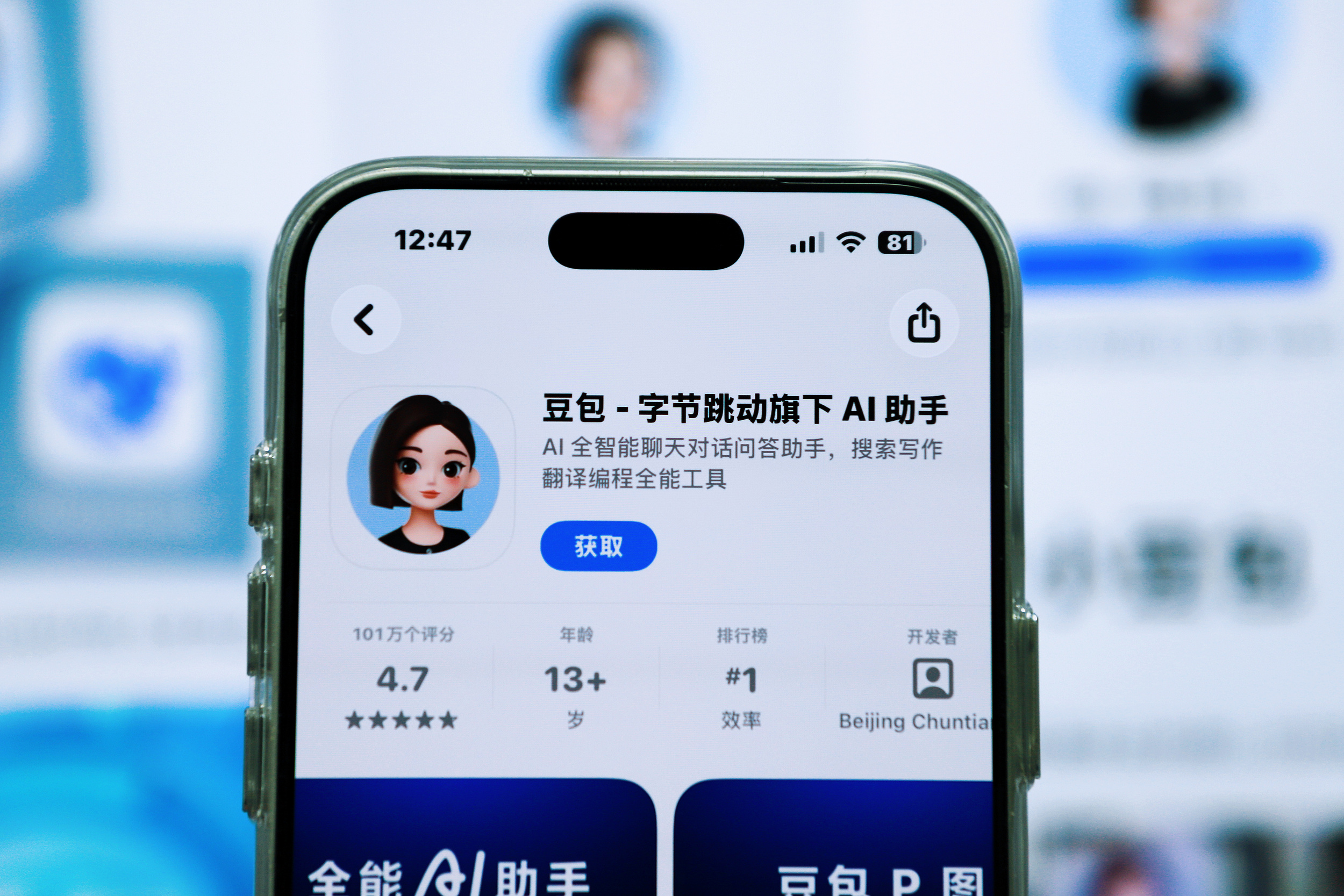
Image source: Visual China
Yet several structural challenges plaguing China’s consumer subscription market remain unresolved—even for ByteDance.
First: Users are willing to pay—but not to keep paying. Over two decades of “free internet” have deeply embedded zero-cost expectations into Chinese users’ psyche—a foundational hurdle for all subscription products.
Even today, achieving a 30% annual renewal rate among consumer utility apps qualifies as industry-leading—while comparable overseas products routinely exceed 60%. The root cause? Chinese users mostly engage in “emergency payments”: subscribing for one month to finish a report or project, then canceling immediately afterward—lacking any habit of sustained, recurring payment.
More critically, ByteDance lacks proven success in this domain. Its prior monetization wins stemmed from advertising, e-commerce, and live-stream gifting—not direct-to-consumer subscriptions. Even CapCut and Douyin’s premium memberships generate only supplemental revenue; neither has ever deployed a tiered subscription architecture for a national flagship product. Faced with China’s entrenched “low persistent-payment propensity,” ByteDance has no pre-tested playbook—making this the biggest unknown.
Second: The “substitutability” of paid value.
Doubao’s disclosed premium features—including long-document comprehension, PPT generation, deep data analysis, and batch high-resolution image creation—are fundamentally commoditized capabilities. Most domestic competitors already offer baseline versions for free—and many open-source models can deliver identical functionality at zero cost via local deployment.
If Doubao’s paid tier merely delivers “marginally faster responses, slightly higher API quotas, and minor model upgrades”—without delivering a step-change in user experience or truly irreplaceable, exclusive value—users won’t develop lasting payment intent. Even ByteDance’s ecosystem synergies won’t create genuine payment stickiness unless they’re deeply embedded into users’ core workflows—not just superficial feature integrations. The likely outcome? A familiar industry pattern: high initial sign-ups followed by steep second-month churn.
Third: The “bottomless pit” of compute costs—the most fundamental—and most intractable—contradiction.
More paying users should theoretically mean higher revenue. But in AI, more paying users often translate directly—and sometimes disproportionately—into higher costs. Without usage caps, revenue may never offset expenses, creating a “death spiral” where profitability deteriorates as adoption grows. Impose strict limits, however, and you damage the paid experience—triggering dissatisfaction and reputational collapse, trapping you between “restrict usage and lose users” and “unrestricted usage and burn cash.”
This is an almost unsolvable balancing act—even ChatGPT hasn’t cracked it: In 2024, ChatGPT’s operational losses exceeded $5 billion, with subscription revenue falling far short of covering costs. ByteDance’s superior cost-control may help, but it cannot wholly escape this industry-wide death spiral.
Finally, price wars will inevitably return.
China’s competitive logic is simple: Once a product proves “profitable,” rivals rush in—then slash prices, offer subsidies, and bundle free memberships.
Should competitors launch a fresh round of discounting, subsidies, and free membership giveaways, Doubao faces a stark choice: match the cuts, plunging into the very “low-price trap” it deliberately avoided—shattering its pricing architecture and cost model; or stand firm, risking mass defection among price-sensitive users.
ByteDance has historically won many battles via low pricing and aggressive subsidies—but this time, it’s the premium-priced player. Whether it can withstand the pressure to devalue—and hold firm to value-based pricing—is a massive test.
Easy Start, Hard Marathon
Returning to the central question: Can Doubao’s subscription model succeed?
The answer is clear. Achieving rapid scale in paid users and establishing initial commercial viability is highly probable. But whether it can sustainably close a healthy profit loop—and become a benchmark for China’s consumer AI subscription economy—remains deeply uncertain.
Short-term, the 345-million MAU foundation is undeniable: Even a 1% paid conversion rate would yield 3.45 million paying users overnight.
Long-term, success hinges not on user scale, nor raw model capability, nor even ByteDance’s ecosystem advantages—but on solving two fundamental questions: First, can it transform ByteDance’s ecosystem strengths into non-substitutable, must-have paid value—not just optional marketing gimmicks? Second, can it break free from China’s consumer subscription “low-price race-to-the-bottom, low-renewal, cost-inversion” death spiral—and forge a genuinely healthy, sustainable business model?
For China’s broader AI industry, Doubao’s commercial experiment carries significance far beyond the product itself. If Doubao succeeds, it charts a viable path for consumer LLM monetization—one that doesn’t rely on destructive price wars. If it ultimately stumbles on systemic industry hurdles, China’s LLM players will need to reconsider: What *does* it take to make consumer subscriptions work?
Join TechFlow official community to stay tuned
Telegram:https://t.me/TechFlowDaily
X (Twitter):https://x.com/TechFlowPost
X (Twitter) EN:https://x.com/BlockFlow_News
 极客公园
极客公园