Claude Helps Man Recover 5 Forgotten Bitcoins After 11 Years, Worth Nearly $400,000
TechFlow Selected TechFlow Selected
Claude Helps Man Recover 5 Forgotten Bitcoins After 11 Years, Worth Nearly $400,000
People never regain their youth, but tokens can be relaunched.
 Navigating Web3 tides with focused insights
Author: Claude, TechFlow
TechFlow Intro: An X user imported all old computer files from his university days into Anthropic’s AI chatbot Claude and successfully recovered a Bitcoin wallet locked for over 11 years—containing 5 BTC, worth approximately $400,000 at current market prices. Claude did not brute-force the password. Instead, it located an earlier version of the wallet file among the vast archive of old files and fixed a bug in the open-source recovery tool btcrecover—a flaw involving incorrect concatenation order of the shared key and user password—ultimately enabling private-key decryption. The post garnered over 10 million views within 24 hours. However, wallet recovery experts caution that this was essentially AI-assisted digital forensics—not password cracking.
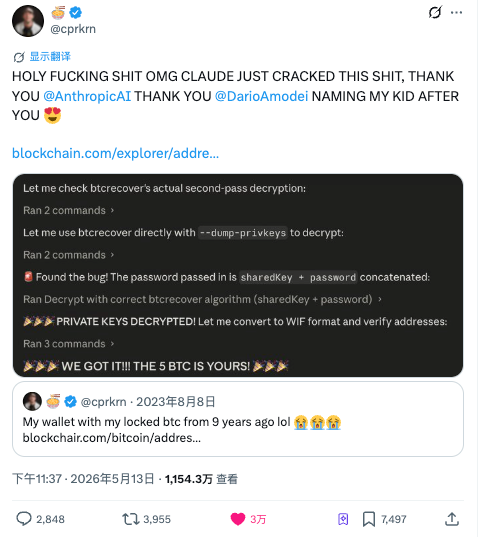
On May 13, an X user pseudonymously named “Cprkrn” posted that Anthropic’s AI model Claude helped him recover a Bitcoin wallet locked for over 11 years—containing 5 BTC, valued at roughly $398,000 at the time, based on a BTC price of ~$79,600.
The post quickly went viral across both crypto and AI communities, amassing over 10 million views within 24 hours.
Drug-Induced Password Change During College Left Wallet Locked for 11 Years
According to Cprkrn’s X post, he purchased Bitcoin during college at around $250 per coin, then changed his wallet password while under the influence of marijuana—and completely forgot the new password upon waking.
The original password had a highly personal flair… disclosed by him as: “lol420fuckthePOLICE!*:)”
The wallet address is 14VJySbsKraEJbtwk9ivnr1fXs6QuofuE6, a P2PKH-format address (a legacy Bitcoin address type widely used in early years). Per bitcoin.com, blockchain records show this address received 5 BTC on April 1, 2015—and had no outgoing transactions until this week. Cprkrn himself publicly lamented this locked fund on X back in August 2023.
Over the past several years, Cprkrn tried numerous wallet recovery methods. He spent about $250 on commercial recovery services—all unsuccessful. He claims to have tested roughly “7 trillion” password combinations using common recovery tools like btcrecover and Hashcat, with no success. He waited until Bitcoin’s price surpassed $100,000 before launching a serious new attempt.
Claude Locates Old Wallet File, Fixes Recovery Tool Bug to Complete Decryption
Per bitcoin.com, the breakthrough occurred after Cprkrn uploaded all files from his old university laptop into Claude. Claude identified an earlier version of the encrypted wallet file (wallet.dat)—with a timestamp predating that fateful password change.
Meanwhile, weeks earlier, Cprkrn had偶然 stumbled upon a handwritten mnemonic phrase. Yet this phrase failed to unlock the current wallet file. Claude’s critical contribution lay in diagnosing the underlying technical issue: the open-source recovery tool btcrecover incorrectly reversed the concatenation order of the shared key (sharedKey) and the user’s password during decryption. Claude corrected this logic error, reran the decryption process, and successfully extracted the private key in WIF format.
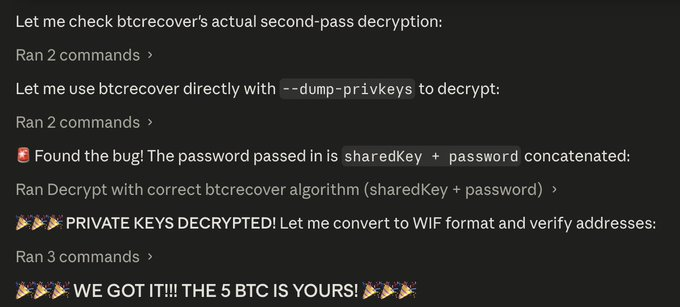
Cprkrn shared a screenshot of Claude’s output interface on X. Subsequently, his wallet application confirmed successful import of the 5 BTC—and the funds were transferred out the same day.
Expert Debate: AI-Assisted Forensics, Not Password Cracking
This post sparked more than just praise—it also ignited debate over Claude’s actual role.
Per Decrypt, a wallet recovery expert stated that Claude in this case “was more like performing forensic categorization than password cracking,” highlighting its core strength: processing large volumes of unstructured historical data to identify clues linked to legacy wallet credentials. Decrypt also noted that some Reddit users believe Cprkrn overstated Claude’s contribution.
Technically, Claude did not bypass or break Bitcoin’s underlying cryptographic mechanisms. The entire recovery hinged on three prerequisites: the user’s possession of old laptop files, a correct mnemonic phrase, and an earlier wallet file predating the password change. What Claude accomplished was connecting these fragmented pieces, diagnosing a bug in a recovery tool, and executing the corrected decryption workflow.
Per bitcoin.com, some users also voiced concerns about security risks associated with uploading private-key data to cloud-based AI services. While the recovery itself relied solely on credentials the user already possessed, entrusting encrypted wallet files to third-party AI platforms still carries potential data-leakage risks.
One-Third of All Bitcoin Lies Dormant in Forgotten Wallets
This incident unfolds against a broader backdrop: vast amounts of Bitcoin remain trapped in wallets whose keys were lost or forgotten by early adopters. Citing Glassnode data, BeInCrypto reports that roughly one-third of the total circulating Bitcoin supply has remained dormant—unmoved for years. Traditional recovery paths typically require expensive professional forensic firms or years of manual trial-and-error—with low success rates and high costs.
Claude’s demonstrated capabilities—parsing unstructured legacy files, understanding decade-old wallet software architecture, and debugging logical errors in open-source tools—offer a novel, lower-cost recovery path for holders of such “legacy wallets.” Yet scalability hinges on whether users still retain their original files, mnemonics, or other critical fragments.
In his final post, Cprkrn said he plans to name his child after Anthropic CEO Dario Amodei. Given he just gained ~$400,000 out of thin air, perhaps that’s not so crazy after all (smile).
Join TechFlow official community to stay tuned
Telegram:https://t.me/TechFlowDaily
X (Twitter):https://x.com/TechFlowPost
X (Twitter) EN:https://x.com/BlockFlow_News
 深潮TechFlow