








ChatGPT and Claude are no longer players on the same path
TechFlow Selected TechFlow Selected
ChatGPT and Claude are no longer players on the same path
Authentic firsthand experience always comes from those driving industry transformation themselves.
 Navigating Web3 tides with focused insights
Recently, OpenAI and Anthropic have successively released core user reports on ChatGPT and Claude. These two documents are not merely simple performance summaries; they reveal a critical trend in the current AI industry: the two leading models are evolving along distinctly different paths, with significant divergence emerging in their market positioning, core application scenarios, and user interaction models.

To this end, TechFlow has conducted a comparative analysis of the two reports through discussions with its Silicon Valley expert team, distilled the underlying industry signals, and explored their deep implications for future technology roadmaps, business models, and related investment strategies.
The data from both reports clearly illustrate differing emphases between ChatGPT and Claude in terms of user base and core functionalities—this is the starting point for understanding their long-term strategic divergence.
ChatGPT: Market Penetration in General-Purpose Applications
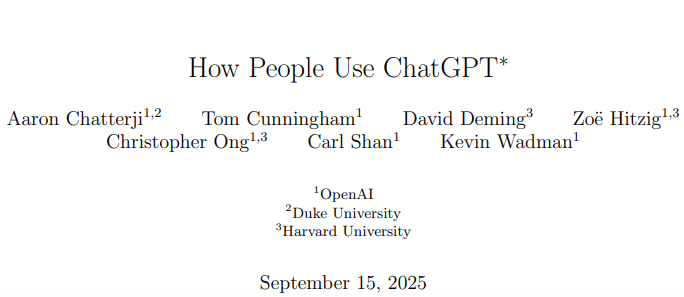
OpenAI’s report confirms ChatGPT’s status as a phenomenon-level application. As of July 2025, its weekly active users exceeded 700 million. The user profile exhibits two key characteristics:
First, the user base has successfully expanded to broader demographics—the early dominance by technical professionals has shifted toward highly educated white-collar workers across diverse occupations;
Second, gender distribution has become more balanced, with female users rising to 52%.
In terms of application scenarios, ChatGPT's core functions are concentrated in three areas: practical guidance, information retrieval, and document writing—accounting for nearly 80% of total conversations.
Users primarily leverage it to assist with daily life and routine office tasks. Notably, the report explicitly states that usage for specialized technical assistance such as programming has significantly declined from 12% to 5%.
Overall, ChatGPT’s strategic path is to become a general-purpose AI assistant serving a broad user base. Its core moat lies in its massive user scale and the resulting network effects, as well as its high penetration rate within users’ everyday information processing workflows.
Claude: Focused on Enterprise-Level and Professional Automation Scenarios
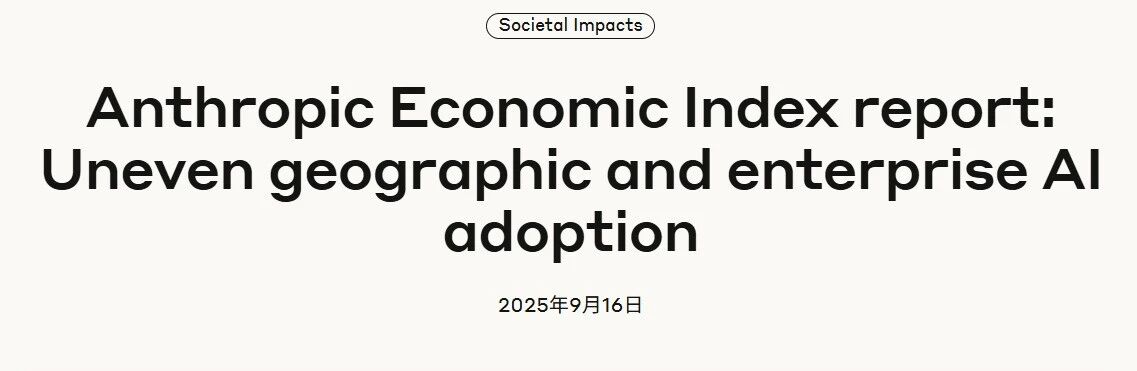
Anthropic’s report paints a markedly different picture. Claude’s user distribution shows a strong positive correlation with regional economic development levels (per capita GDP), indicating its primary users are knowledge workers and professionals in advanced economies.
Its core applications are highly focused. Report data shows software engineering is the dominant use case across nearly all regions, consistently accounting for 36% to 40% of tasks—a stark contrast to ChatGPT’s trajectory in this domain.
The most striking data point in the report concerns the share of “automation” tasks. Over the past eight months, the proportion of “directive-style” automation—where users issue commands and the AI independently completes most of the work—has surged from 27% to 39%.
This trend is even more pronounced among enterprise API paying customers: up to 77% of conversational interactions exhibit automation patterns, with the vast majority being “directive-style” automation requiring minimal human intervention.
Thus, Claude’s strategic positioning is clear: to serve as a professional-grade productivity and automation tool deeply integrated into core enterprise workflows. Its competitive advantage lies in deep optimization for specific professional domains—especially software development—and an extreme focus on task execution efficiency.
Based on these strategic divergences, TechFlow and its Silicon Valley expert team cross-analyzed the data from both reports, distilling three forward-looking industry insights for investors.
One: Divergence in "Programming Use," Signaling the Rise of Specialized AI Tools Markets
The contrasting trends in programming applications between ChatGPT and Claude do not reflect fluctuations in market demand, but rather an upgrade in user needs toward “specialization” and “integration.”
General-purpose conversational interfaces can no longer meet the deep requirements of professional developers within complex workflows. What they need now are AI capabilities seamlessly integrated with integrated development environments (IDEs), code version control systems, and project management tools.
This trend signals the emergence of a major market opportunity: “AI-native toolchains” purpose-built for specific industries (e.g., software development, financial analysis, legal services) and tightly bound to existing workflows.
This requires AI to possess not only model capability but also profound industry-specific understanding. For investors in these domains, assessing whether a target company can build such “deep integration” will become a critical criterion.
Two: The "77% Automation Rate" Quantifies the Acceleration of Enterprise Task Automation
The “77% enterprise API automation rate” cited in Anthropic’s report is an extremely strong signal, indicating that at the forefront of commercial applications, AI’s role is rapidly shifting from “human assistant” to “task executor.”
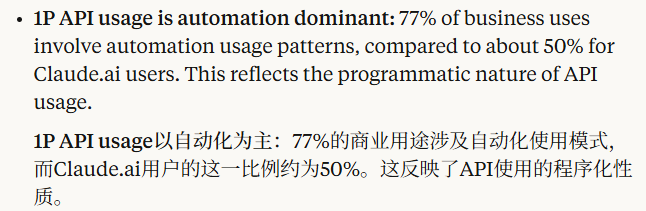
This data compels us to reassess the speed of AI’s impact on corporate productivity, organizational structures, and cost models. While the market has traditionally focused on AI’s “efficiency enhancement” value, the “substitution” value must now be incorporated into core analytical frameworks.
Investment logic should expand from evaluating “how AI assists human employees” to identifying “in which knowledge-intensive fields AI can independently complete standardized tasks with higher efficiency and lower cost.”
Areas such as financial statement generation, initial contract review, and market data analysis—process-driven and labor-intensive—will be where AI automation first delivers significant economic benefits.
Three: Differences in "Collaboration vs. Automation" Modes Reveal the Evolution Path of AI Business Models
A counterintuitive data point in the report is this: in regions with higher per capita Claude usage, users lean more toward “collaborative” modes; conversely, in regions with lower usage, users prefer “automation” modes.
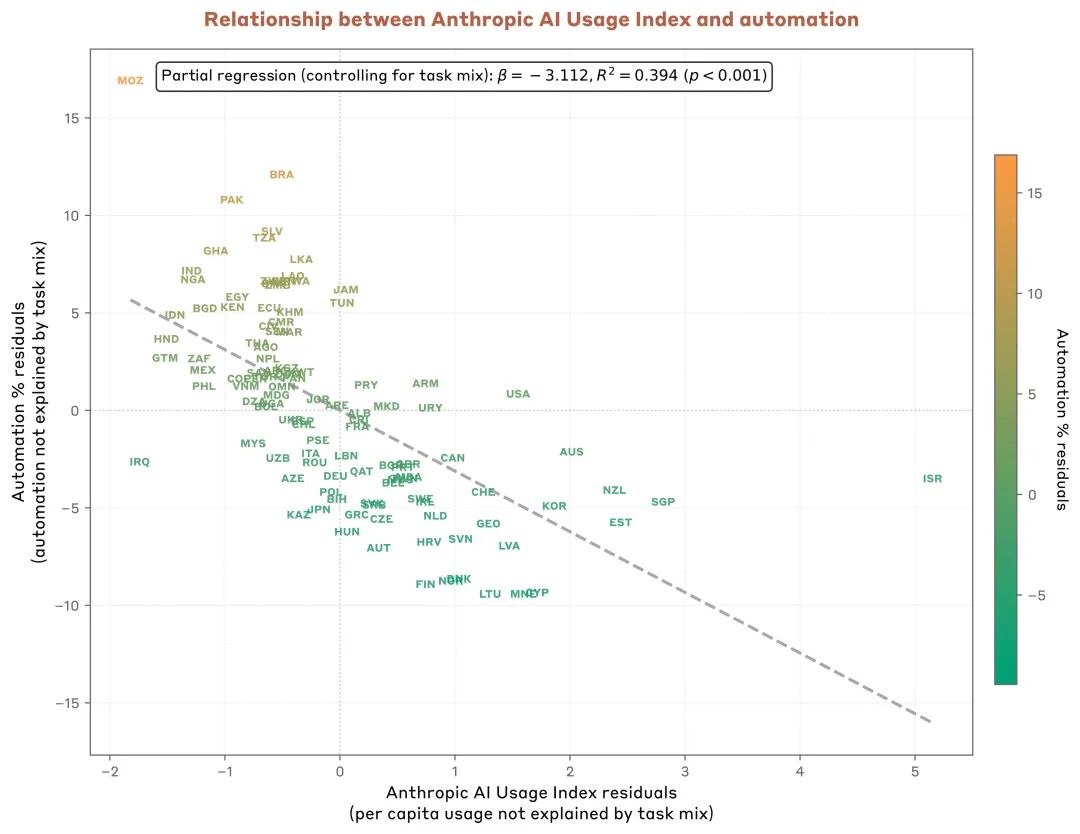
This may reveal the evolutionary relationship between AI business models and user maturity. In the early stages of market penetration, users tend to treat AI as a simple efficiency tool to replace standalone tasks (automation).
However, when users—especially professional ones—gain deeper understanding of AI’s capability boundaries and interaction paradigms, they begin exploring complex collaboration with AI to accomplish previously unattainable, more creative tasks (collaboration).
This raises new considerations for AI’s long-term business models. Beyond cost reduction via automation (SaaS model), creating entirely new value and enhancing decision quality through human-AI collaboration could give rise to more advanced models, such as outcome-based pricing or decision-support subscriptions. Investors evaluating AI ventures should assess potential along both the “automation” and “co-creation” trajectories.
The above analysis based on public reports is merely the starting point of the decision-making process. A complete decision requires answering deeper questions about “how it will be achieved” and “by whom,” such as:
In the field of “AI-native toolchains,” what are the technical architectures, team compositions, and market validation statuses of the most promising startups?
Within major tech companies, what are the actual technical pathways, deployment costs, and ROI metrics behind achieving high levels of task automation?
For companies like Apple, what is the strategic logic and commercialization roadmap of their AI strategy within a closed ecosystem, particularly regarding their proprietary large models?
Such information cannot be gleaned from public reports—it stems from frontline industrial experience. To truly understand the dynamics of today’s AI industry, direct dialogue with the individuals shaping these technologies and products is essential.
For example, to gain deeper insights from the frontlines, our financial clients recently engaged in in-depth discussions with the following two experts:
An ML/DL/NLP scientist and technical lead from Apple’s machine learning division. As a core member who trained Apple’s proprietary large language model (LLM) from scratch, he can directly reveal the technical challenges, real training costs, and strategic considerations involved when tech giants build core AI capabilities in-house, including reporting directly to top executive leadership.
A Technical Lead (Engineer Lead) from Meta’s generative AI organization. As a founding engineer, he has not only deeply participated in LLM development but, more critically, led the integration of GenAI technologies into core business engines such as ad ranking and recommendation systems. Conversations with him clearly outline the transformation pathway from model capability to commercial ROI, along with his investment perspectives on cutting-edge AI startups in North America.
Insights from such experts transform macro-level trends found in public reports into granular, actionable tactical intelligence. In an industry environment where information rapidly evolves, accessing deep insights beyond public data is fundamental to building cognitive advantage and making precise decisions. If you wish to explore the above topics further, we welcome you to contact us to arrange expert consultations in relevant domains.
When your team is locked in debate over technology roadmaps, when your investment decisions remain unresolved, when your product strategy is clouded in uncertainty… remember, the challenges you face may already have been overcome by someone else. We at TechFlow believe: authentic, firsthand experience always comes from those actively driving industry transformation.
Join TechFlow official community to stay tuned
Telegram:https://t.me/TechFlowDaily
X (Twitter):https://x.com/TechFlowPost
X (Twitter) EN:https://x.com/BlockFlow_News






