OpenAI makes a bold move, transforming ChatGPT into a search engine and investing $5 billion to develop custom AI chips
TechFlow Selected TechFlow Selected
OpenAI makes a bold move, transforming ChatGPT into a search engine and investing $5 billion to develop custom AI chips
OpenAI declares war on Google.
 Navigating Web3 tides with focused insights
By: Michael Nuñez
Translation: MetaverseHub
On October 31, OpenAI announced a major upgrade to its popular ChatGPT service, transforming it into a powerful search engine—its boldest move yet in challenging Google.
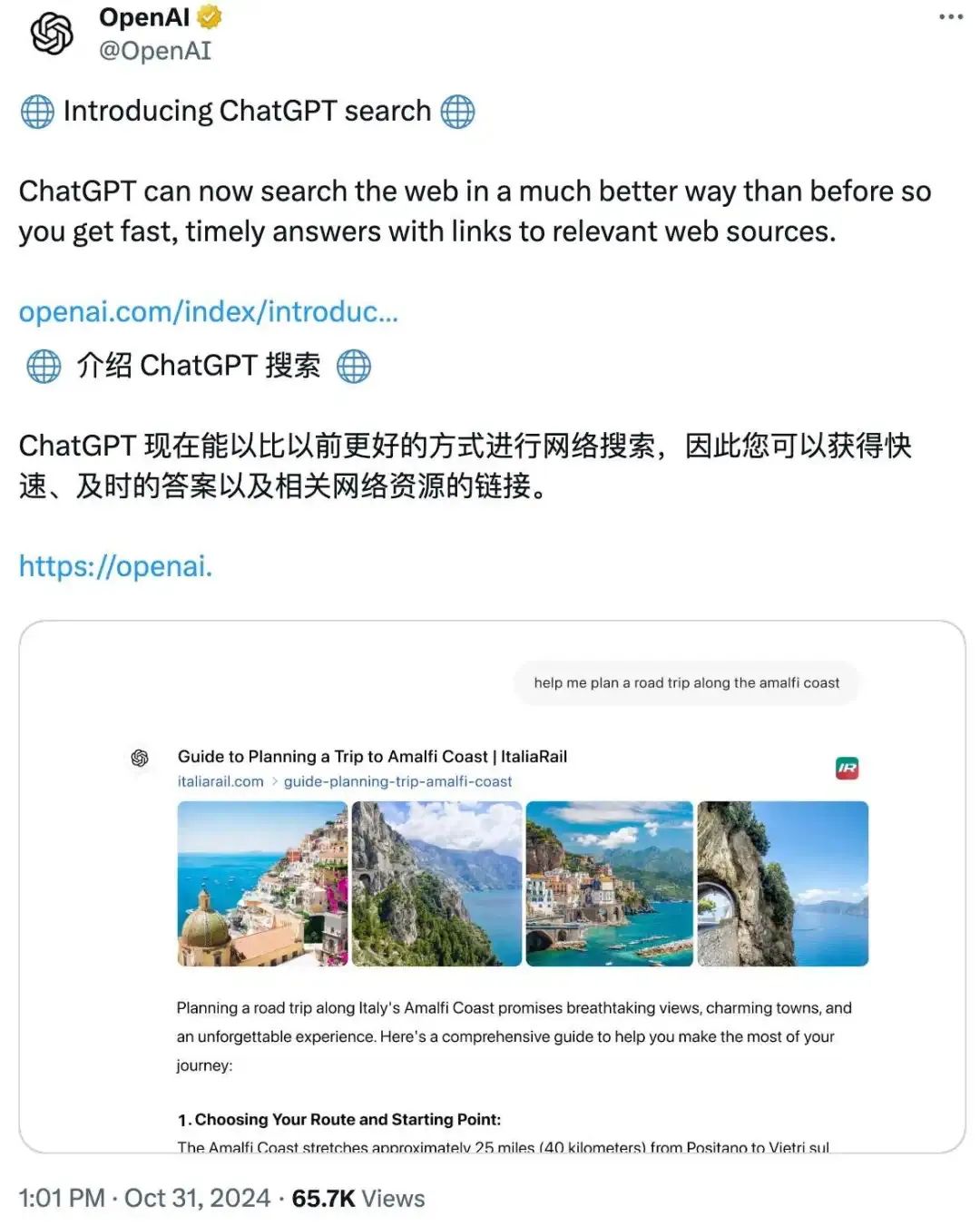
With the upgrade, users can now ask questions in plain English and receive real-time information on news, sports, stocks, and weather—features that previously required separate search engines.
"We believe search should feel as natural as conversation," an OpenAI spokesperson said. "We'll roll this out first to paid users and plan to expand to free users in the coming months."
01. How Does OpenAI’s New AI Search Work?
Unlike traditional search engines like Google and Microsoft Bing, which return lists of links, ChatGPT now processes queries in natural language, delivers curated answers, and clearly cites sources.
Users can click through to original sources or ask follow-up questions to dive deeper into topics.
The technology builds on OpenAI’s SearchGPT experiment launched in July, which tested search capabilities with 10,000 users and helped refine how AI handles web information and attribution.
The system is based on OpenAI’s latest GPT-4o model, specially fine-tuned for this purpose. It has been trained on vast amounts of web data and optimized for improved contextual understanding during extended conversations.
02. Major News Publishers Partner with OpenAI
Prominent media organizations including The Associated Press, Axel Springer, and Vox Media have partnered with OpenAI to provide content.
These collaborations aim to address long-standing concerns about AI systems using publishers’ work without permission or compensation.
"ChatGPT Search has the potential to better highlight and summarize news sources, benefiting audiences," said Pam Wasserstein, President of Vox Media, in a statement.

"It also amplifies the reach of high-quality news publishers. Meanwhile, publishers retain the choice not to have their content used for AI training while still appearing in search results."
03. OpenAI Bets $5 Billion on Custom Chips and AI Infrastructure
This launch coincides with OpenAI’s push to build its own technological infrastructure.
OpenAI recently announced agreements with AMD, Broadcom, and TSMC to develop custom AI chips by 2026, aiming to reduce reliance on Nvidia’s expensive processors.
The investments are substantial. Microsoft, OpenAI’s biggest backer, has invested nearly $14 billion.
Microsoft said this week that the partnership will reduce its quarterly profits by $1.5 billion. Meanwhile, OpenAI expects its computing costs to reach $5 billion this year.
Massive investments in custom silicon and infrastructure signal a pivotal shift in OpenAI’s strategy.
While most AI companies still rely on Nvidia chips and cloud providers’ data centers, OpenAI is ambitiously pursuing technological independence.
This is a high-stakes gamble—it could drain company resources or give it an insurmountable edge in the AI race.
By taking control of its chip development, OpenAI could cut computing costs in half before 2026. More importantly, custom chips optimized specifically for GPT models could enable functionalities impossible with general-purpose AI processors.
This vertical integration—from chips to models to consumer products—mirrors Apple’s playbook that dominated the smartphone era.
The new search features will appear on ChatGPT’s website and mobile apps. Enterprise customers and education users will gain access in the coming weeks, followed by a gradual rollout to OpenAI’s hundreds of millions of free users.
For now, Google remains dominant in search. But as AI advances and more users grow accustomed to conversational interfaces, the landscape of online information retrieval appears poised for its biggest transformation in decades.
Join TechFlow official community to stay tuned
Telegram:https://t.me/TechFlowDaily
X (Twitter):https://x.com/TechFlowPost
X (Twitter) EN:https://x.com/BlockFlow_News
 @VentureBeat