OpenAI named the model "Luna", crypto immediately leveraged up Terra's dead coin.
TechFlow Selected TechFlow Selected
OpenAI named the model "Luna", crypto immediately leveraged up Terra's dead coin.
No fundamentals, no new narrative—traders are simply betting on an attention pulse triggered by a "name collision".
 Navigating Web3 tides with focused insights
Author: Gino Matos
Translation: TechFlow
TechFlow Editor's Note: OpenAI releases GPT-5.6, with three tiers named Sol, Terra, and Luna respectively. Crypto traders reacted within minutes: the name Luna clashes with the Terra/Luna token that collapsed in 2022. LUNA2 perpetual contract open interest surged 43%, and the price was pumped. No fundamentals, no new narrative, traders are betting on an attention pulse brought by a "name collision." This article breaks down the logic of this trade and how the crypto market industrially converts cultural fragments into tradable assets.
OpenAI Released a Model, Crypto Market Moved First
On June 26, OpenAI released GPT-5.6, positioned as a limited preview cutting-edge model series, with three tiers: Sol is the flagship version, Terra is the balanced mid-tier option, and Luna is the fast, low-cost lightweight version.
OpenAI states that Sol's performance on ExploitBench is comparable to Anthropic's Mythos Preview, but uses only about 33% of the output tokens, priced at $5 per million input tokens and $30 per million output tokens.
The initial release is limited to a small batch of vetted partners accessing via API and Codex, an arrangement made at the request of the U.S. government. OpenAI is addressing safety and release process issues triggered by the model's capabilities in biology, programming, and offensive cybersecurity.
This is all background. Crypto traders found another catalyst in the product name.
Within 5 Minutes, LUNA2 Contracts Moved
Within minutes of the announcement, LUNA2 perpetual contracts on Binance began to move unusually. LUNA2USDT 5-minute candlestick chart shows the price pulled from about $0.0486 to a high of $0.0513.
Open interest jumped from about 36.5 million LUNA2 to 52.3 million, up 43%, and the funding rate turned positive to 0.01%.
The Coinbase premium index did not match this trading pair, indicating this rally occurred entirely on crypto-native perpetual contract exchanges, with no participation from the U.S. spot market.
LUNA2 has a market cap of about $36 million and a 24-hour trading volume of about $8.5 million. With such thin liquidity, attention plus leveraged capital can push the price before fundamentals have time to react.
This token is the governance token left over after the Terra collapse, and its name happened to clash with OpenAI's new GPT tier. The entire trade runs on this overlap.
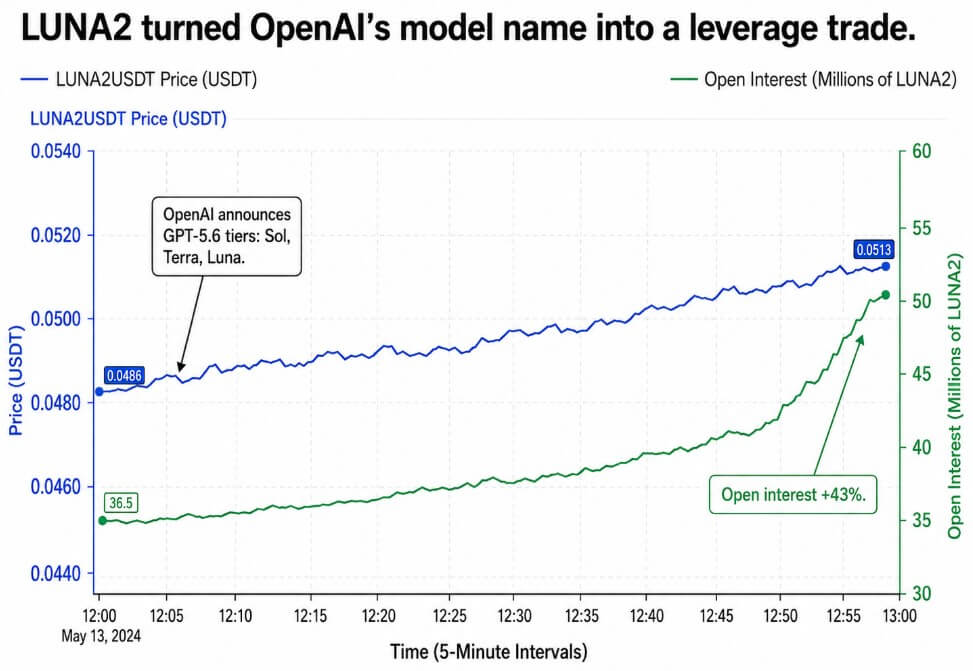
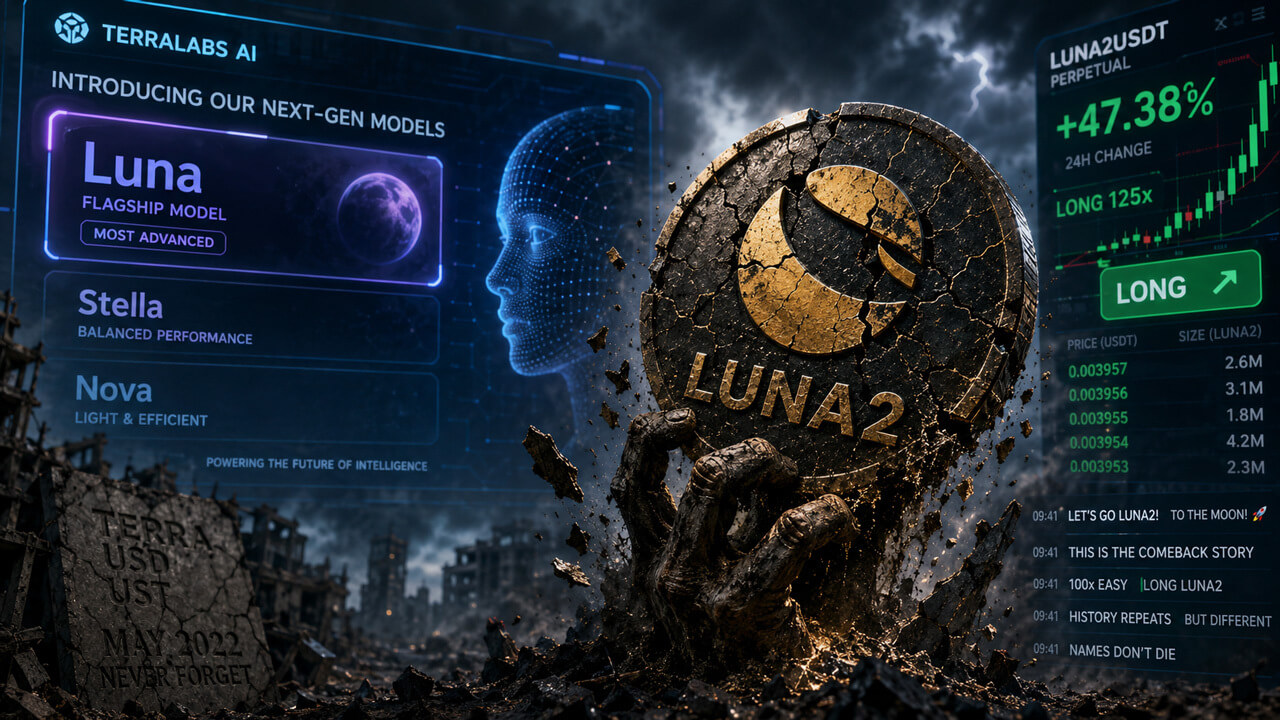
Caption: Within one hour after OpenAI announced the three GPT-5.6 tiers Sol, Terra, and Luna, LUNA2 perpetual contract open interest surged 43%, and the price climbed from $0.0486 to $0.0513.
What Exactly Are Traders Buying
Terra/Luna collapsed within three days in May 2022, evaporating about $50 billion in market cap.
The SEC subsequently sued Terraform Labs and Do Kwon on grounds of billions of dollars in crypto asset securities fraud involving UST, LUNA, and related assets.
Terra 2.0 survived as the remaining chain after the collapse, LUNA2 is its governance token, still listed on dozens of markets, and still carries the cultural memory of one of the most catastrophic failures in crypto history.
When OpenAI named the cheapest model tier "Luna," traders bet that: everyone would react to this word before the joke expires. Enough bots, headline scanners, chart chasers, and social accounts will see the word "Luna," and name recognition alone can get this ticker moving. A 5-minute perpetual position has almost no holding cost during the formation of an attention cascade.
Open interest growth surged 43%, faster than price, confirming the essence of this trade is leveraged positioning around expected attention, rather than spot buying based on new fundamental information about LUNA2.
Crypto researchers call this "semantic arbitrage": traders are buying an expectation—that a recognizable word will pass through the crypto market's attention economy fast enough to generate returns before the cascade collapses.
LUNA2 met all conditions the moment "Luna" appeared in OpenAI's press release.
The Pattern Behind the Joke
The same mechanism has been running for several years, with 2025 and 2026 producing its most industrialized form.
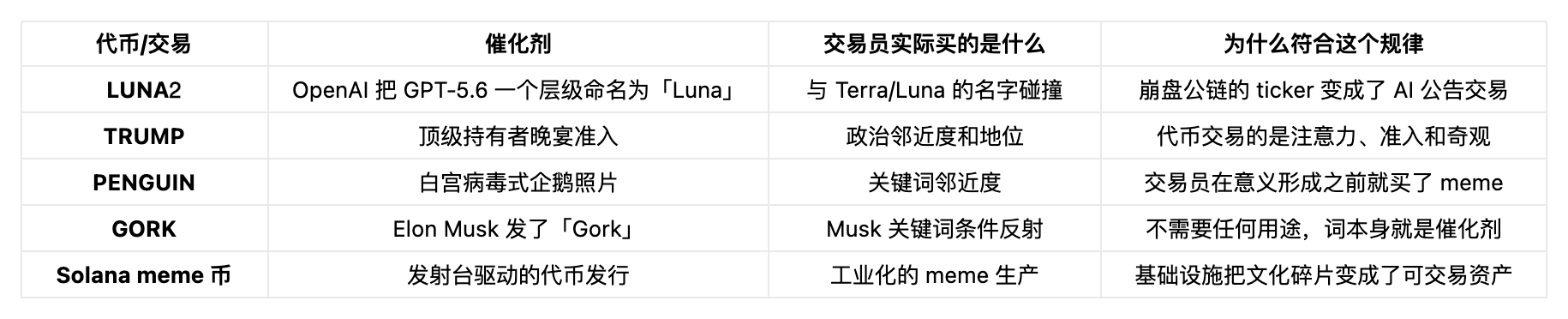
The TRUMP token surged over 50% in April 2025, triggered by the project team announcing that top holders would be invited to an exclusive dinner.
PENGUIN reportedly skyrocketed about 564%, triggered by a viral photo released by the White House showing a penguin standing beside President Trump. GORK surged over 520%, simply because Elon Musk posted the word "Gork" on X, with no project or utility behind it.
An academic paper in 2026 about Solana meme coins found that the launchpad had processed over 40,000 migrated tokens and over 180 million post-migration transactions. This number indicates that the infrastructure for converting words into markets has been thoroughly industrialized.
TRUMP trades on political access, PENGUIN trades on presidential association, GORK trades on Musk keyword proximity, and LUNA2 trades on the collision between OpenAI model naming and a collapsed public chain.
The market forms around one thing: the speed at which everyone realizes everyone else has seen the same word. A token only needs sufficient cultural intersection with the catalyst to trigger a short-lived attention cascade and become tradable.
This time, crypto traders extracted a two-hour perpetual contract trade from the product naming, and then walked away.
This Arbitrage Has an Expiration Date
The bullish side: This LUNA2 operation becomes a template. Traders begin to systematically screen AI model names, celebrity product launches, political speeches, and viral cultural events, looking for ticker collisions with low float, derivatives-channel-enabled tokens.
This trade will professionalize into dedicated teams, real-time monitoring name overlaps in announcements, building positions before social propagation speed peaks, and exiting before the funding rate turns punitive. Any culturally recognizable word linked to thin liquidity tokens with perpetual contract channels will become a temporary market structure. Solana launchpad data already shows the supply side is industrialized; the demand side will follow once the arbitrage logic is clear and systematizable enough.
The bearish side: This LUNA2 move is just a one-off anomaly, and it will tighten its own advantage. Exchanges will increase margin requirements for sudden, fundamentals-unrelated open interest surges. Funding rates in crowded semantic trades rise fast enough to punish latecomers. First movers extract the spread; followers are chasing a chart where the joke is already fully priced.
Imitation trades during the next AI model name collision will be squeezed before the cascade forms, because too many traders have learned this tactic, positioning ahead of the catalyst. Arbitrage space is compressed to where only the fastest execution infrastructure can capture it.

Under both scenarios, the crypto market operates on cultural association faster than fundamental value. OpenAI's goal is to establish cutting-edge AI benchmarks and challenge Mythos in the model war.
During the time the announcement spread, crypto traders had already opened positions, ridden the wave, and begun closing out a leveraged trade betting on a word.
Join TechFlow official community to stay tuned
Telegram:https://t.me/TechFlowDaily
X (Twitter):https://x.com/TechFlowPost
X (Twitter) EN:https://x.com/BlockFlow_News
 @CryptoSlate