Crypto Morning Brief: NVIDIA’s Earnings Exceed Expectations; OpenAI Plans to File IPO Application as Early as Friday
TechFlow Selected TechFlow Selected
Crypto Morning Brief: NVIDIA’s Earnings Exceed Expectations; OpenAI Plans to File IPO Application as Early as Friday
SpaceX’s S-1 filing discloses holdings of 18,712 bitcoins, with an average cost basis of approximately $35,300.
 Navigating Web3 tides with focused insights
Author: TechFlow
Yesterday’s Market Highlights
Trump: U.S.-Iran negotiations have entered the “final stage”
Trump stated that U.S.-Iran negotiations have entered the “final stage” and added, “Let’s wait and see.”
According to Bitget market data, all three major U.S. stock indices continued rising, each gaining over 1%.
Bipartisan U.S. lawmakers reintroduce the EQUAL Act to advance crypto tax reform and request IRS study on tax exemption for small-value transactions
Per CoinDesk, bipartisan U.S. lawmakers Steven Horsford, Max Miller, Suzan DelBene, and Mike Carey jointly reintroduced the Digital Asset Protection, Accountability, Regulation, Innovation, Taxation, and Yield Act (the “EQUAL Act”) this Wednesday. Key provisions of the updated bill include: (1) specifying that regulated payment stablecoins generate no gain or loss if their cost basis is no less than 99% of their redemption value; (2) establishing a safe harbor for broker-dealer trades or taxpayer account trades; (3) clarifying how wash sale rules apply to digital assets; and (4) directing the IRS to assess the current tax burden associated with small-value crypto transactions and study the feasibility—and potential for abuse—of exempting transactions under $200 from taxation.
The crypto industry has long advocated for tax exemptions on small-value transactions to promote broader adoption of cryptocurrencies in everyday payments. Representative Horsford noted that tax policy forms the foundation of the crypto regulatory framework, and that current tax law remains silent on many core issues related to digital assets.
Former CFTC Chair: U.S. conducting closed-door research on digital dollar infrastructure
According to CoinDesk, Timothy Massad, former chair of the U.S. Commodity Futures Trading Commission (CFTC), stated that although Trump previously publicly opposed central bank digital currencies (CBDCs) and government-backed dollar stablecoins, the U.S. may ultimately launch a government-backed, on-chain digital dollar solution amid global momentum toward tokenized finance.
Massad said the White House is conducting closed-door research into related infrastructure, and the U.S. has already joined the Bank for International Settlements’ (BIS) Project Agora. Mark Gould, Head of Payments at the Federal Reserve, noted that a digital dollar currently falls outside the Fed’s mandate—but if one were launched, the Fed would be responsible for its implementation.
LayerZero releases KelpDAO security incident report: to revise security strategy and rebuild affected cloud infrastructure
LayerZero Labs published its post-incident report on the KelpDAO attack, confirming that the KelpDAO rsETH cross-chain bridge—built atop LayerZero’s cross-chain communication protocol—was compromised, resulting in the theft of approximately 116,500 rsETH (valued at ~$292 million). Multiple security firms—including Mandiant and CrowdStrike—as well as independent researchers, attributed the attack to the North Korea–linked hacking group TraderTraitor (UNC4899). The report states the attack began on March 6, 2026, when attackers used social engineering to compromise a LayerZero developer account, obtain session keys, infiltrate the RPC cloud environment, corrupt internal RPC node data, and manipulate response outputs to deceive monitoring systems and the decentralized verification network (DVN).
LayerZero Labs officially announced it will revise its security strategy—including prohibiting its own DVN from acting as the sole signer in single-validator configurations—and rebuild the affected cloud infrastructure, while also introducing short-lived credentials, just-in-time privilege escalation, and multi-party approval mechanisms to strengthen security.
Morgan Stanley files revised application for Solana ETF, ticker symbol MSOL
Bloomberg analyst James Seyffart reported that Morgan Stanley submitted its revised application for a Solana ETF this morning, with the proposed ticker symbol MSOL.
Tether acquires SoftBank’s stake in Twenty One Capital to bolster Bitcoin strategy
Tether announced it has acquired SoftBank’s shares in Twenty One Capital (XXI), increasing its ownership stake. Following the transaction, SoftBank’s board representative at XXI stepped down per the shareholder agreement. Tether stated the move reflects its continued confidence in XXI’s long-term Bitcoin strategy and views XXI as one of the key opportunities to build a publicly traded company “from scratch around Bitcoin.”
NVIDIA Q1 FY2027 revenue hits $8.16 billion, surpassing consensus of $7.87 billion
NVIDIA (NVDA.O) released its earnings after U.S. market hours on Wednesday. Its Q1 FY2027 revenue totaled $8.16 billion, exceeding consensus estimates of $7.87 billion. Data center revenue reached $7.52 billion, beating consensus of $7.28 billion. NVIDIA also announced an $8 billion share repurchase program and raised its quarterly cash dividend from $0.01 to $0.25 per share. Moreover, NVIDIA’s data center spending—the primary driver of its revenue—shows no signs of slowing. The company forecasted Q2 revenue of $9.1 billion (±2%), above the consensus midpoint of $8.68 billion, though the highest analyst estimate reached $9.6 billion.
Catena Labs secures $30 million Series A round led by Acrew Capital and a16z crypto
Per Fortune, Catena Labs—founded by Sean Neville, co-founder of Circle—has closed a $30 million Series A funding round led by Acrew Capital and a16z crypto, with participation from Breyer Capital, General Catalyst, and QED.
Catena Labs focuses on building tools enabling AI agents to conduct financial transactions securely. It has applied to the U.S. Office of the Comptroller of the Currency (OCC) for a national trust bank charter in New York, seeking regulatory authorization to process payments and hold customer funds. The company previously raised an initial $18 million in 2025, also led by a16z crypto.
Crypto custody firm Copper seeks sale at ~$500 million valuation
According to CoinDesk, crypto custody firm Copper is seeking to sell the company at a valuation of approximately $500 million and has engaged Wall Street investment bank Cantor Fitzgerald to assist with the process. Copper’s core asset is its ClearLoop custody-based settlement system, which enables institutional clients to execute delivery-versus-payment (DvP) settlements without moving assets onto-chain—effectively eliminating settlement risk. The firm currently serves over 1,000 active counterparties and processes over $50 billion in notional monthly trading volume. Copper had previously considered an IPO but postponed plans amid weak Bitcoin prices and heightened investor focus on AI-related ventures, leading to broad caution across the crypto IPO market.
OpenAI preparing IPO filing, earliest submission possible this Friday
Per the Wall Street Journal, OpenAI is collaborating with investment banks including Goldman Sachs and Morgan Stanley to prepare its initial public offering (IPO) filing for submission in the coming days or weeks.
According to sources, the banks are assisting OpenAI in drafting its prospectus, with plans to submit it confidentially to regulators shortly—potentially as early as this Friday. OpenAI aims to begin its listing process as soon as September this year, though timelines remain subject to change.
SpaceX S-1 filing discloses 18,712 BTC holdings, average cost basis ~$35,300
In its S-1 registration statement, SpaceX disclosed that, as of March 31, 2026, it held 18,712 bitcoins, with a cost basis of approximately $661 million—implying an average acquisition price of roughly $35,300 per bitcoin. The fair market value of these holdings was approximately $1.293 billion.
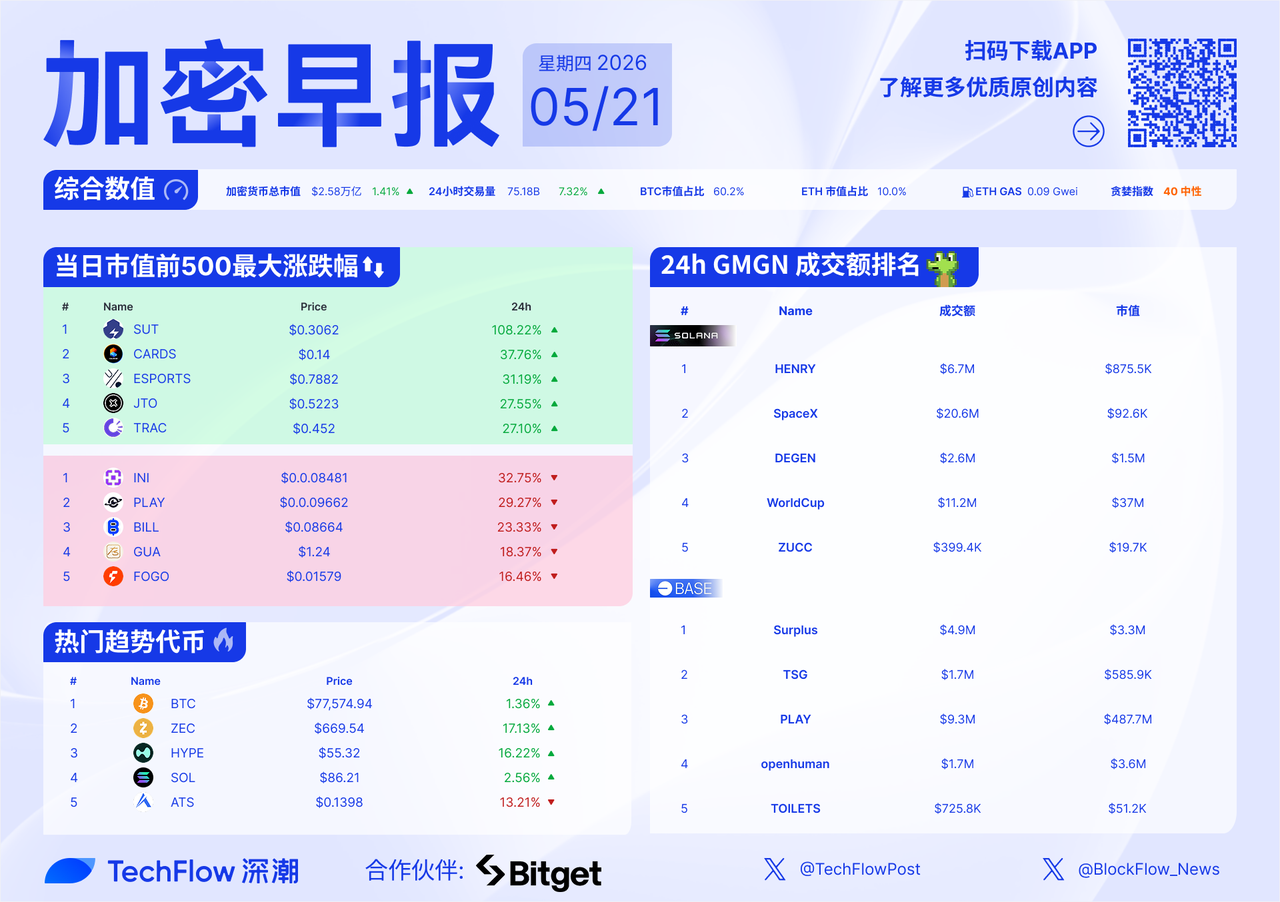
Market Data
Recommended Reading
On-chain data breakdown: BTC drops from $80K; open interest hits annual high—three indicators explain current market structure
https://www.techflowpost.com/zh-CN/article/31649
Bitcoin rebounded to $80,000 in early May 2026, with exchange inflows hitting an annual high—but elevated leverage introduced market fragility. On May 18, geopolitical risks triggered a drop from above $80,000 to $77,000, forcing liquidation of $657 million in long positions. Rapid expansion of leveraged positions combined with geopolitical uncertainty drove extreme volatility. Going forward, key watchpoints include stablecoin reserves on exchanges, ETF fund flows, and critical support levels.
Karpathy joins Anthropic—Anthropic may be emptying OpenAI’s friend circle
https://www.techflowpost.com/zh-CN/article/31653
Andrej Karpathy, former OpenAI co-founder and ex-Tesla AI Director, announced he has joined Anthropic—a company founded by former OpenAI employees—to lead a team researching “AI self-training.” Facing compute constraints, Anthropic is innovating to improve AI R&D efficiency and has attracted numerous former OpenAI core team members. As OpenAI advances commercialization, several founders and executives have departed—and Anthropic has become their top destination.
Google’s official “GEO Guide”: GEO doesn’t exist—this is both truth and rhetoric
https://www.techflowpost.com/zh-CN/article/31654
This article analyzes Google’s recently published official guide, “Optimizing your website for generative AI features on Google Search,” concerning Generative Engine Optimization (GEO). It examines Google’s stance and motivations, distinguishes between factual statements and rhetorical framing in the guide, and offers targeted recommendations based on real-world conditions in China’s crypto sector.
Interview with Circle’s Chief Economist: USDC’s integration with Hyperliquid benefits both Circle and HYPE—stablecoins are becoming marginal buyers of U.S. Treasuries
https://www.techflowpost.com/zh-CN/article/31656
This article explores topics including stablecoins, interest rate markets, AI value capture, and the CLARITY Act, discussing market dynamics, investment logic, and future trends across these domains. It also covers recent developments in Circle’s collaboration with Coinbase, updates on the OpenAI litigation, and implications of the new Federal Reserve Chair’s appointment for interest rate markets.
Leopold Aschenbrenner’s latest portfolio analysis: Why the “King of AI Bulls” turned bearish on NVIDIA?
https://www.techflowpost.com/zh-CN/article/31664
This article analyzes the latest investment strategy of Leopold Aschenbrenner, a prominent Wall Street AI investor. Having previously been bullish on AI, he has shifted toward shorting the semiconductor supply chain while doubling down on power, memory, and infrastructure layers. The piece delves deeply into his rationale and associated risks, and provides actionable insights for retail investors.
Join TechFlow official community to stay tuned
Telegram:https://t.me/TechFlowDaily
X (Twitter):https://x.com/TechFlowPost
X (Twitter) EN:https://x.com/BlockFlow_News
 深潮TechFlow