One Year After Crypto Treasury Company Collapse, Imitators Make a Comeback
TechFlow Selected TechFlow Selected
One Year After Crypto Treasury Company Collapse, Imitators Make a Comeback
This time it is SpaceX and HYPE.
 Navigating Web3 tides with focused insights
Author: Rasheed Saleuddin
Compiled by: TechFlow
TechFlow Editor's Note: Last summer, the frenzy surrounding Digital Asset Treasury companies (DAT) ended in a devastating crash, with early investors losing up to 99%. A year later, the same scam has returned in a new guise—this time packaging SpaceX stock and HYPE tokens. The cycle of greed and fear never stops, and retail investors continue to pay for the insiders' feast.
Last Tuesday, Triller Group (who?) announced it would become the world's first SpaceX treasury company. In other words, it will use newly raised funds to buy and hold SpaceX stock. That is its business model: holding SpaceX. This news sent Triller's market cap soaring from $15 million to $63 million.
Matt Levine noticed this, and I was drawn in as well. This announcement followed the rebranding of an "established" treasury company, LGHL—they previously bought crypto assets SOL and SUI, and now they want to buy HYPE tokens. Because, well, hype.
We've seen this movie before. Just last summer. The ending was so brutal you might think it would never happen again. Worse yet, this is blatantly one of the most obvious scams of all, even I saw it coming.
The sequel is already in theaters. Because global speculators need their "spiritual opium," and pump-and-dump insiders are happy to provide it. Supply meets demand. When will they ever learn?
The Instigator Made the Wrong Headlines
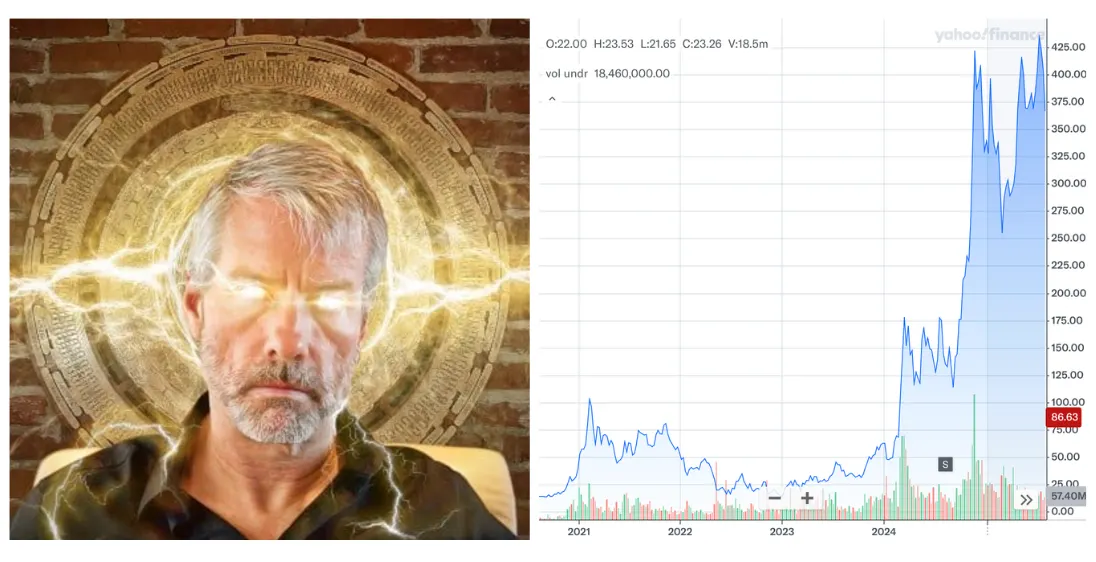
MicroStrategy/Strategy (MSTR) CEO Michael Saylor pioneered the concept of "Bitcoin Yield." Through alchemy, a bitcoin held by a company somehow became more valuable than a bitcoin held by someone not named Michael Saylor.
For a long and awkward period, the market agreed with him.
Not long ago, MSTR traded at 200% of the value of the bitcoin on its balance sheet (Net Asset Value NAV). You spent two dollars to buy one dollar's worth of bitcoin. Saint Saylor was called the reincarnation of Satoshi Nakamoto, frantically absorbing all the bitcoin he could buy, issuing expensive stock and more complex financial instruments to new believers. The stock price looked like it was going to rise to infinity.
The Followers
The premium on Strategy's stock price attracted competitors, just as premiums always attract competition. I documented this scene last May:
SPACs became bitcoin buyers. Loss-making operating companies abandoned their original businesses to raise funds and buy BTC, ETH, and even more obscure crypto assets.
Spoiler alert: None of them performed as well as MSTR. And MSTR itself wasn't exactly successful.
One year later, here is the situation:
Strategy (MSTR): Down 79% from peak. This is the combined result of BTC falling 45% over the same period plus the NAV premium compressing from 2x to 1x. Leverage amplifies gains and also amplifies losses; that's how leverage works.
TwentyOne (XXI): Reached 5x NAV at peak. Creditably, it still trades above 1x NAV, although down 85% from the peak. Even some insiders are stuck holding the bag.
Metaplanet: Down 87% from one year ago, then down another 50% after the crash.
Nakamoto (NAKA) (formerly KindlyMD): Down 87% since October, after already falling 95% from all-time highs. If you invested $100,000 in this stock one year ago, you now have only $650 left.
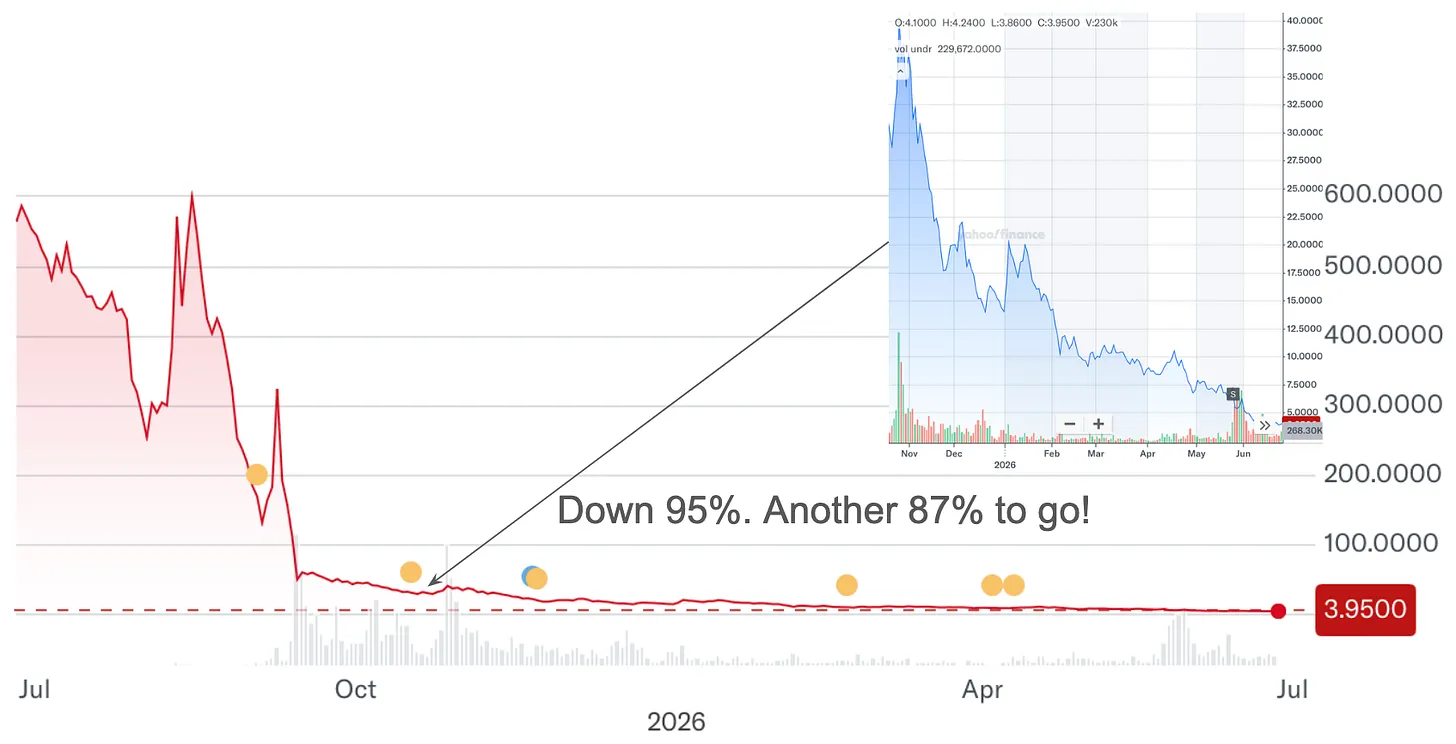
From $100,000 down to $650. Enough for a (very) nice dinner. Those speculators who "bought the dip," thinking "how much lower can it go," fared little better than the initial believers. The answer to "how much lower can it go" is often "quite a lot."
Why This Was Bound to Happen
Bitcoin ETFs exist. They charge only 9 basis points. Bitcoin itself exists. You can hold it yourself. There is no structural reason for DATs to trade at a premium, only the greater fool theory, momentum trading, and a special kind of financial nihilism—retail speculators who believe the system is rigged conclude: since that's the case, might as well play this rigged game with maximum aggression.
If you believe the traditional investment system doesn't work for you, the expected value of speculation looks different. FOMO plus dopamine plus gamification plus GameStop: individually, each is a manageable psychological condition. Together, they become an important part of today's market structure.
Needless to say, insiders are always incentivized to meet demand. They can profit regardless of which direction the stock price moves, which is another thing worth remembering.
About Tulips
The sad conclusion here is that no one cares when the market is irrational. This is too bad, because the DAT crash is simply the best fable of the consequences of fear and greed. It should be the core case study for all bubble reporting. This is Tulip Mania, only real and recent.
The 1637 "Dialogue Between Waermondt and Gaergoedt" tells of two fictional Dutch weavers watching the tulip price crash in real time. One passage spans nearly four centuries, reading as if it were written last month:
"Things have developed to the point where something that used to be basketed and thrown on the manure pile for weeding is now sold for a high price. I thought I was rich enough. I thought I never had to weave again."
Packaging manure didn't work back then either. A flower that sold for 22 Ducats in 1637 was trading at 400 Ducats at its peak a year prior. Then the reckoning came:
"I truly wish this country had never had flowers!"
I wonder how many retail investors, like those who now hold $650 from an initial $100,000, wish they had never heard of Metaplanet, Nakamoto, or the term "Bitcoin Yield."
One More Thing
I hold some bitcoin. My VC fund holds crypto investments. I am not against digital assets. I am against the specific frenzy of packaging digital assets into companies, charging premium fees, issuing debt to leverage, and then marketing the result as financial innovation.
I thought this frenzy had been killed by the 2025 DAT crash. But the Golden Age scams continue (Hat tip to Shrubstack).
History always repeats itself. Always. Pump and dump is not a bug in the system; for those who operate it, this is the feature. Speculators provide demand, insiders provide the product. Until we welcome the mother of all tulip crashes.
Pump and dump is the end goal itself.
Join TechFlow official community to stay tuned
Telegram:https://t.me/TechFlowDaily
X (Twitter):https://x.com/TechFlowPost
X (Twitter) EN:https://x.com/BlockFlow_News