
Research Report Analysis: Corning in a Predicament! Glass Giant Caught in the Cracks Faces Double Blow of Memory Surge and Large-Screen Market Softening
TechFlow Selected TechFlow Selected
Research Report Analysis: Corning in a Predicament! Glass Giant Caught in the Cracks Faces Double Blow of Memory Surge and Large-Screen Market Softening
As the world's largest LCD glass substrate supplier, Corning's display business is facing the risk of losing structural pricing power.
 Navigating Web3 tides with focused insights
Author: Rita
Tide Research Guide
J.P. Morgan's panel pricing monthly report shows that LCD TV panel prices remained flat month-over-month in June, but this "flatness" hides a collective shift by TV manufacturers: from resisting price hikes to actively cutting orders. High-end small-sized and ultra-large-sized panels are both facing downward price pressure, with an expected decline of -1.6% in July. As the world's largest supplier of LCD glass substrates, Corning's display business is facing the risk of losing structural pricing power.
Pricing Stagnation: Better Than Expected or Eve of Decline
The average price of LCD TV panels remained flat month-over-month in June. While it appears "flat," this is already better than historical seasonality. Typically, the historical average decline from May to June is -0.9%, yet prices were maintained this year. Behind this lies no confidence, only the accumulation of pressure.
Year-over-year, panel prices fell 4.7% in June, marking the 15th consecutive month of decline. This indicates that the entire panel industry is in a long-term environment of loose supply. The expected month-over-month decline for July is 1.6%, close to the historical average of -1.4%, but analysts believe this is just the beginning.
The turning point has arrived. TV manufacturers' attitude has shifted from "forced acceptance" to "active reversal." J.P. Morgan's statement is straightforward: TV manufacturers have shifted from resisting price increases to actively seeking concessions, demanding direct price cuts or obtaining Market Development Funds (MDF) to compensate for losses in the TV business. This shift from passive resistance to active order cutting implies that TV manufacturers have abandoned the idea of covering costs through price hikes and have instead chosen volume adjustments.
Why TV Manufacturers Are Cutting Orders
Pressure is squeezing from multiple directions simultaneously. Memory cost inflation is pushing up TV BOM costs; rising DRAM and NAND prices directly increase overall product costs. Consumer demand is weak; retailers are unwilling to raise prices and are instead launching various promotions. Geopolitical uncertainty reduces procurement confidence. The superposition of these three pressures has severely compressed TV manufacturers' profit margins.
Under these triple pressures, some Chinese and Korean TV manufacturers have made extreme choices: cutting panel procurement plans for 2Q26. A decline in procurement volume means panel factories need to reduce capacity utilization to balance supply, thereby abandoning pricing power.
Panel factories are forced into "supply management" mode. They are lowering capacity utilization rates in June and July to control supply and defend pricing leverage. But this is passive defense; actual demand is already shrinking.
Size Divergence: Small Screens Become Waste, Large Screens Also Falling
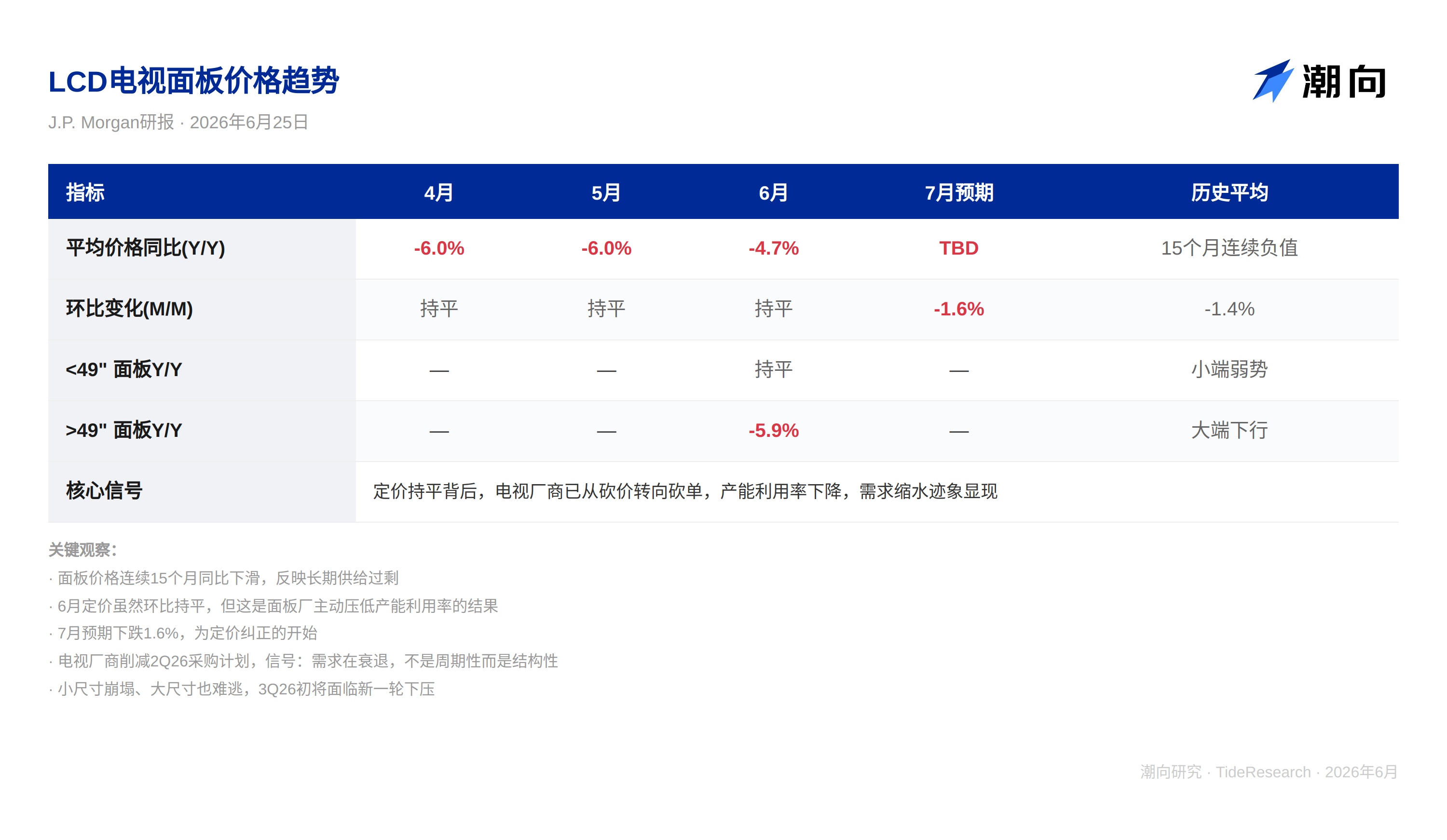
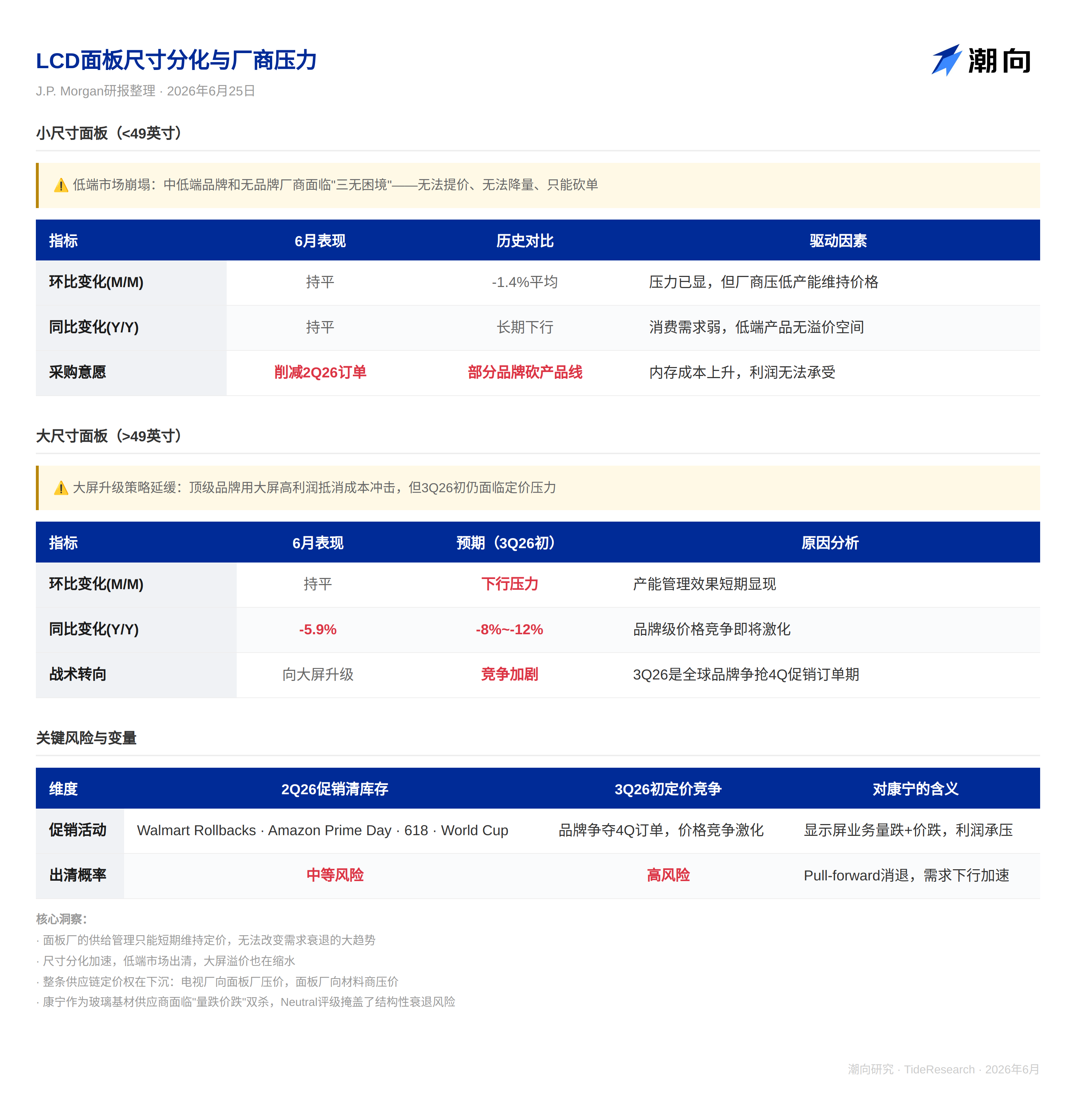
Data speaks volumes. LCD TV panels smaller than 49 inches remained flat month-over-month and year-over-year in June. Historically, this size segment averages a 1.4% decline from May to June; this year it remained flat instead of falling. But more critically, this size segment is experiencing the most severe demand collapse.
Mid-to-low-end TV brands and white-label manufacturers are cutting orders significantly. They produce small-sized TVs, and rising memory costs hit them hardest because low-end TVs already have thin margins. They cannot raise prices to retailers and can only reduce volume.
Panels larger than 49 inches are slightly better off. They remained flat month-over-month in June but fell 5.9% year-over-year. This indicates that prices are at least being maintained, although volume is also declining. J.P. Morgan points out that top TV brands are accelerating their shift to larger, higher-end models, attempting to use the higher margins of large screens to offset the impact of rising memory costs.
But this is only a delaying battle. In early 3Q26, large-sized and ultra-large-sized panels will face a new round of downward pressure. The reason is very realistic: this is a critical period for global brands and OEMs to compete for seasonal promotional orders in 4Q26. To secure large orders, they will exchange large-sized panel procurement volume for cheaper prices.
Will the Promotional Season Save the Day?
The key variable is whether promotions in 2Q26 can clear inventory. Walmart price cuts, Amazon Prime Day, China's 618, and the FIFA World Cup season are all major promotional opportunities in 2Q26 this year. If inventory can be cleared, there is still a chance to stabilize demand in the second half of the year. If not, the effect of pull-forward (buying in advance) will fade, and consumers will be more sensitive to price hikes on TVs; demand may further deteriorate in the second half of the year.
The core issue analysts are monitoring is: whether TV manufacturers can pull ASP (Average Selling Price) back through 4Q26 promotions without continuing to erode demand. Currently, this probability is decreasing.
Corning Caught in Between
From Corning's perspective, what is the direct implication of this report? Corning manufactures the glass substrates used for LCD screens. Globally, 97% of viewing area is covered by LCD displays, of which TV screens account for over 70%. Corning's display business makes an important contribution to the group's profits.
When panel pricing stops rising, panel factories are forced to lower capacity, and TV manufacturers start cutting orders, pricing power across the entire chain is sinking. Panel manufacturers will pressure upstream material suppliers on prices; as a glass substrate supplier, Corning has almost no bargaining space. Costs cannot be passed downstream, and volume is shrinking, so margin pressure is inevitable.
Worse still, if demand truly enters a recession mode in the second half of the year, Corning's display business volume will also contract directly. Although the Neutral rating did not say it directly, the report is already signaling this risk between the lines. The loss of pricing power means Corning can neither enjoy volume growth nor obtain price compensation.
This also explains why analysts' tone is becoming increasingly cautious. The "flat" pricing in June is just superficial; the shrinkage of underlying demand is the core issue.

Disclaimer
This article is a compilation and interpretation of third-party brokerage research reports by TideResearch. The views, ratings, and related judgments cited in the text are those of J.P. Morgan analysts, represent only the position of their affiliated institution, do not represent the views of TideResearch, and do not constitute any investment advice.
Please note three points when reading: First, the report content is based on historical pricing data and existing order information; future pricing trends are affected by multiple factors and involve uncertainty. Second, sell-side research reports are naturally biased towards the positive, and some covered companies have investment banking relationships with the brokerage. Third, the value of research reports lies in the main logic and its underlying assumptions, not in a single data point. Look at the logic, not just the price.
The market carries risks; decisions must be independent. This article should not be used as a basis for buying or selling any securities.
Data Source: Omdia Panel Price Data · J.P. Morgan Research Report (Joseph Cardoso et al., June 25, 2026)
TideResearch · June 2026
Join TechFlow official community to stay tuned
Telegram:https://t.me/TechFlowDaily
X (Twitter):https://x.com/TechFlowPost
X (Twitter) EN:https://x.com/BlockFlow_News
 @chaoxiangooo