Karpathy Joins; Anthropic Is Almost Emptying OpenAI’s Circle of Friends
TechFlow Selected TechFlow Selected
Karpathy Joins; Anthropic Is Almost Emptying OpenAI’s Circle of Friends
When an OpenAI co-founder joins a competing company as a subordinate.
 Navigating Web3 tides with focused insights
Author: David, TechFlow
Another OpenAI alum has joined the ranks.
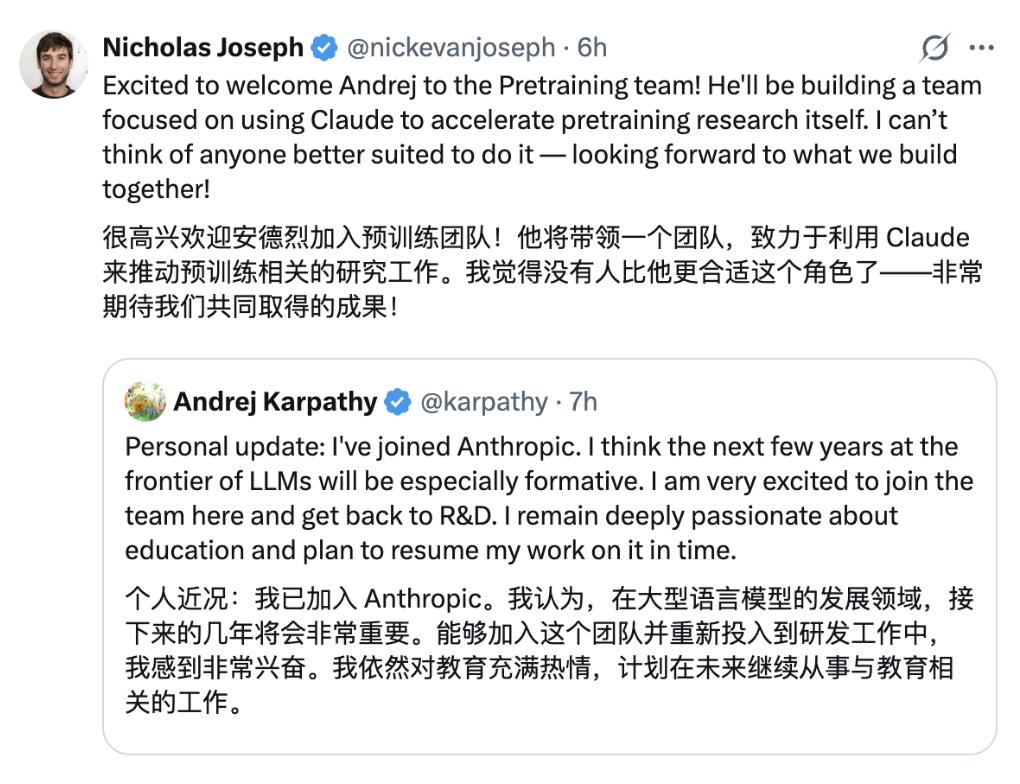
On May 19, Andrej Karpathy—co-founder of OpenAI, former AI Director at Tesla, and renowned “vibe coding” expert—officially announced he is joining Anthropic.
Karpathy joined OpenAI at its founding in 2015, later moved to Tesla as AI Director, and in 2024 founded Eureka Labs, an AI education company.
In short, he’s financially independent, runs his own company, and doesn’t need to work for anyone else—yet he chose to switch jobs.
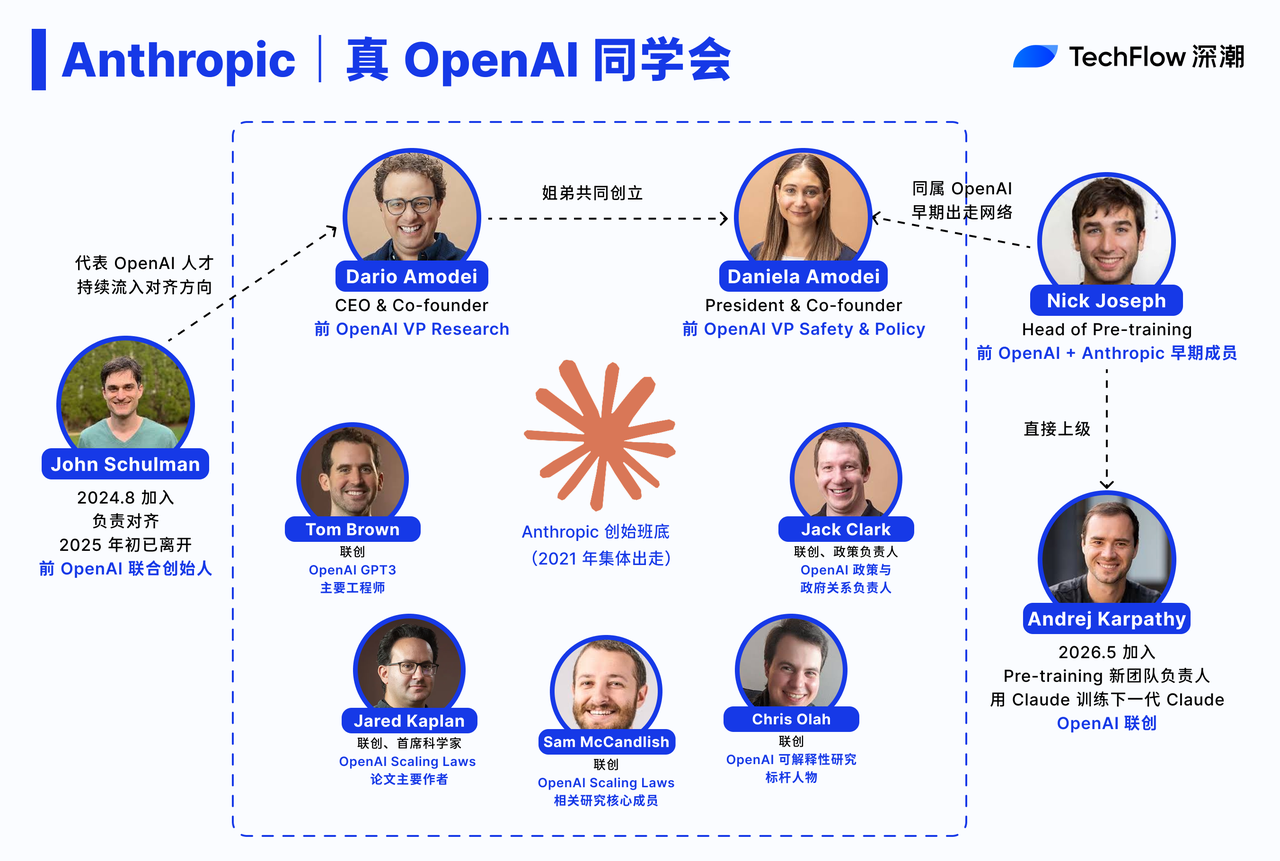
Even more unusually, a figure of Karpathy’s stature isn’t reporting directly to Anthropic’s co-founder Dario Amodei. According to Anthropic’s official statement, he’ll report to Nick Joseph, the company’s Pre-training Lead.
In a traditional tech company, that role and reporting structure would roughly equate to a director-level position. And Nick Joseph himself is also an OpenAI alum…
So the situation is this: a co-founder of OpenAI has joined a rival company as a subordinate—and his direct manager is also a former OpenAI employee. Meanwhile, Anthropic itself was founded by Dario Amodei, who previously served as OpenAI’s Vice President of Research before departing.
That’s fascinating.
The author reviewed Anthropic’s internal leadership roster: from co-founders Dario and Daniela Amodei, to John Schulman—who joined from OpenAI in 2024 to lead alignment research—to Nick Joseph, and now Karpathy, who just arrived…
This company increasingly resembles an OpenAI alumni association that relocated and reopened under a competitor’s banner. If U.S. firms enforced non-compete agreements as strictly as many domestic Chinese tech giants do, today’s reunion venue might well be a courtroom.
A Co-Founder Takes a Subordinate Role to Enable Claude to Train Itself
Karpathy’s specific mission upon joining is to build a new team. As stated officially by an Anthropic spokesperson, the team’s goal is to “accelerate pre-training research using Claude itself.”
In plain English: let AI train AI.
Typically, pre-training is the most expensive and compute-intensive phase of large model development—and it fundamentally determines a model’s core capabilities. Historically, this process has been entirely human-driven: researchers design training strategies, engineers run large-scale training jobs, and results take months to evaluate.
The team Karpathy will lead embeds Claude itself into the training pipeline for the next-generation Claude. In other words, part of the R&D for the next-generation Claude will be performed by the current generation of Claude.
If this approach proves viable, AI iteration speed will no longer scale linearly. Jack Clark, Anthropic’s co-founder, hinted at this direction early in May, stating he is “increasingly inclined to believe” that AI-accelerated AI development is accelerating rapidly.
Returning to Karpathy: why would someone with financial independence, fame, career flexibility, and an active AI education startup choose to become a subordinate to a former colleague?
The only plausible explanation is that he believes AI self-training is critically important over the coming years—so important that he’s willing to drop everything else to pursue it, and so aligned with his interests and expertise that it feels like the natural next step.
Not Enough Compute? Bring in the Experts
Using AI to accelerate AI training isn’t just a technical ambition—it’s driven by real business constraints.
Early in May, Dario Amodei admitted at Anthropic’s developer conference something less than flattering: in Q1, Anthropic’s revenue and usage grew 80-fold year-on-year—but the company had only planned for a 10-fold increase.
That’s an 8x faster growth rate than anticipated—and the company simply wasn’t prepared with enough compute. The immediate consequence? Throttling across paid versions—including Claude Pro, Max, and Code—triggering widespread complaints from paying users.
The cause is straightforward: GPUs are genuinely scarce. Over recent months, Anthropic has been aggressively acquiring compute capacity.
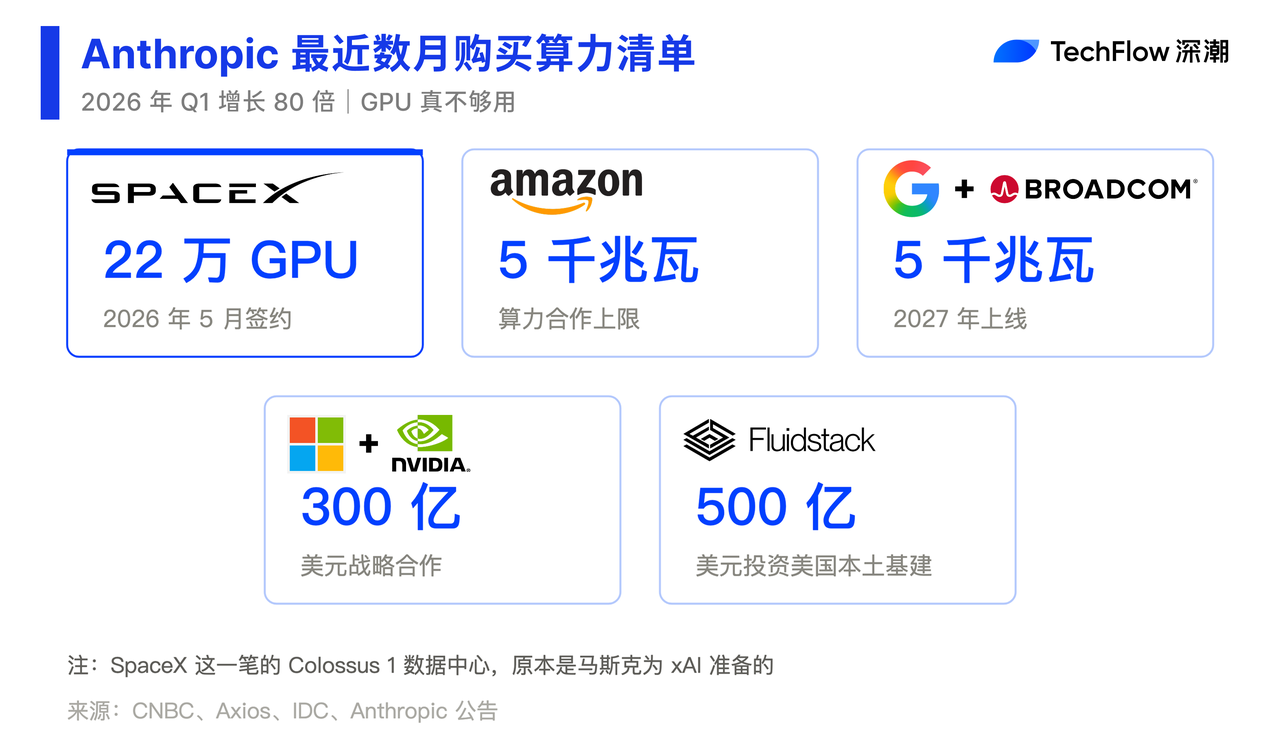
The most dramatic deal came on May 6, when Anthropic signed an agreement with Elon Musk’s SpaceX. According to CNBC, Anthropic secured full access to the Colossus 1 data center—the facility located in Memphis, Tennessee, housing over 220,000 NVIDIA GPUs and boasting over 300 megawatts of power capacity, sufficient to supply electricity to 300,000 homes.
The irony? Colossus 1 was originally built by Musk for his own AI venture, xAI. And just this past February, Musk called Anthropic “misanthropic” on X. That the two sides could negotiate a deal stems solely from Musk’s ongoing legal battle with OpenAI.
“The enemy of my enemy is my compute supplier”—a perfectly logical arrangement.
Beyond the SpaceX deal, Anthropic simultaneously signed agreements with Amazon for up to 5 gigawatts of compute, with Google and Broadcom for another 5 gigawatts, with Microsoft and NVIDIA for $30 billion worth of infrastructure, and with Fluidstack for a $50 billion investment in U.S.-based infrastructure.
This spending spree sounds staggering—but a May report by IDC pointed out that, compared to OpenAI, Anthropic’s current dedicated compute capacity available for training remains significantly smaller.
OpenAI’s strategy is clear: stack compute, build data centers, scale parameters. Anthropic simply can’t follow that path.
Hence, letting AI train AI isn’t just appealing—it’s essential. Using one GPU more intelligently is equivalent to buying another GPU. So bringing in Karpathy isn’t about prestige—it’s about using human intelligence to compensate for unavailable hardware.
Of OpenAI’s 11 Original Co-Founders, Only 2 Remain
If Karpathy is worth an entire data center, then OpenAI hasn’t just lost an individual—it’s lost far more.
And this exodus didn’t start with him.
Anthropic was founded from day one by a group of OpenAI alumni. In 2021, seven key OpenAI employees departed en masse—including the VP of Research, the VP of Safety Policy, the lead engineer behind GPT-3, the two authors of the seminal “scaling laws” paper, a leading figure in interpretability research, and the head of policy. They incorporated a new company: Anthropic.
That’s why outsiders jokingly refer to Anthropic as the “OpenAI Alumni Association.”
Others have since joined. In 2024, OpenAI co-founder John Schulman and former Alignment Lead Jan Leike made the move. This year, Karpathy and his manager Nick Joseph joined—alongside numerous other critical but less publicly visible researchers.
These individuals didn’t scatter across multiple startups. They converged on one company. More crucially, they show no signs of returning.
Public reports state that the 2021 departures were motivated primarily by disagreement over OpenAI’s rapid commercialization and insufficient progress on safety research. Five years later, OpenAI has secured tens of billions in investment from Microsoft, turned ChatGPT into a consumer product, and—this May—even integrated an ad-management backend. Any U.S. business can now run ads directly inside ChatGPT.
Those who left five years ago due to excessive commercialization have even less reason to return today.
Zooming out further: of OpenAI’s original 11 co-founders, only two remain actively employed at the company—CEO Sam Altman and President Greg Brockman. The other nine have all left in various capacities.
2024 saw a near-total turnover of OpenAI’s top leadership layer: CTO Mira Murati, Chief Scientist Ilya Sutskever, Alignment Lead Jan Leike, and co-founder John Schulman all announced their departures within that single year. In 2025, another 12 executives exited—and this summer, Meta poached seven core researchers in one go.
Some of these individuals launched AI-focused startups; others joined rivals like Anthropic. Almost none switched industries—and almost none returned to OpenAI.
Anthropic appears to be the biggest beneficiary of this migration. But the root cause lies not with Anthropic—it lies with OpenAI. Karpathy wasn’t the first to arrive—and he likely won’t be the last.
Join TechFlow official community to stay tuned
Telegram:https://t.me/TechFlowDaily
X (Twitter):https://x.com/TechFlowPost
X (Twitter) EN:https://x.com/BlockFlow_News
 深潮TechFlow