Ethereum Foundation Core Team Members Collectively Depart: “Decentralization” or “Breakup”?
TechFlow Selected TechFlow Selected
Ethereum Foundation Core Team Members Collectively Depart: “Decentralization” or “Breakup”?
Despite high-level personnel turbulence, Ethereum’s developer activity remains solid.
 Navigating Web3 tides with focused insights
Author: Hristina Vasileva
Translated by: TechFlow
TechFlow Intro: Between April and May 2026, at least six core members of the Ethereum Foundation (EF) departed in rapid succession—spanning protocol engineering, cryptoeconomics research, and management. While EF officially framed these exits as part of its proactive “Mandate”-driven restructuring, the community observed a drop in core developers from 225 to 169, a shrinking ETH treasury, and the postponement of the Glamsterdam upgrade. This Cryptopolitan report outlines the list of departing individuals, EF’s restructuring rationale, and the current state of ecosystem developers.
The Ethereum Foundation (EF) has lost several key contributors, intensifying questions around the organization’s direction and Ethereum’s future. This wave of departures followed Tomasz Stańczak’s resignation after just one year as EF’s Co-Executive Director.
In April and May, a total of six contributors either left EF or entered extended leave. Departures were concentrated primarily within EF’s core engineering team and research division.
Some of the engineers who departed came from the Protocol Cluster—the group responsible for Ethereum L1 design. This unit underwent restructuring, with engineers Barnabé Monnot and Tim Beiko leaving consecutively.
Earlier, Josh Stark announced his departure after seven years at EF, where he had co-chaired the “Trillion-Dollar Security Initiative.” Trent Van Epps left EF after five years; he had previously been involved in organizing the Protocol Guild and will continue contributing to the broader ecosystem on a part-time basis.
May Departure Wave Intensifies
Most recently, Carl Beek departed EF after seven years—he was a pivotal figure during the Beacon Chain launch phase.
Julian Ma also resigned recently, having spent four years at EF conducting cryptoeconomic research focused on mechanism design.
These two departures drew heightened attention across the Ethereum community, escalating discussions about EF’s future trajectory. EF’s public statements have consistently emphasized “holistic support for the ecosystem,” deliberately downplaying its role as a central authority.
The departure of core members does not directly indicate that Ethereum itself is facing problems. However, these exits have indeed sparked deeper conversations about leadership, coordination mechanisms, and what “decentralization” truly means as a goal.
Developer Activity Remains Stable
Despite senior-level personnel turbulence, Ethereum’s developer activity remains resilient. Token Terminal data shows the project currently maintains 169 core developers, marking a 63% rebound over the past month. Yet over a longer horizon, the number of core developers has declined—from 225 in May 2025 to 169 as of May 19, 2026.
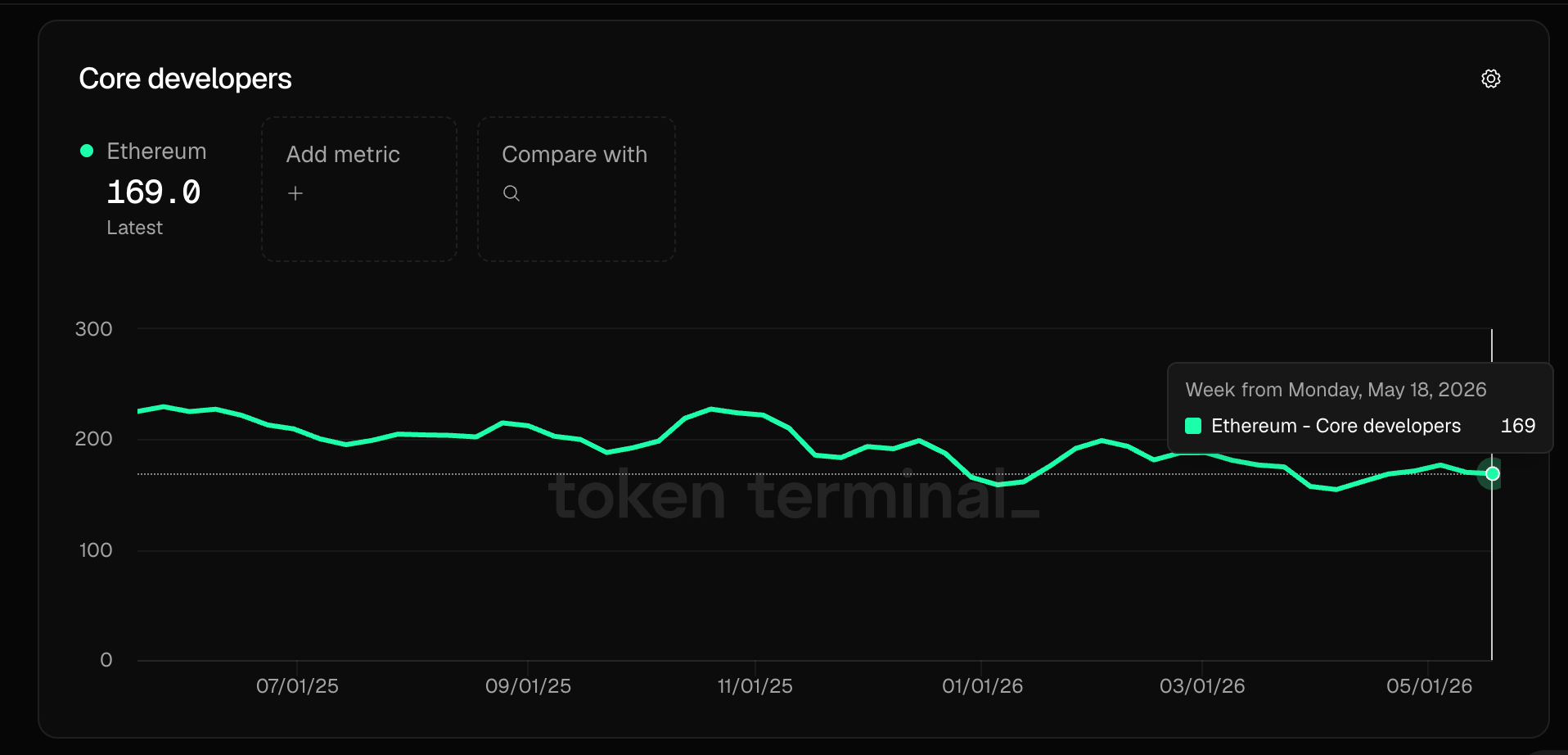
Caption: Ethereum core developer count rose slightly over the past month but fell to 169 from 225 in May 2025.
Source: Token Terminal
Overall ecosystem developer numbers now lag behind Solana’s. However, according to Chainspect data, Ethereum’s ecosystem still hosts 9,744 active developers.
EF is advancing its restructuring in line with its newly published Mandate document, realigning its strategic focus. One core objective of the Mandate is to reduce EF’s direct influence—by definition, this entails parting ways with certain key contributors.
Another practical challenge EF faces is the dwindling ETH reserves held in its organizational wallet. The Foundation currently holds 103,660 ETH, having already staked part of its holdings and sold some reserves to BitMine.
This wave of departures comes at an inopportune time: Ethereum is increasingly expected to serve as the foundational infrastructure layer for global finance. Meanwhile, the team’s restructuring coincides with a peak period of coordinated attacks against decentralized projects—with the Ethereum ecosystem bearing the brunt.
Following these developments, ETH price has lingered near its lows, posting a 40% decline over the past year. At press time, ETH trades at $2,117.02—despite the fact that staked ETH in the Beacon Chain contract now accounts for 31% of circulating supply.
Join TechFlow official community to stay tuned
Telegram:https://t.me/TechFlowDaily
X (Twitter):https://x.com/TechFlowPost
X (Twitter) EN:https://x.com/BlockFlow_News
 @CPOfficialtx