Harvard’s Endowment Fund Liquidates Bitcoin and Ethereum ETFs—Are Top Universities Also Losing Money on Crypto Holdings?
TechFlow Selected TechFlow Selected
Harvard’s Endowment Fund Liquidates Bitcoin and Ethereum ETFs—Are Top Universities Also Losing Money on Crypto Holdings?
Even top-tier universities are running deficits—I can comfort myself with that.
 Navigating Web3 tides with focused insights
Author: Claude, TechFlow
TechFlow Intro: Harvard Management Company (HMC), the world’s largest university endowment fund, disclosed in its Q1 2026 13F filing with the SEC that it fully liquidated its position—worth approximately $86.8 million—in BlackRock’s Ethereum Spot ETF (ETHA), while cutting its holdings in BlackRock’s Bitcoin Spot ETF (IBIT) by 43% to roughly $117 million. This Ethereum investment was held for just one quarter before being sold off—acquired precisely as ETH pulled back from its all-time high. In stark contrast, Abu Dhabi’s sovereign wealth fund Mubadala increased its IBIT stake by 16% to $566 million during the same period, marking its seventh consecutive quarter of accumulation. Narvekar, HMC’s CEO and architect of Harvard’s crypto strategy, is reportedly set to retire by the end of 2027—meaning this crypto experiment, launched mid-2025, now faces winding down.
Harvard University’s endowment fund is systematically withdrawing from cryptocurrency exposure.
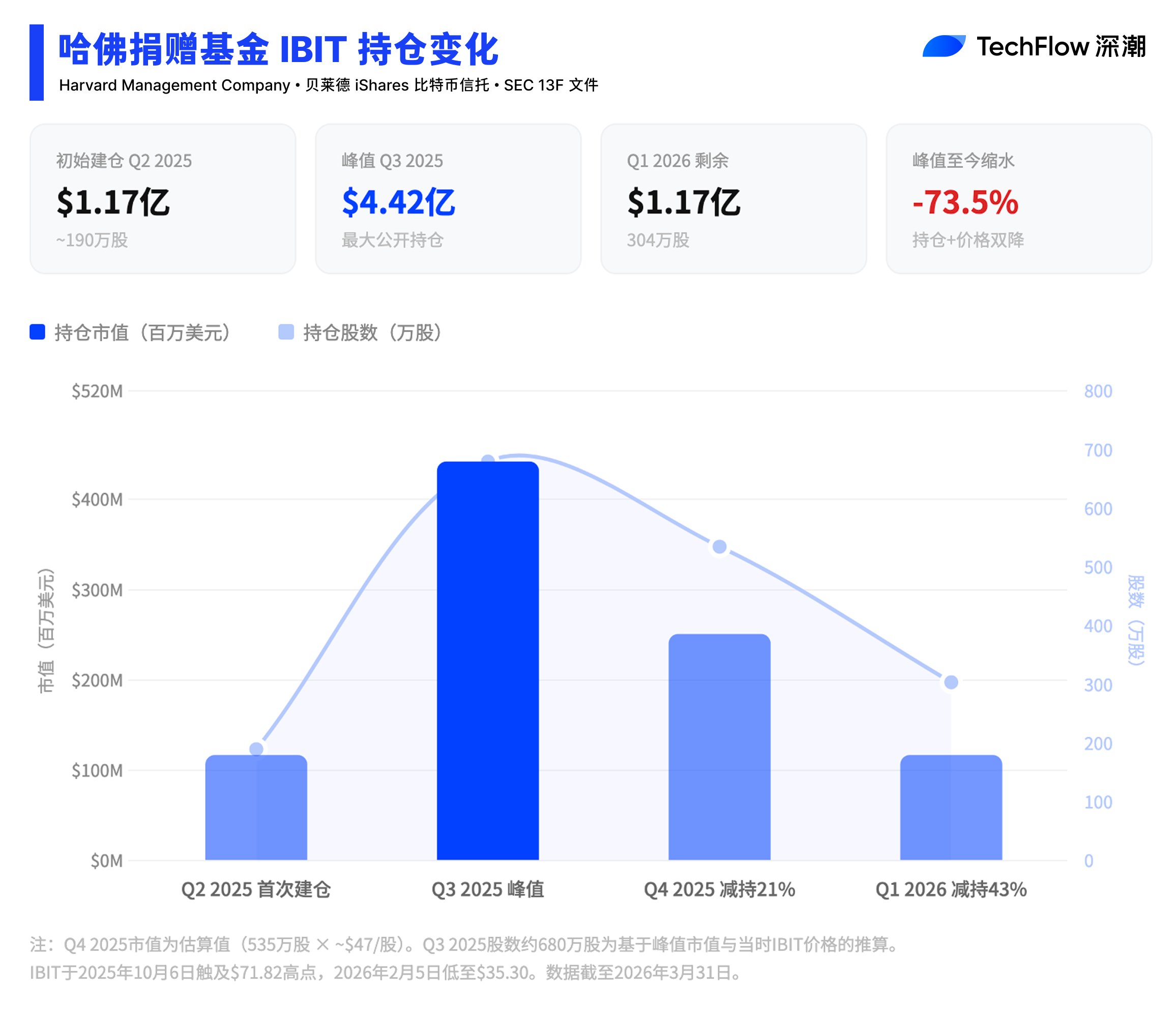
According to a May 18 Fortune report and the SEC’s latest 13F filing, Harvard Management Company reduced its holdings in iShares Bitcoin Trust (IBIT) from approximately 5.35 million shares to about 3.04 million shares in Q1 2026—a 43% reduction—leaving a remaining position valued at roughly $117 million. More notably, the fund fully exited its ~$86.8 million position in BlackRock’s Ethereum Spot ETF (ETHA), an investment initiated only in the prior quarter.
As previously disclosed by Bloomberg analyst James Seyffart, Harvard was ETHA’s largest new buyer in Q4 2025. A quarter later, it sold the entire position—coinciding with ETH’s year-to-date decline of roughly 29%. This marks the third consecutive quarter in which Harvard’s crypto holdings have declined in value.
From Peak of $442 Million Down to $117 Million: A Full “Buy High, Sell Low” Cycle
Reconstructing Harvard’s crypto trading timeline reveals an unflattering sequence of events.
HMC first disclosed its IBIT exposure in Q2 2025, purchasing approximately 1.9 million shares worth around $117 million. It then continued accumulating, pushing the portfolio’s market value to a peak of ~$442 million by Q3 2025—making IBIT Harvard’s single largest publicly disclosed equity holding, surpassing NVIDIA, Microsoft, and Amazon.
The turning point came in October 2025. After Bitcoin hit an all-time high near $126,000, IBIT fell sharply from its peak price of $71.82 (reached on October 6, 2025) to a low of $35.30 in February 2026. Harvard first trimmed its position by 21% in Q4 2025, then cut another 43% in Q1 2026—reducing its total holdings by over 70% from the peak level.
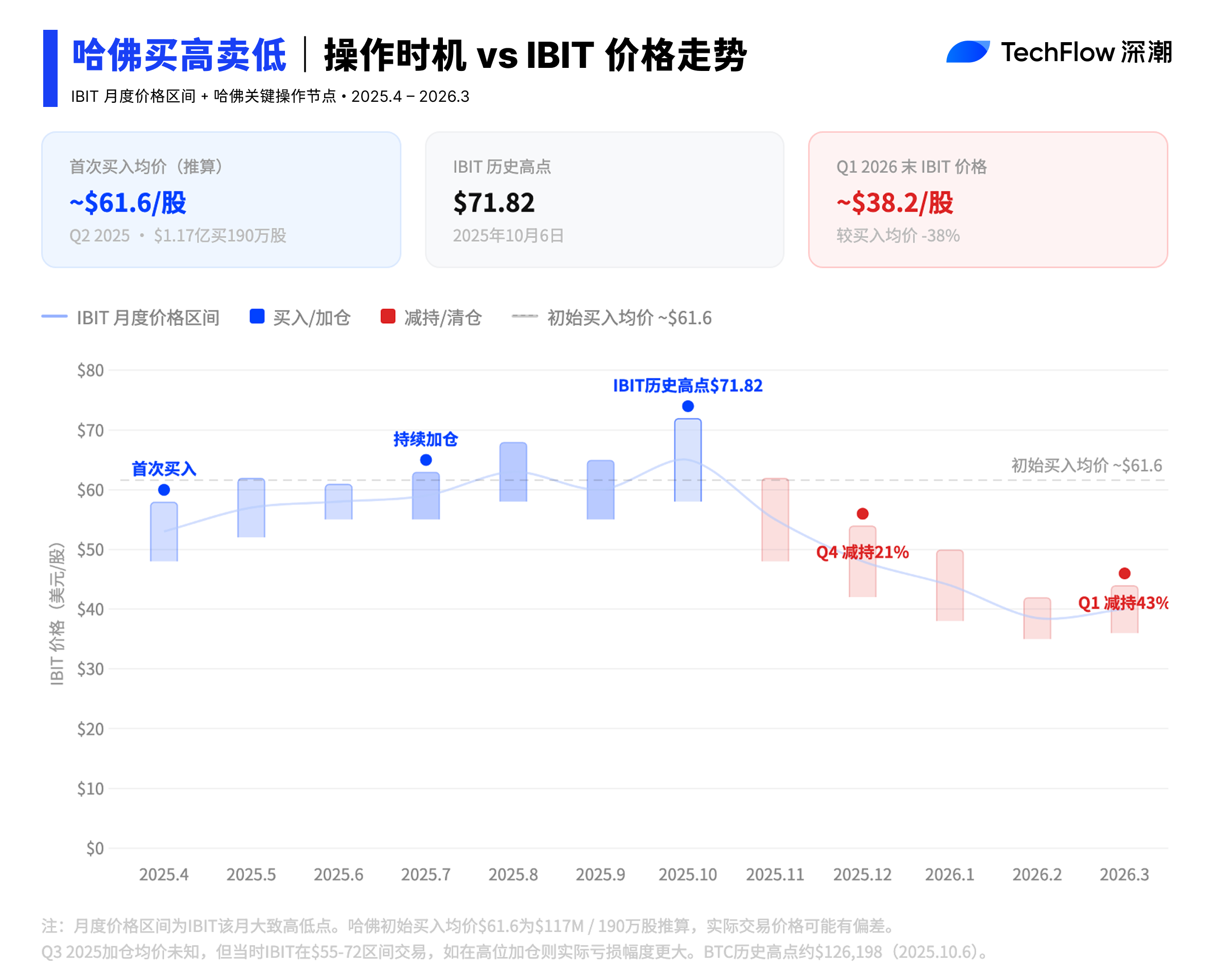
As of March 31, Harvard’s remaining ~3.04 million IBIT shares were valued at approximately $117 million—nearly flat compared to its initial investment a year earlier. Yet this outcome followed a full cycle of aggressive accumulation, paper gains at the peak, and successive rounds of selling. Bloomberg analyst Eric Balchunas told Fortune that Harvard holds other strong-performing stocks, “which may make it easier to absorb losses on Bitcoin—and hold the position longer, hoping for a rebound.”
The Ethereum trade was even shorter-lived. Harvard purchased ~$86.8 million worth of ETHA in Q4 2025, when ETH had already retreated from its August 2025 all-time high of $4,953. In 2026, ETH declined further—down ~29% year-to-date, significantly underperforming Bitcoin’s ~12% drop. Harvard chose to exit the entire position after one quarter, virtually guaranteeing a loss.
IBIT is no longer Harvard’s largest publicly disclosed equity holding. According to the latest filing, TSMC (~$232 million), SPDR Gold Trust (~$200 million), Alphabet, and Microsoft now rank ahead of it.
Strategy Architect Set to Depart: Harvard’s Crypto Experiment Enters Liquidation Phase
The timing of Harvard’s crypto retreat closely coincides with a key personnel change.
According to a May 16 Wall Street Journal report, Harvard Management Company CEO N.P. Narvekar has informed the board of his retirement plans, potentially stepping down by the end of 2027. Narvekar has overseen the world’s largest university endowment—valued at ~$57 billion—since December 2016. Under his leadership, public equity allocations shrank from 31% to 14%, while private equity rose to 41%, delivering an annualized return of ~9.6%.
Per Fortune, Harvard began buying IBIT in Q2 2025, and Narvekar is widely viewed as the architect of this crypto strategy. With his retirement plans now public, his successor will inherit a portfolio structurally underweight in public equities and lagging behind the AI and semiconductor supercycle. As analyzed by ainvest, Narvekar’s allocation strategy caused Harvard to miss out on the compounding gains of public-market tech stocks like NVIDIA and ARM.
Harvard’s public equity portfolio consists of only 16 securities; crypto ETFs account for less than 0.3% of its $57 billion total assets. The next 13F filing—due August 14—will disclose Q2 data and reveal whether Harvard continues trimming its remaining Bitcoin position or stabilizes at current levels.
Institutional Crypto Narrative Under Pressure: ETFs Solved “Access,” Not “Conviction”
Harvard’s retreat reflects a deeper issue: spot ETFs successfully opened a compliant on-ramp for institutions into crypto—but failed to instill long-term conviction in crypto assets.
According to MEXC analysis, university endowments typically base asset-allocation decisions on multi-year strategic horizons—not quarterly momentum trades. Harvard’s full exit from Ethereum within a single quarter and three consecutive quarters of Bitcoin position reductions signal something far beyond simple “portfolio rebalancing.” Meanwhile, short-selling firm Culper Research published a bearish Ethereum research report in the same month, focusing on declining ETH fee revenue and structural weaknesses in its tokenomics.
Balchunas notes that most institutional investors appear willing to give crypto ETFs “a few years” to prove their value. But for Harvard, its top holdings have shifted from Bitcoin to TSMC and gold—indicating crypto’s strategic weight in the portfolio is diminishing, not waiting for a rebound.
The next Q2 13F filing—due in August—will reveal whether Harvard’s retreat is merely a temporary position adjustment—or the beginning of the end for this crypto experiment launched in 2025.
Join TechFlow official community to stay tuned
Telegram:https://t.me/TechFlowDaily
X (Twitter):https://x.com/TechFlowPost
X (Twitter) EN:https://x.com/BlockFlow_News
 深潮TechFlow