








Tom Lee Buys 1 Million ETH This Year—First “Brake” Yet ETFs and Whales Step In
TechFlow Selected TechFlow Selected
Tom Lee Buys 1 Million ETH This Year—First “Brake” Yet ETFs and Whales Step In
E. Guard, don’t worry—the buying pressure is still there.
 Navigating Web3 tides with focused insights
Author: Claude, TechFlow
TechFlow Intro: Bitmine, the world’s largest publicly traded Ethereum holder, reduced its weekly ETH purchases last week from 100,000 to just 26,000—its lowest weekly acquisition volume on record. Yet Chairman Tom Lee’s remarks at Consensus 2026 were not bearish; rather, the slowdown reflects a deliberate pace adjustment as Bitmine nears its target of holding 5% of Ethereum’s total supply. Meanwhile, Ethereum spot ETFs recorded $356 million in net inflows in April—ending five consecutive months of outflows—and on-chain whales acquired 140,000 ETH within 96 hours. A consensus is emerging among institutions: “Buy slowly—but never stop buying.”
Ethereum is experiencing a rare, multi-layered convergence of buying pressure.
According to a May 11 CoinDesk report, Bitmine Immersion Technologies (BMNR) purchased only 26,659 ETH last week—valued at approximately $63 million—representing a roughly 75% drop from its prior weekly average of over 100,000 ETH. This marks the lowest single-week purchase volume since the company, led by Fundstrat co-founder Tom Lee, launched its accumulation strategy in June last year.
Yet this deceleration does not signal bearishness. Speaking at the Miami Consensus 2026 conference last week, Lee stated outright that Bitmine is approaching its core target of holding 5% of Ethereum’s total supply. At the previous pace of 100,000 ETH per week, it would have reached that threshold by mid-July. “We’ve decided to slow down,” Lee said, “because there are other things to do in crypto.”
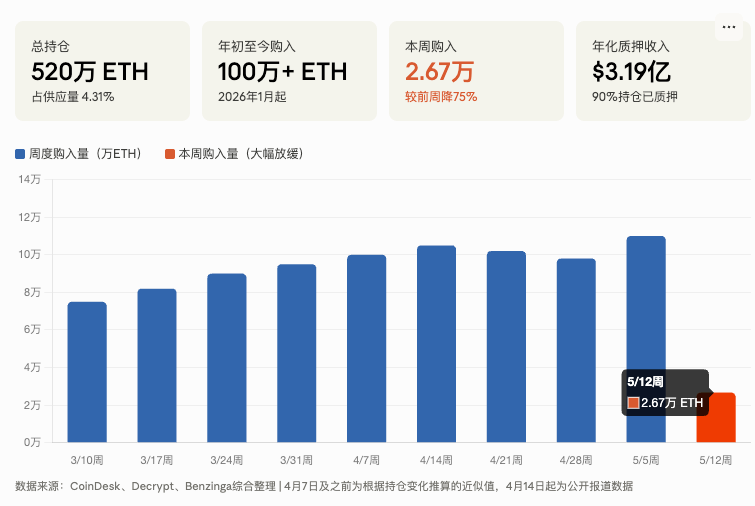
Bitmine: The Ethereum Equivalent of “Strategy,” Having Acquired Over 1 Million ETH This Year
Bitmine’s aggressive Ethereum accumulation rivals Strategy’s (formerly MicroStrategy) Bitcoin hoarding. As of May 11, Bitmine holds over 5.2 million ETH—approximately 4.31% of Ethereum’s circulating supply—with total assets valued at $13.4 billion. Year-to-date, the company has acquired more than 1 million ETH.
Even more noteworthy is its staking deployment. Bitmine has staked over 4.71 million ETH—more than 90% of its holdings—at a current 7-day annualized yield of approximately 2.86%, generating roughly $319 million in staking revenue annually—or about $1 million per day. Its institutional staking platform, MAVAN, initially built to serve Bitmine’s own treasury operations, is now preparing to open up to external institutional clients.
This year, Bitmine has also executed multiple over-the-counter (OTC) purchases directly from the Ethereum Foundation. In March, it bought 5,000 ETH at an average price of ~$2,043; at the end of April, another 10,000 ETH at ~$2,387; and again in early May, another 10,000 ETH at ~$2,292. These three transactions totaled approximately $47 million, all executed via the Ethereum Foundation’s Safe multisig wallet. The Ethereum Foundation confirmed that proceeds from these sales will fund protocol development, ecosystem growth, and community grants.
At the Consensus conference, Lee characterized the current market phase as “crypto spring.” He offered a concrete benchmark: “If ETH closes above $2,100 at the end of May, it will mark the third consecutive month of gains—a pattern never seen before in prior crypto bear markets.”
ETF Flows Reverse: BlackRock and Fidelity Account for 90% of Inflows
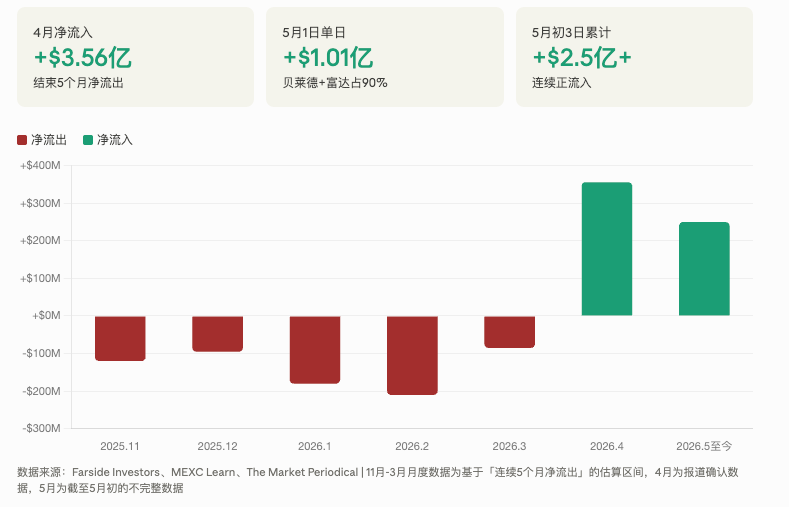
Bitmine is not alone in buying. After five straight months of net outflows, Ethereum spot ETFs recorded $356 million in net inflows in April—marking a decisive reversal.
Per Farside Investors data, buying momentum accelerated further into May. During the first three trading days of May, U.S.-listed Ethereum spot ETFs collectively registered over $250 million in net inflows. On May 1 alone, inflows totaled $101.2 million: BlackRock’s iShares Ethereum Trust (ETHA) contributed ~$69.48 million, while Fidelity’s FETH added ~$49.4 million—accounting for over 90% of that day’s inflows.
BlackRock also operates a staked Ethereum product, ETHB, which saw ~$2.45 million in net inflows on May 5. However, most smaller Ethereum ETFs posted zero net inflows during the same period—indicating capital concentration among top-tier issuers.
The significance of ETF flows lies in their mechanical nature: every dollar of net inflow obligates the fund to purchase an equivalent amount of spot ETH on public markets—directly shrinking the pool of sell-side liquidity. This structural demand compounds with Bitmine’s large-scale accumulation.
That said, ETF flows aren’t unidirectionally positive. In early May, Ethereum spot ETFs experienced a single-day net outflow of ~$75.9 million, ending a streak of ten consecutive days of inflows. Institutional sentiment remains divided—not uniformly bullish.
On-Chain Whales Snap Up $322M in ETH Within 96 Hours—While Large Holders Simultaneously Sell
On-chain data offers another dimension.
According to on-chain analyst Ali Martinez, from May 1–3, whale wallets holding large ETH balances net-bought over 140,000 ETH—worth ~$322 million—within 96 hours. Total whale holdings rose from ~13.78 million ETH to ~13.98 million ETH.
Akham Intelligence also identified two newly created whale wallets that withdrew ~$94.6 million worth of ETH from Kraken—their transaction patterns closely mirroring Bitmine’s prior on-chain behavior, though official confirmation remains absent.
Yet selling activity continues in parallel. Per on-chain tracking platform Lookonchain, Bitcoin OG Garrett Jin deposited approximately 578,000 ETH into Binance over four days in early May—potentially realizing losses of ~$1.3 billion at prevailing prices. This confirms real institutional divergence—not all major holders are betting in the same direction.
Contrast Case: Strategy Hints at Possible Bitcoin Sales
Viewed within the broader landscape of crypto treasury companies, Bitmine’s “slow down but keep buying” stance stands out distinctly.
As the largest publicly traded Bitcoin holder, Strategy (MSTR) signaled this week that it may sell some Bitcoin to meet dividend obligations. Executive Chairman Michael Saylor’s statement starkly contrasts Tom Lee’s “slow down but continue holding” strategy. Bitmine emphasizes that its staking income and cash reserves sustain operations—eliminating the need to liquidate crypto holdings during market volatility.
Bitmine currently holds ~201 BTC and ~$775 million in cash and equity investments. Its business lines are expanding beyond pure Ethereum treasury management into institutional staking services and AI-related investments. At Consensus, Lee described the company’s strategy as resting on three pillars: the Ethereum treasury, institutional staking operations, and investments aligned with AI and creator economy themes.
Join TechFlow official community to stay tuned
Telegram:https://t.me/TechFlowDaily
X (Twitter):https://x.com/TechFlowPost
X (Twitter) EN:https://x.com/BlockFlow_News
 深潮TechFlow


