Ethereum Is Launching “Special Economic Zones”—The Archipelago Era Is Over
TechFlow Selected TechFlow Selected
Ethereum Is Launching “Special Economic Zones”—The Archipelago Era Is Over
Plus 20 L2s and $40 billion. The money remains on the island—but are the people still there?
 Navigating Web3 tides with focused insights
Author: David, TechFlow
Do you still care about Ethereum?
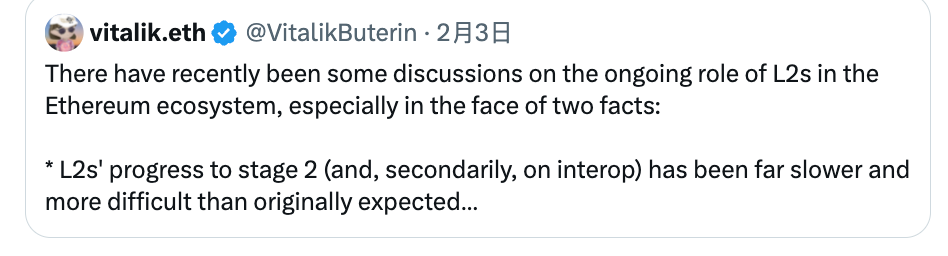
On February 3 this year, Vitalik posted a message on X.
No long exposition—just one sentence: “The original vision for L2s—and their role within Ethereum—is no longer sound. We need a new path.”
For the past five years, Ethereum’s entire scaling roadmap has been built atop L2s: the mainnet handles security and settlement, while all execution-layer work is delegated to L2s. Rollups, bridges, cross-chain messaging—the entire architecture was designed under Vitalik’s leadership.
Now the architect himself says this path is wrong.
Less than two months later—on March 29, at EthCC in Cannes—Friederike Ernst, co-founder of Gnosis, and zero-knowledge proof developer Jordi Baylina took the stage to announce EEZ:
Its full name is Ethereum Economic Zone.
Funded jointly by the Ethereum Foundation and joined by founding protocols including Aave, EEZ aims to accomplish one simple thing: end L2 fragmentation and transform isolated L2s into a single, contiguous landmass.
The direction is clearly right.
But the problem is: these islands have already been built for five years… They were once prosperous—but now they’re almost certainly deserted. Is it too late to start digging tunnels?
Too little, too late?
The name “EEZ” itself reveals Ethereum’s intent.
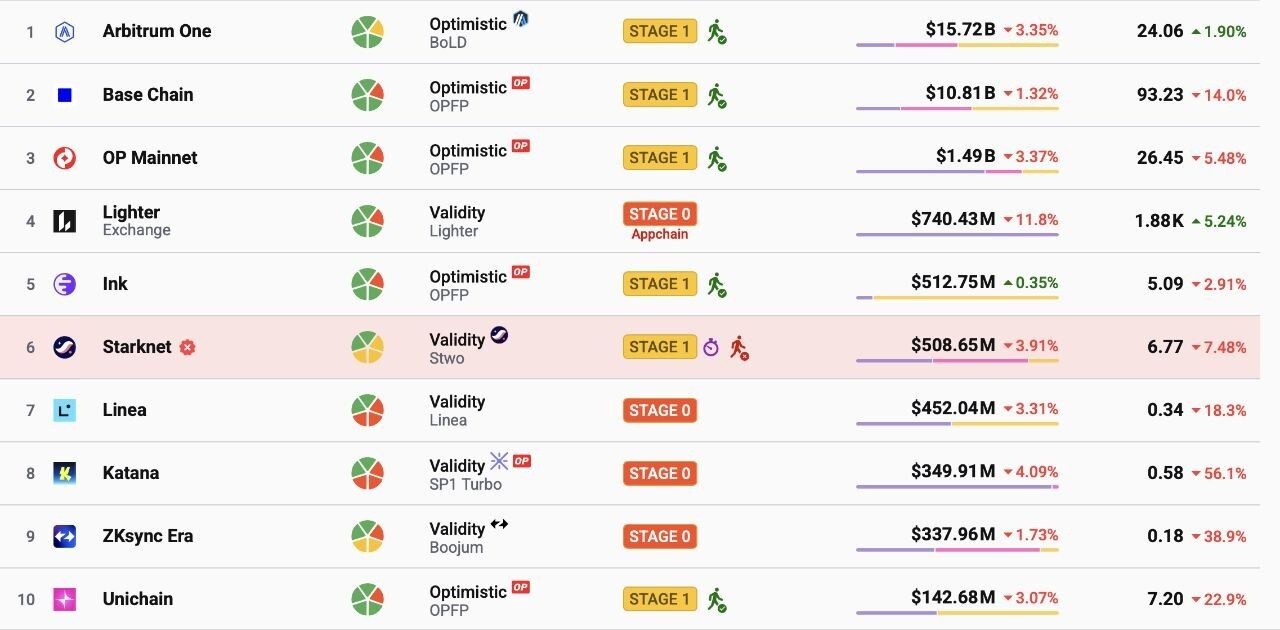
Everyone understands the logic of economic zones: unified rules, free capital flow, no internal checkpoints. The two dozen or so L2s built atop Ethereum have functioned like two dozen small economies—each with its own customs, currency, and clearance procedures. Sending funds from Arbitrum to Base still requires an intermediary bridge and currency exchange.
EEZ aims to abolish tariffs, unify currency, dismantle customs barriers—so that an action initiated on any chain can directly trigger a contract on another chain, with settlement occurring back on Ethereum’s mainnet and gas fees paid uniformly in ETH.
Does this sound familiar?
LayerZero and Wormhole told similar stories years ago: connecting all chains, enabling free asset movement… These are well-worn narratives.
The key difference is that those cross-chain protocols operate asynchronously. For example, if you initiate an action on Chain A, Chain B executes it only after a delay—introducing latency and failure risk. Bridges themselves remain prime targets for hackers.
EEZ, by contrast, is synchronous: contracts on two chains execute simultaneously within a single transaction—either both succeed or both revert. Achieving this requires real-time verification of Ethereum blocks.
This was previously impossible. Synchronous cross-chain execution demands real-time ledger reconciliation between chains—but Ethereum produces a new block every 12 seconds, and verifying the prior block’s state has historically lagged behind that pace. By the time reconciliation finishes, the next block has already arrived.
This speed gap has now been closed technically this year. Synchronous execution has moved from theory to engineering reality—making EEZ possible.
The direction is sound. But open Twitter and ask yourself: who’s even talking about Ethereum anymore?
It’s not just Ethereum that’s gone quiet—it’s the entire industry. Last year brought meme coin mania, Solana’s resurgence, and the AI agent wave. So far this year? No compelling narrative has emerged.
Ethereum isn’t just quiet—it’s profoundly silent. ETH has fallen from $4,800 at the end of 2025 to just over $2,000 today—a loss of more than 60%. And the community response isn’t outrage; it’s exhausted silence.
From archipelago to treasury era
Yet on-chain data tells a radically different story.
According to AMBCrypto, stablecoin supply on Ethereum’s mainnet remains at approximately $163.3 billion. In the $16.5 billion on-chain real-world assets (RWA) market, Ethereum accounts for 58%. Last year, Ethereum spot ETFs recorded net inflows of $9.9 billion. DeFi TVL remains the industry’s highest—at roughly $53 billion.
People left—but money stayed. Not retail money, but institutional money.
The Ethereum Foundation’s own actions point in the same direction. It paused its public grant program mid-last year, reducing its burn rate to under 5% annually. Yet just last week, it executed the largest single staking event in history—staking 22,517 ETH, worth ~$46.2 million, into the Beacon Chain.
Cutting budgets while locking funds into the treasury—and simultaneously funding the latest interoperability proposal.
Put together, these moves signal a clear judgment: Ethereum’s archipelago era has indeed ended. But what replaces it isn’t a bustling continent.
It’s a treasury.
Quiet. Impenetrable. Packed with institutional assets. Nearly uninhabited—but holding more value than any other network in the industry.
No taxes for the treasury: Ethereum isn’t profitable
Ethereum’s economic model follows a simple loop:
Users transact on the mainnet, generating gas fees. A portion of those fees—paid in ETH—is permanently burned. The more users transact, the more ETH is burned, steadily shrinking ETH’s total supply.
When this mechanism launched in 2022, the community dubbed it “ultrasound money”—implying ETH is not just inflation-resistant but deflationary, even “harder” than Bitcoin.
This narrative held for two years—until L2s dismantled it.
Once large volumes of transactions migrated from the mainnet to L2s, mainnet gas revenue collapsed. According to BitKE, Ethereum mainnet revenue has declined ~75% over the past two years. In one recent week, blob fees generated by L2s submitting data to the mainnet totaled just 3.18 ETH.
3.18 ETH—worth roughly $5,000 at the time.
A network securing $53 billion in TVL earned blob revenue equivalent to a decent New Year’s Eve dinner for one table in Shanghai.
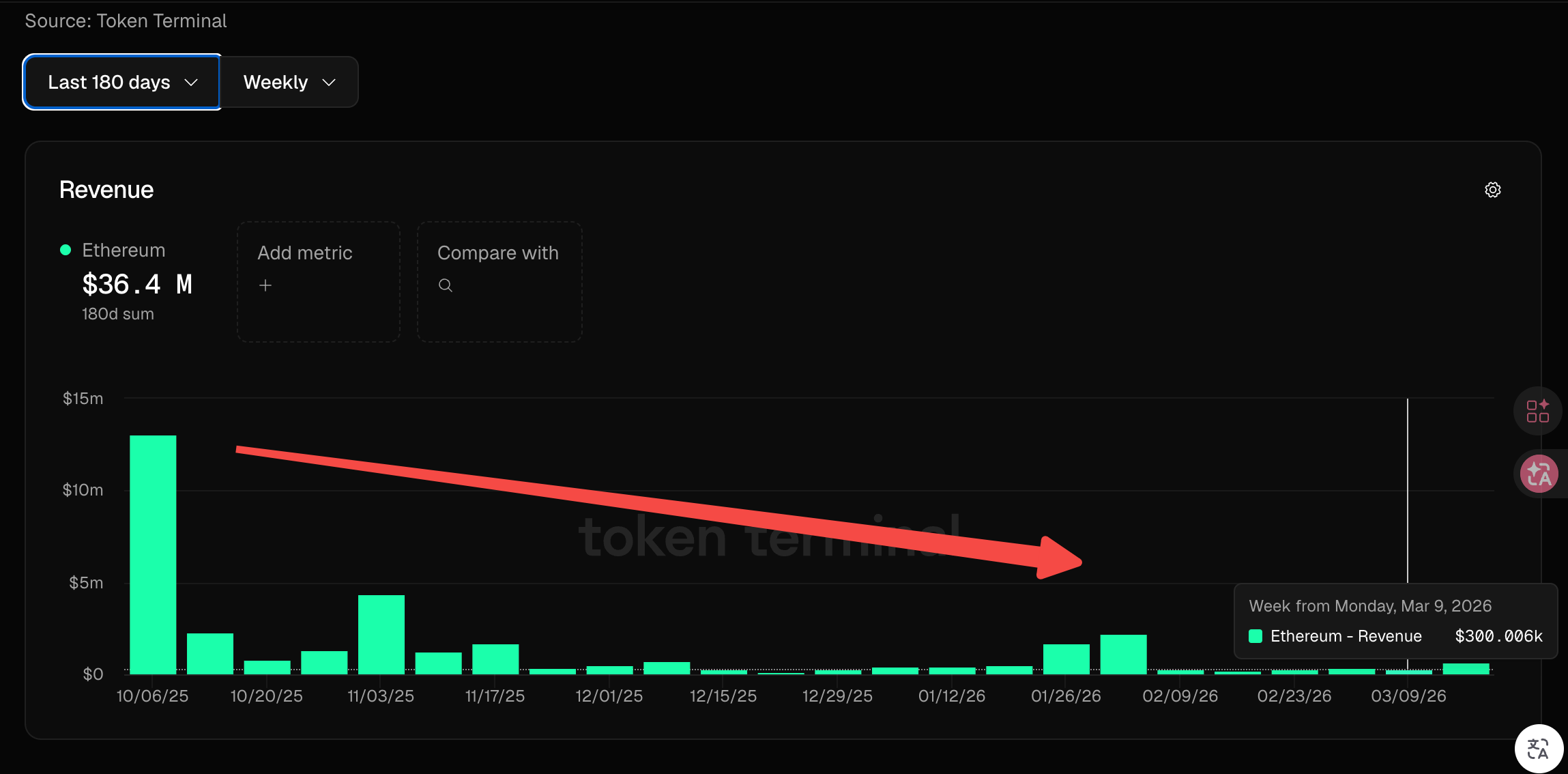
Burning has stalled—and supply pressure has eased. In February this year, ETH’s supply officially turned net-positive, with an annualized inflation rate of ~0.74%. “Ultrasound money” has become an expired marketing slogan.
This is the cost of the L2 roadmap. Users and transactions moved to L2s; L2s captured the fee revenue, leaving the mainnet with only settlement duties. Settlement is critical—but settlement doesn’t generate revenue.
Think of it this way: Ethereum built an economic zone, relocating factories and shops inside. The zone bustles—but tax revenue stays local, while central fiscal income dwindles. The EEZ proposal mentioned earlier seeks to reconnect the zone to the center—but what flows back is liquidity, not tax revenue.
Institutional capital sits securely in the treasury. But the treasury itself—the ETH asset—is growing harder to justify narratively due to its lack of revenue.
The price drop from $4,800 to $2,000 isn’t just sentiment. When an asset’s core narrative shifts from “deflationary” to “actually inflationary,” markets reprice it.
Ethereum now faces this reality:
Strongest infrastructure in the industry. Largest institutional capital base in the industry. Yet its economic model is leaking. EEZ fixes fragmentation—not this.
Is an unoccupied house valuable?
Returning to our opening question: Do you still care about Ethereum?
Most people’s honest answer is probably “not really.” ETH isn’t rising. Its narrative is obsolete. It’s cumbersome to use—Solana seems easier.
But rephrase the question: Do you care about the water pipes under your apartment building?
You don’t—because when you turn the tap, water flows. You don’t investigate the purification technology used at the plant, examine pipe materials, or post about pipe brands on social media.
Ethereum is becoming that pipe.
$53 billion in TVL, $163.3 billion in stablecoins, 58% of the industry’s real-world assets, nearly $10 billion in annual ETF inflows… These figures confirm one fact: most on-chain clearing for global crypto finance still occurs on Ethereum.
Not because users love Ethereum—but because institutions can’t find a second pipe of comparable capacity.
What EEZ—the economic zone—is doing, fundamentally, is widening that pipe’s diameter: enabling institutional capital to flow faster across L2s and reducing settlement friction. This is useful—even necessary.
But pipes have one defining trait: no one pays a premium for pipes.
Water utilities are among the most critical urban infrastructures—but have you ever seen a water utility’s P/E ratio exceed that of an internet company? DTCC, the global clearing giant, processes over $20 quadrillion in transactions annually—yet its stock is rarely discussed.
If Ethereum truly evolves toward treasury- and pipe-like status, it will become extraordinarily important—and extraordinarily boring. Important enough that all institutional money flows through it; boring enough that retail investors won’t hold ETH waiting for price appreciation.
Yet today’s ETH holders mostly still price it using “city” logic: user growth, ecosystem vibrancy, L2s feeding back into the mainnet, new all-time highs? That’s the story Ethereum’s community told itself for five years.
Reality is: Ethereum is becoming SWIFT—not New York.
SWIFT processes $150 trillion in cross-border payments annually—global finance cannot function without it. Yet no one trades SWIFT stock, because infrastructure is valued on stability—not growth.
ETH’s fall from $4,800 to $2,000 reflects more than sentiment—it reflects the market re-evaluating what this asset actually is.
If Ethereum’s future is a treasury, ETH’s fair valuation shouldn’t hinge on user count or ecosystem hype—but on how much value it captures annually as a settlement layer. At today’s mainnet blob revenue level—$5,000 per week—that number looks bleak.
The archipelago era is over. EEZ has arrived. Institutional money remains. But for anyone holding ETH, only one question matters:
Did you buy a city’s real estate—or a pipe’s usage rights?
Join TechFlow official community to stay tuned
Telegram:https://t.me/TechFlowDaily
X (Twitter):https://x.com/TechFlowPost
X (Twitter) EN:https://x.com/BlockFlow_News
 深潮TechFlow