Native Account Abstraction + Quantum-Resistance: Why Hasn’t EIP-8141 Become Ethereum’s Flagship Feature for the Hegotá Upgrade?
TechFlow Selected TechFlow Selected
Native Account Abstraction + Quantum-Resistance: Why Hasn’t EIP-8141 Become Ethereum’s Flagship Feature for the Hegotá Upgrade?
EIP-8141 is an attempt to directly embed account abstraction, gas payment, and signature flexibility into the protocol layer.
 Navigating Web3 tides with focused insights
Author: imToken
Last week, the Ethereum core developers’ meeting formally discussed whether EIP-8141 should be included in the Hegota upgrade—an outcome that surprised many. Though personally endorsed by Vitalik Buterin, this proposal was not designated a “headline feature” of Hegota but instead assigned the status of “Considered for Inclusion” (CFI).
This week, Google’s Quantum AI team released a new whitepaper stating that, under their assumed hardware constraints, the estimated number of physical qubits required to break ECDLP-256 has dropped by a factor of 20 compared to prior estimates. While this does not mean quantum attacks are imminent, it serves as a tangible reminder that if account systems cannot flexibly update their verification logic in the future, many current discussions about wallet user experience may ultimately evolve into security vulnerabilities.
From the pragmatic perspective of protocol advancement, EIP-8141 remains too heavy at present—especially regarding client implementation, mempool security, and validation complexity—lacking sufficiently robust consensus.
Yet at this precise moment, the aspects of EIP-8141 worthy of discussion and serious scrutiny appear to be growing steadily.
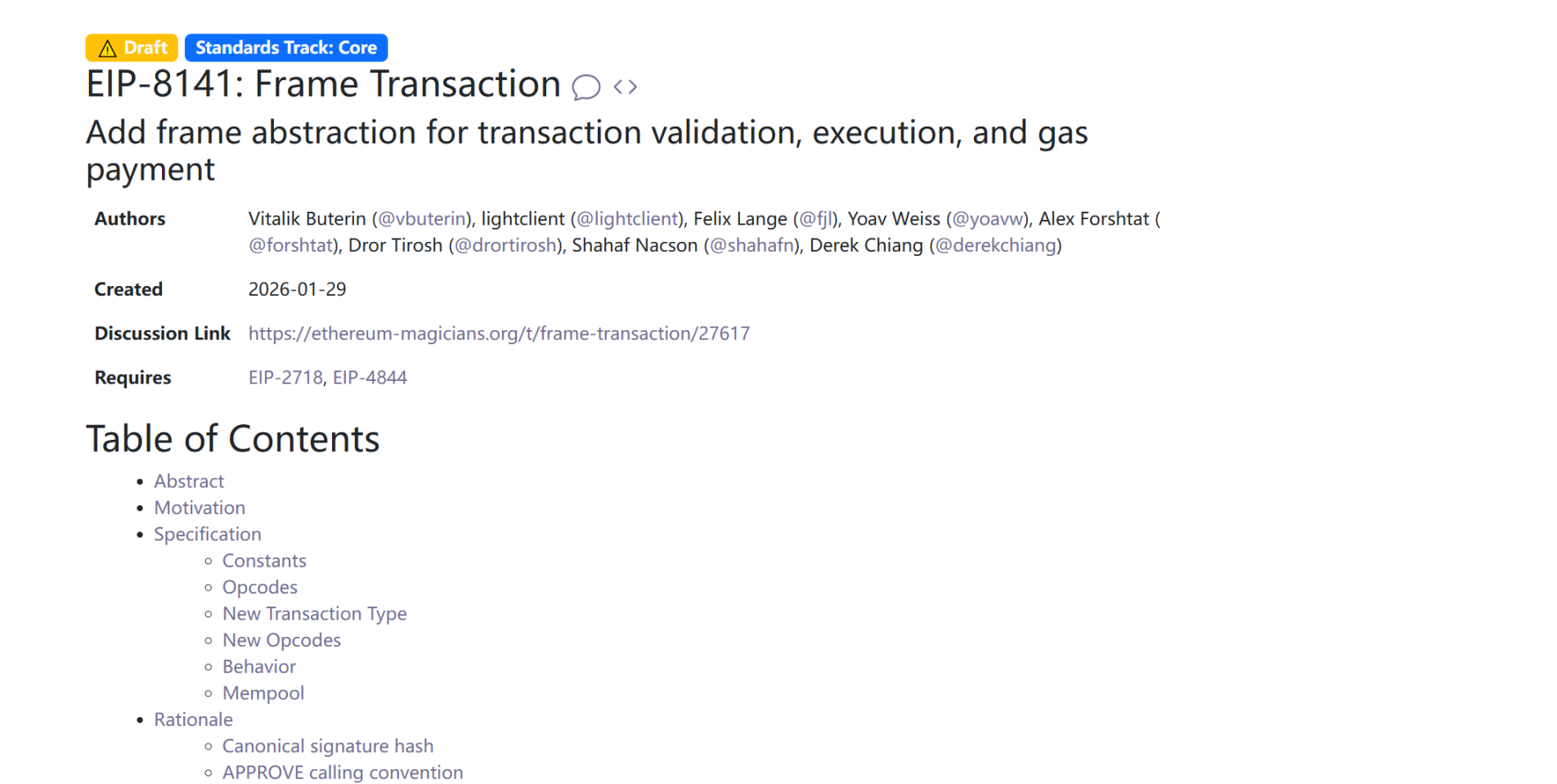
I. What Problem Does EIP-8141 Actually Solve?
EIP-8141 is spearheaded by Vitalik Buterin and core contributors including timbeiko, with the formal name “Frame Transactions.”
Put more simply, it does not aim to add a single isolated wallet feature. Instead, it seeks to liberate all accounts from being bound exclusively to the ECDSA signature path at the protocol level—enabling far more flexible verification and execution logic.
This implies that multisig, gas sponsorship, key rotation, social recovery, and even future integration of post-quantum signature schemes would no longer reside solely as external layers atop wallets—but could become “native members” of Ethereum’s account system.
Superficially, EIP-8141 discusses a set of seemingly concrete capabilities: paying gas in stablecoins, bundling multi-step operations into a single transaction, supporting more flexible signature schemes, and even reserving space for future post-quantum signatures. Indeed, many improvements around wallet UX—from ERC-4337 to EIP-7702—have fundamentally aimed to transform accounts from mere private keys into customizable rule-based entry points.
The issue is that while these enhancements have made wallets increasingly resemble smart accounts, they still fail to touch Ethereum’s foundational default account model.
As widely known, Ethereum accounts fall broadly into two categories. The first is the Externally Owned Account (EOA)—the familiar type controlled by a private key, capable of initiating transactions but lacking programmability. The second is the Contract Account—the smart contract itself—which can execute complex logic but cannot initiate transactions autonomously.
This design permanently couples transaction initiation capability with single-private-key signing. So long as this premise remains unchanged, many features users now consider self-evident—such as flexible signature rule updates, third-party gas payment, account recovery after private key loss, or smooth migration to new cryptographic primitives—remain difficult to implement as default account capabilities.
If you’ve used imToken or another Web3 wallet, you’ve likely encountered these pain points—for instance, holding ample USDC yet being unable to transact due to lacking ETH (since gas can only be paid in ETH); losing your mnemonic phrase and thus irretrievably losing access to funds; or needing to sign and confirm twice for an “approve + swap” operation.
These issues stem not from wallets being “insufficiently good,” but rather from the inherent design of Ethereum’s account model.
Viewed this way, the evolution over the past two years has been remarkably clear: ERC-4337 implemented account abstraction at the application layer without modifying the protocol; EIP-7702 further demonstrated that EOAs aren’t entirely immutable—at least temporarily gaining some smart-account-like capabilities.
In other words, Ethereum isn’t resistant to account abstraction—it’s been approaching it incrementally, cautiously, and deliberately. EIP-8141 marks a new inflection point on this path. Rather than stacking another layer of smart-account functionality atop the existing architecture, it aims to embed account abstraction directly into the transaction model itself—making accounts programmable in verification and execution logic right from the protocol layer.
This is precisely why EIP-8141 is regaining momentum today. On one hand, upper-layer wallet UX has grown increasingly close to native account abstraction, meaning the protocol layer must inevitably catch up. On the other, the long-term pressure posed by quantum computing is accelerating the urgency of “whether accounts can flexibly switch signature schemes”—transforming what was once a distant technical topic into an immediate practical concern.
II. How Does EIP-8141 Work?
At its core, EIP-8141 introduces an entirely new transaction type—Frame Transactions—with transaction type identifier 0x06.
Whereas traditional Ethereum transactions follow a “one transaction, one call” logic, EIP-8141 decomposes a single transaction into a sequence of rule-governed “frames,” thereby decoupling and separately handling verification, payment, and execution—three functions previously bundled together.
Each “frame” operates in one of three modes:
- VERIFY (Verification Frame): Validates transaction legitimacy by executing the account’s custom verification logic. Upon success, it invokes the newly introduced APPROVE opcode to authorize execution and specify a gas limit.
- SENDER (Sender Frame): Performs the actual operation—e.g., transfers or contract calls—with the caller address being the transaction sender itself.
- DEFAULT (Entry Frame): Uses a system entry address as the caller, applicable for scenarios like contract deployment or Paymaster verification.
The significance of this mechanism lies not in enabling more complex transactions, but in being the first to natively disentangle “verification,” “payment,” and “execution” from account actions—and entrusting their orchestration to the protocol itself.
Historically, who validates the transaction, who pays the gas, and who executes the underlying operation were all locked into the same account action. Under EIP-8141, however, these responsibilities are distributed across distinct frames, executed sequentially and explicitly by the protocol—meaning accounts no longer rely solely on a single private key for holistic signing, but begin assuming the form of programmable execution entities.
Take a concrete example: suppose you want to pay gas in USDC to execute a swap. Under EIP-8141, this process could theoretically be structured as a complete frame sequence—first verifying the signature and execution permissions, then having the payer or Paymaster verify willingness to cover fees, followed by fee payment in the relevant asset, and finally executing the swap itself.
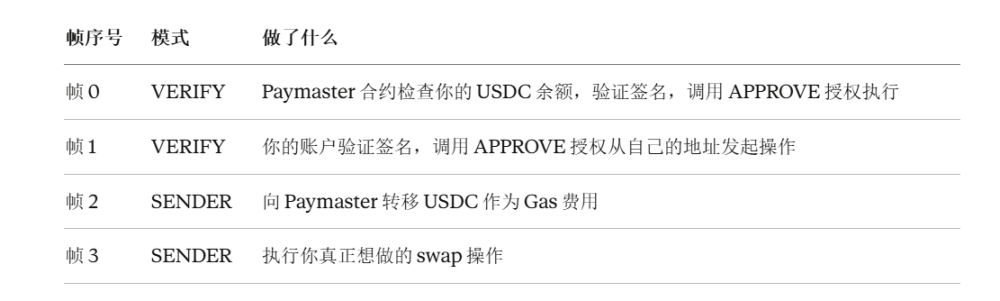
This ensures gas payment and the main transaction are embedded within the same atomic flow—either fully succeeding or fully reverting.
For users, the most direct change is that operations previously requiring multiple steps—and carrying intermediate failure risks—can now behave more like unified actions. This atomicity is one of EIP-8141’s key solutions to fragmented user experiences.
So what does this mean for wallet users? At minimum, four layers of impact emerge:
- Gas payment abstraction: Holding stablecoins no longer necessitates keeping extra ETH on hand—DApps, Paymasters, or other sponsors covering gas will become more natively supported;
- Multi-step operation consolidation: Flows such as “approve + swap” or “approve + stake,” which currently require repeated signing, can potentially be packaged into a single cohesive operation;
- Account security rule flexibility: Multisig, social recovery, daily limits, time locks, and key rotation cease to be merely premium features offered by select wallets—they begin anchoring in more native account logic;
- Signature scheme independence: Accounts are no longer rigidly constrained to the ECDSA path, opening the door—on a protocol level—for migration to alternative cryptographic systems, including post-quantum signature schemes;
III. Why Wasn’t It Made Hegota’s Headline Feature?
A crucial yet easily overlooked point for wallet users is: even if EIP-8141 eventually ships, the existing account system won’t be overhauled wholesale.
Even if you’re currently using an established Web3 wallet like imToken, no migration is needed—it maintains full backward compatibility. Existing EOA addresses remain fully functional; users need only choose to “upgrade” their account’s verification logic when appropriate.
Conversely, precisely because EIP-8141 makes such deep modifications, it wasn’t immediately elevated to headline status in the latest round of discussions. However, per the 2026 EIP Champion process, “CFI” (Considered for Inclusion) doesn’t signify rejection—it indicates active evaluation, though final approval remains pending.
In other words, core developers aren’t dismissing EIP-8141’s direction. They acknowledge its value but also recognize its current “heaviness.”
Native account abstraction differs fundamentally from ERC-4337, which could be incrementally adopted by select wallets, infrastructures, and applications. Once integrated into the protocol, it mandates rigorous implementation, testing, and coordination across all execution-layer clients—naturally raising the bar for adoption and prompting core developers to prioritize caution during fork planning.
What happens next? Two parallel tracks emerge:
- With EIP-8141 in CFI status, ongoing evaluation continues. Proposal authors will further refine critical details—particularly concerning mempool security, validation rules, and client implementation—while subsequent All Core Devs (ACD) meetings reassess its readiness for progression;
- Should these uncertainties be progressively resolved, EIP-8141 may advance toward substantive inclusion in future upgrades; otherwise, it could be deferred to later cycles;
Frankly, EIP-8141 isn’t the sole native account abstraction proposal, nor is it itself a ready-made post-quantum signature solution capable of directly addressing quantum threats. Its significance lies in offering, for the first time, a protocol-level exit from ECDSA’s singular path.
From this vantage point, EIP-8141’s true value isn’t whether it’s the “only correct answer,” but rather that it places the question—“what should native account abstraction ultimately look like?”—squarely and comprehensively on Ethereum’s protocol discussion table.
It’s not the only proposal, but it’s among the most ambitious—and closest to the conceptual ceiling of “full native AA”—currently on offer.
Regardless of whether EIP-8141 makes it into Hegota, this discussion alone confirms one thing:
Ethereum isn’t standing still waiting for problems to escalate—it’s methodically paving the way for the next-generation account system, one step at a time.
Join TechFlow official community to stay tuned
Telegram:https://t.me/TechFlowDaily
X (Twitter):https://x.com/TechFlowPost
X (Twitter) EN:https://x.com/BlockFlow_News
 @imTokenOfficial